I cannot believe that this album came out 20 years ago. We’d been inundated with GN’R solo albums in recent years, and I had no interest in yet another. It was T-Rev who urged me to check it out. T-Rev was a huge Guns N’ Roses fan. Gilby Clarke was in GN’R for a few years, long enough to make some friends in high places and record this amazing debut solo record before being kicked out by Axl himself. (He was replaced by Axl’s childhood friend and co-writer Paul Tobias.) Pawnshop Guitars is, of all the solo material recorded by all the ex-GN’R members, the very best of the bunch.
Every single member of the GN’R lineup circa 1994 makes an appearance here: Slash, Duff, Matt, Dizzy, and even the reclusive Axl himself, on a cover of “Dead Flowers”. Rob Affuso of Skid Row, Frank Black, Ryan Roxie and more show up for the party, and it sounds like one hell of a party. The Slash solos are unmistakable on “Tijuana Jail” (a “Radar Love”-esque smoker) and “Cure Me…Or Kill Me…”. Indeed one wonders why they didn’t just release a bunch of these songs, a bunch of Slash’s songs, and call it the next Guns N’ Roses album. Alas that never happened.
On this side of the border 20 pesos gets you dead
I don’t think there are any weak songs on Pawnshop Guitars. The influences are varied, but there is a strong vintage flavour. Whereas Izzy Stradlin tended to channel the Rolling Stones via Keith Richards on his own solo debut, Gilby draws from the Beatles and Stones in equal measure. A song like “Black” sounds like a John Lennon outtake, but mixed with a batch of Joe Perry’s Boneyard Brew hot sauce. I like Gilby’s lead vocals. He’s not a power singer but his voice has character that suits the music. It lends it a glam rock slant.
Other standout songs include the swampy “Skin & Bones” (an acoustic number that would have worked great as a GN’R tune), “Hunting Dogs”, “Jail Guitar Doors”, “Shut Up”…hell they’re all great. T-Rev talked me into buying this album and it was a great purchase. I liked it immediately. Any serious Guns N’ Roses fan would do well to own this, one of the missing links between Use Your Illusion and Chinese Democracy.
BRIAN VOLLMER – Gimme An R!
The story of Brian Vollmer, lead vocalist of Helix (2005)
Forget all those books by the mega stars like Slash and Sammy Hagar that have come out in recent years. Those books have one thing in common — they were written (or co-written, anyway) by guys who are rock superstars! Megastars! It’s hard for me as a reader to relate to a guy who hasn’t had to hold down a job in 30 years. Not that there’s anything wrong with stardom, it’s just an observation. I can’t relate to the human beings. Not so with this book!
Brian Vollmer, lead vocalist of the hardest working band in Canada (that would be Helix), comes across as a pretty regular guy. (I’ve met him a number of times, and he’s about as regular as anybody you’d know.) Yes, he’s traveled the world in a rock band and played for thousands of people, but at the end of the day the book is something I can still relate to. Through crappy jobs in crappy convenience stores, crappy apartments, getting mugged, it doesn’t seem like a rock star’s life. There are parallels in the story similar to other bands such as Anvil (another hard-working Canadian band). While Vollmer always manages to scrape by and continue to Rock Us, nothing comes easy. Incredibly through it all Brian Vollmer never really stopped being an artist. He seemed to always keep music, and Helix in his life even after dozens of lineup changes and band members. (Approximately 35 people have been in Helix since 1974. The newest member is Cambridge’s Chris Julke, replacing John Claus.)
From humble beginnings in Listowel Ontario to playing in Sweden, England and Trinidad, Vollmer’s tome has plenty of rock and roll stories. As one of the first Canadian bands to release independent albums in the 1970’s, he was a bit of a pioneer. Gimme An R! is loaded with rock star encounters one after the other, from Eddie Van Halen (on stage!) to Gene Simmons. Vollmer remains himself through it all, even after Helix signed their big deal with Capitol and released “Rock You”. The tragic death of primary co-writer Paul Hackman nearly derailed the band. Even after the departures of longtime partners Brent Doerner, Fritz Hinz, and finally Daryl Gray, Brian kept going. He kept the Helix name alive, finding success on the internet which was a brand new way for him to make contact, and sell albums directly to his fans. Then, a little TV show called Trailer Park Boys helped expose Helix to a new audience.
Included between the covers are dozens of black and white photos of the band over the years. From small-town Ontario to meeting superstars like Richard Pryor and Robin Williams, it’s a pretty cool collection of snaps. Unfortunately while reading I found myself distracted by spelling errors — “Atlantis Morissette” for example. I would like to see a second printing that corrects these mistakes. (A new chapter on the last decade would be cool too Brian!)
Vollmer’s prose is not frilly or poetic, but it’s conversational and descriptive. There’s no ghost writer, so the pictures that Brian paints of all those seedy bars in the dead of winter come straight from his memory to the page. He’s a great storyteller. The bottom line is that the story of Helix keeps you hooked. I’ve had friends come over and pick up the book, and they just get entranced. It’s a really different side of the rock and roll tales. It shows what old fashioned determination and hard work can accomplish.
I have to knock off half a star for the spelling errors. It’s just one of those pet peeves — nothing personal, Brian! I do highly recommend it Gimme An R! to rock fans world wide who’d like a different, more humble angle on the whole rock star thing.
“There’s no sun in the shadow of the wizard, See how he glides, Why he’s lighter than air”
RAINBOW – Rising(2011 deluxe edition)
I believe I’m well on record for being a connoisseur of deluxe editions. I love to collect all the extra music, check out the liner notes, and feast on unreleased tracks. The problem with Rainbow Rising is that no extra unreleased songs or demos survived. So, what you’ll get is three different and complete versions of Rainbow Rising, plus a tour rehearsal version of the quintessential Rainbow song, “Stargazer”. If you don’t want to hear the whole album three times in a row, plus a fourth version of “Stargazer”, then don’t buy this disc. Just stick with the regular CD.
The three versions of the album inside include a previously unreleased rough mix. This one is especially interesting because a lot of these song versions run slightly longer than the original album versions. Therefore, you will hear some valuable performance stuff that you haven’t heard before. The other two versions of the album include the “LA Mix” and “New York Mix”. The liner notes don’t go into detail here, but the original LP and CD versions of Rising had different mixes, and now they’re both here in one place. The differences are subtle, but those intimate with the album will recognize slightly different keyboard, vocal, and guitar parts. Previous to this, I had only owned the original CD edition, which was the “LA Mix”. Later CD editions had the “New York Mix” which I haven’t heard until now.
Lastly there is a tour rehearsal version of “Stargazer” from Pirate Sound, where Deep Purple rehearsed Come Taste the Band. It is surprisingly lo-fi considering where it was recorded. It sounds like somebody taped it on a hand held cassette deck. Not very listenable unfortunately, and kind of baffling why something this lo-fi would have been included at all. You can barely hear Dio at all at some points. Still, there was room for it and why waste plastic, right?
This album itself is probably Rainbow’s best. That’s just my opinion. The renowned Martin Popoff ranked Down to Earth higher, but he did rank Rising highest of the Dio-era. I think five of these six songs are incredible. The only one I’m not especially fond of is “Do You Close Your Eyes”, which I just find doesn’t fit the overall darker direction of the album. It would have sounded better on Blackmore’s Rainbow. “Tarot Woman”, the album opener, is one of the most incredible songs Dio’s ever done. It’s absolutely a highlight of his storied career. Cozy’s drum pounding is monumental throughout. “Light In The Black” is just furious jamming throughout. Incredible playing. And of course “Stargazer” is purely epic. The lyrics are cool and the keyboards just take the whole thing to another level. If I could only play one Rainbow song for the rest of my life, it would be “Stargazer”.
The liner notes don’t the mention any sources or history about the three different mixes at all, and I don’t really know anything about it. There is, however, a great interview with keyboardist Tony Carey, supplemented by an old one with Cozy Powell. The packaging, including cover art from Ken Kelly (Kiss Destroyer), looks amazing in digipack form.
While normally Rainbow Rising would be a 5 star winner, hands down, I left this deluxe edition feeling slightly disappointed. It is what it is, but I think I would have preferred some different bonus material. Maybe some live stuff. If no outtakes or extra songs exist in the vaults, there’s only so much you can include I guess.
BLACK SABBATH – Live…Gathered In Their Masses (2013 CD/DVD/Blu-ray box set)
Any time a classic rock band releases new music and goes back on tour, there has to be a live album to go with it these days. Actually, to be more accurate in the current age it’s more likely to be some kind of CD/DVD combo pack. This deluxe of Live…Gathered In Their Masses contains 1 CD, 1 Blu-ray, and 2 DVDs.
The visual program opens with a collage of pre-gig ritiual. The band arrive, and get ready in their own dressing rooms, the cameras offering a brief intimate glimpse. Before too long, the air raid sirens of “War Pigs” brings us to the stage. The Blu-ray looks absolutely gorgeous. Every line on every face is visible, every grain on Tony’s Gibson SG, and the stage is gorgeously lit. It’s a beautiful disc to watch in 1080p. I couldn’t help myself; I sat there playing air drums, and putting my hands in the air when Ozzy commanded. It was fun!
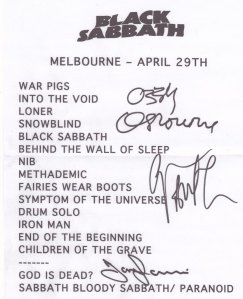
Ozzy hops about, but most exciting visually is unofficial member Tommy Clufetos. I wonder if it’s intentional, but he definitely resembles a young Bill Ward circa 1976 (as long as he keeps his shirt on). And Tony? He smiles, a lot. You would too if you’ve been through what he has I imagine! Ozzy’s already dumped a bucket of water over his head before they get to the second song, a sludgy “Into the Void”. I think the temptation is often to play this song a little faster live, but this version is very much in pace with the deliberately slow original.
My cell phone ring tone these days is that riff from “Loner”, one of the best songs from 13. Unfortunately, the fact that this is a new song means Ozzy’s rivited to one place on stage, concentrating on the words, glancing at the floor. Even so, Ozzy remains a mesmerizing presence. Another bucket of water, and Ozzy’s the cheeleading frontman again. The bonus interview on the disc, by the way, reveals why Ozzy really douses himself in water! (You probably don’t want to know.) “Snowblind” then erupts, Ozzy hitting the high notes with cracking but real voice! (That’s the part that counts.) Tony’s extended guitar solo is a stunner in itself.
The rain and tolling bells of “Black Sabbath” sound great on blu-ray, though I was hoping to hear more stuff going on behind me in the 5.1 mix. “Black Sabbath” is the standard workout, no surprises here. Likewise, “N.I.B.” is very much the traditional Sabbath version, even down to each note of Tony’s solo. Ozzy somehow manages to still be menacing behind the mic. “Methademic” is one of the new songs again, but oddly it’s a only bonus track on the deluxe versions of 13. This is a song that resembles Dio-era Sabbath and would have sounded at home on Dehumanizer or The Devil You Know. With Ozzy behind the mic, it’s still classic Sabbath. I think it’s a great number, only weakened live by Ozzy struggling through the wordy lyrics.
Oz doesn’t seem to have trouble with the old favourite “Fairies Wear Boots”. His wail of “Allllllright now!” looms, and out comes the water again! “Symptom Of the Universe” then stomps on the stage. This is the song that Clufetos can really sink his chops in. He’s obviously not Bill Ward, but I like his interpretation of Bill’s parts. They’re as close to the mark as any other Sabbath drummer’s parts, if not more. Tommy gets an extended drum solo too, during “Symptom”, not bad for an unofficial member! Mrs. LeBrain called the solo “Sweet!”
A drum solo naturally suits “Iron Man” to segue into. “Iron Man” is wooden, Clufetos unable to cop Bill Ward’s loose feel. It’s still “Iron Man”, a song Black Sabbath have probably played live at every show since ’72, but it’s not definitive. Only when the song gets up to speed does it become the beast it should be. Another new song, the deliberately vintage sounding “End of the Beginning” takes over, but it’s not the song I would have chosen to play at this point of the set. Not only is it too similar to “Black Sabbath” but it slows the set down too much so close to the end. It does pick up, but I feel it would have worked better closer to the start of the show.
Ozzy then teases out that they will only play one more song, unless the crowd goes “extra crazy”. This “final” song is the storming “Children of the Grave.” The audience bounces like a wave in sync with the classic tune, led by an energized Ozzy. I detected some clever editing here to make it appear that Ozzy is jumping around more than he actually is, but that’s video. One pretty thing about this song is the appearance of Tony’s old cream Gibson SG, paint cracked and chipping. Blu-ray allows you to see every scratch in the paint.
The crowd goes “extra crazy” and then Ozzy says they’ll play one more song. It’s “God Is Dead?”, the excellent first single from 13. Clufetos nails the stuttering drum roll, but Ozzy’s back to reading lyrics off the floor, which is distracting. But does anyone actually believe it is the last song; that they won’t play “Paranoid”? Of course they play it, and the riff from “Sabbath Bloody Sabbath” too. It’s the quintessential closer, ending the concert as a party, not a session of pure doom! Clufetos and Ozzy are quite animated on “Paranoid”, and of course Ozzy reminds the crowd that they are “number one”! I just wish Tommy would pull up his pants. Fuck, I wish I could fit into that size!
The DVD and Blu-ray versions contain three bonus tracks. “Under the Sun” is a nice one to pull out of the hat. Ozzy handles the difficult vocals without issue. How does he do it? You can hear his voice cracking from time to time; it sounds live. “Dirty Women” is a personal favourite of mine. This is an interesting version. It’s the one that Spotify have as their own exclusive bonus track to 13. I already had an audio copy of this bonus track, but Blu-ray is cool, too. It’s a damn great rendition of a lost classic from Technical Ecstasy. “Electric Funeral” is the big surprise, a song I don’t think I’ve ever heard played live. Ozzy really struggles with the words on “Electric Funeral” but it’s a treat.
Elsewhere on the disc, there are more bonus features. I have to say the Blu-ray menu is an annoying, repeating tolling bell. Leaving the menu running unattended for more than 60 seconds is an excersize in testing your patience. In the bonus features, the Sabbath interview is typically low key. You know what to expect: a difficult to understand Ozzy, and a soft spoken Tony, with occasional comments from Geezer. There’s not too much here in the way of revelations. Vegetable juice and food have replaced vodka and a line before the show, although Geezer still drinks wine. How scandalous! I don’t know who the interviewer is, but he’s very good at getting the band involved and in good humour.
Lastly there’s a feature called “Show Day”. This is a behind the scenes look at the goings-on in the 24 hours before the show in Melbourne. I love it!
Ozzy: “You know what I was looking at, the old re-runs of the Twilight Zone.”
Geezer:“You told me that about 40 times.”
Ozzy: “Sorry. Trying to make conversation.”
Tony: (Laughs.)
Even Joe Perry and Steven Tyler show up backstage. I enjoy watching Joe and Tony chatting…what a meeting of guitar greats in one room.
The packaging for this box set is loaded with goodies. I always enjoy some complimentary guitar picks. There’s one here from Tony, and one from Geezer. There’s also a replica concert ticket, setlist, and a small poster. Nothing to get too excited about, but when you buy an expensive box set it’s nice to get these added touches as a bonus. There’s also two DVDs included with the same content as Blu-ray. That’s extraneous to me, I may never play them, so they’re sealed. I don’t have a problem with that, but I do wish they didn’t edit the CD version of the concert down to fit on one CD. I’m pleased that the CD version contains all the new songs, but for the price of this set relative to the cheap cost of a CD, I don’t know why they couldn’t just make it a 2 CD set. That part is disappointing. When I buy a deluxe edition, I want the whole thing on CD.
That niggle aside, Black Sabbath Live…Gathered In Their Masses is worth:
It’s the end of PRIEST WEEK! It was all Judas Priest all week, and what better way to end it then with a 12 CD remastered box set? Monday: Rocka Rolla (1974)
Tuesday: Priest…Live! (1987) Wednesday:Metal Works 73-93 (1993) Thursday: Demolition (2001 Japanese version)
This slideshow requires JavaScript.
RECORD STORE TALES Part 272: PRIEST WEEK – The Re-Masters
When Judas Priest began reissuing their albums in 2001 (in three waves of four CDs each), of course I had to have all 12. I’ve been a fan of the band since I was a kid, and my complete Judas Priest collection has always brought me much joy. Priest’s “Re-masters” series included all the studio and live albums from 1977’s Sin After Sin to 1990’s Painkiller. Each was expanded with two bonus tracks, with the exception of the live albums. Unleashed in the East contained the four bonus tracks from the Japanese Priest in the East release (which I already had) and Priest…Live had three extra songs. (Today, there is a new budget box set that collects the entire Halford era into one box called The Complete Albums Collection.)
In late 2001, local record store legend Al “the King” dropped into my store to sell some discs. Nimble-minded readers will recall that on day 1 of Priest Week, Al King sold me my vinyl copy of Rocka Rolla in 1989! Al now worked at another store in town called Encore Records. Al’s a good guy. He didn’t see us so much as competition, because really we catered to different groups of people. There were certain discs that Al couldn’t sell at Encore (pop and mainstream stuff), and he knew I would give him the fairest prices in town, so he came to me. It was a good mutually beneficial arrangement. I wanted his stock and he wanted the money!
On this afternoon, I chatted with Al while going through his discs, and he informed me of a forthcoming Priest collectible.
“It’s expensive,” he began, “but it does look cool. It’s a UK import. I sold one to this really excited guy, but Mark’s trying to order another one in. If you want it no problem, but fair warning, it’s not cheap.”
“Tell me more!” I said to Al.
The details were scant. The box set was titled The Re-Masters, and it contained four CDs with room for the other eight, sold separately. The CDs included with the box were the first four of the Columbia years: Sin After Sin, Stained Class, Killing Machine (Hell Bent for Leather) and Unleashed in the East. It was an attractive box, printed to look like it is held together by metal rivets. There was also supposed to be a booklet included. At the time, I was obsessed with collecting the “best” versions of anything. This meant having all the songs, and the best packaging available. I asked Al to hold the box for me. At various points in the conversation, I felt like Al was trying to talk me out of buying it due to the price! What Al didn’t understand was my deep obsession for this band.
A few days later I headed down to Encore and bought my treasure. I eagerly opened it up and discovered one little additional bonus! Nothing major, but cool enough for me: the four CDs included had embossed silver logos on both front and back covers, instead of the regular printed ones. This differentiated the discs from the versions I could buy separately at retail. Also, Hell Bent for Leather was indeed included under the UK name Killing Machine, something I hadn’t seen on CD before. Finally, once all 12 discs were collected, together the CD spines read JUDAS PRIEST and depicted their “devil’s tuning fork” logo. The spaces for the 8 discs sold separately were taken up by individual foam spacers.
Back covers with silver embossed “tuning fork” logo, and without.
The bonus tracks were a mixed bag of live and demo songs from all over Priest history, but some, such as “Race With the Devil” (The Gun cover) were incredible and classic. One by one, I added to the set. Some discs came in used rather quickly: Point of Entry was one such disc. Others I had to order via Amazon, or buy in-store at Encore, such as Turbo and Painkiller. But I did get them all, and my complete Priest Re-Masters set has served me well for over a decade now. Although I have since bought the newer deluxe editions of Screaming for Vengeance and British Steel (with bonus DVDs) I have felt no need to replace this box set with anything else. Having to buy the discs individually and complete it myself makes it rare to find, not to mention the box was made only in small numbers. Some fans expected more out of the box set, and some were upset that the Gull Records and Ripper Owens years are not represented inside, even though Ripper was still the current singer. My attitude was and is, “Who cares?” It’s a great looking set and it comprises a complete era of Priest. I like it a lot and according to Al King I’m one of two guys in town that own it. Cool.
1997: Judas Priest thudded back into stores with Jugulator, their first without Halford. It underwhelmed me, and I had to wait four more years for Judas Priest with Tim “Ripper” Owens to finally return again in 2001 with Demolition. Jugulator was a mixed bag and I hoped for more on the lineup’s second album. I was excited; according to my journal I played my copy three times in the first 24 hours. It doesn’t indicate how many of those plays happened in the record store!
As a die hard fan, I had a lot riding on the first album with Ripper, Jugulator. It was a let down, probably even more so since the new singer was so damn good! The live album that followed, ’98 Live Meltdown, won me over in a big way, the Jugulator songs being much better live. Ripper had an amazing voice with power to spare, but the lyrics (which he did not write) were juvenile and the music was a tad monotonous. Demolition is marginally better lyrically, and much improved musically.
The winner of Worst Lyric Award 2001 was “Cyberface”. As I have stated before, I generally do not like songs about the internet! “Don’t access the site/or beware his megabyte/no virus scan/detects the man”. I’m guessing Glenn just got high-speed at his house or something. This is a low point, but on some tracks we’re getting back to respectability!
The sound and production of the album was still too 1990’s in style. The guitars are good and chunky, the bass, usually lacking on Priest albums, is in your face, and Scott Travis is seriously kickin’ it on the drum kit. The guitars and vocals sound a tad too processed, though. A little too much tinkering with the effects racks. Ripper’s not screaming as much as he used to. I imagine his voice was already starting to wear, considering the great job he did on tour. Still, he rips it out for a couple tracks and it’s very welcome.
Songwriting-wise, the band are coming up with much more interesting riffs and songs than last time. Perhaps Jugulator suffered from lack of variety. On Demolition we run the gamut from fast thrash (“Machine Man”) to groove (“One on One”) to ballads (“Close to You”). At 13 songs, I think Demolition could have stood for some editing. Lose “Cyberface” and “Feed on Me”. What you’d be left with would have been a strong collection of songs. The truth is that a handful of tunes, like “Bloodsuckers” and “Metal Messiah” could have been on a Halford-era album.
Elsewhere there are still the modern nu-metal touches that I never liked too much. The guitar part in “Devil Digger” is a good example, as is the rap-like delivery of Owens on certain parts of certain songs. But Ripper didn’t write the songs. Don’t blame him.
There’s only one tune that Ripper had a writing credit on, which is the Japanese bonus track “What’s My Name”. This is the only song in Priest history with a Ripper Owens writing credit. Live, Mr. Owens often introduced the Priest classic “The Ripper” by inciting the crowd to yell his name. “What’s my name?” Ripper would ask the crowd. That’s where the title comes from, and it’s a pretty good song. This is one I’d been hunting for, for years. I’ve bought Demoltion three times now. First was the regular CD, then a European digipack with two B-sides*, and finally this Japanese edition.
The worst thing about Demolition is the nondescript cover. Mark Wilkinson must have been too busy drawing new Eddies for the reunited Iron Maiden or something, because this cover is by L-Space design instead. And it sucks. Not that Judas Priest have always had the greatest album covers (Stained Class, anyone?) but this sucks. At least the Japanese version came with a sticker sheet of the new Priest logo.
Anyhow, I really do like this album. The Ripper era of Priest was uneven, and although Demolition is overly long it does contain enough Priest metal to salve the soul.
3.5/5 stars
* The two B-sides were the ’98 re-recordings of “Rapid Fire”, and “Green Manalishi”. “Rapid Fire” is thrashed up with additional lyrics, and “Green Manalishi” is slowed down to a grind. These were both originally released on the 1998 Japanese CD single for “Bullet Train”, which I already have. Therefore my digipack version of Demolition will be passed on to another rock fan.
1973 to 1993? But didn’t the first album (Rocka Rolla, which has no songs on this CD) come out in 1974? Doesn’t this CD only actually include music from 1977-1990? And didn’t Al Atkins form the original Judas Priest in 1969? 1973 was the year that Atkins left to be replaced by Rob Halford, who himself quit in 1992. So, 1973-1993? OK, I guess I’ll play along.
Due to complications and conflicts with Gull Records, Metal Works 1973-1993 contains no songs from the first two albums (the aforementioned Rocka Rolla and Sad Wings of Destiny). Instead, a live version (from Unleashed in the East) of “Victim of Changes” is subbed in to represent the early period of the Priest. After that, every album is given a look-see.
Aside from the songs that couldn’t be included for legal reasons, it is hard to argue with most of this track list. It is a near-perfect representation of pre-Ripper Priest, with the odd tune I’d swap out for another, but more or less awesome all the way through. Personally I think “Night Crawler” is and pretty much always has been an excessively cheesy song…like sharp cheddar. I would have put on something else from Painkiller, like “Between The Hammer and the Anvil” or the battering “Hell Patrol”.
Most conspicuous by its absence is “Green Manalishi”. Maybe the band decided not to include a cover (Fleetwood Mac), even if it’s one of the best things that Priest have ever recorded. I think “Green Manalishi” today is equally associated with Priest than Fleetwood Mac, if not more so by a hair. It may as well be their own song.
Many longtime personal faves are included: I love “Bloodstone”, “Desert Plains”, “Night Comes Down”, and “Blood Red Skies”. These are songs that weren’t necessarily “hits”, but were huge hits with my teenage self. There’s one inclusion that bugs me, and that’s “Heading Out to the Highway”. I love that song, but unfortunately somebody chose to use the Priest…Live! version over the original Point of Entry track. Furthermore, none of the live substitutions are listed as such on the back cover. There is no indication on the back that any songs are anything but the original. I consider that dishonest.
The liner notes are interesting for a quick read; tales from four of Judas Priest’s members (Rob, Ian, KK and Glenn) for each of the songs. Nothing earth shattering, just some fun brief stories. It’s interesting, however, how Priest completely glossed over Rob’s departure in the liner notes. Indeed, by reading, one would have no idea he was gone. A little misleading to the metal mongers of the time, especially with Rob about to debut his new band Fight a couple months later….
This 2 CD set is polished off with some fine artwork from Mark Wilkinson, tying in the “metal works” theme with a nod to Birmingham with some iconic characters and images from Priest covers past. The Painkiller does battle with the bird of prey from Screaming For Vengeance, with lots going on in the background.
The summer of ’93 was loaded with expensive sets for metal fans to buy. Ozzy Osbourne put out the double Live & Loud. Van Halen released Live: Right Here, Right Now, also a 2 CD set. Iron Maiden had twoseparate single disc live albums, followed by a double live in the fall. That right there is a lot of cash to be spent, and that’s just a handful of essential purchases that fans had to choose from. There was a ton of new music to buy, not including the grunge bands vying for our dollars that year. Priest failed to deliver in terms of value. Metal Works 73-93 was an expensive collection featuring no music fans didn’t have, and those darned live tracks. It felt tossed off.
JUDAS PRIEST – Priest…Live! (1987, 2001 Sony 2 CD remastered edition)
I have a long history with Priest…Live! My cassette was originally bought at Stedman’s in Kincardine Ontario, July 1987. An LP copy was sold to me by a co-worker named Chris from his own collection about a decade later. Finally I bought a 2 CD remaster which is the last version I hope I’ll need.
Priest…Live!was my first Priest live album. I got the albums out of order: Defenders, Screaming, Turbo, Priest Live. Then, after discovering the pre-Screaming songs for the first time, I slowly began expanding backwards: Point of Entry, British Steel, Unleashed, Rocka Rolla, Sad Wings…
Because of this album’s crucial role of introducing me to “old Priest”, I have a really hard time being critical about it. I will say this: This version of “Metal Gods” with the really melodic chorus is awesome. It’s my favourite version of this song, by a fair bit. I don’t know if that was live or overdubs or backing tapes or whatever. It sounds really cool.
Regardless of how I feel about “Metal Gods”, I can tell you that Priest Live covers pretty most all of the critical post-Unleashed numbers from 1980 (British Steel) to 1986 (Turbo). You get all the tracks you’d expect from the 1980’s: “Freewheel Burning”, “Turbo Lover”, “You’ve Got Another Thing Comin'”, “Living After Midnight”, “Heading Out To The Highway”. Clearly the concept here is to have no songs that overlap with the band’s previous live album, Unleashed in the East, a tactic used by other bands such as Kiss, on records like Kiss Alive II. While being fair to the fans economically speaking, as a live concert experience that means you’re missing out on “Green Manalishi”.
Luckily this remaster is now expanded to two CDs, and decked out with three bonus tracks including the crucial “Hell Bent For Leather”, but this remains the only holdover from the pre-1980 period. While the home video/DVD version of Priest Live contains “Green Manalishi”, that video was taken from just one show (Dallas, Texas) while the CD has songs from an Atlanta concert as well. Essentially the CD and DVD versions are two different things. In addition to “Green Manalishi”, the DVD also has “Locked In” and “Desert Plains”. Live versions of these songs do exist on Priest remasters, but they are different versions, not the Dallas recordings.
Live in Dallas, but not the version on the album.
I enjoy the running order. To begin the concert with the mellow and dramatic “Out In the Cold” was a really cool, daring move. It sets the stage for a dramatic concert. From there it’s pedal to the metal: “Heading Out to the Highway”, “Metal Gods”, “Breaking the Law”…
I know from an old Guitar World interview that KK and Glenn felt the album could have been mixed better, that too much time was spent “fixing it” in the mix. Sure enough the crowd noise sounds artificially enhanced and there are backing vocals that I am certain are not live. Otherwise, the record sounds pretty good! But that could just be the nostalgia talking. The guitars could have had more teeth; it was the 80’s though. Dave Holland’s snare sound is in the annoyingly high range, but these are not major concerns. Halford’s interaction with the crowd is more friendly than usual, which is nice especially after viewing something like the Rising in the East DVD. He does do a couple annoying sing-alongs, with the crowd…I’m sure it was fun to be there, they’re not fun to listen to on headphones.
One more nostalgic point: I remember buying this back in that summer of the 1987 and thinking, “Why did Priest change their logo?” I loved the old logo. I never really thought this was a good album cover. Very plain, which seemed to be the fashion in the late 80’s, a decade that Priest Live embraces without shame.
Welcome to PRIEST WEEK! It’s all Judas Priest, all week. Let’s go!
JUDAS PRIEST – Rocka Rolla (1974 Gull Records)
Years before the glory of Sad Wings of Destiny, Judas Priest was just another Birmingham bar band playing their version of the blues. Original lead singer and founder Al Atkins wrote a lot of the early material, with a variety of lineups. Atkins quit the band in the early 1970’s and “Bob” Halford was brought in, along with second guitarist Glen Tipton. Judas Priest as we know it was born.
I remember the next door neighbor George played me the song “Rocka Rolla” and I immediately loved it. It had a cool riff and a hypnotic chorus. Years later (1989) I walked into Sam the Record Man and bought my LP copy off the near-legendary Al King. Finding a copy on cassette was nigh on impossible so I bought an LP. Little did I realize that was a good move. I can still play the LP and it sounds great, whereas a cassette would be in a Thunder Bay landfill by now.
Unfortunately Rocka Rolla disappointed me. I didn’t like it when I got it in ’89 and I still find it kinda dull. The band wrote a lot of songs with Al Atkins, largely blues-based rock, and that’s what Rocka Rolla is: Leftovers from the Atkins era, slow blues jammers meandering along at a leisurely pace. There is precious little heavy metal here. “Run of the Mill” and the “Winter” suite, for example, run the gamut from hippy-dippy flower power love to amateur British bar blues. Yet, Jethro Tull these guys were not, and Rocka Rolla is strictly second rate. The drummer on Rocka Rolla was John Hinch, a musician that Tipton described as “inadequate” to play Priest’s more challenging material. Maybe that is one reason that Rocka Rolla lacks power.
There are a couple decent moments that keep this album from being a 1-star stinker. The title track is a fun proto-metal number, with a neat classic sounding riff. There is also the outro to “Dying to Meet You”, known as the “Hero, Hero” section which actually has some spark. “Never Satisfied” has some powerful moments. “One For the Road” is a good song. The rest is basically a band trying to find its direction, not sure whether it’s a jam band, a blues band, or a rock band, and excelling at none of those sounds.
There’s a bonus track on some CD versions, tacked-on but unrelated. This is the version of “Diamonds & Rust” from the Best Of album. Great song and great version, sounding totally out of place here. Also of note, there are two album covers. I prefer the soda bottle cap much more than that weird football player bomber guy.
Two years later, Judas Priest laid down one of my all-time favourite metal classics Sad Wings of Destiny. How they turned the ship around so drastically is beyond me. New songs, new chemistry? Let’s be grateful they did turn it around, for if this band failed to do so you never would have heard of them.



 RAINBOW – Rising (2011 deluxe edition)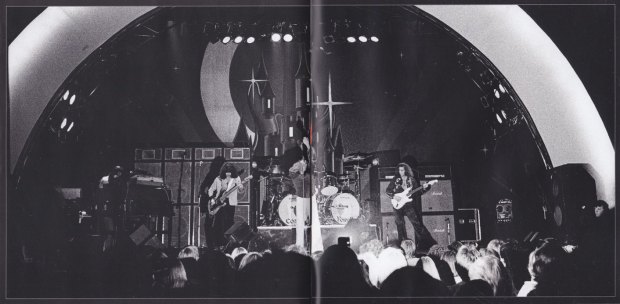


 A drum solo naturally suits “Iron Man” to segue into. “Iron Man” is wooden, Clufetos unable to cop Bill Ward’s loose feel. It’s still “Iron Man”, a song Black Sabbath have probably played live at every show since ’72, but it’s not definitive. Only when the song gets up to speed does it become the beast it should be. Another new song, the deliberately vintage sounding “End of the Beginning” takes over, but it’s not the song I would have chosen to play at this point of the set. Not only is it too similar to “Black Sabbath” but it slows the set down too much so close to the end. It does pick up, but I feel it would have worked better closer to the start of the show.


 The details were scant. The box set was titled The Re-Masters, and it contained four CDs with room for the other eight, sold separately. The CDs included with the box were the first four of the Columbia years: Sin After Sin, Stained Class, Killing Machine (Hell Bent for Leather) and Unleashed in the East. It was an attractive box, printed to look like it is held together by metal rivets. There was also supposed to be a booklet included. At the time, I was obsessed with collecting the “best” versions of anything. This meant having all the songs, and the best packaging available. I asked Al to hold the box for me. At various points in the conversation, I felt like Al was trying to talk me out of buying it due to the price! What Al didn’t understand was my deep obsession for this band.


 Due to complications and conflicts with Gull Records, Metal Works 1973-1993 contains no songs from the first two albums (the aforementioned Rocka Rolla and Sad Wings of Destiny). Instead, a live version (from Unleashed in the East) of “Victim of Changes” is subbed in to represent the early period of the Priest. After that, every album is given a look-see.


 mikeladano.com