ian paice

REVIEW: Deep Purple – Shades 1968-1998 (box set)

DEEP PURPLE – Shades 1968-1998 (Rhino 1999 box set)

I was really excited about this 1999 box set when it came out, but what it came down to was this: I paid “x” amount of dollars for just two songs that I didn’t have on other recent Deep Purple CDs. One song, “Slow Down Sister”  by Deep Purple Mk 5 was only available here. It’s since been reissued on the Slaves and Masters deluxe edition.  The other is a very rare and very great 1971 live version of “No No No” from a compilation called Ritchie Blackmore/Rock Profile Vol. 1. So there’s your bait.

Unfortunately, the booklet and discography is loaded with errors. This was disappointing. The packaging is nice, with that sheet metal looking embossed cover. It opens kind of awkwardly though, making it hard to handle. And man, there are so many Deep Purple box sets out there now! I have Listen, Learn, Read On which is six CDs dedicated entirely to just 1968-1976. Obviously you can’t squeeze Deep Purple’s career onto just four discs. This set covers 1968-1998, which is a huge chunk.  It’s almost the entire Jon Lord tenure.  It skimps in some places and confounds me in others. Usually, Rhino do such a great job, but I felt this one didn’t live up to their other products.

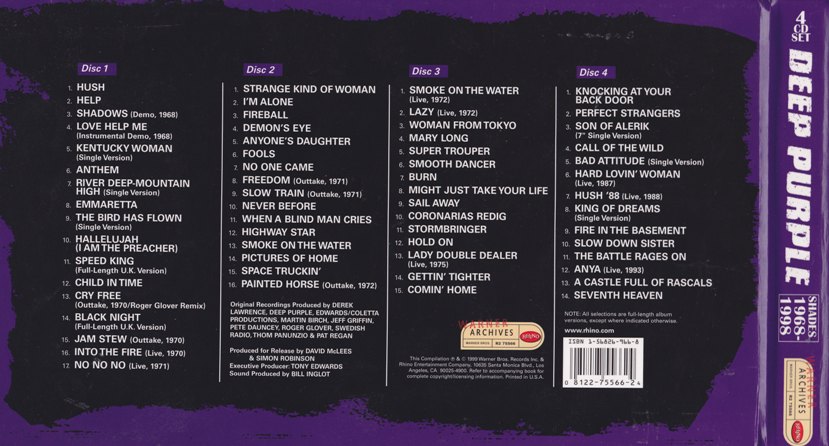
SHADES_0003Disc one covers 1968 to 1971 (Shades Of to Fireball). The tracks listed here as demos or rarities are from the Deep Purple remastered CDs, all except for the aforementioned “No No No” which really is awesome. If you have the great Singles A’s & B’s and the Deep Purple remasters, you have all this stuff. Except maybe the edit version of “”River Deep, Mountain High”, I’m not certain about that one. You get a good smattering of favourites on here, like “Kentucky Woman”, “Speed King”, “Child In Time” and so on, but it’s not really sequenced all that well. The slow-ish Deep Purple Mk I material fits awkwardly with the Mk II.  Other songs of note include non-album singles and B-sides such as “Hallelujah” (first recording with Ian Gillan) and “The Bird Has Flown”.  The version of “Speed King” included is the full UK cut, with the crazy noise intro.

Disc two is 1971 to 1972: more Fireball, and Machine Head. All these tracks can be found on Deep Purple remasters. There  are some excellent tracks here, such as the rare “Painted Horse” and “Freedom”. “Painted Horse”, a personal favourite, has been available for decades on an album called Power House. I guess Blackmore didn’t like them at the time, so they languished until the band broke up before the record label released them. “I’m Alone” was rare for a long time, and “Slow Train” was completely undiscovered until the Fireball remaster. I like that “Anyone’s Daughter” is on here, a very underrated song.  Of course you will hear all the big hits on this disc: The studio versions of “Smoke on the Water”, “Fireball”, Highway Star” and “Space Truckin'”. This will be many people’s favourite disc.

The third CD continues with Mk II.  It starts off with the Made In Japan live version of “Smoke” which is fine, but now you’ve heard it twice.  Soon, it’s  “Woman From To-kay-yo”, “Mary Long”, and the scathing “Smooth Dancer”.  Then Gillan and Glover are out, and in comes Coverdale and Hughes  One rarity on this disc is the instrumental “Coronarias Redig”, which dates from the Burn period. It also includes some of Mk III’s most impressive work, including two of the best tunes from Come Taste The Band. Conspicuous by their absence is the epic “You Keep On Moving”, and Blackmore-era fave “Gypsy”. You will, however get “Burn”, and “Stormbringer” from Stormbringer itself.
SHADES_0005The fourth CD is the one that ticks me off the most. This covers the reunion era, from 1984 to the then-most recent album Abandon in 1998. The hits are here, “Perfect Strangers” and “Knocking’ On Your Back Door”, as well as some singles from the Joe Lynn Turner era. What ticks me off here is the song selection. “Fire In The Basement”? What? That song kind of sucks, why not “The Cut Runs Deep”? Only one song from The Battle Rages On is included, only one from the excellent Purpendicular, and only one from the recent Abandon? And not even the best songs? That makes no sense.

To short-change the later era of Deep Purple only serves to short-change the listener.  The band were revitalized and rejuventated by Steve Morse, and made some really good, well received music. I saw them live with Morse in 1996.

From The House of Blue Light era, a single edit of “Bad Attitude” is included, which is probably rare.  What you won’t get is the full, 10 minute + version of the instrumental “Son Of Aleric”. This is one of the best lesser known tunes from the reunion era. Instead, you get the truncated 7″ single version. That makes the 10 minute version frustratingly hard to get. It was originally released on a 12″ single, which you may be able to find. You might have better luck finding it on the European version of Knocking at Your Back Door: The Best of Deep Purple in the 80’s. It was included there, replacing “Child In Time” from the US version. I managed to get it thanks to my mom & dad who bought it for me at an HMV store in Edinburgh (along with Restless Heart by Whitesnake).
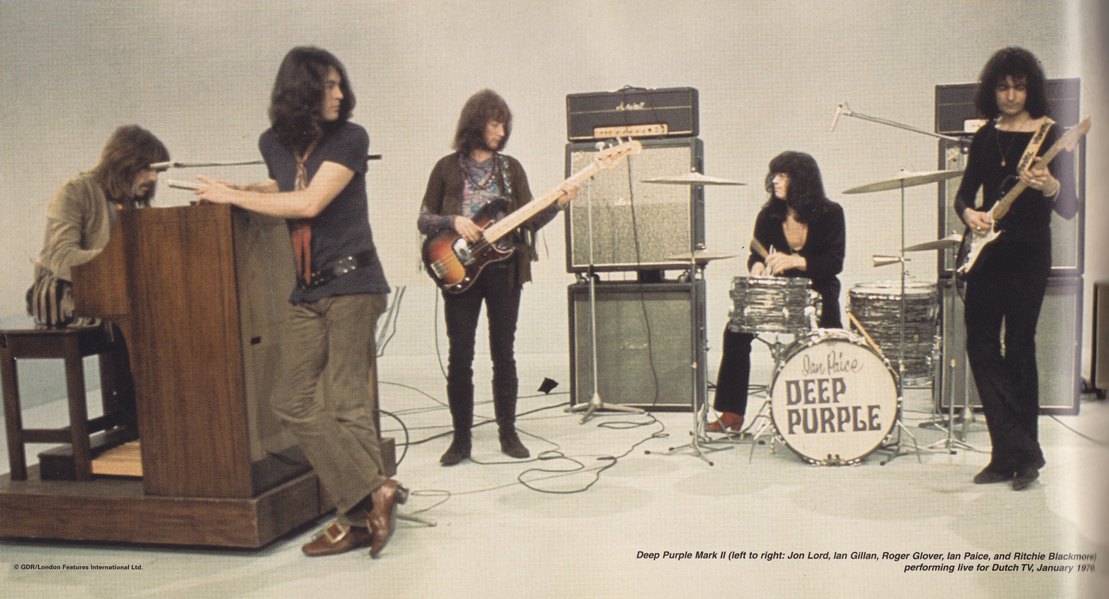
SHADES_0004Mick Wall’s liner notes offer the Morse years a mere mention, and end on a nostalgia note of “bring back Blackmore.”  Come on. Let’s focus on the present of a band that shows no signs of slowing down, shall we? But this box set short changes the present, and by picking it up you won’t hear such awesome later songs as “Sometimes I Feel Like Screaming” or “Fingers to the Bone”.

I know many reviews of this set are glowing, and each reviewer has their own reasons for doing so. I can’t. This band is too important, too vital, and dammit, still alive! This box set simply doesn’t do them justice. I was ticked off when I bought it and realized I owned almost all the “rare and unreleased” material. Collectors won’t find much here worth the coin spent, and rock fans who just want a great box set of Deep Purple won’t get to hear enough Morse.

Somebody dropped the ball on this one! 2/5 stars.
SHADES_0002

REVIEW: Deep Purple – Collector’s Edition: The Bootleg Series 1984-2000 (12 CD)

fb:  Lebrain
“LIKE” the LeBrain Facebook page for exclusive content.

DEEP PURPLE – Collector’s Edition: The Bootleg Series 1984-2000 (2000 Thames Thompson, Australia only, 12 CD set)

There are two (!) 12 CD Deep Purple bootleg collections; this is the first and best of them.  Although Deep Purple’s career is chock full of live albums chronicling this period, this set does feature many treats that are hard to find or not available on official live albums.  These really are bootlegs; the band decided to release their own versions of pre-existing audience bootleg albums!  All artwork, errors included, are copied from the original bootleg releases.

Before you get too excited I will state right off the bat:  There’s no Deep Purple Mk V or VI.  No Joe Lynn Turner, or Joe Satriani.  There is, however, a show from 1995 with Steve Morse, previewing tracks from the yet-to-be recorded Purpendicular album.  This transitional period is very cool.  You get to hear Morse perform “Anyone’s Daughter”, which was dropped from the set not long after.  Since Morse and Blackmore’s styles are vastly different, it’s a cool take on a track that you don’t hear often as it is.  In addition, you’ll hear Morse reinvent “Woman From Tokyo” on a bootleg from 2000.

BOOTLEGS FRONTThe Bootleg Series also contains my favourite version of “The Battle Rages On” ever released.  1995, Ft. Lauderdale Florida, Ian Gillan tore the roof off with that song.  In my mind I always imagined his screams directed towards Blackmore, even though he was probably furthest from Gillan’s mind.  It’s a magical version, you can hear the electricity and the emotion.  Just awesome.

Also a treat is a revisiting of the old In Rock classic, “Into the Fire” from 2000.  This version crushes!  Unfortunately, a stiff and slow version of “Sometimes I Feel Like Screaming” follows it.  Deep Purple are that kind of band, usually they just kill it.  But their history does contain rare stumbles, and this take of “Sometimes I Feel Like Screaming” is nothing stacked up against other versions available.  On the other hand, Purple just smoke the Abandon track “’69” immediately afterwards!  They extend this concise rocker to include an extended jam with a nod and wink to “Paint It, Black”.
Other highlights:  Blackmore’s solo spot “Difficult to Cure”.  Rarely heard 80’s-era tracks such as “Under the Gun”, “A Gypsy’s Kiss”, “Nobody’s Home”, “The Unwritten Law”, “Bad Attitude”, “Hard Lovin’ Woman”, and “Dead or Alive”.  You can’t buy a live version of “The Unwritten Law” anywhere else.  “Fools”, a rarely played track from Fireball, simply crushes.  Holy Ian Paice, Batman!  Steve puts his own slant on the guitar part in “Fools”, but it is his solo spot on “Cascades” that is truly intoxicating.

These being bootlegs, don’t expect sound quality or packaging or liner notes, unfortunately.  The sound quality does improve as you go from the oldest discs to the most recent.   The oldest shows have a lot of crowd noise, and poor sounding drums.  By the time you get the Japan 2000 show, things sound much better although can still stray towards muddy at times.  Packaging-wise, what you see is what you get:  A box, six jewel cases, front covers and back covers.

This was an Australia-only release.  I have no idea what it’s worth today.  I haven’t seen one in years.

4/5 stars

Bootlegs:

Highway Stars (Adelaide Australia, 11/30/1984)

Third Night (Sweden, 06/16/1985)

Hungary Days (Budapest Hungary, 01/28/1987)

In Your Trousers (Stockholm Sweden, 11/13/1993)

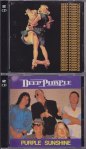
Purple Sunshine (Ft. Lauderdale Florida, 03/04/1995)

Made In Japan 2000 (Osaka Japan 04/01/2000)

I decided that there’s no point rating these bootlegs individually.  For one, it’s a set, and when it came down to splitting hairs, I like them equally.  And that speaks volumes as to the consistency of this band.

REVIEW: Deep Purple – Power House (1977 Japanese import)

PH FRONT CD

DEEP PURPLE – Power House (1977  Warner Bros, Japanese import)

I have always loved listening to the Power House album, featuring the classic Deep Purple Mk II era. After Purple broke up in ’76, the market was inundated with compilations and live albums. This one, and others like Last Concert in Japan, and When We Rock We Rock… were snapped up by fans who wanted more Purple. All of these albums have been rendered redundant by superior, current Deep Purple remasters.  If you’re the kind of fan who collects all of those 70’s posthumous Hendrix albums, then you’ll dig Power House, a brief but enjoyable romp through less familiar Purple. You’ll even get the original liner notes by Simon Robinson.

Power House consisted of 6 then-unreleased tracks. Here’s your complete track list:

1. “Painted Horse”.  This is an outtake from the Who Do We Think We Are sessions in July 1972.  This is the track that Blackmore “didn’t like”.  He hated what Gillan did with the vocal, and demanded it be changed.  Gillan refused, and the result was a great, unique Deep Purple rocker that remained unreleased until after the band was defunct.

2. “Hush”
3. “Wring That Neck”
4. “Child In Time”
From the Concerto for Group and Orchestra program in September 1969.  The original hit LP release of the Concerto had just the three movements of that piece.  Deep Purple played a standard three song set before the Concerto, and here it was released on Power House.  These three versions remain among my favourite performances of these songs.  “Child In Time” had yet to be recorded on album, and Jon Lord’s melodies are experimental and in development.  Very cool.  It’s “Hush” that really smokes, a definitive version of this cover.  Gillan made it his own right there.

Today the Concerto is available remixed on two discs, with the full piece, the Deep Purple set, and the Royal Philharmonic’s rendition of Malcolm Arnold’s “Symphony No. 6”, which was also performed that night.

5. “Black Night”.  Another nearly definitive version in my books!  This is a B-side, recorded at the Made in Japan dates in August 1972.  This is widely available today on various extended versions of the Japan shows, the Singles A’s and B’s, 24 Carat Purple, and many others.

6. “Cry Free”.  Outtake from the Deep Purple In Rock sessions in January 1970.  It is incredible how fertile the band were in the early 1970’s.  As if In Rock wasn’t amazing enough, this kind of song doesn’t even make the album?  Amazing that Deep Purple’s outtakes were so impressive.  That they could throw this away speaks volumes of their confidence at the time.

Regardless of Power House being superseded in recent years by better packages, I still enjoy this album, in this sequence.

4/5 stars

REVIEW: Deep Purple – Deep Purple (1969)

DP FRNT

DEEP PURPLE – Deep Purple (1969 EMI, 2000 The Original Deep Purple Collection)

I love when bands release a self-titled album as their third, perpetually (purpetually?) confusing fans who think it’s their first!  Maybe not so much in the Wikipedia age, but many of my customers thought that Deep Purple was the band’s debut.

This album is unbelievable. I know people, very particular music fans, who consider this to be the best Deep Purple album. I wouldn’t make that claim myself (I prefer Fireball) but I rank this one very high. Neither of the first two albums by Deep Purple Mk I did much for me.  I found them meandering and plodding.  Somehow, by the third record, the band had morphed into something different.  The singer was Rod Evans (Captain Beyond) and the bassist was Nicky Simper (Warhorse).  And of course more changes would come, since this would prove to be the last album for both men.

Side one, track one is an amazing opener called “Chasing Shadows” (not to be confused with a later Deep Purple song just called “Shadows”) that features a Paice-arranged drum orchestra throughout the whole song. “Blind” is second, which features Lord on harpsichord. How 1960’s! Great song though, slow and mournful with a wicked Blackmore solo.  This is followed by the Donovan cover “Lalena”. It is another sad sounding track in a row, but with a beautiful organ opening from Jon Lord. A brief instrumental called “Fault Line” is a crazy interlude, recorded backwards with the bass recorded forwards. That melds into a serious rocker called “Painter”, which ends side one. “Painter” to me is best remembered for Ian Paice’s inventive drumming and Blackmore’s excellent bluesy playing.

Side two began with “Why Didn’t Rosemary?”, a groovy blues rocker with the relentless rhythm section of Paice and Simper driving it. “Bird Has Flown” follows, but not the Beatles song. It verges on heavy metal with Blackmore leaning heavily on the wah-wah peddle. The final track, “April”, is a 12 minute tour-de-force and an obvious foreshadowing to the next Deep Purple album, Concerto For Group And Orchestra. It features a long opening in two movements. The first movement is mostly organ and classical guitar, with some electric guitar accents. The second is based entirely on classical instruments and sounds very medieval at times. (Foreshadowing Blackmore’s Night!)  Finally, the band kicks in with an intense rocker, Paice laying it down hard.  Rod Evans’ lead vocal is among his best, a fitting swan song, although he certainly didn’t know that at the time!

Indeed, even while Deep Purple were gigging with Rod Evans and Nick Simper in the band, they would soon secretly begin rehearsing and recording with their replacements, Ian Gillan and Roger Glover!

This excellent CD remaster comes with an extensive booklet and five bonus tracks. Some of these bonus tracks were completely previously unreleased. These are live BBC performances and non-album singles. Notably included are two cool, catchy and rare singles A-sides:  “Emmaretta” and “The Bird Has Flown” (an earlier version of “Bird Has Flown”).  Some of the BBC performances have since been released on compilation albums, but these are rare performances indeed.  In a short while, the band would write In Rock and drop most of the old songs from their set.

The only flaw with this CD, (and I’m talking the only flaw), is the cover. That awesome painting by Hieronymus Bosch is one of the coolest, creepiest, most interesting paintings I know. The original LP was a gatefold and you could fold the whole thing out and stare at it for years. The cover on this CD is so tiny, and doesn’t show the back part of the LP.  That’s a real shame.  For such a great cover, for it to be chopped and rendered down to about 2″ per side…it doesn’t make any sense.  What a blown opportunity.  The CD should have come with a small fold out poster, at least.

5/5 stars…but pick up an original LP if you can. I have a purple vinyl reissue, but it lacks the gatefold, and you really lose something without the gatefold.

An original LP is seen below.

REVIEW: Deep Purple – “All the Time in the World” (2013 CD single)

“LIKE” the LeBrain Facebook page for exclusive content.
All the time

DEEP PURPLE – “All the Time in the World” (2013 Edel single)

I tried to order this single from the Deep Purple Appreciation Society.   I was order #31.  But then Edel only hooked them up with 10 copies!  I had to order this from Amazon instead, paying $23 plus shipping.  I’m not happy about that, but it’s Deep Purple and I am a completist with this band.

I’m really fond of “All the Time in the World”.  It reminds me of the laid back Purple from Bananas.  The classy keys from Don Airey seal the deal for me, but how about that Steve Morse solo?  Fantastic!  Thankfully, the sonic qualities of compact disc bring out all the richness of Bob Ezrin’s production, lacking in the crappy Youtube videos available.  It might not sound like the Deep Purple of 1970, but that was a long time ago now.  It does sound like a rock band staying classy well into their silver years.  I don’t hear any compromise nor contrivances here.   This is a both a radio remix and an edit, so expect the album version to differ.

“Hell to Pay” is a more traditional Deep Purple hard rocker, but with a shout-along chorus.  You don’t hear shout-alongs too often in Deep Purple, as strange as that may seem, so this is new territory in a sense!  The highlights of this song are the solos by Steve and Don.  I had to play it again to bask in its awesomeness.  There are echos of “Highway Star” at times.

You’ll notice Ezrin gets a writing credit on each track (as does each Purple member).  This is indicative of both the collaborative nature of Deep Purple, and Ezrin’s usual musical input.

There are two live tracks, but I unfortunately already have these!  They are “Perfect Strangers” and “Rapture of the Deep” from the London Hard Rock Cafe in 2005.  They were previously released (and previously reviewed) with the special edition of Rapture of the Deep.  This is disappointing, I was hoping for unreleased live versions.  Regardless, they’re great versions, particular “Rapture” which is perhaps better than the album version.

Now What?! is out tomorrow, April 26.

4/5 stars (for the music, not Amazon’s price)

REVIEW: Deep Purple – Stormbringer (35th Anniversary Edition)

STORMBRINGER OUTER FRONT

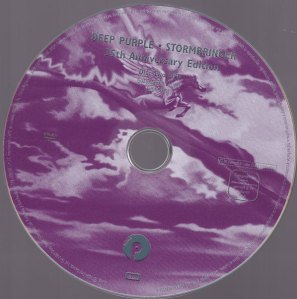
DEEP PURPLE – Stormbringer (35th Anniversary Edition, 2009 EMI, originally 1974)

Stormbringer, now available in the gloriously remastered series of Deep Purple special editions, is one of my favourite Purple platters. Now augmented with bonus material, it has finally been given the treatment it deserved. It’s certainly not everybody’s cup of tea, but Stormbringer has earned some begrudging fans over the years.  I for one find it a more enjoyable listen cover to cover than 1974’s Burn.

A lot of fans did not like the funkier, softer direction of the band. You can understand this, of course. A fan who loved In Rock, one of the heaviest records of any decade, could easily be turned off by the radio-ready soul funk of “Hold On”.  Blackmore himself decried the funky direction of the band.

Here’s the good news: Whatever Deep Purple set their minds to, they could do. And they could do it well.

STORMBRINGER CDBlackmore may not have liked the album, and he did take a step back in the mix, (you can barely hear any guitar on “Hold On”).  He could stilll adapt to and play any style. His playing here, while sparse, is sublime. Ian Paice takes to the funky rhythms very comfortably, laying down some excellent grooves. Jon Lord steps up to the forefront, supplying some excellent, funky keys.

There are a few songs that harken back to the past: “Stormbringer”, the title track, sounds as solid as any epic the band had ever composed. It could have been on Burn as easily as this record. In fact, it stands out as being out of place: As the opening track, fans must have been shocked and surprised when the rest of the album was so different.

Another song that has shades of older Purple is “The Gypsy”.   It’s a slow mournful piece, perhaps akin to “Mistreated” from the previous album.  The lyrics are uncharacteristically bleak.

One track showed an interesting glimpse of the future. “Soldier Of Fortune” is an acoustic track which forshadowed much of the music Blackmore would do with Rainbow, and even now with Blackmore’s Night. David Coverdale has performed it live with Whitesnake.  I think it’s one of Richie Blackmore’s finest compositions.

Of the other tunes, “Love Don’t Mean A Thing” is one of the funkiest, and one of the most entertaining.  It’s just fun to listen to.  David and Glenn co-sing this one.  Ritchie’s solo is very understated, but appropriate.  Glenn takes his first solo lead vocal with Deep Purple on “Holy Man”, a soulful ballad.  “You Can’t Do It Right” features probably the funkiest guitar work of Blackmore’s career.  It’s fascinating to listen to, and the band really cooks on this one.  It’s one of the most extreme experiments of this funky Purple period.

As with all the Purple reissues, this has been lovingly remastered. Finally you can discard your original CD, mastered for digital ages ago, but never really letting the subtleties of the music shine. Stormbringer, of all the Deep Purple albums, perhaps has more subtleties to hear due to the quieter nature of the music.

STORMBRINGER DVDBonus material?  Oh yeah, there’s bonus material, in this case four remixes by Glenn Hughes. These remixes don’t replace the original songs, but they do act as a companion piece of sorts. Fresh light is shed on alternate takes incorporated into the mixes, and “Love Don’t Mean A Thing” is extended by over half a minute. “High Ball Shooter” is presented in an early instrumental form as well.

As an added bonus, a second disc has been included. The second disc, exclusive to this edition, is a DVD containing the original 1975 quadrophonic mix of Stormbringer! Nice. Apparently, this disc is to be a limited edition so get yours while you can. I liked quite a bit, myself. As with many quad mixes from the 70’s, the songs often bear noticeable differences from the originals.  Quad was a gimmicky fad, by today’s standards, but listening to it with the benefit of hindsight is quite enjoyable.

Lastly, I must acknowledge the great liner notes. The most entertaining story included is in regards to “Love Don’t Mean A Thing.”  While in Chicago, Ritchie ran across a street busker, who was snapping his fingers singing a song about money.  Blackmore invited him onto Purple’s plane, collected Coverdale and Hughes, and jammed for 20 minutes with this guy who taught them the song and the lyrics.  The band finished the song that became “Love Don’t Mean A Thing”, credited to the entire quintet, because nobody ever bothered to get the busker’s name.

Pick up Stormbringer in this 25th Anniversary Edition, and finally you can feel comfortable discarding your original.

5/5 stars for both the music, and the reissue!

REVIEW: Deep Purple – The Battle Rages On… (1993)

TBRO FRONT

DEEP PURPLE – The Battle Rages On… (1993 BMG)

After the ill-fated (but personally enjoyed) Slaves and Masters, Deep Purple realized the only way forward was with Mk II screamer Ian Gillan back at the mike. With a full album’s worth of material already written with former singer Joe Lynn Turner, all Gillan had to do was turn up and re-write the melody and lyrics. Much to Blackmore’s chagrin! Blackmore had no qualms telling Gillan that he preferred the original lyric and melody to “Time To Kill”.

Much heavier than Slaves and Masters, The Battles Rages On is much more in line with albums such as Fireball, Perfect Strangers and Machine Head. Lord’s Hammond organ is much more in the forefront. However, a vintage sound does not a great album make. The Battle Rages On has 10 tracks, 5 of which are good and 5 of which are filler. This was disappointing for me personally, but some (M.E.A.T. Magazine and Martin Popoff included) have rated this album very high.  Joe Lynn Turner derisively calls this album The Cattle Grazes On.

The five tunes I like: “The Battle Rages On”, “Anya”, “Time To Kill”, “Ramshackle Man”, “Solitaire”.

The title track is absolutely monstrous. I remember hearing it on the radio and thinking, “Bloody well right!” Big beefy riff, angry lyrics!

“Annihilation, kill ’em all. Capitulation, watch the mighty fall. The road to glory is lined in red, and though the reason now is gone…The Battle Rages On!”  (Always wondered if this was about Gillan and Blackmore.)

The song is a Purple epic, along the lines of “Perfect Strangers” or “Knockin’ At Your Back Door”. Just an awesome track.  I understand that in 2013 they have actually returned it to the set.

“Anya” is a keyboard driven rocker, Jon Lord style, lots of drama. “Time To Kill” is sort of a heavy pop rocker with Gillan trying to get philosophical with the lyrics, which Blackmore hated. “Ramshackle Man” is blues rock, pure and simple as Purple have specialized in. “Solitaire” is mournful, sad, kind of unlike anything Purple had really done before.  Gillan’s droning melody seals the deal.

The rest of the songs just do nothing for me. Some, like “One Man’s Meat” have decent riffs and parts, but weak melodies and lyrics.  As songs, they don’t add up to a satisfying listen.  It is a shame, given the strength of the good songs on the album.

Blackmore left in the middle of the tour.  Joe Satriani filled in, and there was talk that he wouldn’t mind joining Purple full time.  His time proved to be temporary, and Steve Morse has been in the band almost 20 years now. When Joe Satriani was in the band, they did an awesome version of “Ramshackle Man”, which I have on a video bootleg from the European tour.  There was an official live album with Blackmore from the tour, called Come Hell Or High Water.  As well, you could buy official bootlegs with both Morse and Blackmore in a box set called Collector’s Edition: The Bootleg Series 1984-2000.  And let’s not forget the Come Hell Or High Water video, with Blackmore throwing that water bottle in Gillan’s general direction…

Check out Satriani’s outro solo starting at about 7:07…smokin’!

To me, Purple’s true comeback was 1996’s Purpendicular. Having said that, the five good songs on The Battle Rages On are worth the purchase at a reasonable price. And hey, maybe Popoff was right, and I’m just not getting it. You decide.

3/5 stars

And check out these cool supplementary releases, all of which deserve their own individual reviews.

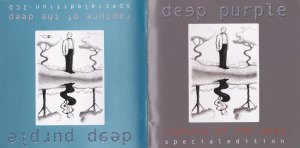
REVIEW: Deep Purple – Rapture of the Deep (2 CD special edition)

DP FRONT

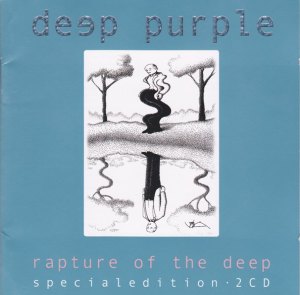
DEEP PURPLE – Rapture of the Deep (2 CD special edition, 2006 Eagle Rock)

Deep Purple, that hard rock institution that formed back in ’68, has been at it nearly non-stop with critically acclaimed albums and tours since reforming back in ’84. Lineup changes ensued, but by and large the band has retained its integrity even if only one member of the original ’68 lineup remains (drummer Ian Paice). However, this lineup of Purple is still 3/5 of the classic “Mark II” lineup that recorded Machine Head and Perfect Strangers, and is chock full of rock royalty.

Vocalist Ian Gillan is intact, his voice no longer screaming, but still unique and recognizable as a one-of-a-kind. His partner in crime, bassist Roger Glover is here, joining drummer Paice to complete the legendary rhythm section. On guitar is Steve Morse (Dixie Dregs), first joining Purple in ’95 and this being his fourth studio album. “New kid” in the band is keyboardist Don Airey, celebrating his second Purple album here, but no stranger to these guys from his work with Rainbow, Whitesnake, Ozzy and many more.

Airey’s first album with Purple, 2003’s Bananas, was a reboot of sorts. Gone was original member (and legend on the Hammond) the late Jon Lord, for the first time ever in Purple’s history. Also new on board was producer Michael Bradford, who was very much a collaborator. Bananas was a great album, but perhaps a little too commercial for Purple in the long run? Rapture Of The Deep is an attempt to steer Purple back to the sounds of ’71 while still retaining the modern edge that they gained with Bradford. It is raw and uncompromising, not slick at all, definitely and defiantly Deep Purple.

Purple and Bradford have produced here an album that is not an easy first listen, but a very rewarding 6th or 7th listen. If you give it a chance it will become a favourite. Keep in mind, these guys are musicians of the 60’s and 70’s. Back when people still had attention spans, you were supposed to listen to an album 6 or 7 times, usually in one night!

DP RAPTURE TIN INNER

“Money Talks” kicks off the album with the growl of a Hammond B3, that’s how you know this truly is Deep Purple. Morse’s guitar, very different from Ritchie Blackmore’s, leaves a lot of space between the chords. It’s a different kind of riffing, staggered and jagged, fast and genius. Gillan’s lyrics are, as always, witty and full of humour. Only Gillan can chuckle in the middle of a lyric and make it sound like it’s suppose to be there, and he does.

“Girls Like That”, the second song, is more melodic and commercial  A little bit more “Bananas”, and exactly what the album needed after the vicious “Money Talks”. Track 3, “Wrong Man”, has one of the most powerful Morse riffs on the album, and it sounds great live (more on that later). Fantastic song, great chorus.

The centerpiece of the album is the title track, “Rapture Of The Deep”. The guitar part sounds like a Morse trademark, slightly Arabic, rhythmically odd; just an entrancing song and worthy of the Deep Purple canon. As if this wasn’t enough, the next song “Clearly Quite Absurb” is simply one of the best ballads Purple have ever done. This is thanks to another trademark Morse guitar melody, and some wonderful singing by Gillan. The lyrics are emotive and optimistic.  It sounds a lot like material from the wonderful Purpendicular CD, and keep in mind this is a band that doesn’t do a lot of ballads. There’s only this one ballad on Rapture Of The Deep.

Other standout tracks on the album includes “MTV”, a wry look at the life of a band of the “classic rock” format.  Gillan and Glover must be used to certain interviewers getting their names wrong, and only knowing one song, judging by the lyrics:

“Mr. Grover n’ Mr. Gillian, you must have made a million, the night Frank Zappa caught on fire.”

“Kiss Tomorrow Goodbye” is one of the heaviest tracks, Gillan attempting a scream here and there, sounding like the furious side of Deep Purple is alive n’ well. “Junkyard Blues” is anchored by a solid Glover bassline, simple but metronomic, and then that takes us into the final track, the atmospheric “Before Time Began”. At 6:30, “Before Time Began” is not for people with ADD!

A great album, demanding of your attention. Worthy of your attention. Deep Purple have always had some kind of standards when it comes to studio albums. Even their weakest have some sort of integrity to them. Rapture of the Deep is not an immediate album, nor will it unseat Machine Head as the fan favourite. But it does serve to remind the world that Deep Purple are still a great band, within the confines that age brings with it. Deep Purple are in fact one of the best bands of this age, because they just refuse to sell out.

DP FRONT BACK

The bonus disc here is a treasure, and I am so glad I re-bought this album (third time now) to get these songs!

The “new version” of “Clearly Quite Absurd” sounds like a re-recording to me, with more orchestration. I’m not sure why this was done, the two songs have a similar feel even though they are instrumentally quite different.  Both versions are equally great in my opinion.  Yet even with a great song like this, Purple can’t get their new material on the radio! What a crime! “Things I Never Said” is a great song, a bonus track, with another busy Morse riff.  This is originally from the Japanese release of the CD. Next up, finally released in its studio version (but recorded during the Bananas sessions) is “The Well-Dressed Guitar”. You may remember this instrumental workout from Deep Purple tours and live albums circa 2002 (check out the Live at the Royal Albert Hall CD). Then, five live tracks, the first ever official live tracks with Airey on keyboards! Two are from this new album (“Rapture” and “Wrong Man”), and there are three classics including — yes — “Smoke On The Water”. These tracks prove that no matter who is in the band these days, they still sound like Deep Purple. The other two live tracks are “Highway Star” and “Perfect Strangers”.

4/5 stars.  Now What?!

I also have a single disc 2005 tin version from Edel Records.  This one boasts an enhanced CD with studio footage and an EPK (electronic press kit video) which I’ve never watched.

REVIEW: Whitesnake – Come An’ Get It (Remastered with bonus tracks)

“Like” the brand new LeBrain Facebook page!

WHITESNAKE FRONT

WHITESNAKE – Come An’ Get It (EMI 1981, 2007 remastered with bonus tracks)

Come An’ Get It is my favourite Whitesnake album.  Therefore it’s a bit of a surprise that I still haven’t reviewed it.  On the other hand it’s always nice to leave some goodies for later and cherish them, I suppose?

The first time I heard this album was in 1990.  I had ordered the cassette from Columbia House, and brought it with me on a trip to go visit my cousin and aunt in Calgary, Alberta.  I remember I brought two brand new (to me) albums with me from that Columbia House purchase; the other was School’s Out by Alice Cooper.  I ended up loving both, not a bad trip eh?  Driving through the mountains with “Lonely Days, Lonely Nights” by Whitesnake on the earphones was pretty fucking cool.

Come An’ Get It features this classic Whitesnake lineup, aside from David Coverdale himself:

  • Jon Lord – organ
  • Ian Paice – drums
  • Bernie Marsden – guitars
  • Mickey Moody – guitars
  • Neil Murray – bass

Basically, THE lineup of early ‘Snake.  In the liner notes, David says he finds this to be one of his most consistent efforts, and his favourite of the early band.

The incredible album kicks off with the flirtatious title track, Cov the Gov as cocky as ever, with this seasoned band behind him solidly grooving.  “If you want it, come an’ get it, I got something for you.”  And kids, I hate to break it to you, Coverdale’s “something” was not something innocent like candy or treats.

“Hot Stuff” is the second track, which changes up to a breakneck speed.  Lordy on the piano hammers away, keeping up with the furious pace of Paice and the 3 M’s – Moody, Marsden and Murray.  Another standout.

The single, “Don’t Break My Heart Again” is a bit more ominous, with Lord’s trademark Hammond organ carrying the song.  It’s a bit darker, a bit plaintive, David convincing us that he really is heartbroken, even though two songs ago he was begging some lovely lass to “Come An’ Get It”.  This is a standout song, with fantastically colourful solos and a memorable melody.  Shades of the Whitesnake to come.

The aforementioned blues, “Lonely Days, Lonely Nights” follows.  It’s this kind of song that David really sinks his teeth into.  Moody and Marsden throw in plenty of bluesy licks, Lord with his Hammond colouring the backdrop.  Once again, David will have you convinced that somehow, he really is lonely.  Lonely, even though the very next song talks about how much he loves “Wine, Women An’ Song”!

“Wine, Women An’ Song” is actually my favourite tune on the album.  Coverdale is as cheeky as ever:

“If I can make you smile, I will raise my glass,
But if you don’t like it, baby you can kiss my ass,
Yes indeed…
You can tell me it’s wrong, but I love wine women an’ song!”

This barroom piano bopper is irresistibly catchy.  I’ve always been a sucker for past piano tunes, that’s why I love Little Richard I guess!  David’s done a number of these over the years (“Bloody Mary”, “Bloody Luxury”) but this one is my favourite.  And that ended side 1.

WHITESNAKE INNER

Side 2 kicked off with one of David’s more philosophical songs, a style he also does well.  “Child of Babylon” starts slow and bluesy but soon becomes something a bit more menacing.  This is another triumph.  “Would I Lie To You” returns David to his cheekier side.  “Would I lie to you…just to get in your pants?  I think so,” winks Cov the Gov.  This is just a fun Whitesnake tune, catchy, danceable, tongues in cheeks (just not necessarily the cheeks of the tongue’s owner).

My least favourite song is the next one, the slightly funky “Girl”.  The liner notes compare it to Deep Purple; I don’t think so.  Yes, both bands forayed into funk.  I think Deep Purple did it better than this.  Much better is “Hit An’ Run”, which drives.  This song kicks.  David’s vocal is perfect, and there’s even a talk-box solo, and then a killer slide solo!  What more could you want?

The final song of the original album was “Till the Day I Die”, another one of David’s perfect philosophical album closers.  He seems to like to close his albums with tunes like this, or “Sailing Ships”, songs with some mood and thought to them.  “Till the Day I Die” is one of the best ever, a dramatic, sweeping number that goes from acoustic to epic in under five minutes.

Martin Birch produced Come An’ Get It, as he did many ‘Snake platters.  It has a workmanlike sound, powerful enough, sonically clear, with excellent performances.  Slide It In is more powerful in the long run, but this is a step on that road.

There are six bonus tracks to keep you satisfied after the main meal.  Think of this as dessert, as these are unfinished or rough mixes of album tracks.  There is nothing especially revelatory here, but as added value, it’s nice to have these bonus tracks.  There’s some unheard stuff here, such as Ian’s count-in to “Child of Babylon”, nothing mindblowing, just nice to have to fill out the CD.  Some alternate vocals, solos, and so on.

The liner notes by Geoff Barton are excellent, loads of photos, lots of text.  Coverdale shows up to offer his perspective, and illustrates a harmonious band firing on all cylinders.

Keep in mind that context is everything, especially when it comes to music.  I have powerful memories of this album.  For you, it might not be worth it, but for me:

5/5 stars

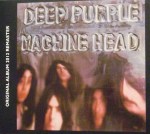
REVIEW: Deep Purple – Machine Head (40th Anniversary Deluxe Edition, vinyl, In Concert ’72 vinyl)

More Purple at mikeladano.com:

Live at Inglewood 1968Deep Purple (1969), Machine Head (40th Anniversary Deluxe Edition + vinyl + In Concert ’72 vinyl), Perks and Tit (Live in San Diego 1974), Stormbringer (35th Anniversary Edition), Come Taste the Band (35th Anniversary edition), Power House (1977), The Battle Rages On (1993), Shades 1968-1998, Collector’s Edition: The Bootleg Series 1984-2000 (12 CD), Listen, Learn, Read On (6 CD), Rapture of the Deep (2 CD Special Edition), “All the Time in the World” (2013 CD single), NOW What?! (2013) Record Store Tales Part 32: Live In Japan, STEVE MORSE BAND – StressFest (1996), ROCK AID ARMENIA – Smoke on the Water: The Metropolis Sessions.

DEEP PURPLE – Machine Head (EMI 40th Anniversary Deluxe Edition, vinyl, In Concert ’72 vinyl)

BLACKMORE 2_0002

For the record, Machine Head is not the perfect Deep Purple album.  I find both In Rock and Fireball to be superior.  Machine Head is, however, the best known Deep Purple album, and I guess that’s why it’s gotten such a grand reissue while the other two have to be content with simple single-disc reissues from the 1990’s.

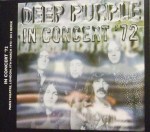
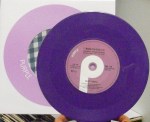
For the 40th anniversary, there have been a number of reissues made available.  First, there is the lovely 180 gram vinyl reissue, which includes a lyric sheet and a bonus 7″ of the first single, “Never Before” / “When A Blind Man Cries”.  Then, Peter Mew remixed the 1980 release In Concert ’72 at Abbey Road, which was re-released on purple vinyl.  This too came with a bonus 7″ single (also purple), “Lucille” and an unreleased rehearsal of “Maybe I’m A Leo”.

Finally, the crown jewel release is the five disc 40th Anniversary box set.  This includes all the stuff you got with the previous 1997 25th Anniversary edition, and more.  Packed inside is a lush 64 page hardbound booklet (including Roger Glover’s 1997 liner notes).  As an added surprise, even the CDs are printed in purple plastic.  I hope this is the last time I ever need to buy Machine Head!

SAM_2347

Disc One:  the 2012 remaster

Hey, I found the 1997 remaster just fine to my ears.  Is this one better?  Marginally, yes.  I imagine this sounds closer to the way it originally sounded if you bought a brand-new vinyl copy back in 1972.

Machine Head is a mere seven tracks, but almost all are winners.  The album kicks off with the adrenalized “Highway Star” (written and often performed during the Fireball tour), which is one of my personal favourites.  I still marvel today at Jon and Ritchie’s unison solos, like something out of a rock n’ roll speed race.  Gillan screams that nobody’s gonna take his car, and you believe him.  “Highway Star” is Deep Purple the way I often think of them:  fast, intricate, with banshee screams.

“Maybe I’m A Leo” takes the pace to a groove, with Ian Paice and Roger Glover holding it down.  This track is quite unlike anything from the previous two Deep Purple albums (except maybe “No No No”), featuring a more relaxed, comfortable band.   It is radio-ready hit material, and a concert staple.  But in case you too were getting comfortable, Ian Paice’s pounding intro to “Pictures Of Home” will wake you up.  This is clearly the most “heavy metal” of all the new songs, and that drum intro is reminiscent of Ian’s work on “Fireball”.  Gillan’s lyrics describe the “eagles and snow” of the Swiss scenery in which they recorded the album.

SAM_2352

In case you didn’t know, Machine Head was recorded at a hotel in Switzerland, by the Rolling Stones Mobile and Martin Birch.  The band occupied several suites, and managed to extract an incredible sonic quality from them.  According to the liner notes, it was simply too much work for the band members to walk through the various suites (needing to go outside onto balconies to do so, due to blocked doorways) down to the mobile to hear playback.  Instead, the band simply plowed through without hearing many of the playbacks, and the result is a spontaneous sounding album.

The first single “Never Before” is next, closing side one.  This is the one predicted to be the hit, only it wasn’t.  It’s not particularly a standout Purple track.  It’s short, simple and sweet but not nearly as powerful or memorable as the other six album tracks.SAM_2369

Side two opened with a track thought to be a mere throwaway, “Smoke on the Water”.  Completed after the infamous Frank Zappa gig at the local casino which resulted in the place burning down, Glover coined the title.  The rest of the band initially balked:  “Sounds like a drug song.”  Of course we know the song and title were the perfect match for each other.  This riff is the riff, the mother of all guitar riffs, never to be topped nor equaled by anybody, including Deep Purple.

“Lazy” was the band’s jam song, a sprawling seven minute stretch, greatly expanded upon live.  It begins with Jon Lord and Ritchie Blackmore playing off each other, a fun blues, until Gillan enters.  Ritchie’s solos are sublime, not to understate the greatness of Jon’s.

Side two closed with “Space Truckin'”, another song which was greatly extended live.  This is not one of my personal favourite album songs, but one cannot deny its importance.  It is an extended concert staple, but in its studio version it isn’t even a full 5 minutes long.

The disc ends with a bonus track, the sublime B-side “When A Blind Man Cries”.  This is a slow, mournful blues featuring some of Ritchie’s incredible six-string feel.  You can see why it wasn’t included on the album proper, as it is unlike anything else on Machine Head.  Restored to the CD as a bonus track, it is now a highlight.  Ian Gillan deserves special praise for his emotive delivery.

SAM_2348Disc two:  the 1997 Roger Glover remix

For the 25th Anniversary CD, Roger went back into the studio with the master tapes and built an alternate, remixed Machine Head.  This was done to provide added value, since no outtakes from the album existed.  This remix is not radically different.  What it is, is a fresh take on an album that I (and perhaps you) have played hundreds of times.  Glover incorporated alternate solos and unheard takes into the songs, making them sound new again.  In fact, this is my “go-to” version of “Smoke on the Water”, with my preferred alternate guitar solo and Ian’s “Break a leg, Frank!” restored to the end.  I tire of the original; this version sounds fresh to me.

Like the 1997 issued version, this also includes Roger’s remix of the B-side “When A Blind Man Cries”.  Missing are the Quad mixes of “Lazy” and “Maybe I’m A Leo” from the ’97 version, but they are included on another disc in the 40th Anniversary version.

SAM_2349Disc three:  Quad SQ stereo mix

Like many hit albums in the 1970’s, Machine Head was mixed in quadraphonic and released on a special LP.  Of course, nobody really has a quad setup at home anymore.  The interesting thing about many quad mixes, Machine Head included, is that it featured a very different mix, including alternate solos.  This version of the album has been mixed down to stereo and included for the sake of completion and historical value.

There are two bonus tracks on this CD, single edits of “Lazy” from a Japanese 7″, and a US edit of “Smoke on the Water”.  The Japanese reduced “Lazy” from almost 7 minutes to a mere 2:30!  I believe both single edits have been made available on box sets and compilations before, but they are included here to make this version of Machine Head the most complete ever assembled.

SAM_2350Disc four:  In Concert ’72, the 2012 remix

This album was previously available on CD, in a compilation that included BBC sessions from 1970 and 1972.  This set collects and remixes the 1972 recordings, complete, and restored to the correct running order.  Previously, “Smoke on the Water” was pushed to second-last in light of its later success.

This is a stunning live album, with clear sonic quality, and a powerful band playing almost all of Machine Head a month before its release!  “Pictures Of Home” is excluded, a song Ritchie did not want to perform live, and it is replaced by “Strange Kind of Woman”.

SAM_2372

Highlights for me include the aforementioned “Strange Kind of Woman”, complete with Ian and Ritchie’s interplay.  Lazy is quite a tour-de-force, and “Space Truckin'” is over 20 minutes long.  It is the full jam that folks would later come to know and love, with ample guitar, keyboard and drum solos.

The band were known to close their sets with Little Richard’s “Lucille” at the time, and it closes this BBC session as well.  There are a few versions of “Lucille” out there, this one is tame by comparison with some of them.  That’s not to say it’s inferior, as Ritchie’s solos are incredible, almost out-of-control, and Ian’s screams as powerful as ever.

SAM_2364

As I mentioned, the vinyl version of In Concert ’72 includes a bonus 7″ single.  This single is the only place you can get the previously unreleased “Maybe I’m A Leo” rehearsal.  It fades in on what seems like a bum note on Jon’s keys, and is a bit more laid back than the one that they played during the proper set.  Ian noticeably takes it a bit easier on the vocal, presumably saving his voice.  Ritchie plays a different solo.

For me, speaking as a collector, having this one rare track on such a cool looking colour single made it worth re-buying In Concert ’72 on vinyl like this.

SAM_2351Disc five:  Original quad mix, 96/24 LPCM stereo version, bonus 5.1 mixes

For a lot of people, this DVD is the main reason to buy this box set.  For audiophiles, there’s a high resolution version of the stereo mix.  For completists and history buffs like myself, you can finally hear the quad mix like people heard it in the 1970’s.  The album has been converted to 4.1 surround so you can play it on your home theatre system.   I very much enjoyed hearing the album in this way, as opposed to the stereo version available on disc three.  The cool thing is, Peter Mew did the original 1972 quad mix, and here he helmed its transfer to 4.1!

The quad is interesting not only because it differs noticeably from the original, but also because of the instrument separation.  You obviously can’t judge a mix like this and compare it to a 5.1 mix of today.  It’s not as full, or powerful.  But it’s also an historical piece.

It’s cool to hear the quad version’s guitar solo on “Highway Star”, Blackmore making his guitar rev like an engine through the front speakers.  I like the way Gillan’s voice multiplies in the mix during “Maybe I’m A Leo”, and the alternate guitar solo on the same song is also cool.  Jon’s keys come from behind, a bit gimmicky by today’s standard, but probably astounding back then.  “Pictures of Home” features Ritchie’s guitar tracks split between different corners, allowing one to hear the separate parts clearly.  The separation of instruments on “Lazy” allow you to hear clearly each member’s playing as well.

As an added bonus, they remixed three songs in 5.1:  “When A Blind Man Cries”, “Maybe I’m A Leo”, and “Lazy”.  I’m sure a lot of people will complain that they didn’t do the entire album in 5.1.  Me, I’m sure they’ll save it for the 50th anniversary.  “Blind Man” is absolutely stunning; it shimmers.  New nuances can be detected.  “Maybe I’m a Leo” shakes the Earth with stomp, its clarity outstanding.  Blackmore’s solo sounds as if he is in the room.  Finally, “Lazy” is spacious and warm.  The different tones of Lord’s organ are incredible.

Conclusion:

I’m very satisfied with this box set.  As if all that music wasn’t enough, the booklet will keep you going for hours with its full-colour photos, liner notes and essays.  Yes, it can be a bit much, having four versions of one album in a single box set.  However, twice I listened to the whole thing in order, and didn’t find myself bored.  You know why?

It’s because Machine Head is a great album.

5/5 (highway) stars

R.I.P. Jon.