scott humphrey

REVIEW: Andrew W.K. – I Get Wet (2001)

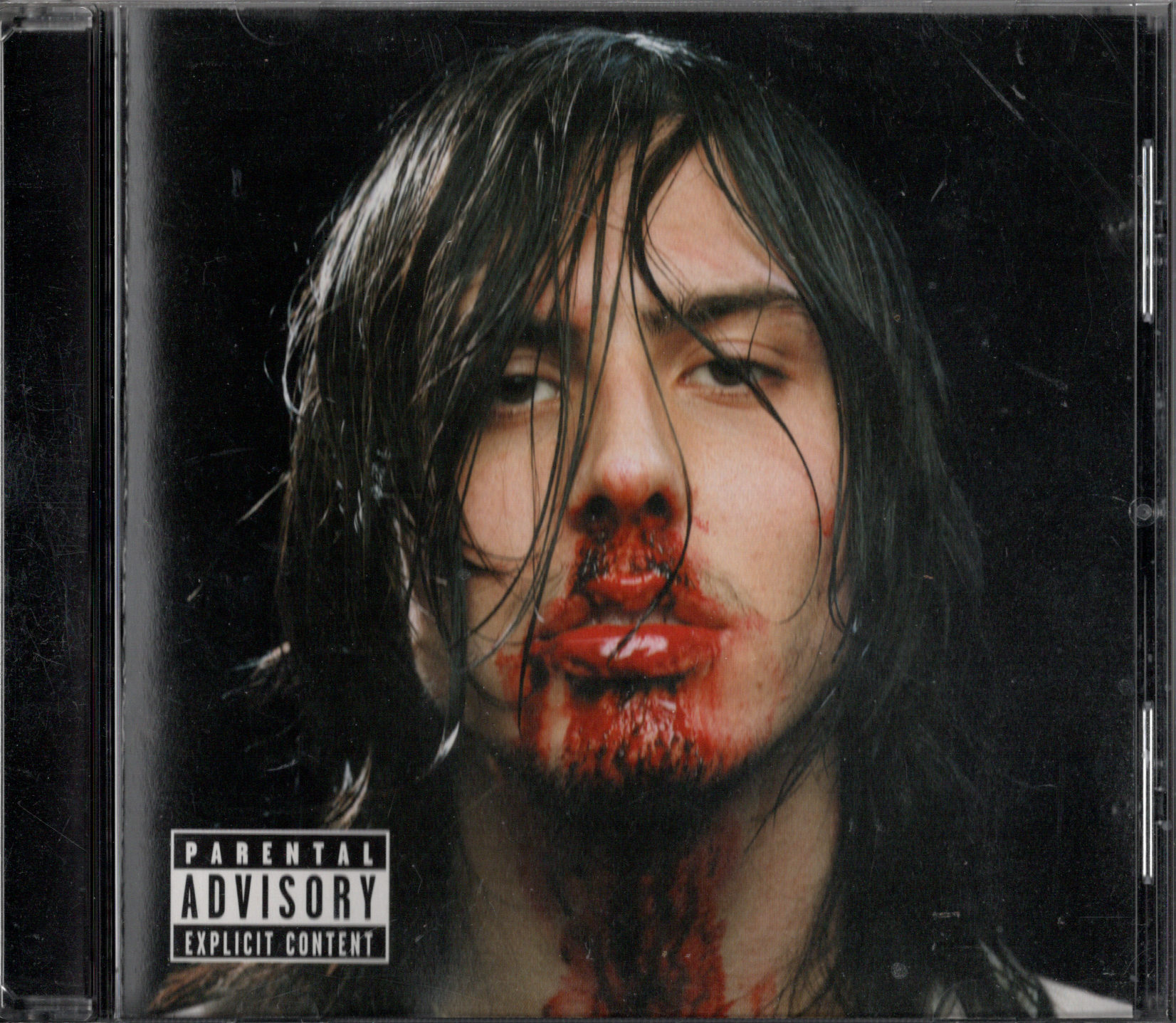
ANDREW W.K. – I Get Wet (2001 Universal)

The early 2000s…they were a weird time, man. Just look at the clothes!  One guy who didn’t look like the year 2001 was Andrew Wilkes-Krier.  With a dirty white T-shirt and equally dirty jeans, Andrew W.K. came at the dawn of a new millennium.  His music was both ultra-futuristically sterile, while also being a throwback to the guitars and keyboards of the 80s. It’s impossible to pigeonhole his music into one genre, possessing qualities of pop, metal, and punk. We do know two things about Andrew W.K.: He likes to party, and he likes to write songs about it.

Andrew’s debut album I Get Wet is hard to describe.  It’s loud and banging, while also feeling like the product of a computer.  Though there are deluxe editions and Japanese bonus tracks out there, the core album is just 12 songs and 35 minutes.  Maximum bang per minute.  There are no songs over four minutes, and two that are under two minutes.  The instrumentation is guitars, bass, drums, and “programming”.  It’s impossible to know how many guitars, as several are credited including Phil X.  It’s a thick sound.  There are no solos.  There is no musicianship.  The volume knob has been cranked right off.

Opening up with “It’s Time To Party”, there’s a simple fun riff to headbang to.  Andrew’s yelling/vocals is augmented by keyboards to add melody.  If it were just his bare voice, it would sound very different.  Vocals, keys and guitars are layered thick and drums are cranked up to maximum bang.  It’s in your face, and one of the strangest sounds in rock and roll.  But…so damn catchy.  Dumb and catchy.  Exactly the point.

“Party Hard” was a significant hit.  I remember watching Andrew W.K. on Saturday Night Live one night, and my girlfriend looked at me and said, “You like this stuff?”  I did, and I still hear what I liked.

‘Cause we will never listen to your rules (No),
We will never do as others do (No),
Know what we want and we get it from you,
Do what we like and we like what we do.

The message is simple:  Party hard.  It’s a loud sonic mush, with a monolithic melody and if you were going to call this a guilty pleasure, then I guess it’s a guilty pleasure.

A repeating piano line introduces “Girls Own Love”, which almost sounds like you were listening to a Van Hagar hit at maximum volume, with your head under water and you’ve already held your breath for half a minute.  The overall melody comes through, but everything else is just loud banging.  Even Andrew’s vocals are a mixture between melody and percussion.  Good song!

The video gamey keys that open “Ready To Die” are indicative of the simple melodic construction of the song ahead.  Of course, the monolith of guitars and keyboards and vocals pile on, but you can’t shake the feeling that this is metal Mario music.  It’s a good thing these songs are short, because they usually consist of one or two ideas, rinse and repeat.

The tempos remain on high for “Take It Off”.  The formulaic piano keys ding while we wait for Andrew to start yelling.  You can imagine a sea of morons bouncing up and down to this song in some weird 2001 setting.  You can even envision what they looked like.  Then, “I Like New York City” breaks formula by opening with Andrew’s multitracked vocals.  Basically just a pop song played on guitars.  It’s simple enough to be a children’s song.  You can hear, in different arrangements, how these songs could be themes for Japanese children’s cartoons.

One cool song is “She Is Beautiful”.  To hell with dynamics; this one hits the mark again with the right combination of melody vs. bludgeoning.  It satisfies, but is best experienced with head bobbing.  Then, the delightful “Party Til You Puke” re-grounds the lyrical message where it should be.  You’ll enjoy the chorus of “Party til you puke, party til you puke.”  Probably the hardest song on the album, but it’s a narrow range of choices.  Fortunately, “Fun Night” brings things down to a sane tempo and non-deafening volume.

“Got To Do It” emphasises pop side of things.  It’s weird to hear a song that had this kind of pop potential, but with Andrew W.K.’s growly singing on top.  Without trying to sound like a broken record, it was 2001 and anything goes.  Synth horns are a surprising choice for the title track “I Get Wet” but they’re soon drowned out by the mush of guitars and keys.  You can exchange this song for “Party Hard”, or several of the others, so similar are they.  Finally we end with “Don’t Stop Living in the Red” which starts off like a Journey tune before Andrew’s signature banging kicks in.

Listen, I won’t lie to you.  You’re not going to get any smarter listening to I Get Wet by Andrew W.K.  You might have to put on some Paganini or Dream Theater to make up for the brain cells you burned.  Still, you won’t find anyone that sounds quite like Andrew W.K.  It’s such a strange combination of sugary sweet melodies, and excessively loud and layered guitars and yells.  Sometimes, it’s just what the doctor ordered.  It won’t be an album you play every day (nor should you; consult your pharmacist) but it might just be that perfect drug on the day you need it.

3.25/5 stars


REVIEW: Mötley Crüe – “Beauty” (1997 promo single with “Audio Bio”)

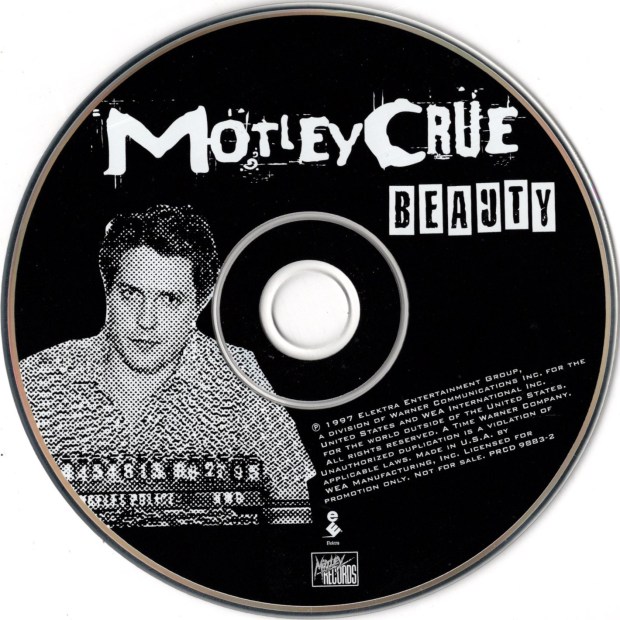
MÖTLEY CRÜE – “Beauty” (1997 Elektra promo single)

Generation Swine was a weird album, and “Beauty” was a weird single. Just the facts.

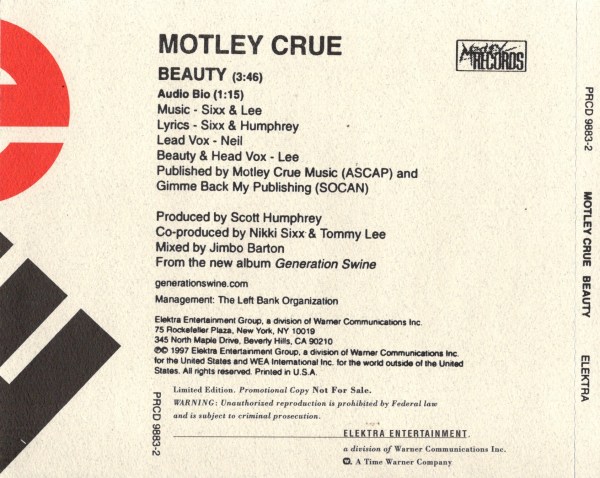
Swine was a “reunion” album with Vince Neil, yet there are several songs with other members singing lead. Not the usual thing to do for a reunion album with your original lead singer!  “Beauty” was one of the songs with multiple singers:  Tommy Lee is credited for “Beauty and Head vocals”.  Not only that, but Vince doesn’t sound like Vince, singing the verses in a low register.  It was definitely an odd choice as the second single, when fans were expecting a return to the 80s.  Not happening here!  Produced by Scott Humphrey, Generation Swine dipped its toes into techno, with “Beauty” being one track that sounds nothing like Motley Crue.

Promo singles are usually not worth buying.  They are strictly for collectors now who have to have everything.  This one, however, might be of wider interest.

Track 1 is just the album version of “Beauty”.  Vince sings the verses in that low voice, but the samples and drum loops are more disorienting.  They were going for a more urban groove here, with mixed results.  The lyrics, referencing prostitution, are apparently about Hugh Grant.  “She got me thrown in jail, my black beauty, she’s still up for sale.”  Motley Crue had the balls to put Hugh Grant’s mugshot on the CD, which makes it immediately interesting enough to be collectible.

Track 2 is perhaps more interesting.  This “Audio Bio” features some pretty crazy quotes.  From Rolling Stone:  “The perfect union of ZZ Top celebration, and Nine Inch Nails self-immolation!”  From Billboard:  “There’s no denying the chemistry between Vince Neil and bandmates Tommy Lee, Nikki Sixx and Mick Mars.”  What??  What chemistry?  Did you even listen to the album?  MTV calls the album impressive, and Guitar World simply said “fuck yeah!”  It’s really hilarious with hindsight.  It also exposes these magazines for the hacks they often are.  Not really listening, just writing what they’re told.

Give it a listen for yourself.

No point rating a promo out of five.  Score one in the wild if you can, for the Hugh Grant mugshot and the unintentionally hilarious bio.


REVIEW: Mötley Crüe – Swine Sampler (1997 promo)

MOTLEY CRUE – Swine Sampler (1997 Elektra promo EP)

Promo CDs are a funny thing.  Any promotional CD that you have ever seen or owned was free at some point in its life.  Since promos were intended to be play copies, or giveaways, selling them was highly frowned upon.  When I say “frowned upon” I mean illegal though not heavily enforced.  So it is funny that this 23 year old Motley Crue promo has “STOLEN FROM CKWR” (the very station that hosts Rob Daniels’ Visions In Sound), written on the disc in black marker.  I did my duty and reported it to CKWR just now, but weirdly enough they could care less!

The real crime here is the “clean” version of a Motley Crue song from Generation Swine, and it is an absolute hatchet job.  Unlistenable.

Why would you even bother with a “clean version” of “Find Myself”?  The very second line in the song is “I gotta find myself some BEEP”!  (The word was “drugs”!)  The first line of the chorus is “I’m a sick mother BEEP er!”  Utterly ridiculous.  You’d think someone would have played it once and said “this is unreleasable”.  I counted seven beeps in under three minutes.

If you prefer, the “dirty” version of “Find Myself” is on the CD too.  Why was the record company Elektra pushing that song so hard?  It’s a weird punky track with Nikki Sixx on vocals for the verses, with the returning Vince Neil handling the choruses.  Not the kind of thing you’d really think to push at fans all excited about Vince coming back, right?  But here it is, twice.  Though the chorus is good, I’m not going out on a limb by calling this song “shitty”.  Or BEEP-y!

Much, much, much better are the album tracks “Let Us Prey” and “Shout at the Devil ’97”.   First, “Let Us Prey”.  This is the only track that sounds like a progression from the ’94 self-titled album with John Corabi.  Crabby even has a writing credit on it, and who knows, maybe that’s him screaming “Let us hunt!”  Tommy Lee did that, according to Tommy Lee, but I think it sounds like John.  It was certainly written for John to sing.  “Shout ’97” is a cool remake of a song that didn’t need remaking, but it was 1997 so what’re ya gonna do?  Added samples and a dance-y beat made it pretty irresistible.  Mick Mars threw down some cool new licks here, although the droning guitars are very dated.  Still, passing grade for “Shout ’97”.

Even though this CD has two good tunes out of four tracks, the “clean” one is such an atrocity that this gets:

0/5 stars

and the dreaded Flaming Turd.


#611: Afraid

GETTING MORE TALE #611: Afraid

1989: A clean and sober Motley Crue take over the world. Dr. Feelgood climbs to #1 and the band rivals Bon Jovi and Def Leppard in the popularity stakes.

1990: Motley continue to tour and rock them all, while announcing their next album will be a “greatest hits”.

1991: Decade of Decadence is released, keeping Motley on the charts. The new single “Primal Scream” is well received.

1992: In a shock announcement, Vince Neil is fired from the band. Unfortunately Motley are not the only rock band to lose their singer at the beginning of the 90s.

1993:  Vince Neil’s solo debut Exposed is greeted by warm reviews.  Motley continue to toil in the studio with new singer John Corabi.

1994: Five years after Dr. Feelgood, the re-imagined Motley finally return with the self-titled Motley Crue.  Corabi blows ’em away, but the album fails to sell. Motley is forced to do a scaled down tour while the CD dropped off the charts.

This was the state of the Crue in the mid 90s.  They had released an incredible album.  Today, many fans rate it in the top three, or even at the #1 spot.   My near-legendary Record Store cohort T-Rev agrees.  “To me, they sounded more like a hard rock band than a hair metal band, because of that album.”

Absolutely true.  They stepped far beyond the preconceived notions of Motley Crue.  Guitars were detuned, lyrics were topical or personal.  Tracks like “Smoke the Sky” might have passed for Soundgarden.  On the other side of the coin, “Misunderstood” was an epic power ballad featuring an orchestra and Glenn fucking Hughes.  There wasn’t a weak track in the bunch, but plenty of variety.

Most fans didn’t embrace it at the time, and instead moved on to current bands.  Back then, nobody was interested.  No Vince, no Motley?  No way.  Corabi was absolutely the right guy at the right time.  Motley added his rhythm guitars and songwriting abilities, not to mention far more aggressive singing.  The band had only gotten better.  But by recording an uncompromising album with an unknown singer, they were indeed taking a chance.  It didn’t pay off.  When I was working at the Record Store, there was a giant pile of unsold Motley Crue CDs taking up space.  They sat next to an equally tall pile of David Lee Roth’s Your Filthy Little Mouth.  All the kings seemed to have been usurped.

At the Record Store, I first befriended the aforementioned T-Rev.  The fact that both of us loved the Motley album didn’t hurt.  T-Rev was the only person I knew who appreciated what they did.  He loved that huge overproduced drum sound.  Back in 1989, everybody had a Motley Crue T-shirt in the highschool halls.  In 1994, we couldn’t get anyone to listen.

Through 1995 and 1996, magazines reported that Motley were back in the studio, working on a followup with Corabi.  Bob Rock was back in the producer’s chair and the band wrote new songs such as “Personality #9”, “Let Us Prey”, “La Dolce Vita” and “The Year I Lived In A Day”.  Things seemed to be going well, but record company pressure was intense.  Bob Rock’s style was now passé and he was fired.  Engineer Scott Humphrey was promoted to producer, and electronics began to dominate.

The pressure was not only on Motley Crue, but focused directly on John Corabi.  Elektra records were eager to get Vince Neil back, a true “star”.  John was getting frustrated in the studio while this was going on.  Nothing he sang seemed to be good enough for Motley Crue anymore.  He was asked to sing like Oasis or the Sisters of Mercy.  John suggested that he just play rhythm guitar while they get Vince Neil to sing.  Somehow, this made its way into the rumour mill.  Before John Corabi was eventually fired, T-Rev and I had heard that Motley were considering this very same five-piece lineup.  What a glorious sounding thing that could have been.

Ultimately the band fired John and got Vince back.  They attempted to piece together the album that they’d been recording and re-recording and re-re-recording again.  Mick Mars was frustrated as well, as his guitar parts kept getting rejected and remixed.  In particular, Mars did not function well with Scott Humphrey.

Personally speaking, I lay these problems at the hands of Scott Humphrey.  I read the book The Dirt, and that’s certainly where the band lay most of the blame.  Have a look at Humphrey’s credits though.  Lots of records loaded with electronics, like Rob Zombie’s Hellbilly Deluxe and Tommy Lee’s solo stuff.  Humphrey started out as a keyboard player and programmer, and I think that high-tech style does not work with Motley Crue.  That’s my personal opinion, never having met Scott Humphrey.  I did, however, have a customer at the Record Store who knew Scott Humphrey, who is actually from Kitchener Ontario.*  “Motley Crue were the problem,” he told me.  “They were messed up on drugs.”  They were also unfocused musically.

On January 27 1997, the reunited original Motley Crue performed on the American Music Awards.  Mere months after being teased by a similar Van Halen reunion on the MTV Awards, I was relieved that Motley were playing a song rather than just standing there.  But what the hell song was it?!  Some strange, techno-y version of “Shout at the Devil”?  It was strange, unexpected and underwhelming.  Hey, cool, it was a fresh spin on an old classic.  But…why?

We soon found out.  The album Generation Swine came out on June 24 1997.  As usual, T-Rev and I got it a few days in advance.  “It sucks!” he warned me.  Of the first single “Afraid”, he said “It sounds more like Def Leppard than Motley Crue.”

“Afraid” is the best song on the album, which does frankly suck.  In a single stroke Motley went from one of their best albums, to one of their very worst.  It was astounding how desperate they sounded, trying to incorporate these influences that have nothing to do with Motley Crue.  The loops and samples and effects ruined many of the songs, but some just weren’t that good to begin with.  This considered, it was an even bigger surprise that Nikki Sixx and Tommy Lee were singing lead vocals too.  Sixx’s silly opener “Find Myself” was a nauseating faux-punk novelty song.  Generation Swine was also unfocused in the extreme, and the muddying effects didn’t help.  The electronic treatments on the drums rendered them limp, compared to the massive sound of 94’s Motley Crue.    Absolutely everything on Generation Swine was inferior to Motley Crue.

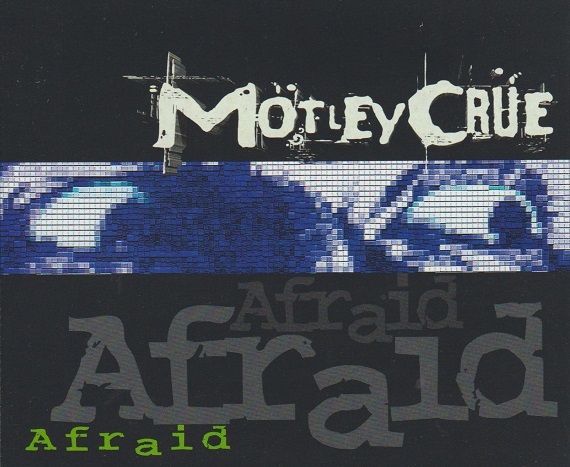
Three CD singles were released for “Afraid”, which was remixed so many times trying to get it right, that they used some of the various versions as bonus tracks.  The album version is fine enough, and in this one instance, the electronics enhance the song.  I’d rather hear “Afraid” with the effects than without.

What did other fans think?  When Generation Swine was new, one of my customers wanted to hear it before buying.  “I saw that Vince Neil is back.  Have you heard it?” he asked me, and I told him the truth.  He was sceptical of my review, but changed his mind upon hearing it.  “It doesn’t sound like them,” he said, and he’s right.  I then cajoled him into listening to the 1994 album.  He didn’t want to, because it didn’t have Vince Neil, but agreed to give it a shot.

Guess which album he bought?  Motley ’94.

At least there’s some redemption, if only temporarily.  During the Christmas season of 1998, T-Rev once again called me up to tell me about Motley Crue.  There was a new compilation out, called Greate$t Hit$ [review coming tomorrow].   This time, there were two new songs:  “Enslaved” and “Bitter Pill”.  Both were produced by Bob Rock.

“The new songs aren’t bad,” said T-Rev.  “A lot better than Generation Swine.  Not as good as ‘Primal Scream'”

Right again, T-Rev.  Not bad.  An improvement, but not as good as what they did the first time out.  That was enough for me to buy the CD.  Not for Trevor, though.

I think Motley Crue were on the right track with “Enslaved” and “Bitter Pill” after the failure of Generation Swine.  They obviously knew that album didn’t work, so they went back to the last thing that did.  Both songs are growers, and still raise a smile to hear.  Unfortunately Motley Crue blew it again.  Tommy Lee and Vince Neil had a dust-up at an airport, and Lee split.  He was replaced by former Ozzy Osbourne drummer, Randy Castillo.**

Fans like T-Rev and myself always supported the 1994 album, and today we’ve been justified.  More and more fans have realised the quality of that CD, and increasingly hold it in high esteem.  There’s something about that CD, and I’m afraid that Motley Crue never came close to touching it since.

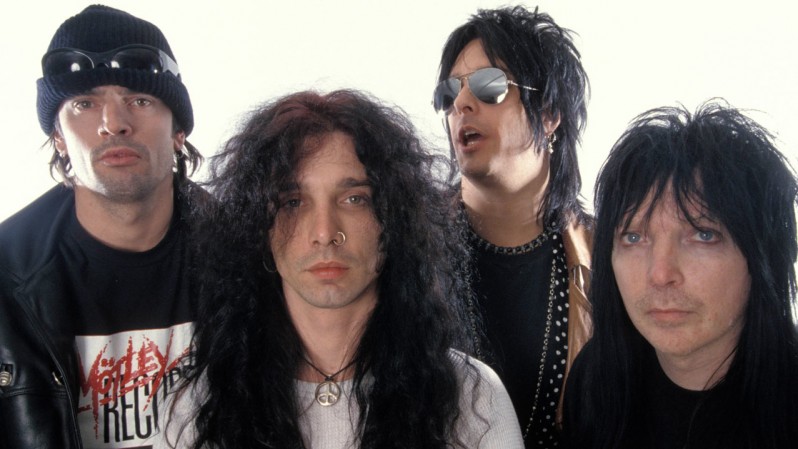
Tommy Lee, John Corabi, Nikki Sixx & Mick Mars

* Fun fact! T-Rev’s mom dated Scott Humphrey!

** In a very sad turn of events, Castillo never got to tour with Motley Crue.  He became ill and died of cancer on March 26, 2002 at age 51.  His replacement, Hole’s Samantha Maloney, did the tour and resultant live video.

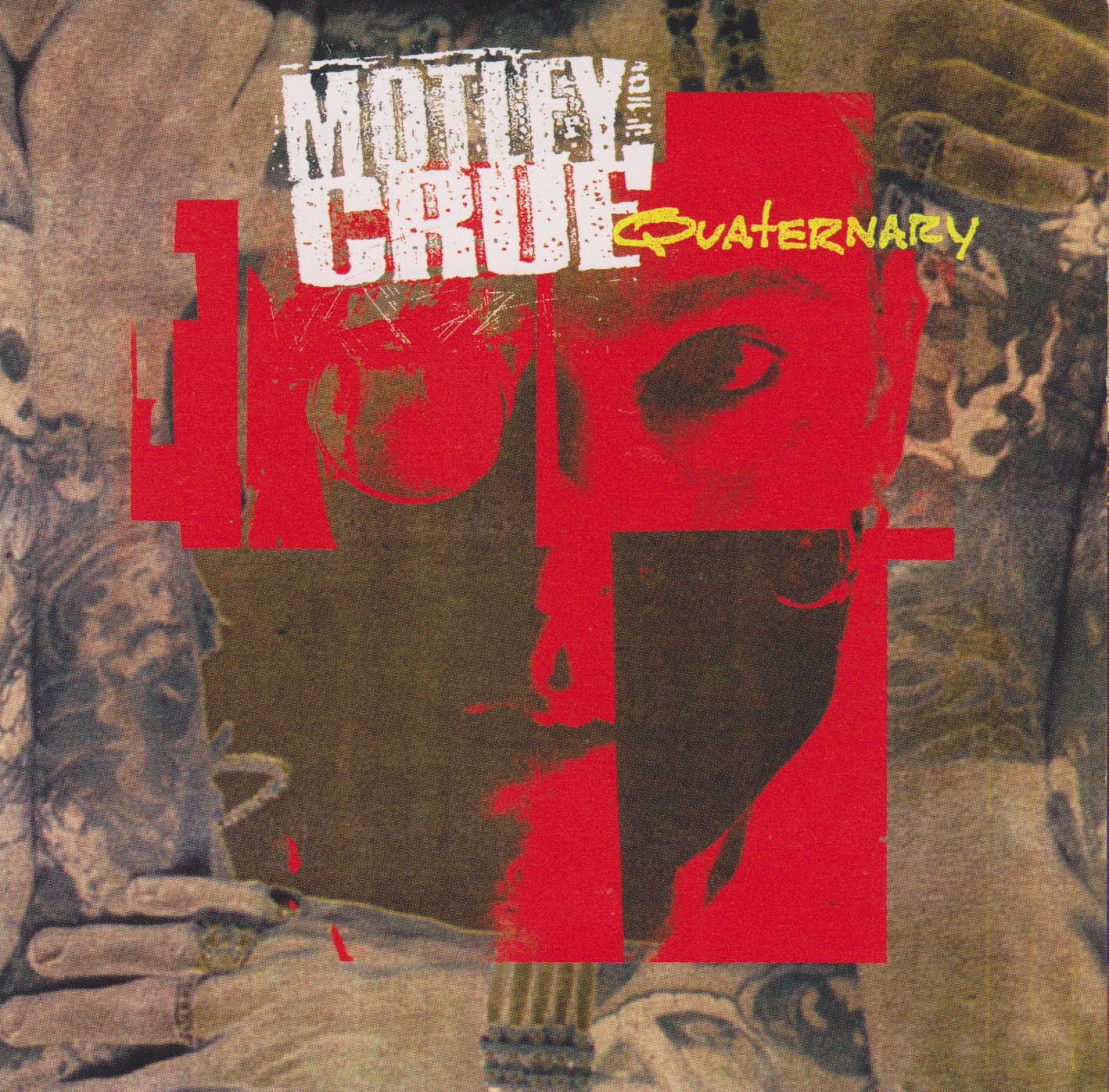
REVIEW: Motley Crue – Quaternary (1994 Japanese EP)

MOTLEY CRUE – Quaternary (1994 Elektra Japanese EP)

For me, undoubtedly the most heavily anticipated new album of 1994 was the new Motley Crue.  Originally titled ‘Til Death Do Us Part, the self-titled ’94 Crue disc was their first with new singer/guitarist John Corabi.  They holed up with producer Bob Rock and knuckled down, creating what could have been the most important album of their careers.  The long wait (five years between studio albums) and cryptic remarks from the studio indicated that this would be the heaviest Motley album ever, and their most ambitious.  The new, serious Motley for the 90’s had, as always, written plenty of extra material too.

In addition, producer Bob Rock had an idea for getting creative juices flowing.  He asked each of the four members of Motley Crue to write and record a solo track with no input from the other members.  This was slightly historic:  the first time Nikki Sixx, Mick Mars, Tommy Lee or John Corabi had done anything solo.  With all the numerous outtakes recorded for the Motley Crue LP, there was now plenty of extra material to put out as a bonus EP.

Scan_20160612A mail-away coupon inside the Motley Crue CD alerted fans that five more tracks were available by mail order only.  20,000 copies of the original EP were pressed.  They included all four solo tracks and a new Motley Crue song called “Babykills”, featuring fifth Beatle Billy Preston on clavinet!

Still, the lucky fans in Japan didn’t have to mail away for anything.  They were able to buy Quaternary right on their store shelves, and because it’s Japan, they also got bonus tracks.  The Japanese version of Quaternary was not a five song EP, but more like a nine-song mini-album.  I had no idea such a thing existed until finding one at Sam the Record Man in Toronto in the summer of 1996.   It still has the price tag:  I paid $49.99, for a total of three songs that I did not have before.

Today, every one of these songs can be found on the box set Music to Crash Your Car To: Volume II, along with even more bonus mixes.

Quaternary commences with industrial noises and studio dialogue:

Tommy Lee:  “I can’t play with fuckin’ clothes on man, this is bullshit.”
Bob Rock: “Play naked.”
Tommy Lee: “Fuckin’ jeans on, a fuckin’ shirt…what up with that?”
Bob Rock: “What, do you work in a bank?”

The industro-rap metal of Tommy Lee’s “Planet Boom” is a track he had been working on for years. An early version made its debut in the background on the 1992 home video release Decade of Decadence. Even though the words “industro-rap” and “Tommy Lee” don’t really sound good together, “Planet Boom” kicks ass. Tommy played all the instruments, utilising a simple, detuned Sabbathy riff and a relentless drum loop. The strength of his vocal came as a surprise, as did the song in general. A few years later it was remixed for Pamela Anderson’s movie Barb Wire. (Stick with this original.)

After a brief studio discussion with Mick Mars about hemorrhoids (?), his blues instrumental “Bittersuite” blows your ears off. Motley fans know that Mick Mars is the most musically talented member, considered an underrated and under appreciated rock god. The blues-rock of “Bittersuite” isn’t as satisfying as I imagine a pure blues offering to be, but there is no doubting Mick’s talent here. Both as a writer and a player, Mick hit it out of the park (Chris Taylor played drums). Mick’s goal was to pay tribute to rock-blues greats like Beck, Hendrix and Blackmore. Mission accomplished. His guitar tone is beautiful and so are his emotive licks.

Nikki Sixx goes third, with another industrial-metal cross. “Father” is one angry fucked up track. It’s heavy and direct, on-trend for 1994, and very abrasive. The riff and song are simple, but Nikki’s anger leaks through. “Father — where were you?” Backwards guitars, electronics and loops on top — you can tell Nikki and Tommy were listening to the same kinds of music at the time!

New kid John Corabi goes last, and in the liner notes he says that “Friends” is his first piano song. He meant to go acoustic, but “Friends” just came out of him. It’s a pretty Queen-like ballad with lovely harmonies in the middle. Although Mick Mars’ song is probably a greater technical achievement, “Friends” is my favourite of the solo tracks. When a guy like Corabi gets going on a ballad, it’s usually going to be amazing anyway. Throw in the Queen elements, and I’m just a sucker for it! It’s really a shame that Motley did not continue with John beyond this. The potential for greatness was always there.

After more studio chatter, we break into “Babykills”, the Billy Preston collaboration. “Babykills” is fun and funky hard rock, probably the heaviest thing Preston ever played on. Unfortunately his part is little more than an added topping. Great tune though; probably far too good to lie hidden away on an obscure mail-order EP.

An impromptu jam that seems to be called “I Just Wanna Fuck You (In the Ass)” ends the original EP on a jokey note.  “What the fuck do you want, for fuck all?”

Scan_20160612 (3)

As mentioned, the Japanese had bonus tracks.   These are tracks that did not make the finished Motley Crue album, since they had recorded so much extra material.  “10,000 Miles Away” is a cool blues ballad, showing off more of Mick’s fine fingerwork.  It was obviously too much of a standard sounding song to fit in with the experimental Motley Crue album.  Not that the album stood a chance in hell after grunge cleared the decks, but you do wonder if it would have been better received if some of these more digestible songs were included on it.

The one track on the Japanese release that is easy to skip is the Skinny Puppy remix of “Hooligan’s Holiday”.  This track was already available on the “Hooligan’s Holiday” single and it’s since been re-released in other places too.  It’s long — over 11 minutes.  Dave “Rave” Ogilvie remixed it with Dwayne Goettel and cEvin Key, so it is of possible interest to Skinny Puppy collectors.  The thing that bugs me about it is that it strikes me as lazy.  The song is pretty much the same as always for the first three minutes, and then the remixing begins.  The whacked out and frankly boring remixed part goes on for almost seven more minutes, before transitioning back to the standard song.  In other words, what Skinny Puppy did here was edit out the middle section and guitar solo of the song, drop in seven minutes of remixed barf, and then put the ending back on.

Two demos round out the CD:  “Hammered” (which did make the album) and “Livin’ in the No” (which did not).  The “Hammered” demo is structurally the same as the album version, no radical departures.  It sounds like much of it is live in the studio, and it’s clear that Motley were focusing on grooves.  It’s all about the four guys being locked in.  Finally “Livin’ in the No” is in the standard hard rock mold.  Again, a track like this fits in less well with the unorthodox LP, but might have made it more accessible for fans.  Even so, a guy like Vince Neil would never have been able to sing “Livin’ in the No” and make it sound good.

There is little question that the Motley Crue album deserves its 5/5 star rating.  This being a collection of outtakes, the same cannot be expected.  Still, it does deserve a very respectable:

4/5 stars

Get the complete EP including all Japanese bonus tracks on Music to Crash Your Car To: Volume II. That set also contains more remixes originally from single B-sides of the era: “Misunderstood” (Guitar Solo/Scream Version), “Hooligan’s Holiday” (Derelict Version), “Misunderstood” (Successful Format Version), “Hooligan’s Holiday” (Brown Nose Edit).

Scan_20160612 (5)

REVIEW: The Cult – The Cult (1994)

First of a CULT double shot!  Come back tomorrow for another!

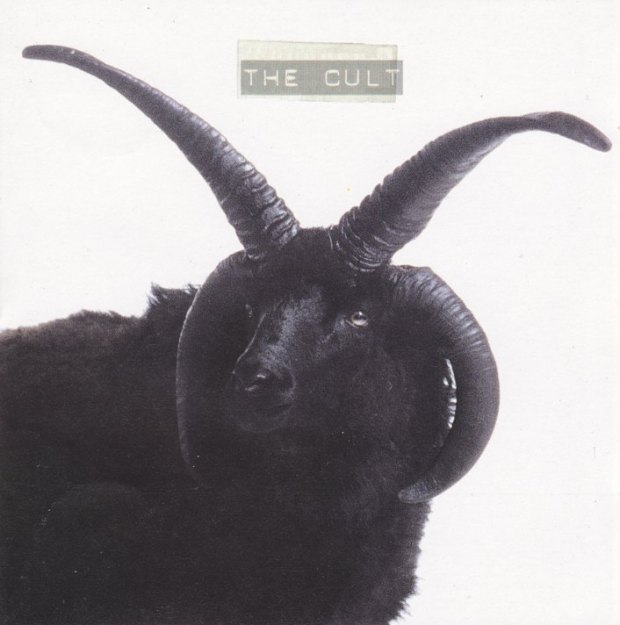
CULT_0002THE CULT – The Cult (1994 Universal)

This is an ugly album.  Even though a 1989 MuchMusic interview with Billy Duffy revealed The Cult would most likely not work with Bob Rock again, they did indeed re-team with the Canadian producer on 1994’s The Cult.  Duffy didn’t think the magic of Sonic Temple was something that could be repeated, based on the less than satisfactory (to him) results of working with producer Steve Brown twice.  On The Cult, however, no attempt was made in any way to recapture any sound or era.  This was brand new from the womb of 1994, and sounds very dated to that dark time.

The twisted “Gone”, unorthodox and sparse, was a shock to the system.  Once the listener gets his or her bearings, it’s actually a great fucking song.  Just a little off-kilter; enough to sound as if it’s not being played right.  It’s a whole new side to The Cult.  I wonder how much of this has to do with the new lineup, including bassist Craig Adams (The Sisters of Mercy/The Mission) and drummer Scott Garrett (Dag Nasty).  Ian Astbury’s delivery was also quite different.  Rather than simply howling those patented Astbury melodies, Ian barks, whispers and bellows.

“Coming Down (Drug Tongue)” was the first single, very different from the hits from the past two or three albums.  It had a droning, U2-ish vibe.  It’s quite a good song, but it wasn’t love at first listen.  “Real Grrrl” has a slower sway to it, and there is a lot to like about the song.  It’s interesting to hear Bob Rock using open space a lot more in his production; this is right after the supersaturated Motley Crue album.  Much of the instrumentation is very dry, but then there are Bob Rock trademarks, such as the Scott Humphrey synth on “Real Grrrl.”

Sounding much like a Superunknown (the softer side thereof) outtake, “Black Sun” is dark and quiet.  Ian sings of abuse.  The band back him with the barest of instrumentation, before the Billy Duffy solo around 3:20.  It is impossible to ignore the similarities to all the grunge bands of the time.  The basic, stripped down guitar parts and rhythm-driven arrangements speak of the time.

CULT_0003

There are few standouts on The Cult.  The album is more cerebral than past Cult albums, and is more about its overall direction than individual songs.  The aforementioned tracks are all great, as are a few others.  They include “Star” (also a single) which is a song that was re-worked many times going back to Sonic Temple.  Previously, it had been known as “Tom Petty” and “Star Child”, and can be found in both forms on the expansive Rare Cult box set.  It is one of the few songs that slightly resemble “old Cult”.  “Be Free” was a single (in Canada at least) given away with a case of beer.  How Canadian, eh?  (I sold mine on eBay for $10).  It too is a pretty good song.  Then there’s “Sacred Life”, a somber ballad naming Abbie Hoffman, River Phoenix and Kurt Cobain as painful losses to the world.  Album closer “Saints Are Down” is a powerful epic, and also a standout.

The Cult broke up/went on hiatus after this album.  They reunited in 1999 (with Matt Sorum on drums) and released a new song called “Painted on the Sun” written by Diane Warren (!!) from the Gone in 60 Seconds soundtrack.  This was followed by the excellent Beyond Good and Evil CD, also produced by Bob Rock.  This self-titled departure remained just that, as The Cult went full-bore metal on Beyond Good and Evil.  This album is an experiment that went unrepeated, and that is fine.  I like it for what it is, but I don’t need another.

3/5 stars

DVD REVIEW: The Devil’s Rejects (2005)

Welcome back to the Week of Rockin’ Movies.  Each movie we take a look at this week will have a significant connection to rock music.  If you missed Monday’s installment, click below.

MONDAY:  House of 1000 Corpses (2003)

THE DEVIL’S REJECTS (2005 Lionsgate)

Directed by Rob Zombie

As stated yesterday, I’m generally not a horror movie guy.  I grew up on all the classics (good or bad) in the 80’s, but I thought I just outgrew the genre. Then I saw Rob Zombie’s House Of 1000 Corpses, and its sequel The Devil’s Rejects.

Picking up several months after the end of Corpses, the cops are closing in on the murderous Firefly family. The house is surrounded, and a surprisingly cool gun battle ensues.  It is only the first of many surprises in this cool conclusion. It may be a sequel, but its stark realistic texture is completely different from the bizarre original film. Set mostly outdoors in the deep south, the titular Rejects are soon on the run. But not all of them.

Mama Firefly (recast from Karen Black to Leslie Easterbrook) has been arrested.  Rufus is dead, and the giant Tiny has escaped. Hitting the road, Baby & Otis meet up with Captain Spaulding, who is revealed to be Baby’s daddy!  The three are on the run from a cop out to even a personal score. Like something out of a Sergio Leone film, music and scenery complement each other to take you on a trip that will shock and disgust.  There are no heroes, only victims and killers.  This is not for everyone.

There are buckets full of blood, lots of parts removed from the body to which they were originally attached, and lots of deeds beyond evil. I must stress again: This is not for everyone. The images contained herein will disturb. You may question why they even need to exist.  I suppose Rob Zombie would be the guy to ask, I don’t know.  All I know is, sometimes I can go for a good horror movie, and The Devil’s Rejects scratches the itch.

Much like the original, there is humour to break up the carnage.  Cranked up a tad, Captain Spaulding portrayed by Sid Haig always has a foul line to elicit a reluctant chuckle.   I enjoyed that, but I also enjoyed the sudden change of gears that is the epic ending.  Going out in a blaze of glory, I will never hear Lynyrd Skynyrd’s “Free Bird” again without seeing the three faces of the Devil’s Rejects.

As seen here, I own this movie with House of 1000 Corpses in a great DVD 3-pack.  The disc has plenty of special features on its own, including a tribute to the late actor Matthew McGrory (Tiny).  Also look for a cool deleted scene with Rosario Dawson and Dr. Satan that ties the two films together.  Included on the bonus third disc is a feature called 30 Days in Hell, which is the making of The Devil’s Rejects.  I enjoyed seeing Zombie work on the finer details; for example finding a specific T-shirt (Cheap Trick) for Brian Posehn’s roadie character.

4/5 stars, and 1 blood-splattered face.

Sid Haig as Johnny Lee Johns
Bill Moseley as Otis Driftwood
Sheri Moon Zombie as Vera-Ellen Firefly
William Forsythe as Sheriff John Quincey Wydell
Ken Foree as Charlie Altamont
Matthew McGrory as Tiny Firefly
Leslie Easterbrook as Gloria Firefly
Danny Trejo as Rondo
Diamond Dallas Page as Billy Ray Snapper
Brian Posehn as Jimmy
Tom Towles as George Wydell
Tyler Mane as Rufus “RJ” Firefly Jr

DVD REVIEW: House of 1000 Corpses (2003)

Hey! Welcome to another week-long series at mikeladano.com!  This time, the theme is Rockin’ Movies.  Each movie we take a look at this week will have a significant connection to rock music.  Enjoy!

HOUSE OF 1000 CORPSES (2003 Universal)

Directed by Rob Zombie

I’m generally not a horror movie guy, although I grew up on all the cheesy classics in the 1980’s. I thought I just outgrew the genre. Then my buddy Thuss implored me to see Rob Zombie’s House Of 1,000 Corpses.

Anchored by Zombie’s uncommon visual stylings and eclectic tastes, this House is rocking, don’t bother knocking. The setup:  An ill-fated foursome of young men and ladies are travelling cross country. They stop for gas and chicken at Captain Spaulding’s “Museum of Monsters & Madmen” (as played by the near-legendary Sid Haig). Spaulding is the best character written by Rob Zombie, both hilariously funny and mildly disturbing at the same time. Well, he’s a creepy clown. If you have a clown phobia, Spaulding’s the creepiest I’ve ever seen, but I can’t help but laugh every time he opens his sizable mouth.

Spaulding tips the kids (Rainn Wilson is the only “name” here) off to the creepy legend of “Dr. Satan”.  They then decide it’s a good idea to go hunting for Dr. Satan’s hanging tree in the middle of the night. In the rain. It is then that they meet the beautifully disordered Baby Firefly (Sherri Moon Zombie)…and get a flat tire. Things only go downhill for the young ones from there, as I’m sure you can imagine. Baby invites our young travelers to her family’s farm, where her brother can surely fix their flat tire.

Special mention must go to out to Bill Mosely who is terrifyingly unstable as the most amoral member of the Firefly family, Otis B. Driftwood. He only gets more interesting as a character in the sequel, The Devil’s Rejects…but that is another review.

Some horror purists can’t get into Zombie’s style. Indeed, he has a unique vision as any fan of his will know. If you like oddly proportioned monsters and robots, just go see him in concert. Zombie also likes to populate his films with 70’s southern stereotypes. Indeed, one would argue that the movie has no actual characters, just character types. That’s the kind of horror movie that I remember growing up with, and I believe his films pay homage to that very well. He also had a practical reason for setting his movies in the 1970’s.  No cellphones.  No-one to call for help.  No GPS. No way to call AAA and get a tire changed.  Isolation.

House of 1,000 Corpses is a visually disturbing film, and that’s one reason I can’t stop watching it. Other horror films are simply cheese-fests. Not this one. There are gallons of blood, body parts, and a couple monsters too, but all presented in a surreal nightmare setting that might have you avoiding country roads at night. Zombie went in a completely different direction in the next movie, so House of 1000 Corpses remains the “weird” chapter in this series.

Will there be justice on the Fireflys? Tune in tomorrow for my review of The Devil’s Rejects.

4/5 stars and 2 severed hands.

Sid Haig as Captain Spaulding
Bill Moseley as Otis B. Driftwood
Sheri Moon Zombie as Baby Firefly
Karen Black as Mother Firefly
Rainn Wilson as Bill Hudley
Tom Towles as Lieutenant George Wydell
Matthew McGrory as Tiny Firefly
Robert Mukes as Rufus “RJ” Firefly Jr
Dennis Fimple as Grampa Hugo Firefly

REVIEW: Triumph – The Sport of Kings (1986)

Part one of a two-part series.

TRIUMPH – The Sport of Kings (1986, remastered 2003, TML Entertainment)

And the award for Worst Album Cover of 1986 goes to…Triumph!

Seriously, can anybody tell me what the hell this is supposed to be? Methinks the band just didn’t care anymore, and the music contained herein bears me out.

The Sport Of Kings, following the double live Stageswas a total about-face for Triumph. Starting off with a turgid sequencer riff, the album shifts immediately into “coast” on “Tears In The Rain”. Keyboards, bad sounding drum samples, coupled with a sappy almost guitarless song, and that is the opening track! (I hereby trademark the word “guitarless” as my own creation.)  Post-split, Gil Moore and Mike Levine were pretty adamant in their blaming up Rik Emmett for the change in direction.  Certainly, the early part of Rik’s solo career backs up that claim.

I’ll admit to being into “Somebody’s Out There” at the time, but it is hard to listen to now in the car with the windows down.  Wouldn’t want anybody to see me.  (The remixed version from the recent Greatest Hits Remixed CD is better.)   This song is just pure pop, way further into that direction than anything Bon Jovi was doing at that time.  But not in a good way.

The sad thing is, I really used to dig this album to the point that I wore out my original cassette. Now, on CD, I once every few years.  I’ll claim that I didn’t know better at the time. When I owned this the first time, I’d never heard a single Led Zeppelin studio recording; not one. I had never heard of “Smoke On The Water”, and I’d never heard a Rush album. Perspective changes even if the songs remain the same. The problem is that Sport Of Kings is too pop:  not enough guitar, not enough rock, not enough Triumph, too many keyboards! Hell there are three keyboard players on this album (one being Kitchener’s own Scott Humphrey).

I’m trying to pick out some non-embarrassing highlights. I kind of like “If Only” for the lyrics and chorus.  “Play With the Fire” is Triumph trying to be progressive again, but the song isn’t any good.  I like “Take A Stand”, and I’ll admit to still enjoying “Just One Night” (an old Eric Martin demo, co-written by Martin and Neal Schon). I only wish the video remix was on an album of some kind. The superior original remixed version used in the music video has never been released on any music format that I own.  I’ll have to use Audacity to rip it from a DVD.

This is not the remixed video, unfortunately — they’ve replaced the remix with the album version

I used to enjoy “Don’t Love Anybody Else But Me”, and I think the melody is still OK, but man, those lyrics. Gradeschool stuff. Of course, I was in gradeschool at the time!  To me in 1986, these lyrics were probably pretty profound.  There’s nothing wrong with admitting that your tastes have changed and some music you just don’t dig anymore. In this particular case, the tastes of the entire world have changed. Richard Marx does not make top-ten albums anymore. This album lacks spark of any kind, it’s just a keyboard-ridden embarrassment. If you played anything on this album side by side with “Blinding Light Show” or “It Takes Time”, you’d never guess it was the same three guys.

But it is, and they had only one more “contractual obligation” record left in them after this. The end was nigh.

1.5/5 stars

Come back in a few days, and we will be discussing that very contractual obligation record!

Gallery: MOTLEY CRUE – Generation Swine (1997 Japanese CD)

A short while ago, Jon and I were discussing the Motley Crue “reunion” album, Generation Swine (review here).  I told him that I was still looking for the original Japanese edition, which had a bonus track called “Song To Slit Your Wrist By”.   Even though I already knew the song from Nikki’s side project, 58, and didn’t like it, I still wanted Motley Crue’s version for my collection.  I found one on eBay for just over $30 which is the best price I’d ever seen.  I bought it, it shipped.

Then Jon told me:  “The bonus track ‘A Song To Slit Your Wrist By’ wasn’t a Crüe song at all, it was taken from Nikki Sixx’ very underrated sideproject 58.”

Rats!

See, for me as a collector, that sucks for two reasons.  If the song is by 58 and not Motley (and he’s exactly right, that’s indeed what it is), then it gets pushed way out into a far orbit of my collecting priorities.  Second, I already had the damn thing a long time ago on the 58 album Diet For A New America!

I knew it wasn’t a pristine copy and the packaging had yellowed, so no big deal.  The plastic outer case has also got a bit brittle and a piece cracked off in shipping.  Again, no big deal, last time I saw this CD it was a lot more expensive, and didn’t have the obi strip.  It comes with a really cool generous booklet (in Japanese unfortunately), exclusive to this release, so that helps to make up for the lack of an exclusive bonus track.

Gallery below.  Enjoy!