RSTs Mk II: Getting More Tale

#803: The Grocery Gang

A sequel to Get a Haircut and Get a Real Job

GETTING MORE TALE #803: The Grocery Gang

I started working at the grocery store in fall 1989.  While it was nice finally having a real job, it was immediately disruptive to my life.  I worked every Thursday, which meant that I was missing at least one Pepsi Power Hour every week.  If I pulled a Tuesday shift too, no Power Hours at all!  I had barely missed an episode in four years.  Now I was missing more than half of them.

That was a monumental shift.  I prided myself in keeping my fingers on the pulse of hard rock and heavy metal.  Keeping up with school work wasn’t hard.  Keeping up with music was!  I felt so out of touch with whatever the latest singles and new releases were.  The Power Hour was my main metal lifeline!

When a door closes, another opens.

I might have been missing the Power Hours* but like a see-saw, music swung back into balance.  Every work place introduces you to new people and new music.  The grocery store was like that as well, but those guys liked heavier music than I had been listening to at home.  Specifically I remember Metallica, Black Sabbath and Led Zeppelin.  Those guys were not interested in Bon Jovi or Motley Crue, two groups I was really hot for in 1989.

There were three places I could be assigned to work at the grocery store:  Packing, parcel pickup, or cart collection.  That was the order of prestige involved.  Cart collection was considered the best assignment because you’d be out in the parking lot with a buddy collecting carts with no supervision.  It was a big parking lot so you could get lost and buy a soda at the convenience store for a minute or two on a regular day.  Parcel pickup was also cool because they had a tape deck down there you could listen to.  It was on that tape deck I heard a lot of my early Sabbath, Zeppelin and Metallica.  I wasn’t sure about Zeppelin yet.  They were telling me about this song “Moby Dick” that was a 10 minute long drum solo.**  And those guys didn’t care about Peter Criss’ drum work on “100,000” years.

I started absorbing the music.  There was one guy a few years older than me, Scott Gunning.  I went to school with his brother Todd.  I credit Scott for getting me into early Sabbath.  All I had was Born Again and Paranoid.  I’d never heard “Sweet Leaf”, “Black Sabbath”, “The Wizard”, “Supernaut”, “Changes” or anything else.  I decided to buy We Sold Our Soul for Rock ‘N’ Roll and it quickly because a favourite.   Bob Schipper also worked at the grocery store, in the bakery.  He was already over early Sabbath and seemed bemused that I had bought it.  He much preferred solo Ozzy.  But I was really into the Sabbath, much more than I expected.  “Sweet Leaf” took over during the spring of 1990.

As discussed in Getting More Tale #709: The Stuff, I had no idea what “Sweet Leaf” was actually about.  I also don’t know if Scott Gunning though I’d gone drug mad, so much did I love “Sweet Leaf”.  But there I was in the parking lot, collecting carts, and singing “I love you, sweet leaf”.

Packing groceries indoors was the usual job, however.  It was a rare treat to be on carts.  Indoors, all the packers raced to pack for the young cute cashiers.  There were only a couple of them.  Kathleen Fitzpatrick, with her jet black hair, was the newest and most popular.  She was really nice.  She’d drive me home in the winter so I didn’t have to walk.  But other guys with more seniority would make me go pack somewhere else with the older ladies.

In fact, one guy had only about six months seniority on me, but he sure used it.  He kicked me off Kathleen’s lane more than once!  The funny thing about this guy is that his older brother would later be the owner at the Record Store.  I would regale the Big Boss Man of the times his brother kicked me off any cute girl’s lane.

Since the grocery store was located in the local mall (the same one the Record Store would later occupy) I could go music shopping at the Zellers before my shift.  It was there I bought the compilation Stairway to Heaven/Highway to Hell, loaded to the gills with metal rarities like Ozzy doing “Purple Haze”, the only studio recording of that lineup with Geezer Butler on bass.  I still have that.  I also still have my copy of Back for the Attack by Dokken, that I paid a co-worker $10 for, because he was tired of it.

I left that job in the summer of 1990 with lots of cash and new music in my back pocket.  I was off to new adventures including a week in Alberta that also featured a ton of new music.  The grocery store was good to me but I never went back.  I wanted to focus on getting into the school I liked most (which I did) but I also got my Pepsi Power Hour back for another year.  (It was replaced by the inferior Power 30 in ’91.)   Still I met some great friends there like Scott, and, oh I almost forgot, bought my first Flying V guitar from a guy that worked in the bakery too!  I can’t deny that the grocery store had an unexpected but indelible effect on my musical history.


* No, I didn’t set my VCR to record the shows.  When I usually taped the Power Hour, I sat there with my finger on the record button, ready to grab every video I wanted.  I didn’t record entire shows.  I didn’t have a way of transferring one tape to another.  I preferred missing the show entirely, to recording it and not being able to keep the videos I wanted for my collection.  I’ve always been picky that way.  The result is the VHS Archives that you enjoyed in 2019.  

** Live version.


#802: Get a Haircut and Get a Real Job

A sequel to #488:  Almost Cut My Hair

GETTING MORE TALE #802: Get a Haircut and Get a Real Job

“No razor has ever been used on my head, because I have been a Nazirite dedicated to God from my mother’s womb. If my head were shaved, my strength would leave me, and I would become as weak as any other man.” – Samson, Judges 16:17

The Biblical Samson drew his great strength from his hair.  He foolishly shared his secret with Delilah, who had his locks cut in his sleep.  True to his confession, Samson’s supernatural strength was gone.

As a young rock fan, I once identified a lot with Samson.

As soon as I discovered rock and roll, I wanted long hair.  Guys seemed to have so few options to stand out in a crowd.  Looking at the gymnasium during class, it looked like groups of clones.*  Different body types, different heights, but all the same.  No individuality.  I didn’t want to look like that.  Like them.  Like people I shared nothing else with.  I wanted to look like me.

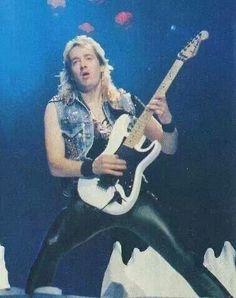
I admired the long hairs that adorned my rock wall of fame.  I thought Adrian Smith from Iron Maiden, the blonde straight mullet style, looked best.  I didn’t like Bruce Dickinson’s fringe, and Steve Harris’ curls would never come naturally to me.  That was the thing.  I wanted something that looked natural, not hair that seemed supported by an invisible superstructure like Bon Jovi’s.  Nothing flammable due to excessive use of chemical fixatives.  It had to look effortless – like you woke up that way.

I didn’t want my allegiances to be misidentified.  I wanted it to be obvious:  rock and roll, and only rock and roll.  I didn’t want to walk down the hallway, mistaken for somebody who listened to Duran Duran.  And so, starting in grade nine, I really tried to grow out my hair.

The major issue was, of course, parental guidance.  Dad didn’t like my “long” hair.  It never got that long; a couple inches tops.  Then he would order it to be chopped.  Bob and I sometimes went to the barber together, and we would always request to “leave the back long”.   They’d explain they had to trim the dead ends, and so what we were left with rarely looked “long”.  It did look very, very 80s.

Dad just didn’t understand.  This wasn’t about looking neat and clean and tidy.  It was about looking different from all the clones.  There were very few long-hairs at our school, and once they had some length going, each guy looked different and unique to me.  That’s what I wanted.  Nothing that said “conformity”, but maybe something that said “Def Leppard”.  Who, by the way, had not become the biggest band in the world yet.

The cycle went on for the first three years of highschool.  Grow it, cut it, “leave the back long”.  Eventually I developed a nice mullet that I considered a good start.  This came to an end in late 1989.

It felt like the end of the world.

In October of ’89, my dad insisted it was time to get a job.  He knew the manager at the local grocery store and put in a word.  An interview was set up.  I dutifully went to the mall and checked in at the barber shop.  “Cut it all off,” I said despondently.  None of this “leave the back long” stuff.  Not this time.

I walked out looking like everyone else, self esteem made worse by my new glasses.  Over at the grocery store, I was expected.  “Your hair looks fine,” said the manager.  He had already spoken to my dad, who told him I was just getting a hair cut before the interview.

It was only about 10 minutes before I was welcomed aboard and introduced to new co-workers.  My first day would be the coming Friday.  But before that, I had to make it through a day at school with my new hair.


For the last couple years, I had been co-authoring a sci-fi highscool comic book called Brett-Lore.

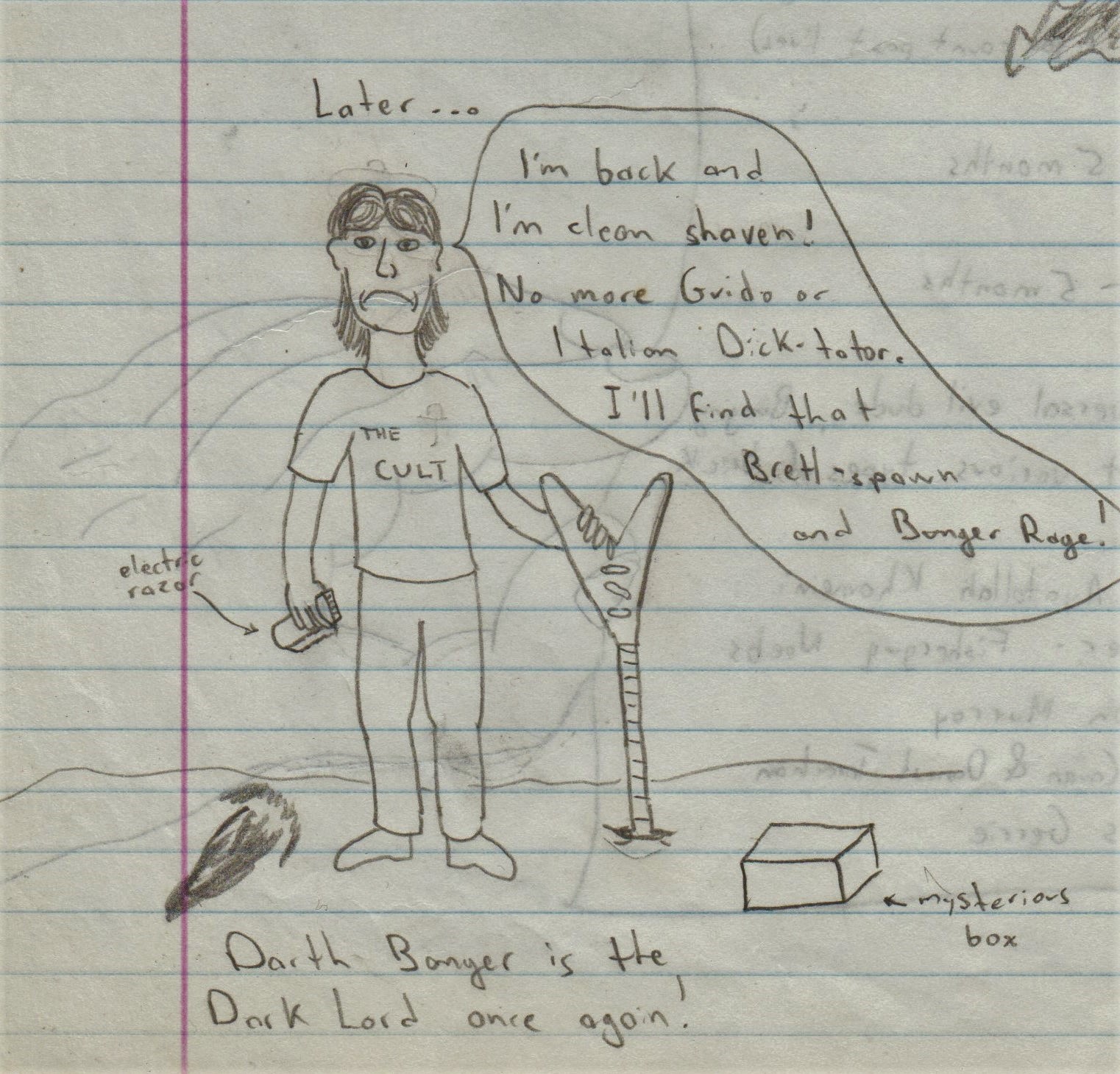
I was quite happy with my character, the evil Darth Banger.  Most of my classmates were being lampooned far worse than I.  David Kidd, who was obsessed with drama class, was Emperor Kiddspeare.  Later when we decided to go after him harder, he became the Phantom of the Opera.  My stalker Bobby was Bobby the Hutt.  I got off easy.  Whatever misdeeds he was up to, Darth Banger was always rocking a guitar.  In fact, his starship was a giant Flying V.  He was just a stereotypical metal head, but also leader of the Evil Empire, so I went with it knowing I could have had it so much worse.

When I showed up at school with the new short hair that I was forced to adopt, Brett-Lore had to reflect it.  I couldn’t be Darth Banger anymore.  Because I am Italian, and because I now resembled Mussolini more than Metallica, my character was briefly reborn as Il Duce, the Guido.  Later on, I tried letting my facial hair grow in and suddenly my new character became Beardo-Weirdo.

This was all very depressing to me.  I didn’t care that I had a job.  All I could think about was that I had seemingly lost the only thing that made me different.  Now my ears stuck out.  I looked like everyone else.  And now even my comic book was becoming something I didn’t enjoy anymore.

The one interesting thing about work:  for me, in my life, every job introduced me to new music.  The guys at the grocery store liked heavier music than Motley Crue and Bon Jovi.  They liked Sabbath, and Zeppelin.  As soon as I was able, I added We Sold Out Soul for Rock ‘N’ Roll to my collection.  “Sweet Leaf” became my new favourite although I had no idea what it was about.  A girl named Leaf, possibly?
I worked at the grocery store for about nine months, leaving before the start of a busy summer.  The hair started growing back as soon as I could make it.  The Duce character never worked for Brett-Lore, and as soon as I was able, I forced Darth Banger back into the story.  The other authors agreed but under one condition.
Everybody in the comic got teased pretty mercilessly and so I had to pay more dues before Banger was allowed to return.  Il Duce had to be put through hell, and so I drew all sorts of embarrassing shit for him to go through, before he finally transformed back into Darth, this time with a nice single-seater Flying V spaceship to pilot himself.

As my hair grew back, I started to feel like myself again!  I was happier.

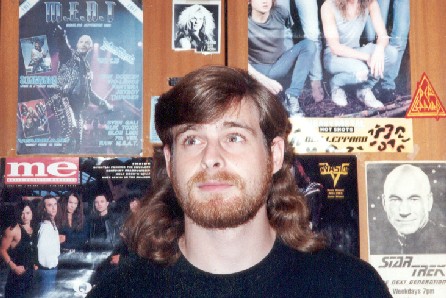
It reached record lengths by the early 90s.  But the landscape had changed.  Long hair was more common, and looking unique less easy.  One day my dad made a comment about how he’d pay me $10 per inch if I cut my hair off, so I went and did it.  He didn’t think I would, but I did.  Some of my biggest rocker heroes had shed their locks.  By this time I’d discovered something almost better than hair:  beards.

The fact was, try as I might, I never had “good” long hair.  It always wanted to curl up; get out of control.  Without investing in styling and products, it would never really look “good”.  And that defeated the whole “effortless” idea.  But it took grunge to get me to the point where it didn’t matter to me anymore.

It’s funny how something as superficial as hair took up so much of my time and energy, but the fact is, these things used to matter.  They used to matter a lot!  Maybe not in the grand scheme of things, but when you’re in highschool, the grand scheme of things was limited to the walls of the school.  I just wanted to walk my own path my own way.  I think I did OK.

* Later on I wrote a tune about this subject called “Clones”, a bitter examination of all the ball-capped lookalikes in school.

#801: Dinking Your Records

GETTING MORE TALE #801: Dinking Your Records

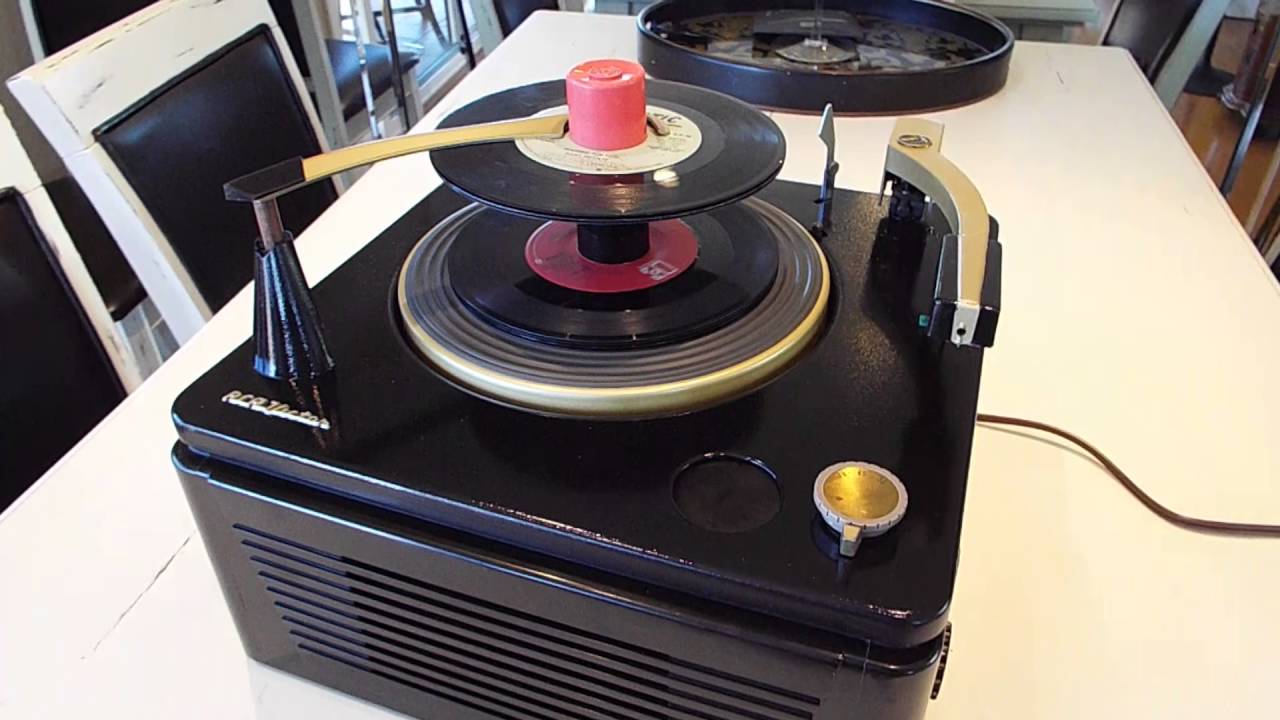
Let’s say you have a stack of new and old 45 rpm singles to play, but only an old Wurlitzer jukebox to play them in.  You might run into some problems if you don’t have the right records.  You know how some singles have the large holes and some do not?

Back in the 1940s, RCA were 100% behind their new 45 rpm record format.  They had a system where you had a stack of up to 10 records on a thick spindle.  One would automatically drop as the previous record finished.  When all 10 songs had played, you just flip the entire stack over and play the other sides.  That’s why singles have an upraised ridge around the center; so their playing surfaces never touch when stacked.  The larger spindle size made for tougher, longer lasting records and players since that auto-changing could be pretty rough on the 45s!  Through trial and error, RCA learned that the smaller standard holes would eventually deform if their mechanism were to use it.

The two hole sizes on records today are the remnants of an ancient format war.  The now standard small spindle won out, but many jukeboxes still used the larger spindle.  So what happens if you have a jukebox but not the right kind of record?  You dink ’em!

I’m not talking dirty here.  The term for cutting out a larger hole in your singles is called “dinking”.  We won’t speculate why.

If you need to dink a large number of records, or if you simply need it done right, there are actually record dinking services out there.  You send them your records, and they will use proper machinery to cut the holes perfectly.  If you’re braver, you can try dinking your records at home.  You can buy a couple different devices to do this.  One looks like your old school compass.  You simply etch a new hole by cutting around and round.  The other is a little device that you attach to the center of your record and tighten, and tighten, and tighten until it cuts through.

Neither device is perfect and both require you to do some serious handling of your precious vinyl.  It also requires practice to get the hole just right.  If it’s a little off-center, you’ll notice when you play it.

Watch the informative video below by Youtuber Mat aka Techmoan. Notice that he purchased a stack of worthless records from Ebay to pull this stunt. (New Kids on the Blech!)  Is this something you’d be willing to try yourself?

Granted, the number of working vintage Wurlitzer jukeboxes out there is dwindling, but if you had one, I’m sure you’d be well familiar with dinking services at this point!

Most record collectors doubtlessly have singles with both size holes.  We’ve been putting those little plastic “spiders” or spacers in the middle without thinking too hard about it.  Sure beats dinking around doesn’t it?

#800: It’s Beginning to Look Like Marillion Christmas

GETTING MORE TALE #800:
It’s Beginning to Look Like Marillion Christmas

Immediate apologies to probably a large percentage of readers.  There are two kinds of people:  those who like Christmas music, and those who do not.  Those in the “not” category will probably be dropping in droves this December, as I announce the latest review series here at mikeladano.com.

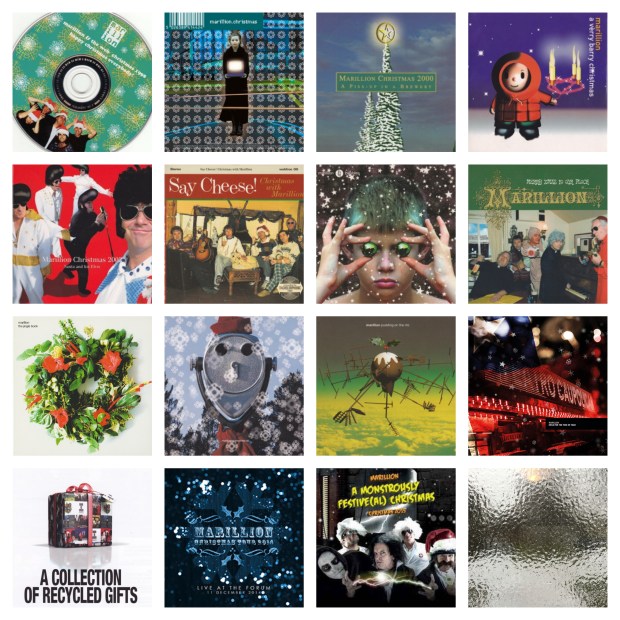
It’s an interesting matter of fact, but Marillion have a total 15 Christmas themed albums.  That’s an incredibly large number!  Most were only available (for free) to fans of the Marillion Web fan club.  Over the last few Christmases, I’ve reviewed a number of them (linked below).  In 2019, I finally acquired the only two I had been missing.  I didn’t get into Marillion early enough to get the first two, but I was on board by the third.  Now, two decades later, I decided to bite the bullet and pay Discogs prices, which were not all that bad ($30 US each).  And now I have them all!

For a short while, Marillion switched from releasing Christmas albums to Christmas DVDs, which I do not collect.  In 2014, CDs resumed for a short additional run.

  • Chile for the Time of Year (2014 – Webfree 17)
  • A Collection of Recycled Gifts (2014 – Compilation with new Christmas material)
  • Christmas Tour 2014 – Live at the Forum (2014 Abbey Road “instant live”)
  • A Monstrously Festive(al) Christmas (2015 – Webfree 18)

Now that I actually have them all, I’d like to get them all reviewed too.  After all, I can really only do that kind of thing once a year — in December.  Starting with Webfree 1, I’m going to work my way down the list.  And if this doesn’t interest you at all, that’s cool.  I get it.  That’s the thing about personal projects.  This is more about me than you, I’m afraid.  But there’s plenty of reason for you to stick around, too.  Many of these Marillion “Christmas” albums have minimal Christmas content.  Chile for the Time of Year? That’s just, flat-out, a double live album.  It was recorded in May!  It boasts some of Marillion’s best known songs (“Kayleigh”, “Easter”, “Cover My Eyes”), and also a number of key later progressive epics (“Gaza”, “Ocean Cloud”, “Neverland”).  If it were not one of their annual Christmas fanclub freebies, it would fit in any other time.

If you’re a diehard, or just remotely curious about Marillion, I’ve done my best to write for both of you.  These CDs are going to expose to you to variety of Marillion songs.  Hits, deep cuts, and stuff you never heard of before.  And you won’t find a series this detailed anywhere else.

As I buckle in for what looks to be a chilly season, I wish you all the very Merriest of Christmases.  It matters not if you celebrate it.  As the world pauses together this season, I hope you have nothing but warmth and happiness in your life.  Perhaps a hot drinky-poo or a pipe by the fire is all you desire.  Might I recommend a Marillion Christmas to nail the vibe just right?

#799: Mix CD 10 – “I’m So Bad Baby I Don’t Care” (2003)

GETTING MORE TALE #799: Mix CD 10 – “I’m So Bad Baby I Don’t Care” (2003)

Welcome back to an informal series of stories on the subject of musical rediscovery!  It is a blast listening to mix CDs (or tapes) that you made ages ago. To get you caught up, you can check out the below if you so choose!

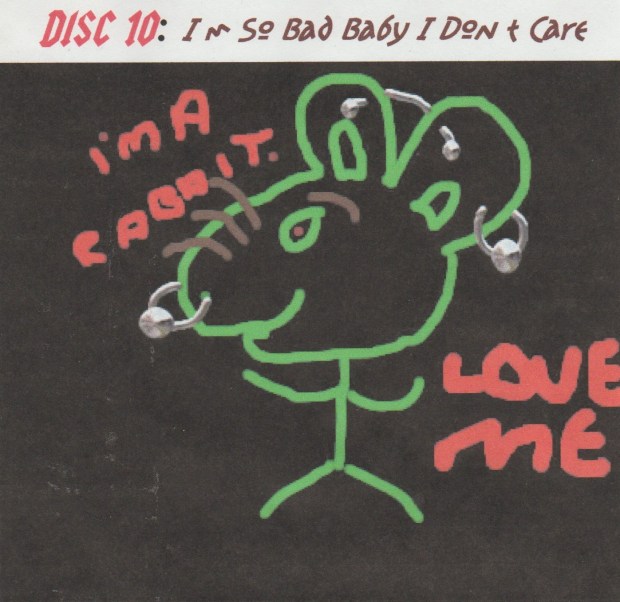
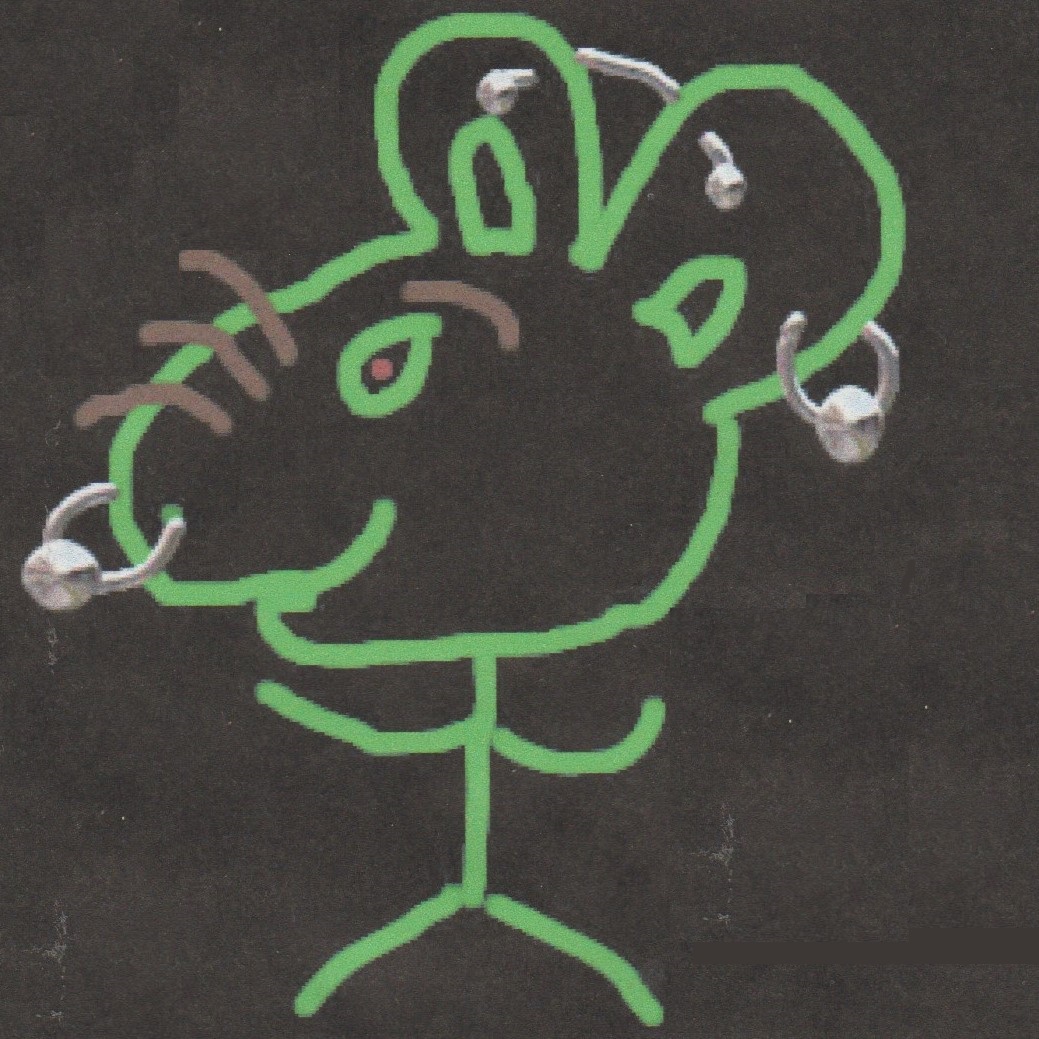
This is one I have been looking forward to, for a couple reasons.  One, I love the cover artwork.  I recently reconnected with an old friend from the UK named RooRaaah.  He drew this rabbit, “Rab C. Rabbit”, and I always thought the crude sketch was hilarious.  If I hadn’t used it on my 10th mix CD, I might have lost it forever.

The second reason is that I burned this CD in the aftermath of dating Elli, as told in Record Store Tales Part 15: Dating a Radio Station Girl.  I was seeking all sorts of music, from heavy and angry to soft and soothing.  There’s a healthy dose of nostalgia, as I knew I could always return there to fill the holes in my heart.  There are even some rarities here, the kind of things you found by browsing Limewire.

As usual, I opened with a comedy bit:  Trey Parker and Matt Stone yelling “Dude!” at each other, from the movie Baseketball.  “I guess you’ve got a point there.”  Then straight into the brand new Anthrax:  “Safe Home”.  We’ve Come For You All was fresh and this song captured part of how I felt.  “My whole world has moved on.”  It was a strong, albeit mainstream single for the thrash pioneers, and one that still holds up.

From there to full-on nostalgia:  “Mr. Roboto”!  Wow, she must have really done a number on my heart to make me go all the way back there, the first rock record I ever bought.  At this point in my history, I lost my original LP copy and hadn’t yet got one on CD since it was so hard to find.  Hence the Limewire download.  A co-worker picked up the Styx CD for me in Toronto a year or two later.    Then, first of three Motorhead tracks is a wakeup:  “I’m So Bad Baby I Don’t Care”.  I was definitely pissed off!  But then it’s onto the Faces classic “Ooh La La”, a taste for which was acquired by repeated viewings of Rushmore.

Albums and artists tend to repeat on this CD.  Even certain songs repeat!  Jellyfish’s excellent “The Ghost at Number One” is the first of two appearances.  I can taste the nostalgia, as I retreated to a simpler time, sitting in front of the TV watching music videos on Much.  I always appreciated the Beatles-esque track, which I haven’t heard in years.  Back to the 80s again, and the Gowan classic “A Criminal Mind”.  Comfortable MuchMusic memories in the basement.  A dark, plaintive song that spoke to me.  “And you will never break me, till the day I die.”

Motorhead’s “R.A.M.O.N.E.S.” reflects a fresh appreciation for punk rock in my post-Elli haze.  You could thrash out to it and just rock the frustrations till they were gone.  This song will lift you up no matter how deep the hole.  A real weird rarity follows this, a Limewire discovery:  Mike Patton & Dillinger Escape Plan covering Justin Timberlake’s “Like I Love You”.  And they fucking kill it, too!  Just a bootleg, but good enough for a mix CD.

Back to the movie Rushmore.  One of the most impressive tracks in that movie is the Live At Leeds version of “A Quick One (While He’s Away)” by The Who.  Once a co-worker told me exactly what that song was (from expanded edition of Live at Leeds), I grabbed it (before buying the CD later on) from Limewire.  The track is an utter marvel, and I maintain the live version is the superior one.  I couldn’t believe it was actually live!  It’s as clean as a studio cut with perfect harmonies, but with explosive live energy.  It’s my favourite Who song, hands down.  It’s the kind of song that made me feel smug, like “Yes, I have fucking great taste in music.”

The first repeat band (and song) is “The Ghost at Number One”, this time live.  Jellyfish’s immaculate live version is tight as a drum.  Then, a magnificent double repeat:  Styx, now with Lawrence Gowan on lead vocals, with “A Criminal Mind”!  And not just “A Criminal Mind”, no; live in Kitchener Ontario, this one!  It’s cool that James “JY” Young threw down that wicked guitar solo right across town.  So this one is special to me no matter how you slice it.  The centerpiece of the CD, perhaps.

Don’t read anything into “Crabsody” by AC/DC being on this CD.  It’s not on any of the US albums, so I downloaded it when I searched for “rare AC/DC” on Limewire.  (Strictly a novelty song, incidentally and not a lost AC/DC classic.)  You can definitely read “nostalgia” into the next track.  Back to 1981 (Jesus!) and “Believe It Or Not” by Joey Scarbury.  And I clearly went for the most mangled transition I could manage, since the very next song is “Chinese Arithmetic” by a Patton-fronted Faith No More (second appearance for Mike).  The track opens with Patton announcing, “The word of the day is…fuck.”  Which he then repeats a few times, before seguing into “Vogue” (as they often did).

Finally it’s back to Gowan again, and “Strange Animal” (featuring Tony Levin on the Chapman Stick).  The rhythm that Levin lays down is a beast!  Even in shitty Limewire quality, this song moves.  Motorhead make their final appearance on the war ballad “1916”, a song which I found real affecting at that time.  I got the album as soon as possible.

Ending the CD (sort of) is CKY, whose only real claim to fame is an attachment to the Jackass guys via Bam Margera’s brother Jess.  The details are lost to me now, but I would have heard this song either a) on a Margera DVD or b) on a mix CD played in store.  It’s a good little ballad circa the millenium, and it suited my grey heart.  It’s been years since I last played it, and I can hear what I liked in it.  Thank God I’m not that sad sack o’ shit anymore, though.

The real final track is just a coda, a preview of the new Metallica song “Frantic” via a show called MTV Icon.  Remember, when they paid tribute to Metallica and had Snoop up there doing his thang to “Sad But True”?  Well Metallica closed the show with their own song, and then I guess the credits must have rolled or something, because this thing just fades out before James can even deliver one “Fran-tic-tic-tic-tic-tock!”

I put some effort into typing out an interesting looking tracklist on the back, and Rab C. Rabbit looks fab on the front.  I even glued the two together to make the insert.  Here’s the funny thing though.  I guess I must have needed a case to put this CD in, so I swapped out one from a local band called Vacuity, and threw their CD in the trash.  The vacuity.net sticker is still on the back.  This is funny, because one of the guys from Vacuity worked at the Record Store, and, well, he really wanted me to like his band.  When he and store parted ways, I parted with the CD!  Dick move, I know, but he was kinda a dick.

I think this my mix deserves:

5/5 Rab C. Rabbits


#798: Chinese Democracy

A sequel to Record Store Tales Part 285: Chinese Democracy

GETTING MORE TALE #798: Chinese Democracy

I met Thussy back in 2007.  He joined the team at work and we became friends immediately.  We liked the same stuff.  Trailer Park Boys, Guns N’ Roses, comedy.  He is responsible for getting me into Super Troopers, which admittedly took a couple tries.  We were also both getting married around the same time, so we had similar complaints and gripes to talk about.  Drama with bridesmaids and seating plans, egads.

Thuss is a gamer, and we enjoyed chatting games.  Axl Rose did a voice (a radio DJ) in the video game Grand Theft Auto: San Andreas.  You could switch between stations, and if you chose the rock station you got Axl.  It was one of the few things Axl did that was released during that long dry spell between albums.  Of course, this led to ample discussions of Chinese Democracy.

“It’s never coming out,” Chris insisted.  I hated to say he was right, but it sure seemed that way.  He refused to back down on his position.  We’d been fucked with by this band for so long.  Guns had missed several release dates, so many that it had become a joke.  Axl chewed up managers and spat them out like stale bubblegum.  Then the Dr. Pepper soda company offered to buy a Dr. Pepper for everyone in America if Axl managed to make his 2008 release date.  Axl seemed good-naturedly amused by the idea, offering to share his Dr. Pepper with Buckethead when the album comes out.  (This because Dr. Pepper said the only Americans exempt from this offer were former Guns members Buckethead and Slash!)

On October 22 2008, I was working at my desk, listening to the radio when the DJ, Carlos Benevides, announced that they would shortly be playing a brand new single by Guns N’ Roses.  It was the title track, a song both Thuss and I were already familiar with.  He had a disc of rough mixes for many of the tracks, and I had the Rock In Rio bootleg CD set.  We already knew half the new songs, and “Chinese Democracy” was a track I thought smoked.  I called Thuss and he listened in as it played.

It sounded like shit on our little mono telephone speakers, but we were listening to brand new Guns!  The overall listener reaction was mixed to negative, but I already loved it.  “The album’s never coming out,” said Thuss.

“It has to, now.  There’s a single out.  It’s definitely coming.”

“No.”  Thuss was insistent.  “It’s never coming out.”

“But Dr. Pepper…” I began before being cut off.

“No.  Not coming out.  Never.”

The funny thing was, “Chinese Democracy” wasn’t actually the first song released from the album.  A month earlier, “Shackler’s Revenge” became the first new Guns song in nine years, when it was released as part of the Rock Band 2 video game, which neither of us had.

A new release date of November 23 was announced.  “Nope,” said Thuss.  “Nothing is coming out on November 23.”  It was, strangely, a Sunday.  Generally, nothing came out on Sundays.  It was absolutely an odd move that did throw the whole release into question for some.

I asked ye olde Record Store to hold a copy for me.  “Do you want vinyl?” he asked.  “No, just CD.”  It was something I’d regret, when he sold out of the vinyl a week later.  I emailed to ask if he had any left.  “Do you remember me asking you if you wanted vinyl?” he scolded.  “Yeah,” I sulked.

When I walked into the store on November 23 and was handed my precious copy of Chinese Democracy, it was so anticlimactic.  There it is.  It’s in your hands, the culmination of a decade and a half’s work.  You’ve been waiting all this time for this album, and there it sits.  An album that had “release dates” going back to 1995 and every single year since.  Then, you witness Guns return to the live stage from their cocoon, different but recognizable.  You watch them struggle to establish a lineup, and you hear rumour after rumour about song titles and release dates.  Then you’re holding a CD in your hands, a pitiful little plastic case with a little paper cover inside.  You hand the guy your debit card, he rings it in.  Transaction approved, you are handed your receipt.  Chinese Democracy goes into a little plastic bag.  Even though it’s probably the most expensive and longest gestating album of all time, your little plastic bag weighs the same as if you bought Sex Pistols.

At least I’d be able to show it to Thuss.  Monday the 24th rolled around.

“It came out.  I have it,” I told him as I strolled into his office.

“No it didn’t.  It never came out.  It’s never coming out.” He was sticking to his story come hell or high water!

“Yes it did! It’s in my car right now!  I’ll show it to you.”

“You have nothing,” he responded, refusing to come and look.

In the years since, Thuss has stubbornly stuck to his guns and his believe that Chinese Democracy has never come out.  “I have the unreleased mixes,” he says.  “That’s all there is.”


I emailed him to tell him I was writing this story, our tale of the time Chinese Democracy was released.

“So you are going to take a crack at some fictional writing…nice.”

I will never win this one!

So now I have two stories both titled “Chinese Democracy”.  I say, why not?  Peter Gabriel has three self-titled albums.

#797: Don’t Be Afraid to Ask For It!

GETTING MORE TALE #797: Don’t Be Afraid to Ask For It!

In the early 90s, we got our first Costco store in Kitchener.  My parents raved about how much I’d love it.  In those early years, I enjoyed going with them.  I’d throw a 20 pack of Hot Rods into the cart and see if they’d notice (they always did).  They didn’t have much of a music selection, but what they did have was priced to go.  So I picked up a few current releases:

The Guns was a nice score.  The full Tokyo show, split onto two VHS tapes (sold separately).  At Costco prices they were affordable.  The show later made up a large portion of their album Live Era.  Costco was great for buying new releases, junk food in bulk, and the occasional electronics.  We enjoyed getting free food samples and checking out the latest in TVs and videos games.  I stocked up on blank tapes.  But there was one thing Costco didn’t have.

To be clear, it wasn’t that I was looking to buy this.  I was just being a shit.  I have a juvenile sense of humour, and always have.  Costco should have known that if they were going to leave pads of paper for “suggestions” at the end of every aisle, someone was going to write silly things on it.

Most people wrote sensible suggestions.  “Too much packaging on products” was a good one.  It’s true, Costco would use far too much cardboard and plastic to package together three things of deodorant.  But I noticed they didn’t carry something; something important that could easily be sold in bulk.  My mom gave me shit for it, but I always wrote “CONDOMS” on the suggestion pads.

I didn’t need condoms, believe me.  Definitely not in bulk.  But something about the idea tickled my funnybone, and so every time, I wrote it down.

“MICHAEL!” my mother would scold.  I’d grin and laugh.  It went on and on like this, visit after visit.

But you know something?  It was a good idea.  So good that a few years later, they were stocked.  I couldn’t believe it.

“Kathryn!” I shouted at my sister.  “Get over here, you won’t believe this.”  I proudly pointed at the condoms.  “Do you think that’s because of me?”  I mean, I wrote it down enough times.

I think I had something to do with it.  At least, that’s the way I tell the story, and I’ll be damned if I’m changing it now.  Costco carries condoms because of me.

There was one guy I knew back in the day who would have appreciated it.  He was a friend of a friend.  We were at an age when you’d be expected to be “embarrassed” to be buying condoms.  Not this guy.  He went up to the counter at the drug store and said, “See that?  That’s a five pack.  That means I’m getting it five times.”  Then when the transaction was done, he’d conclude by saying “See you tomorrow!”  No embarrassment for that guy.  I like to think that I got Costco to carry condoms in bulk, and I did it for that guy.  You’re welcome!


#796: Improvisation

GETTING MORE TALE #796: Improvisation

When I need a particular piece of audio hardware today, I just have to decide what I want and order it.  It’ll be at the house two days later.  Oh, I need some more RCA cables to plug my tape deck into my PC?  No problem.  What colour and how long?  We have become soft and spoiled today, with the convenience of everything we desire at our fingertips.  Want a frozen turkey delivered to your front door?  No problem.  I’ll get you a turkey.  Or RCA cables.  Anything.

In the 1980s, we had to improvise.

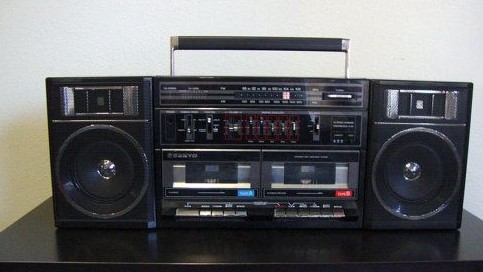
When I first discovered music, the second most important music-related activity (after listening of course) was taping.  It was the easiest, cheapest way to get new music and there was a social aspect to it as well.  You had to borrow an album from someone, go to their house to tape it, or vice versa.  Most kids had a budget price dual tape deck.  I had a single-deck Sanyo, eventually getting a dual deck boom box for Christmas of 1985.  By today’s standards, recording tape-to-tape on a cheap deck yields horrendous results.  In 1985, it was the next best thing to owning the album yourself.  If you were in a hurry, you could use the high speed dubbing feature but that always created speed and warble issues that we could even hear as kids.  Regular speed dubbing was the only acceptable way to copy a tape.  However sometimes we had to think outside the box.

The most notable instance of improvising with what we had was using speakers as impromptu microphones.  It’ll work if you have nothing better to use.  We used speakers as microphones frequently back then, but what about copying music tape to tape?

Let’s say I was making a mixed cassette, and that mix was going to have some live songs on it.  There was no practical way to do a fade-in or fade-out on a low end dual tape deck.  In this case, I would use a Walkman as an audio input to my recording deck.  The sound was, shall we say, harsh.  But you could do it.  You could take a cable and go right from the headphone jack to the microphone-in jack on the deck, but that sounded pretty terrible.  A better way was to use a cable that had a headphone jack on one end, split to RCA left and rights on the other.  But I didn’t have one of those.  I had to make it myself by splicing one to the other.  Improvisation!  We couldn’t just buy everything we wanted.  Cables are still expensive today and finding the right ones in stock at a given time wasn’t a guarantee.  You made due with what you had until you could afford to do better.  Using the Walkman’s volume control, I could now fade in any live track I wanted.  A small thing, but I was already ambitious.  I enviously eyed pictures of mixing boards in guitar magazines.

Another issue I had was recording vinyl.  I had never heard of a preamp.  But I realized that my old turntable sounded better when plugged into something else first.  My parents had an old receiver with an 8-track deck and radio.  The 8-track didn’t work anymore but I used that gigantic unit to boost the signal from my turntable, before going into my tape deck.  The sound was messy to say the least, but at least I was able to listen to and record my LPs.

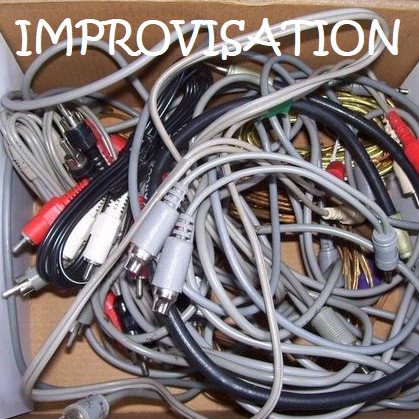
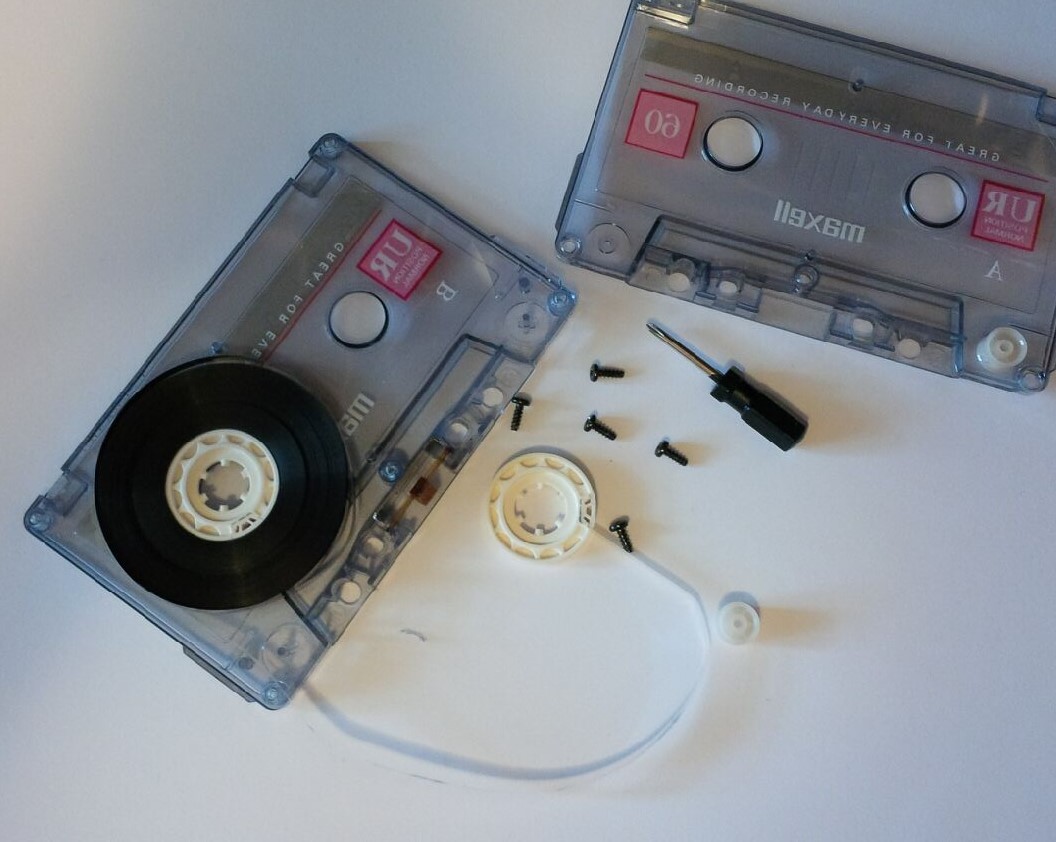
I had a little shoebox full of stuff I needed to push my audio capabilities, a small but mighty toolbox of essentials.  A tape head demagnetizer.  Isopropyl alcohol and lint-free wipes.  A record cleaning kit.  A little magnetic screwdriver for taking apart cassette tapes.  A gnarly pair of grey RCA cables that were the top of the line that I could afford.  My prized possession:  an RCA Y-connector.  That baby enabled me to take a mono signal, like from the family VCR, and split it to faux-stereo for recording to cassette.  Until we got a stereo VCR in the early 1990s, that Y-connector saw weekly usage on my Saturday mix tape sessions.

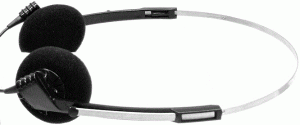
I had a little soldering kit that I could use to splice wires together, but one thing that I could never fix was a cheap set of Walkman earphones.  The kind with the little foam earpieces.  Utter shit, but that’s what we all had.  The headphone jacks on those things would not take long to start shorting out.  You’d go from a stereo signal to a mono signal to no signal back to mono without even moving it around.  I tried everything and could never fix those damned shitty earphone cords.  So you’d buy a new pair for $10 at the local Bargain Harold’s.  Those would be good for about a week before starting to give you problems.  Otherwise, everything that broke had to be fixed.

Maintaining your tape deck at home was essential, hence the isopropyl alcohol.  Hold your breath, dab some of that on a lint-free cloth, and gently clean the rollers and capstans inside your treasured boom box.  It would be remarkable how black that cloth could get.  I used my tape deck a lot.  I was constantly cleaning it, but it always had speed issues.  This was probably more due to poorly made, tightly wound cassette tapes than the deck itself.  Still, those old Sanyo tape machines were not designed to be worked as hard as I worked mine.  If I had known what a Nakamichi Dragon was back then, I might have been more motivated to get a part-time job!  But such machines were not available on an eighth grade allowance, nor was such a beast even known in these parts.

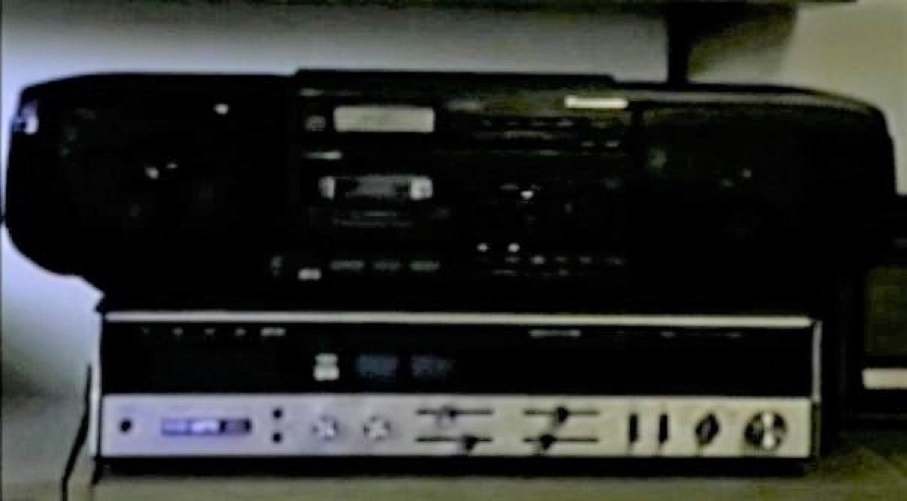
Using my limited resources, I was able to listen to and record from every format I had.  My turntable was so old that I could even play 16 and 78 rpm records (not that I had any).  Then a new format came along that slowly but surely digitised my entire world:  the compact disc.  I received my first CD player/tape deck for Christmas 1989, a mere four years after my first dual cassette.  An eternity in teenager time.  A significant fraction of my life to that point was spent meddling with tape decks and cables trying to get them to do what I wanted them to do.  Now this compact disc comes along, allowing me to hear the most perfect audio I’d even been exposed to.

My first CD player on top of an old Lloyd’s 8-track/radio/receiver.  The old setup!

I remember playing one of my first CDs, Motley Crue’s Dr. Feelgood, for my buddy Bob and his brother John.  I skipped ahead to “Time For Change”, and then fast-forwarded to the fade out.

“Just listen to that!” I said with a proud look on my face, as I cranked the volume all the way to 10.

After a pause, John asked “What are we supposed to be hearing?”

“The silence!  Listen to that silence!”  There was no static on the digitally recorded, mixed and mastered fade out.

Bob and John weren’t as excited as I was, but the compact disc represented a new standard.  The stuff I had wasn’t going to cut it forever.  Soon, as long the source was digital, I was making mix tapes that sounded better than store bought.

As much as the results were often dicey, improvising with audio equipment was tremendously fun.  Working with your hands, the satisfaction of getting something to work the way you wanted…it was a fun way to spend a Saturday in the 80s.  Even if the only people who got to hear your handiwork were a handful of your neighbourhood friends and classmates.


#795: A Case for Security

A sequel to #424: How to Stop a Thief


GETTING MORE TALE #795: A Case for Security

Back when people used to actually steal physical CDs instead of just stealing a download, extravagant measures were taken to secure our precious inventory.

We had a magnetic tag security system.  At the entrance stood an electronic gate that would go into alarm mode any time one of those magnetic tags was near.  Every item we had in-store was tagged.  The system was not cheap.  I believe the tags cost 5 cents each (in 1994 dollars).  They were the cheapest ones available and they quickly added up.  The tags were not re-usable.  Once they were de-magnetized they were done.  Also, because they were sticky tags, if you ripped one off you wouldn’t be able to re-apply it very well as the sticky side got less sticky.  You could put it back on with tape, but no matter what you did, over time the tags would always start to peel off on their own.  We did a “tape check” every week to make sure every cassette still had a security tag firmly attached.

There was a different method for securing CDs.  To cut down on the use of the magnetic tags, we used plastic CD long boxes.  The magnetic tags were fitted inside, didn’t peel off, and could be re-used time and time again.  You couldn’t get the CD out of the long boxes without a key, or you’d destroy what was inside.  The key was kept behind the counter.

Like anything at the Record Store, this security measure had its pros and cons.  Storing those long boxes when not in use was a constant struggle.  We always seemed to be bursting at the seams with them.  We had cabinets underneath the CD shelving that were usually packed full.

The biggest “pro” was reducing the cost of the magnetic tags.  Since you could use the same case over and over again with the magnetic strip intact, you didn’t have to keep buying new ones.  The long boxes were also an added deterrent.  If you wanted to steal a CD you had to hide the long box under your jacket.

This didn’t stop people from trying.  One day, somebody from the mall came into the Record Store and told me that they found half a dozen broken long boxes in the trash outside.

“I think someone has been stealing from you,” she said.

I was immediately worried that someone managed to rip us off on my shift.  Fortunately that wasn’t the case, though Zellers were not as lucky.  Upon seeing the broken long boxes, I could tell they didn’t belong to us.  They came from Zellers, who used a similar system.  Someone managed to beat it.  How?

If nobody was looking, you could lift the CDs right over the magnetic gate.  That was the easiest way, and at Zellers, chances are nobody was looking.  Another method (supposedly anyway) involved lining the inside of your jacket with aluminum foil.  Apparently this would allow you to shoplift anything with a magnetic tag.  The urban legend, which may have been true, is that a local gang of CD thieves used this method.

The gang were known locally as “Pizza Guys”.  The cops were always two steps behind them.  The main detective on the case gave us pretty clear instructions.  We were to buy everything the “Pizza Guys” brought in, record it, and get their ID.  We were to flag any “shady” purchases but otherwise they told us it was business as usual.  I don’t know if the detective ever caught the “Pizza Guys”, but years later their leader Aristotles (real name!) went to jail for selling ecstasy, meth and heroin.  Quite a large step from stealing CDs!  According to the news, he got just six years in jail.

I don’t think the “Pizza Guys” were shoplifting CDs normally.  I think they were getting them from someone on the inside.  We’ll never really know.  We used to joke that one day we’d be in an HMV store minding our own business, when Aristotles would pop his head out of the stock room.  “We’re out of Big Shiny Tunes again!”

Even though the “Pizza Guys” usually brought in what you would call good titles (usually new releases), we all hated dealing with them.  As time went on without getting caught, they got more and more cocky and difficult to deal with.  It was good to know the cops were on our side, but I’m not a detective.  My job was not to fight crime in the city of Kitchener.  My job was to sell music, and these guys didn’t make it a pleasant experience for us.


#794: “Hockey Sticks”

GETTING MORE TALE #794:  “Hockey Sticks”

Though Jimi Hendrix is responsible for the invention of the “hockey stick” guitar, it was my old guitar instructor Gary Mertz who coined the phrase.

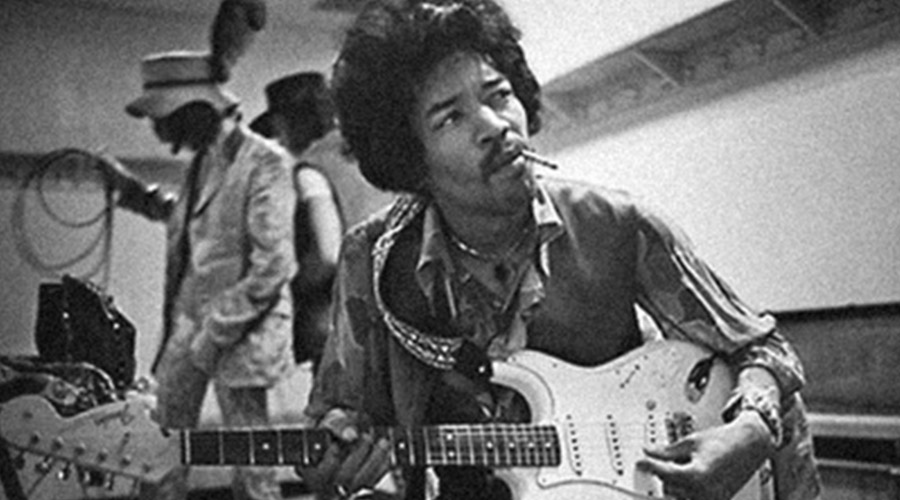
In the 1960s, it was difficult for Hendrix to find good guitars for a lefty like him.  Ned Flanders’ Leftorium store was still decades in the future, so what was a young Jimi to do?  Like many things in his life, he got inventive.  He simply flipped a right-handed Fender Stratocaster over, restrung it for a lefty, and played it.

Flipping the guitar not only enabled Jimi to play a Strat, but also gave him some unique advantages in his quest for new sounds.  In this new orientation, the strings were now over the pickups in unusual locations, and had different tension than intended.  The long strings — the highest — were now the shortest strings.  Since the high E was shorter it didn’t have to be as tight, and this made it easier to bend.

This arrangement also had the effect of making Jimi look even cooler.  The iconic image of Jimi playing the upside down Strat became world famous.  With tuning pegs facing down, young righties were envious of this cool new look.

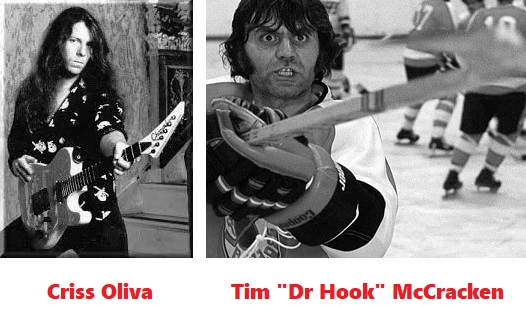
When those young righties grew up and signed to big labels themselves, they popularized the flipped headstock for righties — the “hockey stick” neck!  You can see it, can’t you?  Look at this photo below, of Criss Oliva from the band Savatage, and Tim “Dr. Hook” McCracken from the movie Slap Shot.

That’s a high sticking penalty.  Incidentally, the character of McCracken inspired Marvel’s Wolverine.  You see that too, don’t you?

It wasn’t always players with the calibre of Oliva playing these hockey sticks.  For every Criss Oliva there was a C.C. DeVille.  You knew C.C. wasn’t doing it to gain any string-bending advantage.  He was doing it strictly for image, and that’s one thing my old guitar teacher hated about it.  I think he also hated the sharp jagged headstocks on those Charvels, Jacksons and B.C. Rich’s.  Turning them upside town made them to look even more ridiculous to him.  Like you were about to hit the street for a little two on two ball hockey.  Utterly ridiculous.


I always had rock magazines and videos playing in the basement, so when Gary came for lessons he would often comment on what I was listening to at the time.

“Oh no, you don’t like those hockey sticks, do you?”

Sheepishly I said that I did.  I thought they looked cool, like a weapon.

But a guitar is a musical instrument.  The subtle curves on a Fender Strat echo those of a classic violin, not a melee weapon or a piece of sports equipment.  Regardless, by 1989 both Criss Oliva and Christopher Caffery were playing hockey sticks in Savatage!  They looked lethal in the video for “Gutter Ballet”, wielding those implements of both rock and high-sticking.

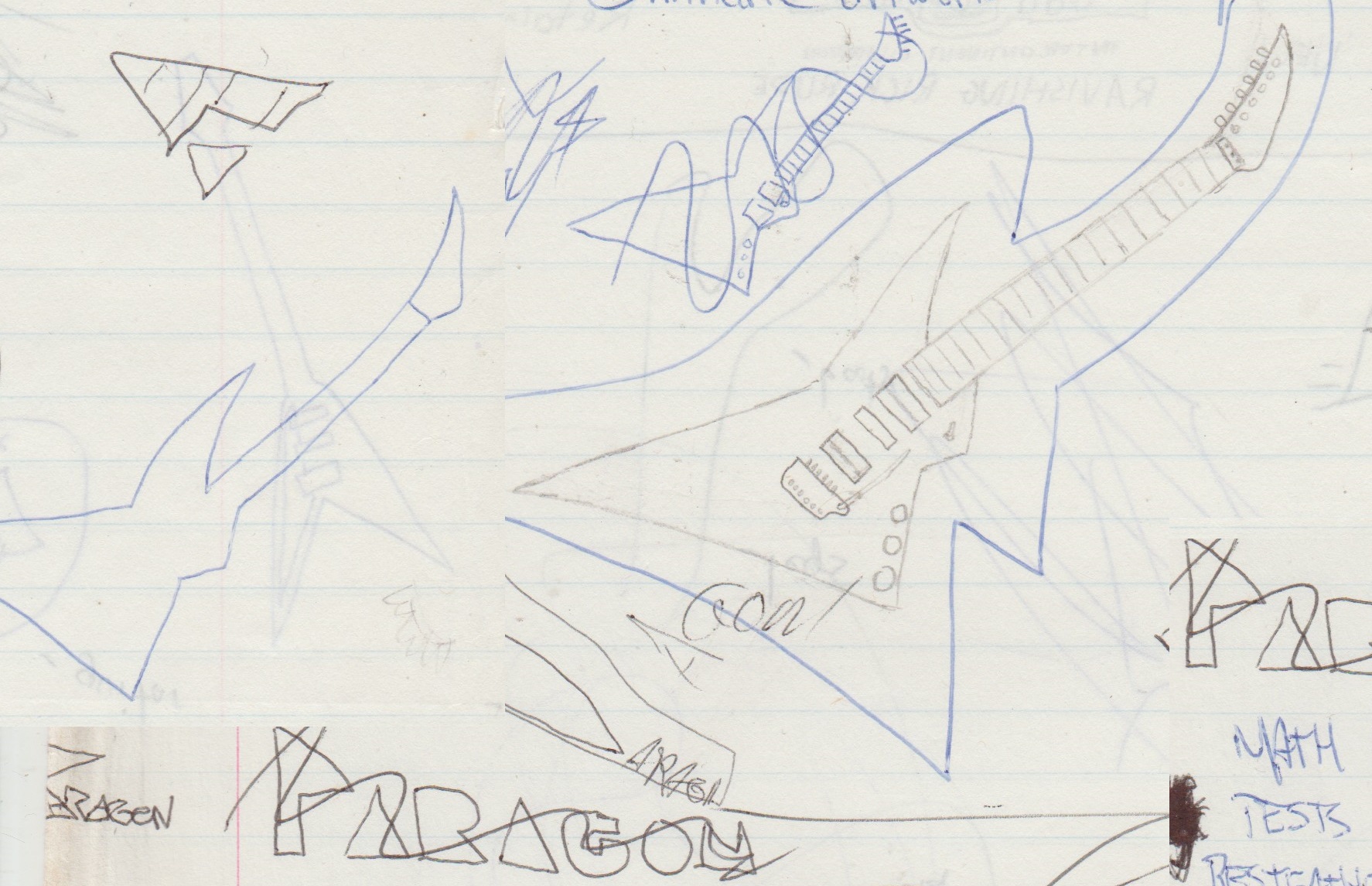
Although I wouldn’t fully confess my deep love of hockey stick guitars to Gary, I found drawings in my old school books that prove it beyond a shadow of doubt.  See below, this page removed from a grade 11 history note book.  I found three hockey sticks on one page alone!

I clearly liked the shape.  The proof is in the puddin’, or in this case, the 30 year old notebooks that I kept for occasions such as this.

Whammy bar, too.  Floyd Rose, no doubt.  Two open-coil humbucker pickups and a single coil in the middle.  Not a very common arrangement.  Was I trying to combine the best properties of a Fender and a Gibson?  Or was I just doodling?  The latter, most likely.  I screwed up the tuning pegs.  For all I remember, that mysterious top pickup might have just been for flash bombs like Ace Frehley’s.

The guitars do look a little silly today, but the 80s were a different time.  Every band had a shredder and you had to do whatever you could to look different.  Savatage’s dual hockey sticks complemented their jagged logo and looked damn cool being foisted in the “Gutter Ballet” video.

Raise a goblet of whatever you’re drinking, and let’s salute the hockey stick.  With all due respect to Gary Mertz, looking cool, young and lethal on stage used to mean something.  We all wanted to stand out, and a hockey stick was one way to add to an image.  I always wanted one!  Just watch your bandmates’ eyes when you’re swinging it around.  Taking an eye out is a lot worse than high sticking!