The LeBrain Train: 2000 Words or More with Mike Ladano
Episode 52 – Best of the Bootlegs
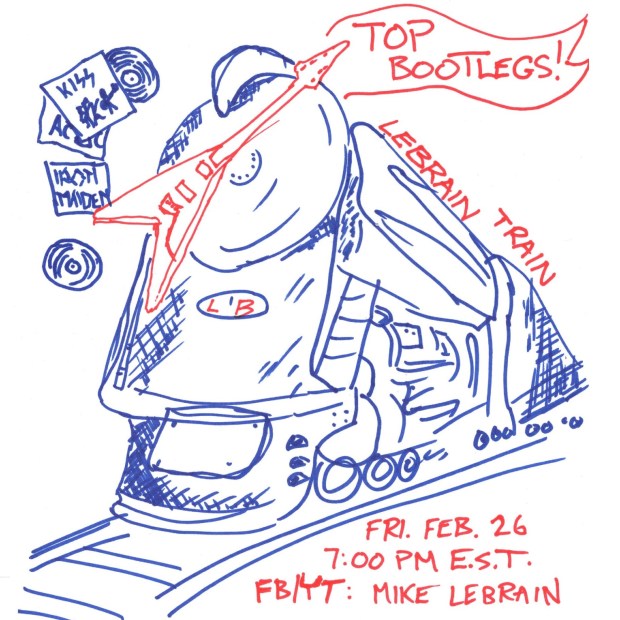
This live broadcast of the LeBrain Train is brought to you by John “2Loud2OldMusic” and Harrison the “MadMetalMan“! They have driven the demand for a show about our favourite bootleg recordings. Bonus: you can also expect to hear from Kevin “BuriedOnMars” about his favourites too!
What are bootlegs? The simplest definition is this: a recording, usually live, released without authorization, or knowledge of the artists. Also without compensation to the artist! Most bootlegs are audience recordings (covertly sneaking a tape recorder into a gig), some are soundboards. We will we be talking about LPs, CDs, cassettes, VHS tapes and even Youtube videos.
Take a glimpse into our personal music collections with this rough and raw episode of the LeBrain Train!
THE MIGHTY MIGHTY BOSSTONES – Let’s Face It (1997 Mercury)
Once upon a time I thought Dicky Barrett was the most ridiculous singer I ever heard. That still might be true. His low growl is part Tom Waits and part Sherman tank. Fortunately the three piece horn section of the Mighty Mighty Bosstones is capable of delivering all the good clean melodic hooks. This leaves Barrett to deliver verbal gut punches while gargling glass mixed with sandpaper. 1997’s Let’s Face It was their breakthrough. It’s a fine honing of their frantic ska-punk rave ups with a commercial understanding.
All the tracks are dance-able, it’s just a matter of slow or fast. Most are fast! “Noise Brigade” starts the party with some serious skanking, but the Bosstones give you a chance to breathe on hit “The Rascal King”. You can sing along while you get down: “The last hoorah? Nah I’d do it again!” Gentler reggae picking soon gives way to a chorus full of punch. The horns (Tim “Johnny Vegas” Burton – sax, Kevin Lenear – sax, and Dennis Brockenborough – trombone) are a major part of another big hit, “Royal Oil”. Great trombone solo, and upbeat chorus despire its dire anti-drug message.
This cluster of hits concludes with the big one, “The Impression That I Get”, #1 on the Canadian rock charts, was all over the place in ’97-’98. For good reason. If you could distil the Bosstones down to a chewable concentrate, it would probably taste exactly like “The Impression That I Get”. Written by Barrett and bassist Joe Gittleman, it’s simply impossible not to move to this one. The hooks that the horns deliver are just important as the chorus. Both are equally timeless. Nate Albert on guitar is the rhythmic master of ceremony, with the tricky offbeat reggae stylings mixed with metal pick slides. While we’re handing out kudos, drummer Joe Sirois hits hard, but check out his cool shuffle at the end of the song. Meanwhile, dancer Ben Carr makes his biggest impression (that I get) in the music video, as the newspaper-reading dude in a suit just dancing through various shots. Brilliant video, too — cool use of backwards photography at the start. The stark white background with the sleak dark suits matches the whole image and vibe of the Let’s Face It album. Barrett looks about to burst of blood vessel when delivering that yell before the chorus. The video was always in heavy rotation in Canada that year.
It doesn’t matter that there aren’t any singles left, because this is an album of great songs from top to bottom. The title track could have been a fourth single. Upbeat with hooky horns and a very important message: “We sure weren’t put here to hate, be racist, be sexist, be bigots, be sure. We won’t stand for your hate.” Two decades before “woke” culture”, the Bosstones were already leading the charge. And the message is as true then or now.
They take it heavy again on “That Bug Bit Me”, but with the horn section to the melodic rescue. Nate Albert’s penchant for the odd metal hook makes a return, but the horns dominate “Another Drinkin’ Song”. It starts slow and ominous but picks up and turns on the party hooks once more. “Numbered Days” lets a guitar riff stand out, but Barrett’s barrelling baritone is a force to reckon with here.
Through to the end, there are no low points. It’s just a matter of style and what hooks are the ones that stick. “Break So Easily”, “Nevermind Me”, and “Desensitized” all hit the mark. But closer “1-2-8” is mental. And that’s the party in 33 minutes. Over before you know it. A perfect album.
RECORD STORE TALES #883: Live! Bootlegs – the Prequel
I didn’t discover “bootlegs” right away. But inevitably, I had my first encounter and was confused by what I saw.
The setting: Dr. Disc, 1988 or ’89. Downtown Kitchener. In the store with best friend Bob and one of his friends. Browsing in the cassettes, I had worked my way over to Guns N’ Roses, a band I was still learning about. Something about an EP that came before Appetite? But what I saw was not that. In fact, there multiple Guns bootlegs in their cassette section, only I didn’t know they were called “bootlegs”, or what that even meant. Each one seemed to have a different member on the front. One had Slash, one had Axl, one even had Izzy. They were printed on different coloured paper. They had songs I never heard, like “Knockin’ on Heaven’s Door”. Live shows from the last few years.
Were they official releases? They had to be if they were sitting there in a store, right? But A&A Records at the mall didn’t have these.
I didn’t get of the Guns tapes. I didn’t have the money, and even if I did, I wouldn’t have taken a chance.
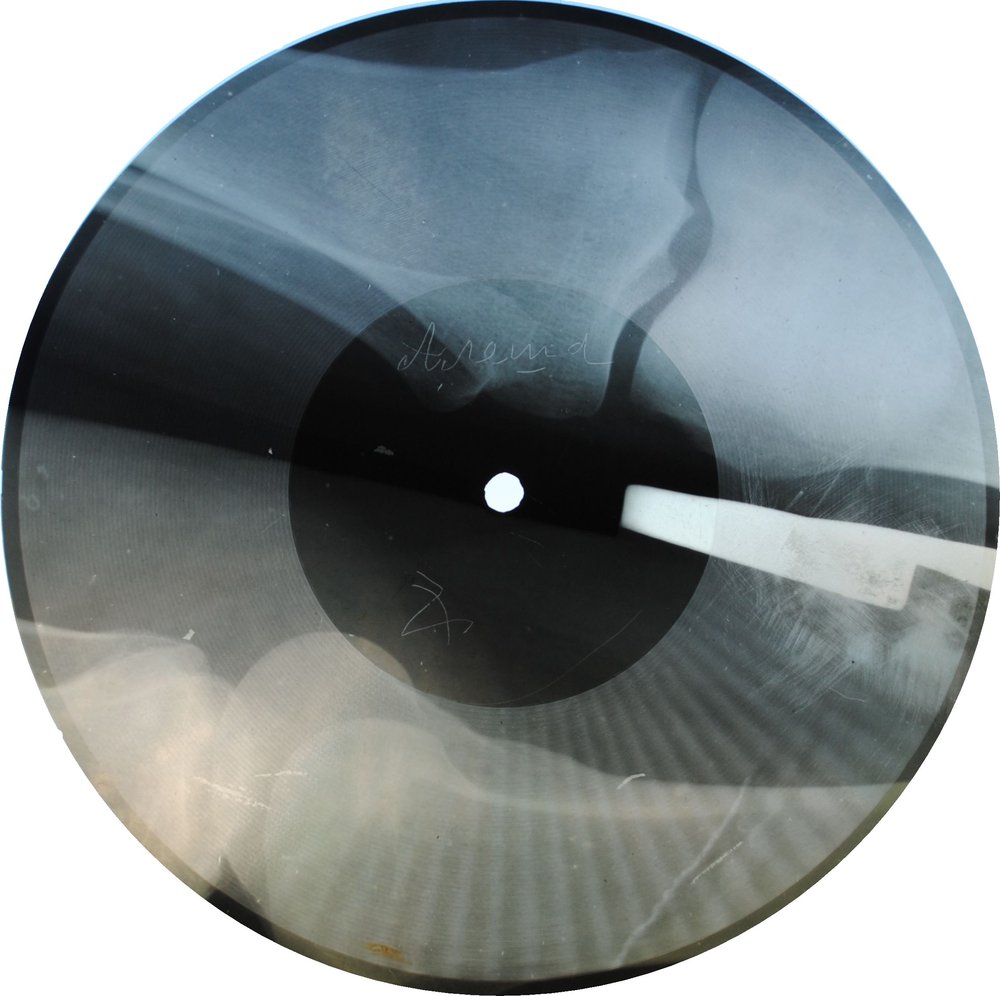
My knowledge of bootlegs was limited. In my mind, I associated the word with the kind of bootleg records they had to buy in communist Russia. Since you could not buy American music in the Soviet Union in the time of the Iron Curtain, fans got creative. There is a famous series of Beatles bootleg records, etched into X-ray photographs. It was the right kind of material to cut the music on. Like a flexi-disc. When I heard the word “bootleg album”, I associated it with an album that was illegal to own, but somehow you got a copy of a copy. Not live recordings smuggled out of a gig and sold for profit.
I finally put the pieces together when I bought the book Kiss On Fire on December 27, 1990. In the back: a massive list of live Kiss bootlegs, from Wicked Lester to the Asylum tour. Tracklists, cover art, the works. Suddenly, it clicked.
“These must be bootlegs!” I whispered to myself in awe.
“We must have them,” said my OCD to my unconscious self.
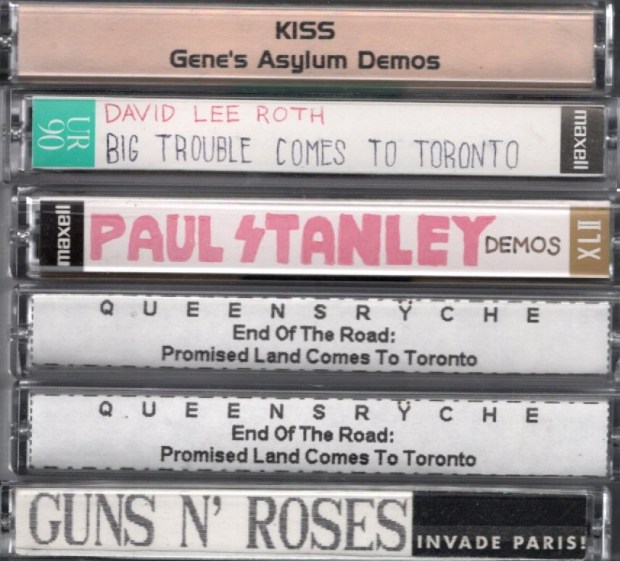
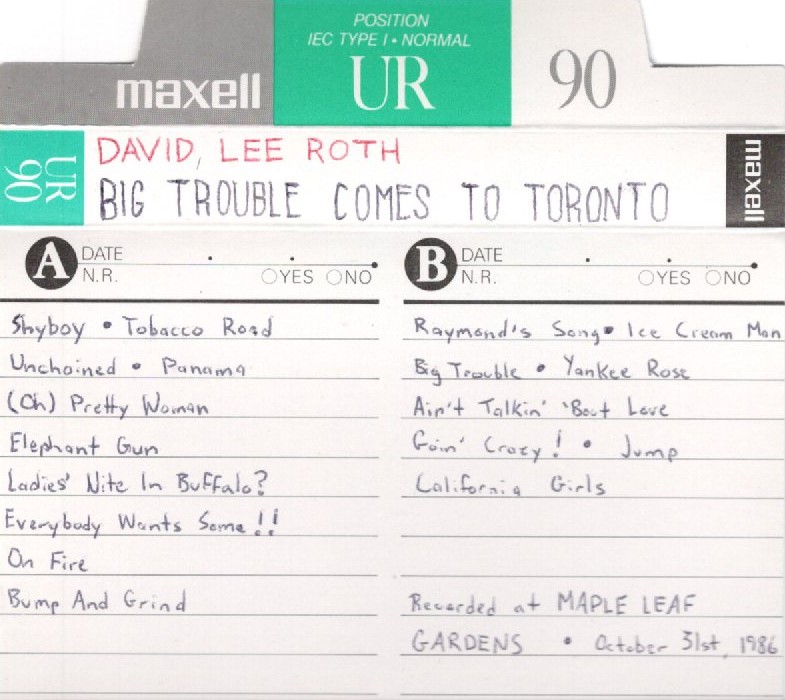
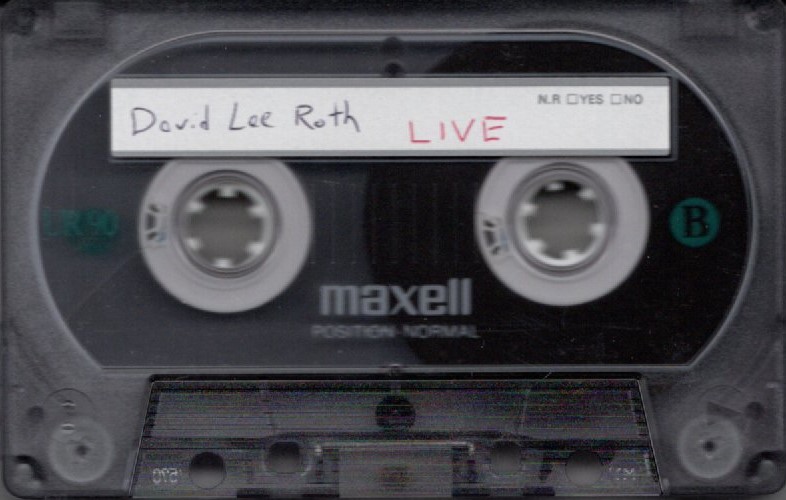
I acquired my first live bootleg from Rob Vuckovich in 1992. It was David Lee Roth live in Toronto on the Eat ‘Em and Smile tour with Steve Vai. It was just a taped copy on a Maxell UR 90, but it was my first. My sister got an early Barenaked Ladies gig on tape shortly after, including the rare “I’m in Love With a McDonald’s Girl”. Then in 1994 she bootlegged her own Barenaked Ladies show on the Maybe You Should Drive tour!
Around this time, my sister and I also started attending record shows a couple times a year. Bootlegs were now available on CD. And there were many. Who to choose?
Black Sabbath with Ozzy, or with Dio? Def Leppard before Rick Allen was even in the band? Deep Purple, Led Zeppelin, Motley Crue’s final gig with Vince Neil…so many to choose from!
Interestingly enough, the idea of one band member being on the cover art carried into the CD age. By my side at one show was Bob once again. I flipped through the Kiss. There were so many! I picked one out with Gene on the cover. Not knowing what bootlegs were himself, Bob thought they were solo albums. “Don’t get one with just Gene!” he advised. It wasn’t something I wanted anyway — it was from the Animalize tour, which I already had represented on VHS at home. I wanted something I didn’t have anything from yet. There it was! The Revenge club tour! Unholy Kisses, they called the disc. Stupid name, great setlist. I only hoped it sounded good when I got it home. They used to let you listen to it before you bought it, but I think I was too shy and just bought it. As it turns out, I loved it. Every thump and every shout.
That’s the thing about bootlegs. You really never knew what the sound was going to be like. Or even if the gig advertised was the gig you were buying. Or just because it sounded good at the start, will it still sound good at the end? Or did the guy recording it have to move to a different seat next to a loud dude? A soundboard recording was almost a too-good-to-be-true find. One thing you were certain not to hear: overdubs. No overdubs on a bootleg! They were raw and authentic.
I had made a good “first bootleg” purchase. A whole new world opened before me. There were not just live bootlegs, no! Also demos, remixes, even B-sides. And among them, some great, and some dreadfully bad choices!
Hear about some of the great ones this Friday, February 26 on the LeBrain Train: 2000 Words or More with Mike Ladano
DAVID LEE ROTH – Big Trouble Comes to Toronto – Maple Leaf Gardens 10/31/86 (bootleg cassette)
This cassette is a second generation, recorded from a buddy (with good equipment at least) in 1992. My first bootleg. It opens with a Van Halen-era interview with David Lee Roth about “precision rock”. The crackle of original vinyl is audible.
A nice fade-in brings Steve Vai’s guitar to the fore, and then it’s wide open into “Shyboy”. High octane, even though it’s just an audience recorded cassette with not enough volume on the guitar. Without pause they rock into “Tobacco Road”. Gregg Bissonette’s toms a-thunderin’. Vai certainly needs no help in hitting all the guitar hooks that he baked into the vinyl, just with more flair and energy.
Dave has never shied away from Van Halen hits or deep cuts. “Unchained”, “Panama” and “Pretty Woman” are the first three. The bass rumblings are unlike anything Michael Anthony played on the original. The backing vocals are far more elaborate. Like in Van Halen, “Unchained” is interrupted part way, but this time it’s so Dave can ask what you think of his new band! Pretty hot. After “Unchained” he stops to talk to a “pretty Canadian girl”. “Panama” sounds a little odd with Brett Tuggle’s keyboards so prominent in the mix. And it’s also way way way too long, with Dave trying to figure out who is reaching down between whose legs, but that’s Dave. You don’t go to the show just to hear the music. You go to see the whole schtick. You put in the quarter, you gotta let the jukebox play the whole thing out.
“Pretty Woman” is zipped through fairly quickly (with one audience participation stop), going into Dave’s rabid “Elephant Gun” and the slick “Ladies’ Night in Buffalo?” “Elephant Gun” features solos galore that would have been pretty awesome to see up close. It sounds like there’s a vinyl side break before heading into “Buffalo”. Vai’s guitar is the star here, in an extended solo backed only by Tuggle. This turns into a dual bass/guitar call-and-answer.
When Bissonette starts on those tribal beats, you know it’s Van Halen’s “Everybody Wants Some!!” This great version includes a drum solo. Next it’s “On Fire” from the Van Halen debut. Dave asks for the guitars to be turned up – we agree. “On Fire” with keyboards and Vai noodling is a different animal. After Dave’s original “Bump and Grind”, it’s time to flip the tape.
Side two opens with some of Dave’s acoustic strummin’, and a story called “Raymond’s Song”. It’s just an excuse for him to say “Toronto” a whole lotsa times before introducing “Ice Cream Man”. Which completely smokes. Vai puts his own space-age spin on it, and Tuggle adds boogie piano, but this is one wicked version!
Dave’s solo track “Big Trouble” has plenty of atmosphere and fireworks for the Toronto crowd, but “Yankee Rose” is just nuts. Nothing but the hits from here on in: “Ain’t Talkin’ ‘Bout Love”, “Goin’ Crazy!”, “Jump” and “California Girls”. The heavy riff of “Ain’t Talkin’ ‘Bout Love” sounds great in Steve’s hands, who doesn’t go too crazy with it. Of course there has to be another long break in the middle (too many breaks at this point now). This time it’s so Dave can get Stevie to make his guitar say “Toronto kicks ass, because the chicks are so fine”. The rest of the songs are somewhat fluffy, the pop stuff, and rendered a little sweet with the added shimmer of Brett Tuggle. “Jump” misses the deeper tone of Eddie’s Oberheim OBXA.
It’s worth noting that Roth closes with “California Girls”, not “Jump”. His solo career is the point, not Van Halen, he seems to be saying. This is the cherry on top. Roth hands it to his new band several times in the show — he knew they had to deliver, and they did. And he wants people to know that he has a band that can compete with his old group.
The show is complete, and apparently Dave didn’t play “Just a Gigolo” on this tour. The opening act in Toronto was Cinderella, supporting Night Songs.
Sometimes you wish Dave would get on with it and play the next song, but that’s only because this is a cassette bootleg being played on a Technics RS-TR272. If you were there in Toronto on the Eat ‘Em and Smile tour, you’d be eating up every word Dave laid down. He is the master of the stage. Sure, it doesn’t always translate to tape but that’s the nature of Dave’s live show, isn’t it? It’s precision rock — visually and audibly combined.
4.5/5 stars (for what the show must have been in person)
Working retail means you can’t control who you see on a day-to-day basis. Faces from the past are part of the job. Teachers, old neighbours, bullies, and so on. Sometimes it’s not a face you really cared to see again. For example, there was this one kid named Terry Moulton from grade school. He was known as a burnout even in grade eight. The word in class is that he would skip to go and smoke pot with his dad. One day I was working and who should show up to sell me some used CDs but Terry. He recognized me. I’m not so good with faces from the that long ago, but I remembered the name. I made him a generous offer on the discs, and asked for his ID. We had to ask for ID in order to buy anything used from the public. Part of theft prevention. Of course Terry didn’t have any ID so I skipped that part for him as a favour. I asked for his address and he didn’t even have a fixed address. I broke a few bi-laws by buying discs from him that day.
My journal records another encounter with a forgotten face from the Catholic school days.
Kevin Kirby’s name was ingrained in my memory even if I didn’t recognize his face. Kirby was into metal when none of the other kids were. He had Black Sabbath, Van Halen and Ozzy records thanks to an older sister. He was my “friend” I guess. Friends by circumstance, not by choice? Frenemies? He copied my homework. He pushed me around. He made fun of me. Once he picked on me, and I fought back, so he cried to his mom about it. His mom called the school.
According to my journal the last time I saw him was in 2004.
Date: 2004/08/04
An interesting day, thus far.
A couple assholes, but not many in general.
Saw Jessica, waved hello.*
Then a dude with a mullet came in. Bought a CD. Asked if I remembered him. He knew my name. Kevin Kirby it was…guy who used to pick on me in grade eight. Nice to see ya, pal.
He might have been into good music, but he was a prick to me in our last year of school together. Don’t care if I ever see him again.
Star Trek IV: The Voyage Home (1986) is remembered for many things, all of them good. People call it “the one with the whales”, but I call it “the funny one”. It really was the closest they got to doing flat-out comedy. (Don’t forget: director Leonard Nimoy also directed the hit comedy Three Men and a Baby.) As the second-best Trek (behind The Wrath of Khan), The Voyage Home was successful by utilising the old reliable time travel gimmick.
Sending the crew of the USS Enterprise HMS Bounty back in time to 1986 set up numerous fish-out-of-water sequences. One of the funniest involved Spock and Kirk on a bus, annoyed by a punk rocker playing a song called “I Hate You” on a boombox.
Just where is our future, the things we’ve done and said! Let’s just push the button, we’d be better off dead! ‘Cause I hate you! And I berate you! And I can’t wait to get to you!
The sins of all our fathers, being dumped on us the sons. The only choice we’re given is how many megatons? And I eschew you! And I say screw you! And I hope you’re blue, too.
With a single-fingered gesture, the punk refuses to turn it down. Spock makes the point moot with an ol’ neck pinch. It’s a brilliant scene.
“I Hate You” was written and performed by associate producer Kirk Thatcher, who also played the punk in the scene. The full song was never heard in the movie, only a few seconds. Now you can hear the whole thing on Youtube. Enjoy!
RECORD STORE TALES #881: The Return of the Record Store Tales
A minor announcement, but an announcement nonetheless! As of this chapter, for all of my stories going forward, I have decided to retire the name Getting More Tale. I am returning to the original moniker of Record Store Tales.
It’s really always intended to be considered one body of work.
One of the most important parts of the original Record Store Tales was the “ending” — quitting the store in Part 320. That series of events was one I was really anxious to tell, so when the time felt right, I got it done and wrapped Record Store Tales up in a lil’ bow. I then broadened the scope of my stories with the “sequel” series Getting More Tale (title suggested by Aaron of the KMA).
Getting More Tale has often dipped back into the Record Store days for subject matter, as well as childhood, and the 15 years since I quit. I’ve also told stories about technology and historic records. The sky was the limit when I changed the name to Getting More Tale…but I have always identified as a “Record Store guy”. Even if it has been 15 years since I last worked behind a counter…once a Record Store guy, always a Record Store guy.
The 12 years I spent in the store were 12 of the defining years of my life, from the highest highs to the lowest lows. But to quote a song, “It’s My Life” and calling the whole she-bang “Record Store Tales” feels right. Even if roughly half the stories have nothing to do with working in a store, “you are what you is”. Today I may be a guy who works in the steel industry, but I will always be a guy who managed a Record Store, and proud of it!
So there you have it; the lines shall no longer be blurred. The ongoing story of Mike LeBrain, former Record Store manager, obsessive music collector and all-around open book, shall henceforce be known once more as the Record Store Tales.*
The content is not changing one iota. I have the next 10 chapters locked and loaded, with subject matter covering the whole gamut. Childhood musical flashbacks, working behind the counter in the glory years, school daze, old tech, bad dates, toys, and maybe even some controversy. I continue to be excited to bring you stories that you seem to enjoy! It has been been over six years since I “wrapped up” Record Store Tales. There was backlash to the ending. But that only emboldened me. My writing has improved ten-fold since. I’m proud to fly the flag of Record Store Tales again.
Thanks for reading all these years! It has been an organic experience and for nine years you have been an integral part of it. Let’s go forward, shall we?
To be continued….
* I won’t be going back and re-naming anything, I will just be carrying on the numbering system will the title Record Store Tales.
Concept albums! A marathon session with a five person panel. The best concept albums in the history of music (the earliest dating back to 1918). Genre busting lists. A rush of inspiring music, from hip to elders.
Aaron kept tabs on the titles and I’ll post them when I get a chance. There was one album that was a clear winner, and one subject that crossed over multiple albums. You’ll just have to watch to see for yourself.*
There was some preamble chat about the latest episode of WandaVision, and a bit on Desmond Child. We hit the lists at 0:21:30 of the stream.
Thanks for checking it out! Tune in next week for Top Bootlegs with Harrison Kopp, John T. Snow, Buried On Mars and maybe more. Cheers!
* If you don’t want to see for yourself, you can try to read Aaron’s hand-written notes below!
The LeBrain Train: 2000 Words or More with Mike Ladano
Episode 51 – Nigel Tufnel Top Ten Concept Albums
This show doesn’t need a lot of preamble. It’s another list show and it’s another great panel! “Top Concept Albums” was the topic suggested by Rob Daniels. A subject so good, I’m amazed it took this long to get to it. What’s a concept album? One of those records that tells a story. We’re keeping the definitions broad.
Please give Rob a warm welcome back to the show for his first appearance of 2021.
Whether the lead character of the story is Pink, Kilroy, Torch, or perhaps one of the many nameless protagonists throughout rock history, this is the show you want to catch. By the end, we hope you say “I didn’t know they made a concept album,” to some of our picks.
One of my favourite ways to spend a Saturday morning was down in the basement drawing pictures while listening to heavy metal music with my best buddy Bob. Most likely, we were watching one of my VHS tapes of the Pepsi Power Hour while doodling away with our pencils. It was the best of times, with the best of friends, and the absolute best kind of music.
In the early to mid 1980s, MuchMusic was only available on pay TV. We had it, but Bob Schipper did not. Therefore he only had two pathways to the Pepsi Power Hour:
Wait for the one or two weeks per year when pay TV was free for sneak preview.
I tape the videos, and share my finds with him on Saturday mornings.
It was an amazing way to bond as kids. He brought with him his paper and pencils, and we would get down to business while watching music videos.
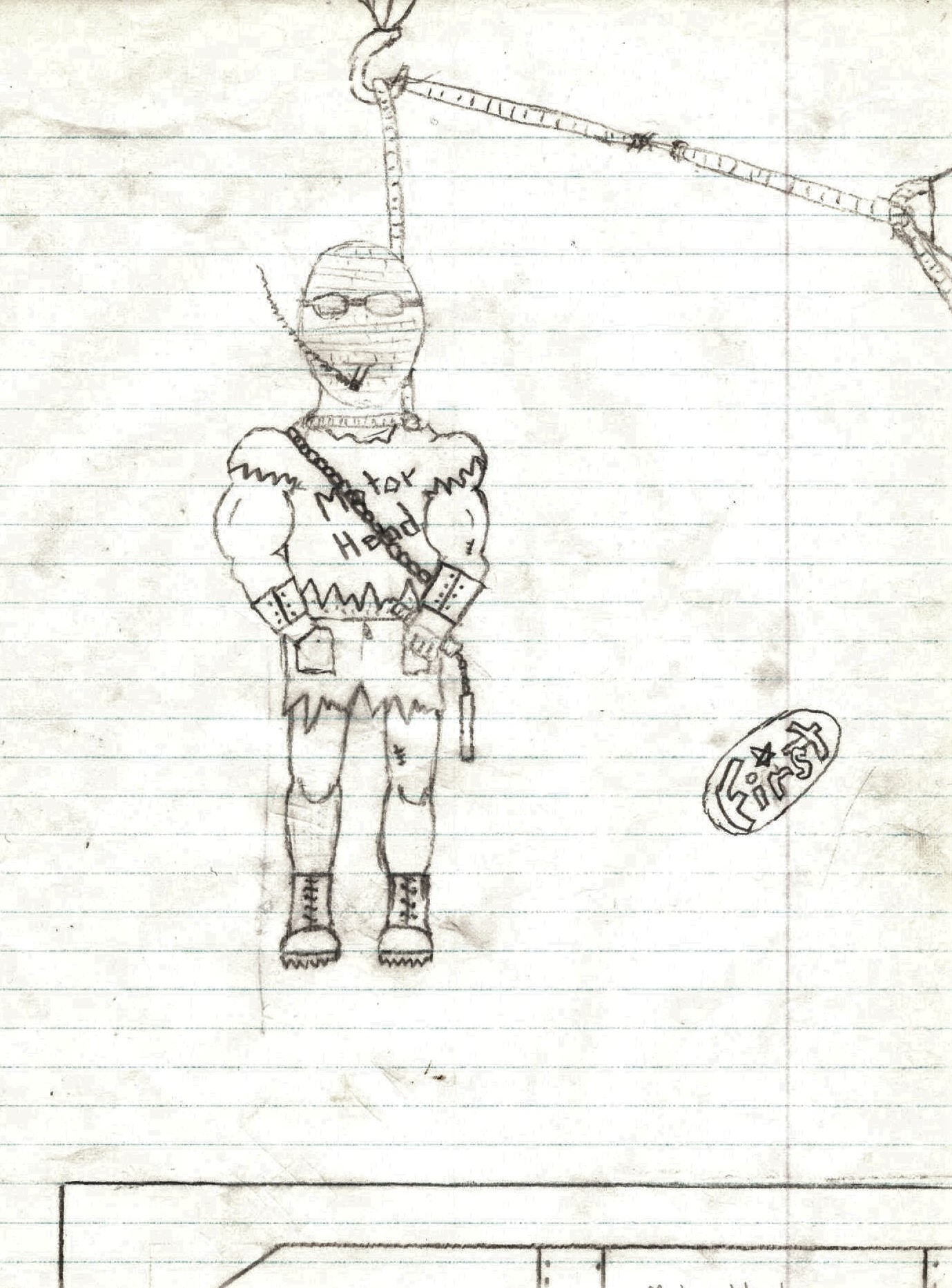
In the summer, we moved activities to the front or back porches, with a ghetto blaster playing Kiss or Iron Maiden as we sketched. In fact, the story really begins on the back porch. The very same back porch on which we schooled George Balasz about Accept. Bob had mastered the art of drawing muscled warriors in cool poses. His very first was a master of escape whom he dubbed “Motor Head”. In his first appearance, he seems doomed, hanging from a noose. But a closer look reveals him casually smoking a cigarette and holding a pair of nun-chucks for his imminent escape. Note the frayed rope. He was in no danger – he was biding his time!
Having mastered this first character, it was time to expand on the concept. Bob drew many different designs and body types. Giants, archers, characters with cybernetic limbs…the field was wide open, but heavy metal music was always an influence.
Bob’s second sketch was a man in a metal Quiet Riot mask he named “Killer”. Killer was one of Bob’s favourites. As his drawing abilities grew, he expanded upon Killer. Next, he designed a custom car and robotic pet for the character. I liked the way he used metal plates and rivets for detail.
Bob taught me the secrets of drawing these heroic figures, and I began to create my own warriors. The characters we were sketching resembled Mad Max marauders, crossed with heavy metal tropes. Really, all of that metal stuff was inspired by the post-apocalyptic fiction genre that was all the rage in the early 80s. Nobody did it better than Mad Max, and many of our characters wore masks like Lord Humungous. Others had bandaged faces, like Eddie in some of the Powerslave-era Iron Maiden artwork. Some wielded ninja-like weapons, since ninja movies were also all the rage at the time.
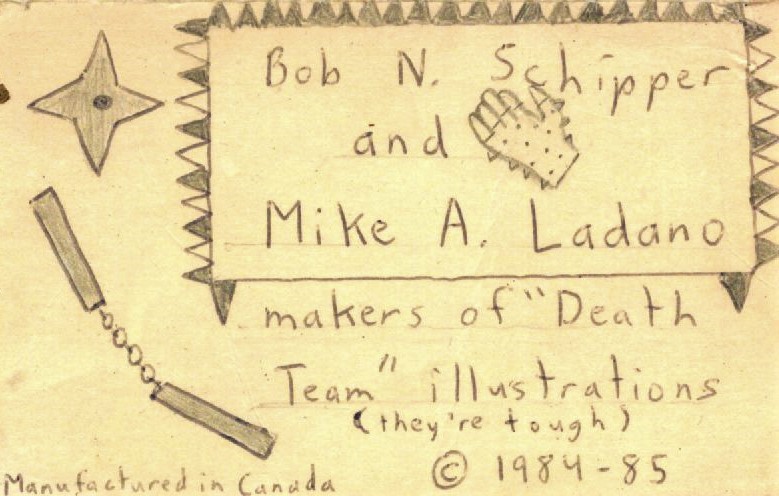
We called our characters “Death Team”.
Bob’s backstory concept of Death Team was a school gang, with a strong influence from martial arts movies. The idea was that the gang evolves into a government-sanctioned fighting force. That meant no limits. The cars and trucks that we drew were armoured and kitted out. Very much inspired by M.A.S.K., Mad Max, and other shows of the time. If there was something cool on the screen, we would try to draw it and add our own twists. What I brought to the table was my interest in GI Joe comics, and the military side of fiction. The ninjas were the common ground between Death Team and GI Joe, and many of my characters had weapons and outfits inspired by the comics. I started giving my characters code names and bios, just like GI Joe, and gave them the inverted star sigil.
At this point during the earliest Death Team drawings, my sister and I had our big musical schism. That means that up until 1985, she was into the same music I was. Well…not W.A.S.P. But she liked Quiet Riot, Motley Crue and Iron Maiden. Then something happened, and she went into what I called “New Wave”. Pointer Sisters, Corey Hart, Tina Turner. To counter our heavy metal Death Team, she created her own squad called the Wavers. She drew her own team members: “Waver” and “The Wave”. Needless to say, Death Team would have crushed the Wavers in combat.
Bob and I sketched solo, during the week. Then we’d gather on the weekends to share our work. We’d inspire each other and keep drawing more. Those are the Saturday morning Power Hour sessions I remember so fondly.
One weekend, Bob came over excited that he had learned to draw “a really cool bike”. He arrived at my door with his new character “Bike Ninja”. We helped each other name our characters, but that one didn’t need anything fancier than simply “Bike Ninja”. His boots had outward-facing spikes, and his left hand was replaced by a robotic claw with a laser in it.
“That might make it hard for him to ride his bike,” I offered up.
“Nahh!” said Bob. “He’s a ninja!”
My mom noticed that many of the characters were smoking cigarettes. She asked why that was. Bob started putting cigarettes in some of their mouths (even the ones wearing masks) to make them look cooler, so I followed suit. That was the rock and roll influence, as many of our rock star heroes like Eddie Van Halen were constantly smoking. We had no interest in it, but the visual followed into our art.
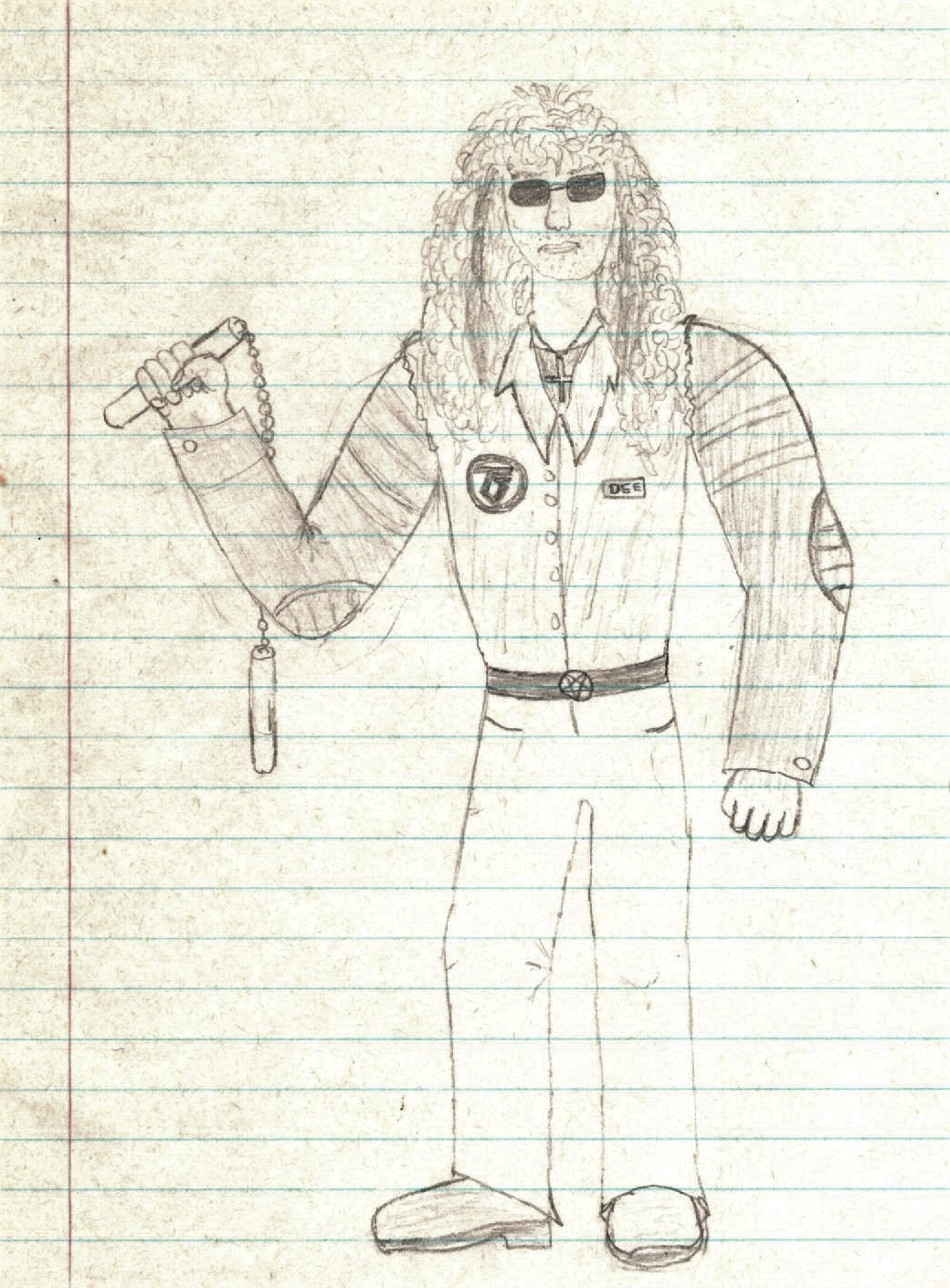
Bob’s art was much better and more original than mine. I improved over time. By 1987 I had finally drawn one I was really proud of, a character all about street justice and inspired by Dee Snider from Twisted Sister. In fact this character was meant to be the real Dee Snider, joining our team to save Earth. The concept was stolen from Sgt. Slaughter, the WWF wrestler who joined the fictional GI Joe team. If that could happen, then Dee Snider could join Death Team!
As Bob and I built our little world of characters on paper, we realized our gang needed someone to fight. Bob was watching the Silver Hawks cartoon before school in the mornings, and took influence from some of the creatures seen on early morning TV. We decided on a force of alien invaders as our adversaries, and a wide variety we did draw.
Bob was really the visual guy though; his drawings were so far ahead of mine. I was more a conceptual guy. I came up with the character bios and some of the overarching story. It was hard bridging the street gang origins together with the alien invasion concept, but I wrote an origin. Together, Bob and I wanted Death Team to be a Canadian team (with some American and overseas volunteers). We wrote them as a down-on-their-luck school gang who lived together on the rough side of town, wherever that was. They actually began as two rival gangs who combined their forces together. We wrote the first pages together and then I finished writing the story. The guys were so tough, that they were swiftly recruited by the Canadian government as a unit of street enforcers. The Death Team was born!
I decided that the leader of the alien invasion was to be a human. Perhaps inspired by Xur in The Last Starfighter, the alien leader was a former Death Team computer wizard who made contact with the aliens by sending a signal through a black hole. He then defected and joined them, determined to conquer the Earth for his own. We even named our alien alliance the “Xor Aliens”.
Bob was really good at drawing aliens, though most had human bodies with alien heads, hands and feet. Some were covered with hair. He was good at drawing big round mouths with a circular row of teeth. I thought that was a cool visual. Many of ours were aquatic. Planet Xor must have had a lot of oceans.
When I look back at these drawings, I see a difference between Bob and I. It’s quality vs. quantity. His are better while mine are plentiful. Some of mine were little more than outlines with no shading or depth. Plenty of mine are rip-offs. He was coming up his own ideas. The thing we have in common, easily seen in these sketches, is how much fun we had!
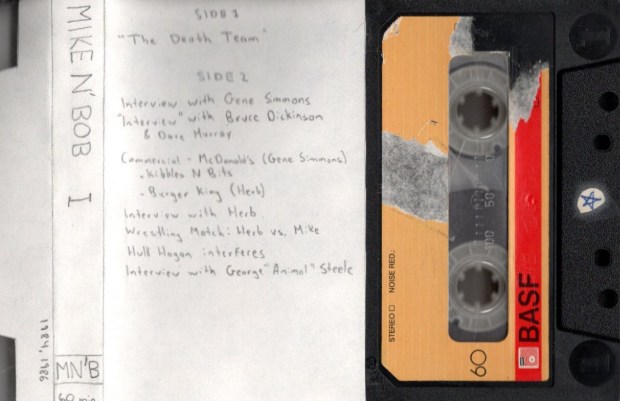
The pinnacle of of our fun was realized one afternoon when we decided to commit Death Tape to an audio adventure. One side of a 60 minute tape contains us acting out our favourite characters, in a series of adventures. This is all done to the backing tracks of great hard rock tunes. It opens with “In the Beginning” and “Shout at the Devil” by the mighty Motley Crue. This meant we used two ghetto blasters in making this tape. One to record, and one to play the backing music while we acted out the scenes. Quiet Riot’s “Slick Black Cadillac” and “Caught in the Crossfire” by April Wine were the songs used for the other scenes. I just remember having so much fun doing it. It didn’t matter if the tape is unlistenable. My face was red from laughing so hard that day.
All this Death Team stuff goes hand-in-hand with the earliest days of my discovery of metal. You can see the influences bleeding through. Characters named “Motor Head” and “Killer” and “Helix” and “Crazee” and “Iron Maiden”. We weren’t terribly original, but we were terrifically entertained. Entertained by ourselves! All we needed was some paper, some sharp pencils, and a good song. I can still hear the tunes playing, whether it was W.A.S.P. or Motley Crue or Iron Maiden themselves. The tunes were critical. The team could not have existed with the tunes, and the tunes were only more fun to listen to while drawing pictures of the team.
Later on in school, when I was much better at art, I tried my hand at doing a sequel team, called “DT 2”. I played the music, and tried to recreate the magic by sitting down and drawing some updated ninjas. Without my friend it was a futile exercise. Death Team cannot exist without three things:













You must be logged in to post a comment.