bruce fairbairn

REVIEW: Aerosmith – Pump (1989 collector’s faux leather edition)

AEROSMITH – Pump (1989 Geffen collector’s faux leather edition)

When speaking of Aerosmith “classics”, fans often skip over the 80’s or 90’s and talk singly about the 1970’s.  This is unfair to 1989’s Pump, a bonafide classic indeed, a rebirth, an all-too-brief twinkling of Aerosmith turning back the clock and smoothly kicking your behind.  Sure, Permanent Vacation brought them back from the dead and provided three surprise hit singles.   But that album wasn’t as laser-focused as Pump.

Teaming up for a second time with the late great Canadian producer extraordinaire Bruce Fairbairn, Aerosmith (and co-writers) cooked a short and sweet batch up.  10 songs, all to the point and done “just right”.  That’s how Aerosmith albums were in the 70’s, and Pump is as close as they have ever been able to touch that magical golden era.

Incidentally, if you’re curious about how this album was made, there was an excellent behind the scenes doc called The Making of Pump that was out on VHS.  The band were clearly riding a wave of energy, it was palpable in the studio.  There was some conflict but it all seemed productive.  There was a surplus of songs.  Titles such as “Looking Up Your Old Address” and “News For You Baby” were dropped in favour of stronger songs — the 10 on Pump.

“Young Lust” and “F.I.N.E.” have always seemed to work as a supercharged pair.  The band sound young, therefore “Young Lust”!  Joey Kramer on the skins propels the whole thing forward, aided and abetted by Tom Hamilton’s unmistakable bass slink.  Whitford and Perry — locked on to target, supporting and boosting each other’s licks.  And Steven Tyler, always the centrepiece, keeping the attention focused on the hooks.  “I got a brand new record, and I gotta play,” he sings, and you have to believe it.  When Aerosmith have all five members firing at peak performance, then you have one hell of a lethal weapon.

We don’t need to address “Love in an Elevator”; it’s all been said.  All you really need to focus on when listening to this overplayed radio staple is the musicianship.  All these years later, it’s still smoking hot.  Hamilton’s bass rides that riff like a surfer.

Aerosmith weren’t a preachy band, but they were pretty open about their drug usage and recovery.  “Monkey On My Back” was their first real statement about this subject.

“I made believe the devil made me do it,
I was the evil leader of the pack,
You best believe I had it all and then I blew it,
Feedin’ that fuckin’ monkey on my back.”

The reborn Aerosmith infuse it with all the energy and greasy groove required to make their point.  They’re a better band without the powders; deal with it!

“Janie’s Got a Gun” is another track we don’t need to delve into deeply.  It was an innovative and daring track for the time; a real statement from Tyler.  He fought hard for his lyrics.  “Put a bullet in his brain” was changed to “Left him out in the rain” on some edits, which robs the song of its shocking impact.  In my opinion, the real moment people started to pay attention was that line.  And incidentally, this is one of the best songs to watch come to life on the Making of Pump video.  From the initial work on the song with writer Jim Vallance to the punching in of final vocals, you can watch the creative process like a fly on the wall.

A brief but impressive acoustic bit called “Dulcimer Stomp” was used to open side two, right before another hit single, “The Other Side”.  I always appreciated that they included “Dulcimer Stomp” in the music video, even though it’s not part of the single version.  “The Other Side” is probably the safest track on the album, the only one without some kind of edginess.  It does boast some popping horns, a Bruce Fairbairn production trademark.  Bruce is one of the players in the horn section, dubbed the Margarita Horns.  “My Girl” is similarly simple and to the point, although later plagiarized for not one but two songs on 2012’s Music From Another Dimension!  Much more interesting is the heavy duty “Don’t Get Mad, Get Even”.  Swampy, even including didgeridoo, this is one of those Aero-blasts through the blues that Perry and Co. do so well.  Just as awesome is “Voodoo Medicine Man” which is probably the most…ominous…Aerosmith track ever recorded.  It is different and groove-heavy.  Deeply impressive heavy rocking happening here.

Closing out with the ballad “What It Takes” was a classy move.  Unlike some other ballads this band has had hits with over the years, “What It Takes” has a sincerity and authenticity that has kept it from ageing badly.   The country tinge of “What It Takes” foreshadows Steve Tyler’s current solo direction, but in 1989 this was just slightly different for the band.  Listen for a callback to “F.I.N.E.” from side one, and a hidden bonus track.  There’s an unlisted track of acoustic instrumental jamming, an outtake from the sessions, at the very end.  Even incidental bits like “Going Down” and “Dulcimer Stomp” are given their own titles on the CD, but this last jam is left a surprise.

This rare limited edition version of Pump comes in a “leather case”.  There is an outer slipcase, and an inner digipack.  It was manufactured as a promo and then later sold as a limited release at retail.  It’s cool and looks sharp, but there is nothing else exclusive about this release.  It’s a cool find if you happen upon one in your travels, but sticking with the zillions-selling regular CD edition will do you just F.I.N.E. fine.

4.5/5 stars

AERO-REVIEWS:

MORE Aero-Reviews:

aerosmith-pump

REVIEW: Scorpions – Face the Heat (Japanese and Canadian versions)

Part 2 of 2 — for yesterday’s instalment, click here.  For Aaron’s review of the domestic CD, click here!

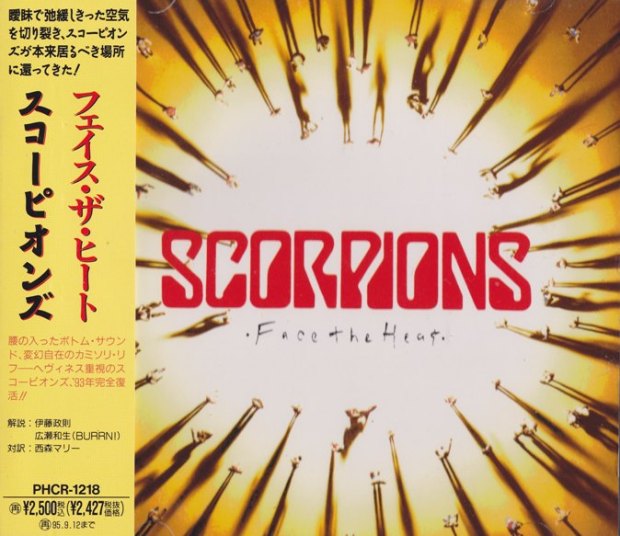
FACE THE HEAT_0002SCORPIONS – Face the Heat (1993 Polygram, Japanese and Canadian versions)

1990’s Crazy World was a huge hit, but before Keith Olsen produced it, Scorpions had approached Canada’s Bruce Fairbairn.  Pleased with his work on their Who cover “I Can’t Explain”, Scorpions prepared to convene in Vancouver with the producer.  They were disappointed when Bruce changed his mind at the last minute when forced to choose between the new Scorpions and AC/DC projects.  Fairbairn chose AC/DC, and the result was the five times platinum (US) Razors Edge album.

Since Crazy World ended up selling two million in the US and another five million worldwide, I’m sure there were no hard feelings between the two parties when they finally did hook up together on the followup album, Face the Heat.  Personally speaking I felt Crazy World wasn’t heavy enough.  I was hoping for more in Face the Heat.  Additionally, this album was the Scorpions’ first since 1972 without bassist Francis Buchholz.  Replacing him was five-stringer Ralph Rieckermann who ended up spending almost a decade with the Scorpions.  Rieckermann was a very different player and added new elements such as slapped bass.

The first single “Alien Nation” showed promise.  A menacing, metallic riff ushered in a tune with some slamming drums (thank you Herman Rarebell), and that ultra-low fifth string on the bass guitar. I preferred “Alien Nation” to just about any song on Crazy World. The year was 1993 and a heavy groove was exactly what the doctor ordered.

“No Pain No Gain” exhibits the Scorpions’ knack for naff song titles. Thankfully it too is a grinding metal groove, showing off Matthias Jabs’ talkbox skills on the guitar. With the Scorpions post-Schenker and post-Roth, you have to expect a certain amount of boneheaded metal. I think these guys genuinely love givin’ er on that trademark, simple sound. I believe they like playing this kind of thing with earnest, so good on them.

Three songs in and “Someone to Touch” is another great little Scorpions rocker. This speedy one won’t tax your brain cells in the lyrical department, but you will find yourself singing along to the chorus without realizing it. The chorus bears the stamp of Fairbairn with its answering lines. After this much firepower, I don’t mind a ballad and “Under the Same Sun” (perhaps a sequel to the worldwide hit “Wind of Change”) is a good one. Besides, Scorpions follow it by firing off another rocker called “Unholy Alliance”, another knockout with a great chorus. This helps lessen the impact of the next ballad, “Woman”. “Woman” is very different from “Under the Same Sun”, being dark and mournful. Another success.

Unfortunately, Face the Heat stalls in a major way on side two. A number of boring songs in a row (“Hate To Be Nice”, “Taxman Woman”, “Ship of Fools”, “Nightmare Avenue” boast only a few surprises and memorable moments. Jabs sports a nice fatbody jazz guitar solo on “Hate To Be Nice”, a trick that Fairbairn later encouraged Eddie Van Halen to use on his band’s next album, Balance. Unfortunately, a cool unique solo like this is within the same song as these lyrics:

“Hey baby, listen up,
I’m not in love with you,
You keep runnin’ off at the mouth,
And someone else can scratch my back,
And I could care less about your legs,
I just wanna see ’em walk all over me!”

The last listed track on the domestic CD is the ballad “Lonely Nights”, another really good ballad. Who cares that they just copied the way they ended Crazy World, with a slow dark ballad like “Send Me An Angel”?  All well and good says I, but as I mentioned in yesterday’s instalment of Getting More Tale, the US and Canadian versions of the album have a hidden bonus track!  Way back in ’89, the Scorps and Fairbairn discussed recording an Elvis cover.  Tucked away unlisted after “Lonely Nights” is Elvis Presley’s “His Latest Flame”.  It is a pleasant surprise!  The trombone and trumpets are the perfect added touch.  I’m sure Scorpions grew up listening to a lot of Elvis Presley records, and this version is faultless.  It’s gleeful and authentic sounding despite the fact that it’s the Scorpions!

FACE THE HEAT_0003Neither of the two bonus tracks on the Japanese version of the CD are as good as “His Latest Flame”.  Both are ballads:  “Kami O Shin Jiru”, and “Daddy’s Girl”.  They are inconsequential to casual Scorpions fans who don’t obsessively collect all their songs.  Additionally, they are disappointing to Scorpions collectors who buy these things hoping the extra tracks will be better.  I dig Rieckermann’s fretless bass on “Kami O Shin Jiru”, but these songs only serve to end Face the Heat on an excessively mellow note.  “Daddy’s Girl” is particularly depressing; I don’t want to listen to songs about child abuse — I already know it’s bad!  Scorpions tackle the subject in their usual subtle-as-a-brick fashion.

If only the second half of Face the Heat was as strong as the first.

3/5 stars

#397: Face the Heat (Mail From Sydenham)

Part 1 of 2 — First the tale, tomorrow the review!  This tale itself is a direct sequel to Aaron’s story “Mail From Jedi Master LeBrain”.

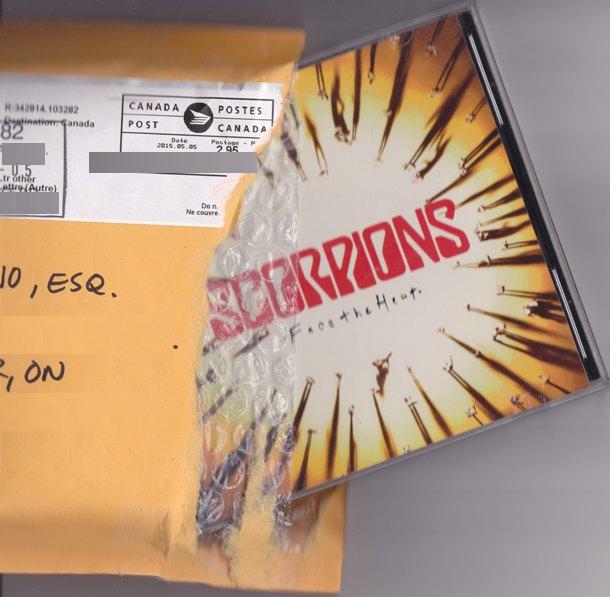
PARCEL FACE THE HEAT

RECORD STORE TALES MkII: Getting More Tale
#397: Face the Heat (Mail From Sydenham)

I collect Japanese imports, especially when there are bonus tracks afoot. A year ago, I found a Japanese copy of Scorpions’ Face the Heat CD with two such bonus tracks. I bought it from one of my favourite vendors, at the Toronto Musical Collectibles Record & CD Sale. It was $15 and complete with obi strip. A steal. (Who says Japanese imports are very expensive anyway?)

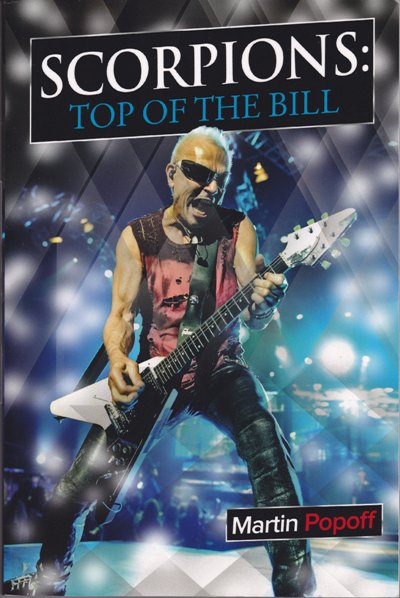
TOP OF THE BILLBecause I try to avoid redundant copies in my collection, I donated my original CD of Face the Heat to Aaron. He reviewed it and called it “a collection of strong songs that gets better as it goes along”. I played my Japanese copy, and filed it away without giving the album much thought until recently. Martin Popoff’s excellent Scorpions tome, Top of the Bill, reminded me of an Elvis cover that Scorpions did as a hidden bonus track.

The Scorpions almost recorded “His Latest Flame” back in 1989 for their hits compilation, Best of Rockers ‘n’ Ballads. It was between Elvis and The Who’s “I Can’t Explain”. “I Can’t Explain” won out, but the Scorps gave it another go in 1993 for Face the Heat. (Incidentally both tracks were produced by the late Bruce Fairbairn.)

“His Latest Flame” was one of the first “hidden bonus tracks” in my collection. It’s very unlike anything the Scorpions had done before, but they did a damn fine job of it in my opinion. I love the horn parts. I’m sure that was Fairbairn’s doing, a trumpet player. It was buried unlisted after the end of “Lonely Nights”, the final song on the CD, as part of the same track. When I read Popoff’s book, I realized, “When I gave Aaron my original CD, I didn’t check if the Japanese CD retained that bonus track…”

Indeed, “LeBrain” the Bonehead did fail to check if “His Latest Flame” was on the Japanese CD, and it is not. It’s very rare to find a domestic CD that has a bonus track not included on a Japanese version, but it does happen, and it did happen on Face the Heat!

Gratefully, when “LeBrain” the Bonehead asked if he could have the disc back, Aaron immediately said “no problem”! He knows the kind of collector I am. He sent it back to me as a part of a recent parcel exchange that we enjoy doing from time to time!

I do appreciate that he was willing to send this “gifted” CD back. It just goes to show how two collectors understand one another! As for Face the Heat, look for my review of both CDs right here tomorrow!

REVIEW: Poison – Flesh & Blood (remastered)

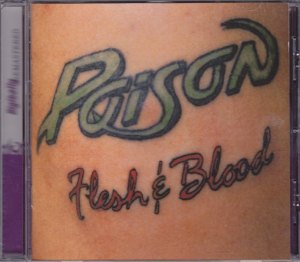
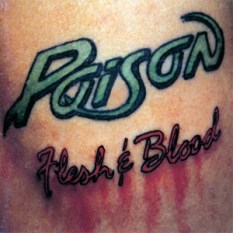
FLESH AND BLOOD_0001POISON – Flesh & Blood (1990, 2006 Capitol remaster)

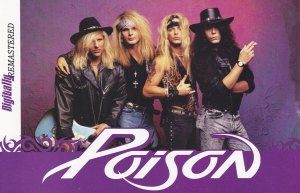
Ah, Poison!  The band everybody loved to hate!  In spite of that, Poison made a couple pretty good albums.  Flesh & Blood is the best of the original C.C. DeVille era, and probably their most successful.  It spawned a huge headlining tour that also produced a double live album.  Flesh & Blood was also their “get serious” album, although in that regard it was only a partial success.  The idea was to write and record more mature music and lyrics, something that C.C. was opposed to.  He saw nothing wrong with the glam-slam-king-of-noize direction that they started on, and maintained that Look What the Cat Dragged In was their high point.  He saw the introduction of blues influences as diluting the Poison sound he liked.

That’s all bullshingles.  Flesh & Blood is the best thing C.C. has done, and is second only to Poison’s Native Tongue album with Richie Kotzen.  C.C. was still far from a great guitar player, but on most tracks it’s his most accessible and least annoying playing.  (On others…well, we’ll get there.)  Take the opening track “Valley of Lost Souls” for example (preceded by a jokey answering machine tape called “Strange Days of Uncle Jack”). “Valley” rocks heavy with integrity and an edge that Poison hadn’t displayed before, and C.C. throws in a lot of tasty, toffee-like strings.  His soloing will never be considered virtuoso, and his tone has always been thin and annoying, but never has C.C. generated such guitar thrills as he does on this album.  (Most of it.)

FLESH AND BLOOD_0002

I’m sure that producer Bruce Fairbairn steered this ship with a firm hand.  His stamp is all over Flesh & Blood:  from weird segues to rich backing vocals, this is a Fairbairn production through and through.  Fairbairn was known to be a taskmaster, and I’m sure he worked C.C. (and the whole band) to the bone.  The title track, “(Flesh & Blood) Sacrifice” has his patented, perfectly arranged vocal stamp.  The vocals are layered and almost Leppard-lush.  When we’re talking about a singer like Bret Michaels, you know it’s not going to be Pavarotti.  The credits don’t list additional singers, but there are some names in the tail end of the thank-yous:  Paul Laine, for example.  Laine was a Vancouver local, where Poison recorded the album.  Why is he being thanked?  I think it’s safe to assume that Laine and others helped out in the backing vocals department.  Anyway, “Sacrifice” is the second excellent song in a row.  Say what you like about Poison as performers, they wrote some fucking good songs too.

“Swampjuice (Soul-O)” is some surprisingly good C.C. acoustic blues.  Actually not bad at all — but just instrumental filler.  As is the next song, a massive huge hit single: “Unskinny Bop”.  The song is awful, the lyrics worse, and C.C.’s solo is like razor blades.  I mean that in a bad way.  Total shit.  Garbage.  “Let It Play” verges on filler, but it’s good enough.  It’s simple but memorably melodic.  Better is the timeless sounding single “Life Goes On”.  I liked this bombastic electric ballad then, and I still do now.  Michaels is a limited singer, but this is a damn good ballad.  I give Fairbairn credit for the backing vocal hooks.  The first side of the album closes on the forgettable but adequate hard rocker “Come Hell or High Water”.

Kicking off side two with the single “Ride the Wind” is a no-brainer.  This song sounds like its title.  It sounds like a car song, a rock and roll ode to the thrills of the road.   I’d rank this easily among Poison’s best hits — top five.  “Don’t Give Up an Inch” is filler, but “Something to Believe In” was another huge single.  Hearing it again today, I find it hard to dislike.  I wanted to, but I can’t.  I think Bret wrote some pretty good lyrics here.  The part about his best friend who died “in some Palm Springs hotel room” is about his bodyguard, a guy he was really close to.  It’s pretty heartfelt, and the piano ballad still stands up as well as any by Aerosmith from the same era.

Some boring C.C. pedal steel guitar leads into “Ball and Chain”.  It’s a pretty good rock boogie, but the second-to-last song “Life Loves a Tragedy” is the best track on the album.  Even better than “Ride the Wind” but similar in vibe, this song shoulda woulda coulda been a hit.  The soft intro fools you into thinking it’s a ballad.  It’s not.  It’s a ballsy rocker with another Bret Michaels lyric that you’d call more mature.  “My vices have turned to habits, and my habits have turned to stone,” sings Bret.  “I gotta stop living at a pace that kills, ‘fore I wake up dead.”  Not poetry really, but a hell of a lot better than “Unskinny bop bop, blow me away.”  The chorus kills, as does the whole song.  Another top five Poison track in my book.

The album ends on a pile of shit called “Poor Boy Blues”.  This may well be the worst Poison song of all time.   Of all time!  C.C.’s playing is so pointless, so brutal, so annoying, that I don’t know why somebody didn’t pull the guitar out of his hands.  Wah-wah alone does not a solo make!   This song stinks so bad.  Dammit, Poison, you’re not a blues band fer fuck’s sakes!  This song should have been axed, there is no reason for it to still exist.


POISONThe 2006 remastered edition has two bonus tracks.  The first is a disappointing acoustic version of “Something to Believe In” from the “Life Goes On” single B-side.  It has new lyrics (erasing one of the things I liked about the song) and absolutely pointless guitar playing by C.C.  His solos and melodies go nowhere.  It’s just a guy playing all kinds of notes on an acoustic guitar that don’t have any direction:  There’s no tension, no release, no hooks.  This version sucks.  Lastly there’s “God Save the Queen”, an instrumental demo version.  This too sucks.  More directionless soloing from C.C. over the Pistols riff.  That’s all it is.

Interestingly the remastered edition has two changes that I’ve noticed.  The cover is the “censored” version without the extra blood on the arm.  This is a US import, and I think in Canada we had the other cover originally.  Second, the reprise of “Strange Days of Uncle Jack” that closes the album is missing.  Normally this would fade in from the end of “Poor Boy Blues”.  Now, “Poor Boy Blues” ends with a few seconds of silence where that reprise used to be.  I don’t know why they did that.  I’m assuming somebody mistakenly used a version of the song from a compilation album.

I know I’ve been hard on Poison in this review, but this is actually a great album.  Take away “Unskinny Bop” and “Poor Boy Blues” and I would call it pretty damn solid.  As for the remaster?  Disappointing.

4/5 stars (for the album)

REVIEW: Bon Jovi – New Jersey (1988)

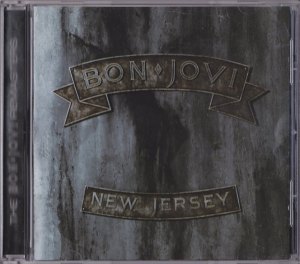
BON JERSEY_0001BON JOVI – New Jersey (1988 Mercury)

Slippery When Wet sold 28 million copies and went to #1 in over half a dozen countries, including Canada. The easy way to follow that might have been creating a carbon copy album, a sequel to follow it. Bravely, Bon Jovi chose not to do that. Their ambition was running high. The next album (tentatively titled Sons of Beaches after a line in the song “99 In the Shade”), was intended to be a double. The record company ixnay’d that due to the cost, but Bon Jovi had written and recorded plenty of good songs. The proof of this is that some of the best, including the B-side “Love Is War”, didn’t make the final single disc album.

New Jersey is not a carbon copy of Slippery nor any other Bon Jovi record. It’s more raw, more rock and roll, with bluesy elements added. There are dueling solos, long song structures, live jams and even a song in mono! Bon Jovi’s three main musicians (Richie Sambora, David Bryan, Tico Torres) performed and recorded some of their best playing on this album. Indeed, if New Jersey had come out under a different band name I don’t think many people would have recognized it as Bon Jovi. I think it remains one of their highest achievements, if not the very highest. Clocking in at almost an hour, it was a long varied album even if it wasn’t a double.

Slippery began with a long, ominous opening and New Jersey maintained that. “Lay Your Hands On Me” begins with drums and chants, but soon morphs into a top-ten (US) soul-rock single. The guitar is muscular and song is about as heavy as Bon Jovi get. “Bad Medicine” follows; the first single and one of the more pop-rock oriented songs. On the last album, Jon claimed he had a “Social Disease”, this time he needs a shot of “Bad Medicine”. I don’t think “Bad Medicine” is one of their best songs (I felt it was “just another Bon Jovi song” back then) but it sure had legs. It’s still a concert highlight today. I do prefer the album version to the single version with its playful, “Wait a minute, wait a minute, I’m not done!” false ending.

“Born To Be My Baby” was written acoustically and intended to be “the hit”. I think it’s just fine electrically, which is how it was recorded. I got this one as a single in a cardboard sleeve with post cards (see below), and I prefer it to “Bad Medicine” by a fair deal. The “na na na, na na na” vocal part is catchy as hell and the song rocks hard enough for the dudes. The ballad and single “Living In Sin” follows. It too was a huge hit, helped by a black & white video with some blonde-haired male model that looked like Mike Tramp, for the ladies.

Side one’s closer was the heartfelt epic “Blood On Blood”, which was not a single, but still gets played live today. Once again, Jon has managed to capture the essence of his young adulthood, growing up in Sayreville, New Jersey. Jon, “Danny” and “Bobby” are three friends who went through everything together. But with the years and miles between them, Jon lets them know that if he got that call, he’d be right by their sides. Lyrically, it’s this kind of thing that was Jon’s bread and butter, and it also resulted in a great song musically. “Blood On Blood” is one of the band’s proudest achievements.

BON JERSEY_0002If “Blood On Blood” was not enough musicality for ya, then “Homebound Train” is Bon Jovi at their most impressive. A 5-minute blues-rock workout, “Homebound Train” is one of those tracks that laymen just won’t believe is Bon Jovi. The band laid down some harmonica and guitar solos backed by some serious groove, something not often associated with Bon Jovi. “Homebound Train” would have to be among the band’s best tracks, and it serves to open a killer side of vinyl.

“Wild Is the Wind” might be considered a ballad, I think it’s more an anthem. If you can’t stop singing along to it, congratulations, you have a pulse! The chorus is brain-explodingly good. “Ride Cowboy Ride” follows, which is a brief instrumental in mono. Although it’s intentionally just an intro to the next song, on its own it’s an enjoyable listen – in fact it made my own mix tapes on its own a few times. “Ride Cowboy Ride” serves to introduce another cowboy anthem, “Stick To Your Guns”. The title reflects the positive affirmations of the lyrics, but this is just another standout song. Any one of these songs could have been singles.

A massive single, “I’ll Be There For You”, slows the side down a bit by being so soft. I’m sure there are those out there who don’t hate this song. Musically it’s fine, but the lyrics…I just can’t handle the lyrics. “When you breathe, I wanna be the air for you.” What does that even mean?

“99 In the Shade” contains the lyric that almost named the album: “I see those Sons of Beaches out there living it up, in the surf and the sand, yeah that life ain’t so tough.” This would be the weakest song on the album. It’s a standard Bon Jovi boogie, nothing wrong with it, but it pales compared to the rest of the songs on the record. Having said that if it were on Bon Jovi’s latest, it would be one of the best songs…

A personal favourite is last: “Love For Sale”, recorded live “during one hell of a party”. This drunken jam is among the most magical musical moments on any Bon Jovi album. Consider that it was the 1980’s, and the band just came off the ultra-sleek Slippery When Wet. They threw down a drunken, smoking acoustic blues jam to close the album? Yeah, man – cool! I’m down. It’s hilarious and fun, not to mention Richie just smokes on that six-string. Tico’s on the brushes and Jon sounds blasted.

And that’s New Jersey, an album the band had to be proud of. It went #1 all over the place, and multi-platinum in the US. It’s a curious mix of rootsy hard rock quality, and pop melody. It’s certainly among the best examples of such a mixture.

4.5/5 stars

BONUS GALLERY!  “Born To Be My Baby” 45 rpm single!

I believe this baby was about $2.99 at Zellers in 1988.  It came with postcards which I obviously kept.

REVIEW: Bon Jovi – Slippery When Wet (2010 special edition)

BON JOVI – Slippery When Wet (1986, 2010 Universal special edition)

I’m not blown away by the new series of Bon Jovi reissues. For the running time of a CD, they could give you a heck of a lot more content. I mean, I’ve bought this album 3 times. I bought it on cassette back in ’87, then I bought the first round of remastered CD issues of the entire Bon Jovi catalogue. Now, begrudgingly, I’m starting to pick these up, because I’m a completist. How many times have you bought Slippery When Wet already? At least once, I’m guessing.

Slippery When Wet is one of those oddball albums: It’s considered the classic landmark by a very successful band, but it is by no means their best.  I’ll tell you what it is though:  It’s a concept album.  When I listen to Slippery When Wet, all I can hear is a concept album about growing up in Sayreville, New Jersey.  Think about it!  “Wanted: Dead or Alive”?  That’s not about touring, man.  That’s a song about dreaming, while writing songs in Richie Sambora’s mom’s laundry room.  Lyrically, Slippery When Wet captures a more innocent era and presents it in the form of different characters from all walks of life.

She says we’ve got to hold on to what we’ve got
Cause it doesn’t make a difference if we’re naked or not

Slippery is the album that made people like Desmond Child and Bruce Fairbairn into household names.  It’s notable for the presence of three smash hit classics: “Wanted: Dead or Alive”, “Livin’ On A Prayer”, and “You Give Love A Bad Name”. All three are obviously available on various Bon Jovi hits compilations. There are a couple deep cut classics, but Slippery is mostly padded out with filler. Surely, “Social Disease” with its juvenile lyrics and terrible synth-horns is one that Jon would like to disown?  Also cheesy are “Wild In The Streets”, “I’d Die For You”, and the sappy “Without Love”.  What helps save these songs are earnest performances from Jon, but especially Richie Sambora.

Two of the best songs are the deep cuts.  “Let It Rock” is a cool song, a bit muddy in the mix, but with some really cool sounding keyboards.  The atmospherics of it were unique for the time.  It still stands as one of Jon’s better moments.  Then there is “Raise Your Hands” which opened side 2.  This one rocks, and has some blazing guitars.  I have always been a fan of “Raise Your Hands”. Remember when it was used in that one scene in Spaceballs? Sweet!

John freakin’ Candy

The production, by the late Bruce Fairbairn, is muddy at times and too glossy at others. Fairbairn’s work on the 80’s Aerosmith albums was more innovative and interesting. I’ve always liked talk-box on guitar solos though, so I’ll give him and Richie Sambora credit for the catchiest talk-box solo in history.  Regardless this album set new standards.  Suddenly, everybody wanted to work with Desmond Child and Bruce Fairbairn.  Aerosmith were next, then Poison, then AC/DC.  As for Desmond Child, his old pal Paul Stanley came-a-knockin’ when it was time to write for the next Kiss album.  Slippery When Wet was undeniably one of the biggest influences on the second half of the 1980’s.  Rock bands were adding keyboardists, and trying to find ways to get played on radio and MTV the way Bon Jovi had.  Jon also used his newfound influence by helping friends like Cinderella and Skid Row get signed.   Cinderella certainly benefited from having Jon and Richie appear as rivals in their “Somebody Save Me” music video.

As influential as it is, albums such as New Jersey, Keep the Faith, and These Days are superior in my ears.  When I was swept up in the Bon Jovi tide in ’87, I finally picked up Slippery on cassette.  I was surprised, because I expected it to be a lot better.  Considering all the hits, all the hype, and all the sales, I was hoping for more than half an album of good songs.

As far as the reissue goes, the reason I picked this particular one up was that I saw there was a “live acoustic” version of “Wanted” on here. I hoped and prayed that it was the acoustic version from the original 1987 “Wanted” cassette single. (If you haven’t heard it, man, you absolutely need to.) I only have that on cassette.  However, it’s not the same version. It’s a good live acoustic version, with just Richie and Jon.  It’s purportedly from the Slippery tour, and made stronger by Richie’s powerful vocals. “Prayer” and “Bad Name” are the other two live songs included, sounding pretty standard.   These three bonus tracks are all there is; no era B-sides such as “Edge of a Broken Heart” or “Borderline” are included.  Songs like these would have gone a long way to strengthen an album that’s a little weak in the knees.

I was pleased to see a retro looking backstage pass included within the slipcase. That made me a bit happier with my purchase. Nice touch, this is the kind of thing that rewards people for buying the CD rather than downloading.

3/5 stars

REVIEW: Van Halen – Balance (1995)


VAN HALEN – Balance (1995 Warner – Japanese version included)

I had no idea what to expect when Van Halen released Balance in 1995.  Grunge had come and gone, the landscape vastly altered since Van Halen’s last wax in 1991.  Eddie was the king of pyrotechnics, and that kind of playing was not in vogue.  How would the band adapt?  Well, they didn’t.  Balance takes Van Halen into a highly polished, commercial direction. This is “balanced” with heavier grooves and a couple more “serious” lyrics.   The result turned out to be one of Van Halen’s most pop outings.

BALANCE_0003Produced by the late Bruce Fairbairn, Balance borders on over-polished. The sounds are rich, thick and glossy, but miles away from the raw guitar pummeling of the early days, or even the previous For Unlawful Carnal Knowledge. Eddie Van Halen, in a Guitar World interview, said the album was characterized by “better song writing”, but I think what he really meant was “more commercial songwriting”.

The album starts with a different sound for Van Halen: Gregorian chants. Hey, it was the 1990’s and later the same year, Iron Maiden would introduce their X Factor album with similar chants, no shit. The chanting merges into a heavy guitar riff accented by a wall of droning fills. This is “The Seventh Seal”, and Sammy’s voice is in top form. Michael Anthony’s bass rolls and hits the notes at just the right moments. This is truly a great song, completely different from Van Halen of old, but surely a triumph.

The next tune (and second single) however, “Can’t Stop Loving You”, is an embarrassing foray into pop. While Van Halen wrote pop stuff before (“Love Walks In”), this song lacks cojones of any kind. The guitar is really thin, Alex Van Halen cha-cha’s his way through the drum fills, while Sammy sings a lyric that David Lee Roth would have used to wipe his ass.

“Don’t Tell Me (What Love Can Do)” is anything but a love song. Sammy tackles drugs, faith, youth in crisis, and the 1990’s. Hagar has never sounded more foreboding, or mature for that matter. Eddie’s riff is simple, but dark and rhythmic. Michael locks onto the riff, creating this unstoppable wall of groove.

BALANCE_0005Sammy has an unfortunate habit of being too jokey when it’s inappropriate. Eddie didn’t like the lyrics to “Amsterdam” and you can see why. There is nothing wrong with this mid-tempo rocker with spare Eddie riff, except the lyrics. After the previous song’s warnings about drugs, suddenly Sammy is singing, “Whao, wham bam! Roll an Amsterdam!  Stone you like nothing else can.” Granted, two very different drugs (heroin vs. weed) but lyrically “Amsterdam” isn’t winning any awards.

“Big Fat Money” is very old-school boogie ‘Halen in intent; the music could have fit on virtually any of the first six albums. Producer Fairbairn had Eddie playing a fatbody jazz guitar during the solo section (mirroring a trick he pulled with the Scorpions two years previous) but it doesn’t save the song.  I’ll give VH a C for trying, but “Big Fat Money” is a C+ at best.

C+

“Strung Out” is a jokey opener to the ballad “Not Enough”. Basically, this is Eddie messing with (and wrecking) a piano from the inside! This was recorded years prior, at Marvin Hamlish’s house in Malibu during the writing sessions for 1984. Van Halen destroyed Hamlish’s white Yamaha piano and had to have it repaired.  It was covered with cigarette burns, and Van Halen had attempted to play the piano from the inside, by throwing balls at the strings.

That fades into “Not Enough”, another ballad.  Not quite as embarrassing to listen to as “Can’t Stop Loving You”, but not by much. Really, in the year 1995, Van Halen should have stuck to the serious themes, and guitar-based songs. Tunes like this made Van Halen seem completely out of touch with what was happening in the 1990’s. Within months of its release, Shannon Hoon would overdose, Layne Staley locked into a dance of death with smack,  and Richey Edwards of the Manic Street Preachers went missing (presumed dead) after suffering long bouts of depression. These were dark times in rock and roll.  I just wasn’t feeling “Not Enough” and “Can’t Stop Loving You”, then or now.

Baluchitherium

Baluchitherium

“Aftershock” is another hard rocker, nothing embarrassing here, good riff, good melody, good song. Won’t make anybody’s desert island Van Halen list, however. A pair of instrumentals follow, an interesting touch seeing as Van Halen didn’t do too many instrumentals post-Dave. “Doin’ Time” is Alex messing around on the drums, which segues straight into “Baluchitherium”. “Baluchitherium” was so named because a baluchitherium was one of the biggest prehistoric land mammals known — and Eddie felt a stomper like this tune needed to be named after one of the biggest baddest animals to ever walk the Earth.  Unlike most VH instrumentals, this one just sounds like an unfinished song — an idea without a vocal.

“Take Me Back (Deja Vu)” is a pop song that I don’t mind at all, accented with acoustic guitar. Apparently Eddie had the guitar part in his head for decades, going back to the pre-Van Halen 1970’s, when he was a kid. It’s very laid back, but also very summery and the lyrics are decent.

BALANCE_0002“Feelin'” is a morose song but with an epic, powerful chorus. It is very different from anything the band had done prior, and hints at the directions to come in the Cherone years —  for better or for worse.  It’s a good album closer, as I like a dramatic ending from time to time.

If you’re lucky enough to be in Japan, there was one bonus track: this is the groove laden, oddball “Crossing Over”.  It’s a song about the afterlife and lyrically it’s probably the best tune of the bunch. The bass part alone on this song was so infectious that in my opinion, it is actually the main hook of the song. I’d consider this the best track on the album myself.  The arrangement is fairly unconventional, and the drums tumble and roll against the groove in a cool way. Again, apparently this song dates back to 1983! I think you will not regret tracking this one down.  Thankfully it was easier to find on the “Can’t Stop Loving You” single.  Notably, the Japanese version of the cover was also toned down.

On the whole, I think the majority of Sammy’s final Van Halen album is not to be ashamed of. I think the songwriting and lyrics were stronger than Unlawful, if only the production had been less geared towards pop and a couple ballads deleted, this might have been the very best thing Van Hagar ever did. However I’m not always the most objective guy.  There are Van Halen fans out there who don’t think much of Balance.  Some of those fans really, really don’t like Balance.  In order to end this review with some “balance”*, I found one and asked for his opinion.

Craig Fee: “I kept re-listening to Balance, doing my best to like it because it was 75% of my favourite band. It turned out to be more disappointing than my illustrious NHL career and my attempts to have a three-way with Rose McGowan and Liz Phair. “Can’t Stop Lovin’ You” is a steaming pile. It still is.”

I don’t have any sort of rebuttal for that.

3.75/5 stars

* Two clear signs of a writer doing a half-assed review:  Using the same pun twice, and padding it out with quotes from other people.

VAN HALEN CONSPIRACY THEORY (™)

The band were foreshadowing the firing of Hagar with subtle hints left on the back cover of Balance.

REVIEW: Aerosmith – Permanent Vacation (1987)

AEROSMITH – Permanent Vacation (1987 Geffen, Japanese import)

Ahh, the much-ballyhooed Permanent Vacation! Granted, it was a step up from previous two studio albums (Done With Mirrors and Rock in a Hard Place) but it’s nothing compared to Toys or even Draw The Line. This is the birth or the new pop Aerosmith, the Aerosmith guided by David Geffen and John Kalodner. This is the new Jim Vallance and Bruce Fairbairn Aerosmith. On the whole, it’s not bad and it sure was a big hit in the late 80’s. But let’s be fair — if Aerosmith had come out with Rocks in 1987, would it have gotten airplay? Of course not – Rocks was far removed from what was happening in 1987. This was Aerosmith in survival mode, employing outside writers, the biggest producers, and going for broke. If we’d known back then that Aerosmith would never be able to return to their old school ass-kicking rock and roll (aside from the awesome Pump of course), I think we would have been a lot less excited.

“Heart’s Done Time”, the opener, ain’t bad. In fact it’s one of the best tunes, Joey’s traps reminding us that this was still Aerosmith.  The song has some rock to it, while remaining accessible. The next track, “Magic Touch” is more of the same:  strong chorus, fairly hard rocking guitars and drums. I prefer both songs to the well-known hits. Then it’s “Rag Doll”. Damn, I’m so sick of that song. I never liked it even when it was new. I think it’s filler.  I’m glad for them that it was a huge hit, but I never felt the need to put it on a mix tape.

This is followed by some filler, “Simoriah”, one of the many tunes on this album that were never played live (Joe Perry’s big beef with the album is that half of it wasn’t played live). “Dude (Looks Like a Lady)” is probably the most overplayed singles of Aero-history. I know it’s a huge hit, but come on…the Aero of old never would have written this. However it’s the kind of Aerosmith song that people today know, therefore, people want to have it. Shame it’s not “Coney Island Whitefish Boy”….

“St. John” – more filler! “Hangman’s Jury” is good though, a nice bluesy swampy acoustic number.  This is the kind of thing from Aerosmith’s roots and it comes off as the most sincere.  This is followed by “Girl Keeps Coming Apart”, a song which, aside from some killer playing by the boys in the backline, is skip-worthy. The song keeps falling apart! Up next is the last of the singles, “Angel”, a song which I actually like a lot. I like the lush production; I love the choruses, the verses, and the guitar solo. I think this song is still pretty excellent.

The title track is next, a catchy number with no outside writers, and co-written by Brad Whitford. This is proof that Aerosmith are at their best when they are just five guys writing and playing together. There’s some embellishment with jungle noises and tropical sounds, but the song is a winner. Another winner is the Beatles cover “I’m Down”, but I don’t know why they needed to pad an already long album with a cover. Still, totally listenable. The final track is a lame instrumental called “The Movie”. Honestly, most Aerosmith instrumentals are boring. They’re just not that kind of band. This ends the album on a decidedly dull note.

I give the band credit for sobering up, and working hard on this album. Fairbairn (rest in peace) was known as a bit of a taskmaster, he made his bands work hard, and I’m sure Kalodner did too. I think that they were so intent on a charting hit that they lost sight of the roots of Aerosmith. Songs like “No Surprize” or “Nobody’s Fault” sound like a completely different group of guys than the band on Permanent Vacation. As a result, I rarely play this album today. After all, when I can’t turn on the radio without hearing “Dude” and “Rag Doll”, why would I want to?

3/5 stars

More AEROSMITH at mikeladano.com:

AEROSMITH – Draw The Line (1977, Columbia)
AEROSMITH – ”Dude (Looks Like A Lady)” (1987 Geffen 12″ single)
AEROSMITH – Get A Grip (1993 “cow hide” cover)
AEROSMITH – Music From Another Dimension! (Deluxe Edition)
Record Store Tales Part 95:  Aerodouche Dandy

REVIEW: Aerosmith – “Dude (Looks Like A Lady)” 12″ single

It’s THE WEEK OF SINGLES!  Each day this week I’ll be bringing you reviews and images of a recent CD or vinyl single acquisition.  

Monday:  Van Halen – “Best of Both Worlds” 7″ single
Tuesday:  Deep Purple – “Above and Beyond” CD and 7″ singles


AEROSMITH – “Dude (Looks Like A Lady)” (1987 Geffen 12″ single)

There was an old Canadian magazine called Music Express that was…well, it was OK.  Back in 1987 they did a spread on the new Aerosmith (Permanent Vacation), including a really cool caricature of Steven Tyler that I cut out and kept.  This Aerosmith article contained what I now consider to be a myth, although one that led me on a wild goose chase for years.

1378547_10153352143530517_1197119603_n

Music Express

The magazine claimed that one of the new Aerosmith B-sides was a song called “Once is Enough”, a collaboration with Willie Nelson.  Not only did I believe this to be true, but it was seemingly confirmed by an old customer of mine who insisted she had this Willie Nelson tune.  Now I’ve finally acquired the “Dude (Looks Like A Lady)” 12″ single with “Once is Enough”, and there is absolutely no indication that Nelson had anything to do with it.  I wonder if the confused writer thought that John Kalodner in the music video for “Dude (Looks Like A Lady)” was Willie Nelson?  That’s as much insight as I can offer on this strange myth.

As it turns out, “Once is Enough” is an outstanding song, and no wonder:  It was written by Richie Supa, who also wrote three of my personal Aero-faves:  “Chip Away the Stone”, “Lightning Strikes”, and “Amazing”.  Supa has a certain magic in his melodies, rooted in old time rock n’ roll.  When Aerosmith record a Supa song, the results are seldom disappointing (“Pink” being the only letdown I can think of).  It does have a country twang to it, particularly the intro, but otherwise this is a rock n’ roller.

Although “Once is Enough” is instantly likeable and arguably an unknown classic, it was never released on any of the numerous Geffen Aerosmith compilations.  I think it’s stronger than much of the material on Permanent Vacation itself.  I can only assume it did not make the album because it’s too different from the songs that did.  In fact it probably would have fit better on Pump, which also had some twang on the hit “What It Takes”.  The country vocal harmonies are really sweet, and Joe Perry lays on some awesome slide.  When it takes off into full-on rocker mode, it’s irresistible.  Why a great tune like this remains so hard to get more than 25 years after its release, I don’t know.

The rest of the songs on the single are Permanent Vacation album tracks:  “Dude”, “Simoriah” and “The Movie”.  I’ll be honest, I never thought much of “Dude”.   It was originally titled “Cruisin’ For A Lady”, but obviously the new words (supposedly inspired by Motley Crue) have become a Tyler landmark.  So, good on them.  It’s been used in numerous movies and is a radio staple today.  With that Bruce Fairbairn horn section in there, I just thought it was too pop.   No matter how I feel about this commercial rock song, Joe Perry’s solo smokes.

Both “Simoriah” and “The Movie” are filler as far as I’m concerned.  For its merits, Permanent Vacation had a bit too much filler on it.  I’m more of a Pump guy myself.  As filler goes, “Simoriah” has a speedy groove going for it, but it’s not an outstanding song.  “The Movie” is just an atmospheric instrumental.  I’ve never felt that Aerosmith compose the most interesting instrumentals in the world.

Just 3/5 stars for this one…but 5/5 stars for “Once is Enough”!

One last thing:  I also have a CD single for “Dude (Looks Like A Lady)” completely different from this.  It was obviously a later release, since one of the B-sides was “Love In An Elevator” live.  “Once is Enough” was not on that CD single.

More AEROSMITH at mikeladano.com:

Music From Another Dimension! (2012 deluxe & regular editions) – Get A Grip (1993 limited “cow hide” cover) – Draw the Line (1977) – Record Store Tales Part 95:  Aerodouche Dandy

REVIEW: Aerosmith – Get A Grip (1993 “cow hide” cover)

Let the arrows fly!

COW

AEROSMITH – Get A Grip (1993 “cow hide” cover)

As an Aero-accolyte, I thought Pump was a great album. All killer no filler, just like they made in the early to mid 1970’s. Permanent Vacation, while laden with huge hits, also had a lot of filler. I think Get A Grip falls somewhere between those two albums. It’s heavier than Vacation, but suffers from filler syndrome.

Witness: “Gotta Love It”. “Shut Up And Dance”. “Boogie Man”. Crap, crap, and crap!

SAM_2554

I think Get A Grip has some of the best Aerosmith tunage of the past 20 years though: “Eat The Rich” is absolutely brilliant. “Fever” as well, musically and lyrically: “The high you be gettin’ from the crack don’t last, I’d rather be OD’ing on the crack of her ass.” That is the Steven Tyler I love! I could do without two of the ballads: “Cryin'” (which maybe is more of a blues?), and “Crazy” I could do without. Even if I liked those two songs, they’ve been so overplayed. “Amazing” on the other hand is string-laden Aero-brilliance, a worthy successor to tracks like “Angel” or even dare-I-say-it, “Dream On”. I also enjoyed “Line Up”, with Lenny Kravitz’ cameo. “Come on, Joe!”

The crown jewel of this album is the lengthy “Living On The Edge”. What a great song, and adventurous too. It wasn’t commercial but became a massive hit. Maybe the last time Aerosmith did a really adventurous single that really wasn’t very single-like.

I think production-wise, this album didn’t shine like Pump did.  Fairbairn produced both and Get A Grip was considered by the band to have a better sound, but I don’t know. I think Pump rocks harder and cleaner.  On the plus side, Get A Grip has good separation between Joe Perry and Brad Whitford, so you can really hear them playing and meshing. Same with Tom Hamilton’s rolling bass, you can pick it out and listen to the notes rather than just the groove. And, of course, Joey — Joey Kramer is one of the most underrated drummers in rock. His thrift is Bonham-esque and his groove is legendary.

I hate the standard album cover, it’s dated and stupid. It was even stupid in 1993, let alone now. Much better is the “cowhide” cover. There are no bonus tracks on that version, but it looks cool sitting in my collection (right next to my faux-leather edition of Pump).

There were numerous notable B-sides and other tracks available elsewhere, now all very easy to get on assorted Geffen compilations. Noteworthy, and worth tracking down, are “Deuces Are Wild”, and the two bonus tracks from the “Living on the Edge” single (“Don’t Stop” and “Can’t Stop Messin'”). There was also a good song called “Head First” that was an early attempt at digital distribution and song downloading!

3.5/5 stars. I wish it were better, but I think it’s too long and loaded with filler. I think it could have been 10 songs, like the Aero-classics of old.