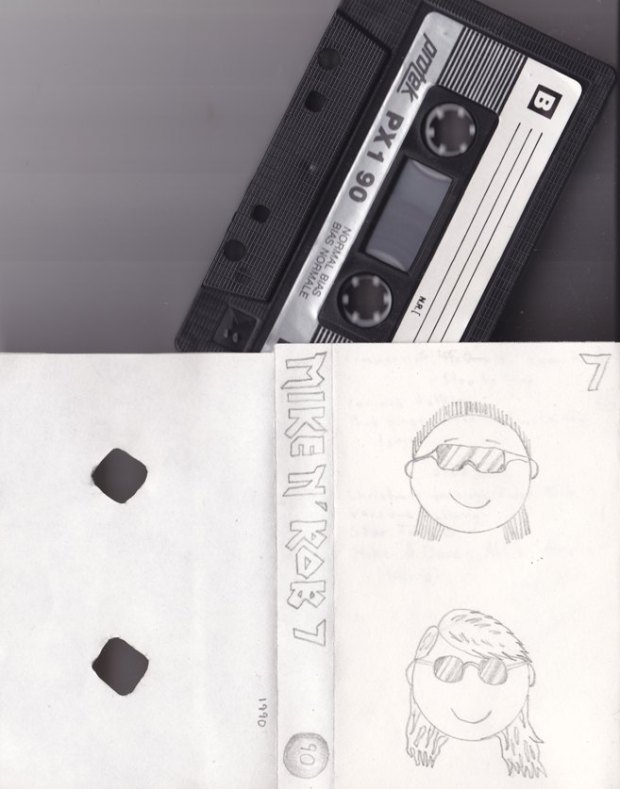
What are “WTF Search Terms”, you ask? Simply, they are phrases that people typed into a search engine to wind up at mikeladano.com. They’re sometimes weird, sometimes wonderful, and always amusing. I hope you enjoy this 37th instalment of WTF Search Terms!
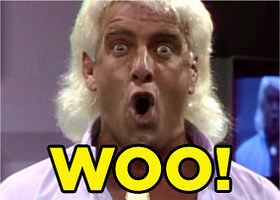
First please welcome “Nature Boy” Ric Flair to the WTF Search Term family! The 16 time world wrestling champion was immortalized in the Legendary Klopeks song “Ric Flair” from their album Straight to Hell. Someone googled the lyrics:
i wanna do a chop i wanna do a woo i wanna be like ric flair cause he’s so fucking cool
I love that somebody heard that lyric and had to google it. Next up:
does anyone like the 2002 version of blizzard of ozz
The answer is yes: Sharon does. But next is a band that Sharon does not like.
This next person mixed up two bands, but it also could be autocarrot. Funny either way:
deep leppard heartbreak
Then a grouping of searches for Snake the Tattoo Man. But people need to decide where he’s from. (It’s London).
snake from brantford tattoo guy guy named snake in london, on the man called snake, london, on
I got a chuckle from this next one:
fankie banali sucks
Well, let’s be fair. Frankie Banali is an awesome drummer. I’d never say he sucks. I never have. But his current version of Quiet Riot does kinda suck. Unlike the following album:
How many of you were members of the Columbia House music club? Tapes or CDs?
The concept was simple. Get 12 tapes or records for one penny. Then agree to buy “X” more at “regular club prices” within a year. They would usually offer all sorts of incentives, such as getting your first regularly priced item for half price. Their “regular club prices” were fairly high, but if you played your cards right you could make joining the club worthwhile.
Every few weeks after signing up, Columbia House would send you a catalogue and an order form. The order system was controversial, because it required a negative response if you didn’t want to buy something. When you signed up, you could pick your favourite genre of music (I chose “metal”). Each time a catalogue came out, your selected genre would have a “selection of the month”, usually a new release but not always. If you did not respond with an order form expressing that you didn’t want it, they would automatically mail you the “selection of the month” and bill you for it too. (The Columbia Record Club system was worked into a sub-plot of the movie A Serious Man by the Coen Brothers.)
For many people this wasn’t a problem. Our parents let my sister and I sign up when I was in grade 11. We split the membership and free tapes 50/50. We paid for everything ourselves and diligently sent in our order forms each time. We were both already massive music fans, so we poured over every single page. Most times, one of us ended up buying something, if not the selection of the month itself.
I can still remember every album I received in that first shipment. Seven tapes. These tapes went into immediate and constant rotation, which is why I remember them all so well today.
Our musical world opened up in a massive way, and not just because of the new music we were listening to. The catalogues introduced us to names and album covers that we’d not experienced yet. What is this Bitches Brew thing? Why did Deep Purple albums have so few songs? Did Iron Maiden copy their Maiden Japan from Purple’s Made In Japan? Holy crap, Hank Williams Jr. has three greatest hits albums?
Everything was absorbed. Five years later, when I started at the Record Store, my boss was surprised that I knew who most of the artists were, what sections they should go in, and even what record labels they were on.
“I read the Columbia House catalogue cover to cover every month,” was my answer!
The catalogue provided knowledge, and pictures to cut out for locker or wall. We made the most of that catalogue every time. It was rare when pictures were not cut out!
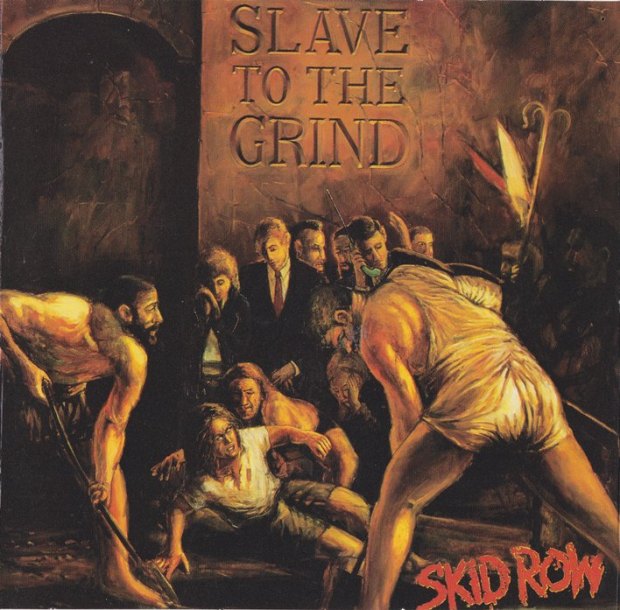
I was even able to acquire things that might have been considered rarities back then. I had never seen Leatherwolf stocked in a store, but Columbia House had it. When vinyl was being discontinued, I was still able to get Skid Row’s Slave to the Grind (1991) on LP. They had most of the Savatage albums.
It all sounds wonderful, but Columbia House had flaws too. The biggest one was horrendous quality control. They licensed and manufactured the tapes themselves, which were simply not as good quality wise as the ones you could find in a store. They would be warbling within weeks (if not right out of the case) and the J-cards were sometimes shoddy, with printing not lining up with fold lines, or just they’d just start falling apart along perforations. They also didn’t carry certain record labels. While they had everything Warner Bros and Columbia Records, they had nothing from EMI. Finally, bands made next to nothing on albums that were sold through Columbia House. Some bands such as the Tragically Hip refused to sell their music via Columbia House. We didn’t know all of this as kids, of course. I started to pick up on the quality issues when they seemed to take a serious dive around 1991.
The key to not getting ripped off by Columbia House was to order smart. The 12 free tapes sounds like a great deal, but when you balance in buying the rest of your selections at full price, most people ended up on the losing side. Get in and get out, buying the bare minimum. That was the way to do it. Of course, we didn’t. We just enjoyed the convenience and stayed members for years! No regrets since this led directly to a 12 year career in the Record Store!
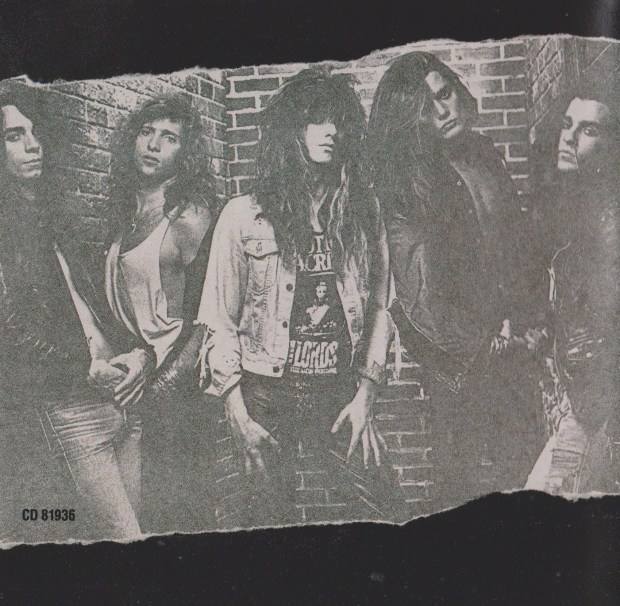
Skid Row had the songs, but most importantly, they had the frontman. Only once in a blue moon does a congenital entertainer like Sebastian Back happen upon the scene. Born in the U.S. but raised in Canada, Bach had it all: the looks, the youth, the charisma, and most importantly the voice. He was a bull-headed bastard in those days too, but that is often a part of the frontman package. Bach was a dynamo, always “on”, and with that voice on his side, people paid attention.
Without Bach, would Skid Row ever have made the impact they did? Not to that degree, no. Sure they had Jon Bon Jovi in their corner (and to take them out on tour) but without Bach, Skid Row would have been just another hard rock band in 1989, the peak year for the genre. It can’t be understated how important the voice was. Bach had the power, range and unique style required, but he had it right out of the gate! The band was good too: Dave “Snake” Sabo, Rachel Bolan and Scotti Hill wrote some great, bone-shaking cock rocking tunes. Rob Affuso (today in Four by Fate with members of Frehley’s Comet) has long been an underrated drummer capable of some serious steppin’. With Michael Wagener in the producer’s chair, everything aligned and came up platinum.
Three major hit singles made the album a must-have. They were, of course, “Youth Gone Wild”, “18 and Life” and “I Remember You”. These have become their career-defining songs, particularly the ballad. “I Remember You” may have misled more than a few listeners when it first came out. This is not a ballad album, but a very hard rockin’ record. This wasn’t Bon Jovi. It was heavier than everybody else on the radio that summer: Motley, Warrant, Aerosmith, Van Halen, Def Leppard. Though it rocks hard, it’s still memorable.
With the benefit of hindsight, we know Skid Row were capable of so much more, and they delivered on the next album Slave to the Grind. Once they let the thrash metal and punk influences come out, the real Skid Row sound was conceived. Their debut is good, but the next two were even better.
NOTE: None of the information below should be taken as actual singing advice!
RECORD STORE TALES Mk II: Getting More Tale #337: Oh Say Can You Scream
In the 1980’s, screamers were king. Rob Halford, Bruce Dickinson, Brian Johnson, Udo Dirkschneider…all of them were able to scream the high notes, sending chills up and down your spine. We all wanted to be screamers back then! None of my friends were able to croon like Coverdale, so screaming seemed like a viable option. We worked on our screaming voices with practice, practice, practice.
My buddy Bob came up with two ways to practice our scream techniques:
At home: Go to your bedroom and close the door. Put on AC/DC’s Who Made Who cassette, and grab a pillow. Then, scream along with Johnson directly IN to your pillow. Nobody should be able to hear you! The pillow should muffle your wailing Johnson imitation. You can belt it at top lung power without disturbing mom and dad’s TV shows. Just remember to lift your head from the pillow for breathing! (That part is really important.)
If out at dusk: Go to your local park. Make sure the coast is clear. Then, just sing and let it out! Bob and I did this one frequently, walking through our local Stanley Park. We serenaded the neighbors with a selection of AC/DC and Iron Maiden.
There were a couple specific Maiden songs that Bob and I really enjoyed screaming along to. One was a classic from Powerslave: “Rime of the Ancient Mariner”. Such an excellent, challenging choice. We would focus on the line, “Then down in falls comes the raaaaaaaaaaain!” We’d scream that section over and over again until we were satisfied that we had it right.
After a few years, I became quite good at hitting the high notes. I moved on from my screaming by the time I was in University, and focused on the Bee Gees. I knew that screaming Maiden tunes wasn’t a good way to attract female attention. Singing “Stayin’ Alive” note for note though? That may have had potential! (Note: it didn’t.)
Although I can no longer perform the song as I used to, I am proud to say that I used to be able to hit every note in “Stayin’ Alive”. Something to be proud of at Karaoke.
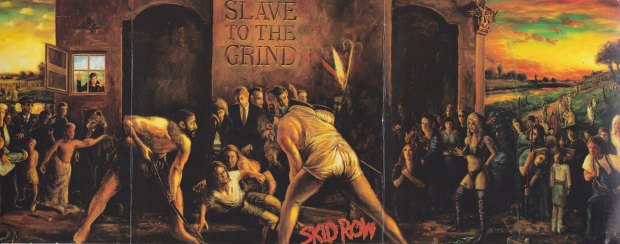
SKID ROW – Slave to the Grind (1991 Atlantic “clean” and “dirty” versions)
The Skids knew the second album had to kill. The band, always heavier live than the first album implied, also knew the second album had to sound more like they did in concert. And following up a huge hit debut, they also demanded the album be all killer, no filler. Raising the bar and ignoring the record company, the band re-convened and kicked every ass in the room. The result is Slave to the Grind, one of the best hard rock albums of ’91 period.
The first single “Monkey Business”, which is essentially just dirty grooves n’ screams, was about as commercial as the album got. With this as first single, it was clear that Skid Row didn’t care whether they got played on MTV or not. There was nothing glossy or slick about it. It’s still obvious that there’s something special here, and I credit that to two factors: the songwriting talents of Snake Sabo & Rachel Bolan, and the frontman chops of Sebastian Bach. Bach commands this song. It’s not just his vocals. It’s his confidence, his swagger, and his ego shining through.
If “Monkey Business” didn’t scare your little sister, then the second single “Slave to the Grind” definitely did. For the first time, Skid Row jumped straight into the thrash metal deep end. Drummer Rob Affuso had the chops to do it, and it really was a natural step to take. Other bands were getting heavier in 1991 too, but none of them took a turn like this. Skid Row raised the bar for everyone in their field in ’91.
The other singles from the album were technically “ballads”, although the band were eager to point out that none of them were anything like “I Remember You”. They were dark and edgy. The record company execs no doubt shit their pants when they heard the magnificent “Wasted Time”, which I can only describe as epic. It’s an incredible song, and it’s one of the few that Bach had a hand in writing. Baz wrenches all the emotions from his soul and that’s what I hear coming from the speakers. “Quicksand Jesus” and “In A Darkened Room” are only a little less impressive. They share the same kind of mood and sonic landscape. There is really nothing commercial about any of them. They all have headbanging moments and integrity.
Rounding out the album were several very strong deep cuts. “The Threat”, track 3 on the disc, easily could have been a single. In fact Terry David Mulligan of MuchMusic asked Sebastian if it was going to be selected as a future video, so I’m not alone in thinking that. “Psycho Love” is a bangin’ bass groove, laid to waste by Bach’s scorching vocal. “Livin’ on a Chain Gang” is another standout, an angry one about injustice. Then you have slow, landmine-infested blasters like “Mudkicker”, and fast smokers like “Riot Act”. All strong songs. The only one I’m not keen on is “Creepshow”, a jokey tune about the kind of people you’d see on daytime talk shows.
Skid Row knew well ahead of time that some markets would not release an album with a song called “Get the Fuck Out” on it. This fun punk rocker sounds like a Rachel song, but Bach’s attitude nails it. It’s probably a bit of a novelty, but it’s fun. “Fuck you if you can’t take a joke!” says Bach in one line. But it’s OK: if you can’t take the joke, you can buy the version of the album without “Get the Fuck Out”. Earlier pioneers in the clean/dirty dual releases, Skid Row saved the song “Beggars Day” for the Walmart version of the album. (Also sold by Columbia House in Canada.) I think it’s cool that they gave both markets added value with exclusive songs. This song is more traditional metal (perhaps Priest-like) than the rest of the record, but it’s equally strong.
Michael Wagener produced this album with a raw, unpolished finish. But there are backing vocals where you need ’em, and the instruments are clear and in your face. It still sounds heavy today, unlike a lot of other music from the same year. It just seems like everything clicked, and all the factors were in place. Slave to the Grind kicks ass with the best of them.
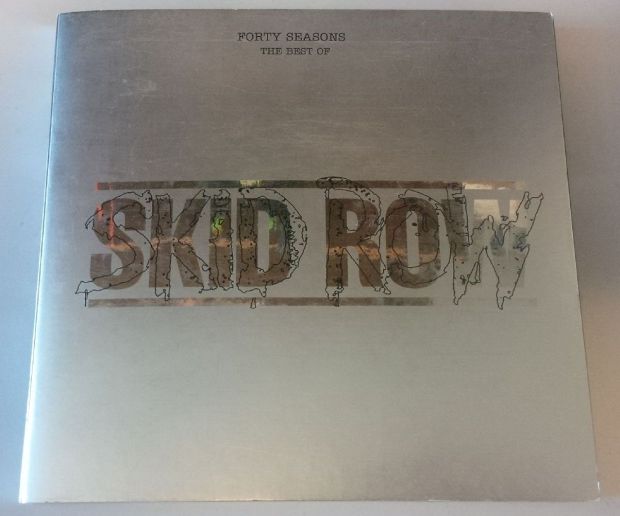
SKID ROW – Forty Seasons: The Best of Skid Row (1998 Atlantic Japan)
US cover
The Japanese fans always seem to get the coolest stuff. Look at this package: shiny silver, instead of the boring grey of the American release. Digipack with foil stickers! Bonus track! So much cooler than the standard release here. Hell, the Japanese title is even spelled F-o-r-t-y, where the American version has the briefer 40. Why? Not sure. Either way I’m glad to have this version, which fell in my hands thanks to customer Conrad in the late 90’s. He sold it to me with stickers intact and still sealed; all that is missing is the obi strip.
Whether you own Forty Seasons or 40 Seasons, the party starts with “Youth Gone Wild”. Any commemoration of the Sebastian Bach years should open with that track. Although “Youth Gone Wild” is Bach’s signature track today (along with “I Remember You”), he actually wrote neither. Some fans would be surprised how little Bach has written in Skid Row, and indeed he only has two writing credits on this greatest hits disc. What Bach brings to the party is his spirit, attitude, and incredible voice. When Skid Row came out in ’89, Bach was almost instantaneously a 21 year old superstar. He had the ego to deliver the rock star vibe in concert and in print, and he certainly had the vocal chops. This is why Bach has remained a thorn in Skid Row’s side today, 15 years since hiring Johnny Solinger to replace him.
Track two is a little too soon for a mellow song in my opinion, but “18 and Life” works in this slot due to its dark vibe and powerful choruses. The singles “Piece of Me” and “I Remember You” are the other representations from album #1, although I definitely could have done without “Piece of Me”. Skid Row have written much better heavy rockers since. “I Remember You” is a song I still haven’t really tired of, thanks to Bach’s timeless performance. Every time Baz sang this tune in Toronto, the place went insane, as Bach always sang it for his old stomping grounds. Rachel Bolan and Snake Sabo may have written the song, but when I think of “I Remember You”, I think of Toronto.
Skid Row’s second album Slave to the Grind blew away the first. I’m glad “The Threat” was included. It may not have been a single, but it was one of the outstanding album cuts. Equally solid was the bass groove of “Psycho Love”, which is relentless. Skid Row really turned up the octane on that second album. I think both tracks outshine the single “Monkey Business”, but nothing can overpowerful the thrash metal of “Slave to the Grind” itself. When it was released, I couldn’t believe how full-on Skid Row had become. This is a high water mark of heaviosity.
“Quicksand Jesus” represents one of the three slow tunes on Slave; I would have selected “Wasted Time”. “Quicksand Jesus” is an outstanding song, and so is the other slow tune not included here, “In A Darkened Room”. “Wasted Time” is so clearly above and beyond either of those two, that I can’t understand why it’s not on this CD. It has something special to it, like “I Remember You” did.
So the first half of the CD covers the first two Skid Row records with all the big hits. The second half covers the rest, plus rare and unreleased stuff. I love the third Skid Row record, Subhuman Race. I consider it a great metal record in the context of the mid 1990’s. For some reason, none of the Subhuman songs included here are the album versions. I know the band fought with Bob Rock over the production on that album, and maybe that is why. “Into Another”, which might be considered a slower song, is remixed making a little lusher. The single “My Enemy” is also remixed, perhaps to tame down the St. Anger-esque drums. My favourite Skid Row ballad, “Breakin’ Down” is remixed as well, but you have to know the song really well like I do to notice by ear alone. (Listen to the guitar accents.) Overall it’s more polished and finished, which is fine, because the album version was actually more or less just the demo version. Lyrically the song is a message from Sabo to Bach, about their failing relationship. Bach reportedly received the demo, sang to it, and that’s what was put on the record.
The excellent banger “Frozen” is presented in demo form, which is interesting but inferior to the excellent, slamming album version. Finally, “Beat Yourself Blind” (Bach’s favourite song from Subhuman Race) is live. What an awesome tune live. This is from the Japanese Subhuman Beings on Tour EP. As great as the stuttery album version is, the live one is more fluid. I’ve heard Rachel Bolan say the Subhuman album “sucked”. I don’t understand how he can say that, and I think the five songs here prove my point.
The album closes with a pair of treats: unreleased songs! “Forever” from the first album’s sessions is better than many of the songs on that record! Who chooses these songs? Perhaps it was a bit too derivative of other popular 80’s bands, but Sebastian makes it sound like nobody else but Skid Row. This not only should have been on the album, but could have been a hit single. Then there’s “Fire in the Hole”, a great little slammer that didn’t make the second album. This time I agree. That second album is incredible and “Fire in the Hole” isn’t up to those high standards. It’s definitely better than many bands’ album tracks, but not Skid Row.
Last of all, the lucky Japanese got the Ramones cover “Psycho Therapy” from the B-Sides Ourselves EP (1992). This is the only inclusion from that EP, and it’s a gooder. Rachel sang lead (with Taime Downe of Faster Pussycat backing him). We all know Rachel’s a punk guy, and I think that’s the side of Skid Row that clashed with Bach’s metal tendencies. Just my theory.
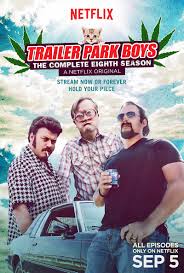
Thank Santa’s tits! It was with tremendous joy that I watched the long-awaited Season 8 from the Trailer Park Boys this past weekend. I watched five episodes on Saturday night, and five more Sunday morning. Then on Monday, I re-watched my favourite episode, “Orangie’s Pretty Fuckin’ Tough”. As a long time fan, to say that I am pleased is an understatement. I am thrilled. Knowing in advance that a couple characters weren’t coming back (Ray and Trevor are no longer on the show), everything I wanted out of the show was there. There are even a couple new characters, who look like they may be important in the already finished Season 9.
As if there was no pause at all, Season 8 feels like classic Trailer Park Boys, immediately. Some new characters are introduced, such as Don, who joins Randy as the new Assistant Supervisor. “Officer Highcock”, another new face, is no George Green. He’s smart. But fear not, George Green is back too, although Lahey is approaching retirement.
Trinity is tending bar at Julian’s new in-park club/gym, “The Dirty Dancer”. Bubbles is building his “Shed & Breakfast” for humans and cats. Julian and Ricky have numerous schemes on the go. Ricky’s growing dope at a mad rate, and refining it into honey oil, by special order of Sebastian Bach. He’s also realized that he can use hash as currency almost anywhere: on the bus, at the hardware store, or the dentist’s office. Seems just about everybody accepts Ricky’s $2 hash coins!
There’s also plenty of shady horsecockery. Cyrus and Sam Losco are working together again, and they want to buy the park and bulldoze it to the ground. The only solution is for Julian and Barb Lahey to work together to keep it. Needing capital, Julian sets into motion businesses and schemes galore. Steve Rogers returns for a hell of a bachelor party at Julian’s bar, attracting the attention of the cops.
Ricky’s life is complicated by some unexpected news. The only thing holding him together is Orangie. My buddy Chris and I agree on this: the best element of Season 8 has to be Ricky’s goldfish, Orangie. Ricky loves to party with him, and takes him everywhere in a bowl with ORANGIE scrawled on it in magic marker. Ricky’s car now has a sun roof (of sorts), which functions as Orangie’s swimming pool after it rains. Ricky wakes one morning to find Orangie unresponsive: “Orangie, you finally passed out in the pool, did you buddy?” When Bubbles asks what happened, Ricky explains: “We got fucked up on hash tokes and shooters. Orangie’s pretty fucking tough. Woke up this morning with my fucking pants down and my hands on my cock, thanks to Orangie.” Now it’s up to Bubbles to replace Orangie before Ricky realizes the fish is dead. As if minding a goldfish isn’t enough, Ricky also decides to turn his trailer into a hockey rink.
Bubbles’ doesn’t have it easy either. Due to a complex series of events regarding Steve Rogers, hookers, crabs, and Bubbles’ shed(s), he goes nucking futs at a drug store and is sentenced to community service. Where Ricky has Orangie for support, Bubbles turns to his new puppets…Bobby Turkelino, and little Ricky! And you know what happens when you mix Bubbles and puppets.
The story arc in this season was hilarious, with only one dud in the bunch (I’ll let you figure out which). Some story points hint at what may be coming in Season 9, and that has me anticipating more hilarity. Hopefully, Orangie will make an appearance in Season 9. With a few more trips to the pet store, Bubbles should be able to make that happen. Trailer Park Boys is off to a hell of a new start, and with the progress made in Season 8, I see no need to stop.
4.5/5 stars
Review by LeBrain with contributions from Chris Thuss.
There were very few people that I had standing orders to kick out if they ever came into the store. Sure, there were some. The Barefoot DJ was to be kicked out if he ever came in without shoes on his feet. The Creepy Twins, a couple of racist identical twin brothers, were to be kicked out if seen. The one that I remember most clearly was the owner of a rival CD chain. He was notable for his coiffed blonde mane. He looked like he was a member of Def Leppard, and still does to this day. The fear was he would steal ideas for his own store.
That CD chain owner, who I shall dub Mutt Lange, had a longstanding rivalry with my boss, the owner of our stores. Mutt seemed like a total douche. Just a pompous ass. When we first started out, we based our pricing scheme on Mutt’s own catalog. He published an annual catalog, which we bought several copies of each year. When we first started creating our own price database, we used Mutt’s as the starting point. That really would have chapped Mutt’s ass if he had known. I was even sent into Mutt’s locations to buy the newest catalog. They needed to send someone that wasn’t recognizable.
I recall not really being into Mutt’s stores. I don’t remember ever buying anything there besides the catalogs. T-Rev found some old Saga CDs there, but it wasn’t really my kind of place. A lot of cheap mainstream “Super Saver” CDs, but not a lot of the stuff I was looking for. The catalog was useful, because it not only indicated retail prices, but would tell us if an album was still in print (or not).
My boss also checked out Mutt’s website regularly. I learned a valuable lesson there.
“Look at this,” my boss said while loading up Mutt’s site. “This hasn’t changed in three years. His site is exactly the same. He hasn’t added anything, he hasn’t changed format, or changed the look at all. It looks like a place that isn’t even in business anymore.” That was a good point, so when we started up our own site, he made sure we gave it a good solid revamp semi-regularly. They’d change the graphics, the layout, and the way the search engines worked. That was probably the best lesson that I learned about e-commerce. Keep changing things up. People have short attention spans, but if it looks like your store is defunct, they’ll probably assume it is.
Back to Mutt himself – I recall seeing that blonde mane walk through my doors one summer day. It was actually T-Rev’s doors; I was filling in for him while he was helping to build a new store. And yeah, I had to kick him out! Not a fun experience I wanted to repeat!
This subject came up in discussion a few months ago: Did you used to draw band logos on all of your stuff? Sure you did! If you’re reading this blog, then you’re a music lover, and all true music lovers have scrawled a logo on something at least once.
I found a single page with dozens of my old hand-drawn logos. This goes back to my first days at the Record Store! Some are good, some are shite, some aren’t even the real logo! I think the TS “bone” logo looks pretty good, and I’m going to give myself props for using obscure versions of the Kiss and Helix logos.