QUIET RIOT has “amicably” parted ways with singer Scott Vokoun and has replaced him with LOVE/HATE vocalist Jizzy Pearl. Pearl will make his live debut with QUIET RIOT on New Year’s Eve (December 31) in Flagstaff, Arizona. QUIET RIOT is currently in the recording studio with Jizzy in preparation for the release of a new album in early 2014.
It’s time for THE TENTH installment of WTF! Like the others, this is a collection of strange/humorous/whatever search terms that somehow led people to mikeladano.com. If you missed the last one, “Top ten edition”, click here!
who was the hunchback on the vban halen pretty woman video (It was David Lee Roth himself)
joe elliott kissing phil collen (No.)
iron meiden son so seven son yu tube
mike patton quiet riot(I have no idea what these two things have in common.)
It’s true. You may have a nickname at your favourite store that you don’t even know about! Maybe you’re known for your surly manner. Maybe you’re known for returning everything you buy, or a unique form of transportation. Whatever the case may be, here’s a selection of my favourite nicknames from the record store days!
There’s not much music on this one, it’s more a photo review this time. Enjoy!
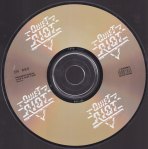
QUIET RIOT – “Slick Black Cadillac Live” 1983 Kerrang Flexidisc
The reason I have this (scored from Discogs!), aside from it just looking cool, is that it’s hilarious! The version of “Slick Black Cadillac” is the same great version that was later released on the remastered edition of Metal Health. However…it has recorded messages from the band members as well! These messages are directed to the UK readers of Kerrang! (who gave away this flexi-disc), and are dubbed directly over the song.
After Kevin DuBrow mentions the upcoming December gigs they’ll be playing, each member gets to say a word. Rudy in particular strikes my funny bone. “Hi, this is Rudy Sarzo, and I play the bass!” He’s just so…excited! As for Kevin? “When I see you I wanna hear you scream ’til your throats bleed!”
Flexi-discs are obviously fragile and are only good to play a handful of times. They have a bit more background noise than normal 45’s, but have the bonus of looking cooler than the average 45! This one is single sided, and came taped inside an issue of Kerrang! Not all flexi’s are clear like this one, so I consider this a fun conversation piece.
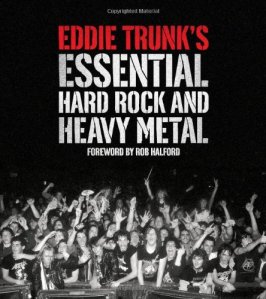
Here is a book that I heartily endorse — for beginners. I bought my best bud Peter a copy of this for his birthday a couple years ago. For a guy like Peter, a general survey book like this is perfect. It’s boiled down to the essentials, by a guy that many trust: Eddie Trunk.
I normally don’t go for this kind of book, because what can Eddie Trunk tell me about Judas Priest in three pages that Martin Popoff didn’t in his excellent book, Heavy Metal Painkillers? So this book is for the people that just want the facts, ma’am. Anybody who’s listened to Eddie Trunk’s show on Sirius XM knows that this guy is the real deal — he knows his stuff, he knows the bands personally, and he doesn’t pander. He has a genuine love for the music, all of it. His personal touch helps make his radio show that much more enjoyable. Same with this book.
After Rob Halford’s forward, Eddie presents his essential hard rock and heavy metal bands, in alphabetical order. AC/DC, Aerosmith, and all the way down the line. You may take exception to some of the bands that he skips over (I read on a message board that Quiet Riot were ticked that they’re not in here) but I think by and large he hit the nail on the head. The bands that he does include…well, it’s hard to argue against them, and you only get so much page space, right? And this is a gorgeous book. Full colour photos, every page. Beautiful. Lots from Eddie’s personal collection, you’ll see a very young Eddie Trunk meeting the bands as a kid!
In addition, Eddie gives you a discography for each band (not perfect, there are a couple errors here, as in inevitable in a book like this). He also lists the members of the bands, and the most important ex-members and sidemen. So when you get to Queen (and yeah, you may argue that Queen is not a hard rock band) you’ll see the four original members, and Paul Rodgers listed beneath them. Finally, Eddie gives you his list of his ideal mix CD for each band. Go ahead and make your own, and see if you agree!
As a gift to Peter who likes the music but doesn’t know the details, he gleaned plenty from this book. Before reading it, he only knew of one Billy Squier song. Eddie Trunk got him up to speed. Thanks Eddie!
5/5 stars
For a guy like me, and quite possibly you as well:
2.5/5 stars
Added note: I know there is a Part II as well, but I have not checked it out.
RATT – Infestation (2010 Roadrunner Japanese and iTunes editions)
Ratt needed a comeback. Lineup changes galore, deaths, poorly-received changes in sound — forget all that stuff. The band has since stabilized. Pearcy’s back on lead vocals, and Carlos Cavazo (ex-Quiet Riot) has taken over guitar duties from John Corabi. Corabi’s a rhythm player, not a soloist (and that’s not a knock on Corabi). Cavazo rocks out quite a few solos on this album. The difference is noticeable, and it’s a welcome return to something like the Ratt sound of yore. Do you like twin leads? Cavazo and Warren DeMartini rip out a few, each with his own distinct sound, but meshing well like they’ve been doing this forever. Cavazo also contributes strong co-writes to about half the album. Surely, you can’t imagine a better match than this for Ratt.
Pearcy’s in great voice, the passages of time disguise-able. But be forwarned, if you never liked Pearcy’s style before, this album is not going to change your mind. His vocals are augmented by some nice, but not overdone, backing vocals from the band. Longtime bassist Robbie Crane supplies backing vocals while holding down the bottom end.
The sound of the album is pure Ratt, but modernly produced; surely the best sounding record they’ve done so far. Picture a heavier Out Of The Cellar. There are nods and winks to other eras of Ratt as well: I hear a little bit of “Way Cool” here and there, and damned if “Best Of Me” wouldn’t have fit right in on Detonator. Yet this is no retro-fest, as much as it does echo the 80’s. There are still sounds here that sound tougher and more modern, like the fast and heavy opener “Eat Me Up Alive” (my second favourite song). There’s filler here, but even the filler is worth holding your finger off the skip button. All except perhaps the dreadful “A Little Too Much”.
There Japanese bonus track is a cool slow groove rocker called “Scatter”, with a great memorable chorus. This is the best song to me. Itunes got the track as well, but because I always prefer a physical edition, I bought the Japanese for my physical copy. You will have to judge the value of that expenditure yourself, however I deemed it worthwhile.
There are also three live bonus tracks on the iTunes version, worth getting. These songs are “You Think You’re Tough”, “Tell The World”, and “Way Cool Jr.”, all previously unreleased and with Cavazo on guitar, “Live from the Rockline Studios”. “You Think You’re Tough” is my favourite song from Ratt EP.
If you have ever liked Ratt, pick up Infestation if you’re curious what the band sounds like 25 years later. This is a solid Ratt album, not classic, but song for song among their better records. They’ve retained their signature “Ratt N’ Roll” sound, but also what dignity and integrity a bunch of Ratts have. Well done.
Part 2 of my 2-part review of the Quiet Riot Twin Pack set. Twin Pack bundled the band’s final two releases: a retro live album, and the final studio album, Rehab.
QUIET RIOT – Rehab (2006 Demolition)
I love Quiet Riot, even more than I have reason to. Metal Health was the first “metal” album I ever bought, on cassette, and I’ve re-bought it three more times since. I just love that album, and I admit it’s probably 60% music and 40% nostalgia. Since it came out, I’ve managed to collect a lot of Quiet Riot. Prize possessions are my CD copies of Quiet Riot I and II. This Twin Pack set was important to me because the version of Rehab contained herein has the European bonus track, “Wired To the Moon”.
It turns out, however, that Rehab kinda sucks. It has its supporters who enjoyed the heavier, bluesier sound. Rehab unfortunately repeats the problem that Quiet Riot have had for many years: they don’t write very many good songs! Kevin DuBrow and Frankie Banali were reduced to a duo after the departures of Rudy Sarzo (who went on to Dio and is now in Tateryche) and Carlos Cavazo (now in Ratt). Rehab had the right ingredients in place, with the awesome Tony Franklin on bass and Glenn Hughes providing backup vocals, but it was not to be. I give them an A for effort, as I am usually in favour of heavying up the sound and adding blues elements. They get a D for execution.
The concept was to leave behind the glam rock, but the songwriting is so underpar. Choruses and verses don’t mesh, melodies don’t stick in the head, and riffs don’t hit you where it hurts. The best song, “South of Heaven”, is a really good Zep-ish tune though. “Strange Ways” features an incredible solo by Neil Citron, like a cross between jazz fusion and Eddie Van Halen. Jazz Halen? On the other hand, “Old Habits Die Hard” is one of the more colossal failures. Aping Joe Cocker’s “With A Little Help From My Friends”, DuBrow sinks this one all by himself with his overwrought lead vocal.
There are some good moments. Pretty much all the guitar solos and instrumental sections are incredible. The drums are good. A song called “Beggars and Thieves” is one of the better songs, because it is anthemic and memorable like old Quiet Riot. Unfortunately, that cannot be said of most of this material. Glenn Hughes classes up the place by several notches when he shows up at the end, but this also highlights Kevin DuBrow’s limitations.
1983 hairline
2005 hairline
I dislike the cover art and packaging. DuBrow’s wig, oh my God. Seriously? The old Quiet Riot logo is also gone, and the masked mascot dude is barely visible. The album was self-produced by Kevin and Frankie, but they really should have spent some money on a producer with a decent set of ears. These songs would not have passed muster with any serious producer. The title of Quiet Riot’s final album is now a sad irony, considering DuBrow’s overdose at age 52.
Part 1 of my 2-part review of the Quiet Riot Twin Pack set. Twin Pack bundled the band’s final two releases before DuBrow’s untimely death: a retro live album, and the final studio album, Rehab.
QUIET RIOT – Live & Rare (2005 Demolition)
I will tell you right off the bat, the only reason to own Live & Rare by Quiet Riot is if you are like me (obsessive collector), and must own everything. That’s it. There are no other reasons. This is a terrible, terrible CD. Awful. It is so cheaply and carelessly put together that it truly is the definition of “cash grab”.
The original pressing of this CD had a major flaw, a 2 second gap between the songs. This amateur mistake caused the audience noise to cut out and then start again in a way that was just jarring and unpleasant. They partially fixed the problem on my second printing…but only partially. The 2 second gap is gone, but it is replaced by a quick split-second pause — think about the way a live album sounds when you play it on an mp3 player. It’s not nearly as bad as the 2 second gaps, and it makes the album so much more listenable. At the end, the live portion doesn’t even finish with a fade-out. Just an amateur abrupt silence. Lastly, the three demo tracks at the end aren’t even listed in the correct order on the CD sleeve. I have a hard time imagining how these flaws made it past quality control — twice!!
I can remove the gaps using Audacity, and re-burn the thing using Nero, but really what’s the point? If the album was decent, it might be worth the effort. Unfortunately, Live & Rare is pretty poor. You wouldn’t expect this to be the case upon reading the track list. Live performances from the 1983 Metal Health and 1984 Condition Critical tours, the golden years with the classic lineup. Throw on three bonus tracks from the 1981 DuBrow demo and it should be a pretty satisfying listen, gaps or no gaps.
Musically the songs are fine, but the recordings are terrible! Basically this sounds like a bootleg, and I have heard far better bootlegs. I’ve heard audience bootlegs that were better quality than Live & Rare. It’s nice that there are some rarely played tracks on here (“Gonna Have a Riot” and “Danger Zone”) plus a drum solo, but otherwise the CD is close to unlistenable. What’s the point of a drum solo if it sounds this terrible? The only, and I mean only, saving grace on this CD are the three unreleased DuBrow demos. They date from a time when Quiet Riot was actually broken up, and Kevin was recording under the name DuBrow. Banali was a part of the DuBrow lineup. They were eventually renamed Quiet Riot and they recorded Metal Health and made metal history. These demo tracks are historically significant to fans, and it’s nice to finally have them.
Buyer beware. I was not at all impressed with this CD, and I think Quiet Riot should have been embarrassed to release it. The liner notes state that it was “produced and mixed by Neil Citron and Frankie Banali”. I wonder exactly what they did to produce and mix it. I speculate that they adjusted some levels on a home PC and burned a copy to CD…without removing the 2 second gaps! Not very pro at all.
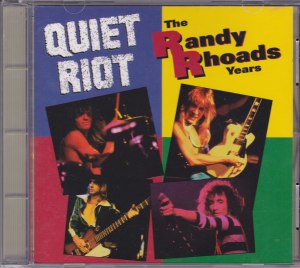
A while ago I talked about the rarities/remix compilation album, The Randy Rhoads Years. I recommended that album, but I am also lucky enough to own CD copies of the first two Quiet Riot albums. Over 13 months ago (!) I promised you that we would take a closer look at Quiet Riot I and Quiet Riot II. That day has come! LeBrain never breaks a promise to his readers.
In a 1993 Guitar for the Practicing Musician interview, Kevin DuBrow complained that producers Derek Lawrence and Warren Entner “didn’t know from guitars”. Quiet Riot I is ample evidence for that. Randy’s guitar is but a shadow of what it would later become under the wing of Ozzy Osbourne. Where later on, Randy would fill songs out with catchy, intricate licks, on QRI he tends to stick to riff-solo-riff song structures.
And this is one awful sounding album. The vocals of Kevin DuBrow are shaky, and the recording is muddy. There are very few standouts among its 12 tracks. Even the Small Faces cover “Tin Soldier” is rendered lackluster. You can hear Randy doing some neat tricks on the guitar, but it’s buried in the mix.
Lyrically, “Mama’s Little Angels” is beyond awful:
“As soon as mommy’s at work, Out come the paint cans, We start to spray it on the wall. That’s getting boring, Go get the bats! Gonna have us some indoor ball! …Well Randy’s up to bat, gonna hit me a home run! Sorry ’bout that, outside! Ball one!”
Whooboy.
“Look In Any Window” is better on the Randy Rhoads Years CD. Here, DuBrow is singing a completely different, annoying vocal melody. Shame, because this is QR’s slant on Alice Cooper, very much up the alley of “I’m Eighteen”. I’ll stick with the remixed/re-recorded version, thanks.
The best song on Quiet Riot I is easily the Dave Clark Five classic, “Glad All Over”. I remember growing up, Bob had a Randy Rhoads guitar book. It was loaded with transcriptions of his Ozzy classics, as well as “Glad All Over”. We had never heard of “Glad All Over”. To this day I don’t know why that seldom-heard song was included in a Randy Rhoads guitar book! Kevin’s vocalizing here is hilariously screamy. I love it. Randy’s solo is Nuge-tastic, with a little intricate lick at the end. Great stuff.
So that’s QRI. Quiet Riot II is marginally better in the songwriting department. The band wisely included only nine tracks on the second album. A few of these are standouts: “Slick Black Cadillac” would be re-recorded effectively by another lineup on the Metal Health album. To hear that song played by Randy Rhoads, the guy who co-wrote it, is cool. His take on the guitar is different from Carlos Cavaso’s, although Carlos obviously did copy some parts. If only it were better recorded, this version could easily supplant the hit Metal Health version.
Another familiar song is “Afterglow (Of Your Love)”, also originally by Small Faces. This song was rendered in an acoustic form on The Randy Rhoads Years. On QRII, it is full-on electric. I prefer the electric version, I just wish it sounded better. There are other decent songs on QRII, such as the melodic “Eye For An Eye”, “Trouble”, and “We’ve Got the Magic”. By the second album, Quiet Riot had gotten better at writing melodies. They had work to do on stitching catchy melodies together into complete songs. Most songs on Quiet Riot II have some really good parts, but are not necessarily great all the way through. The dead production does not help the situation.
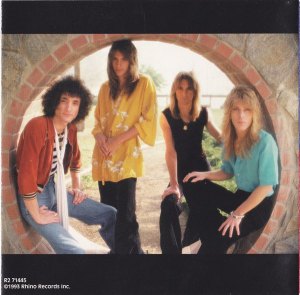
Even though Rudy Sarzo (Tateryche) is pictured on the sleeve and credited, he did not play bass on Quiet Riot II. Kelly Garni played bass, as he did on the first LP. To this day, I don’t know if the CD copies I have are promos or bootlegs. While I don’t know of any promotional CD test pressings, these are definitely high quality for bootlegs. They even have the hilarious mis-transcribed lyric sheets that usually accompany real Japanese CDs. So, I really don’t know!
Growing up in the 1980’s, Quiet Riot was the first “metal” band I liked. Back then, we were aware that Quiet Riot had two albums prior to Metal Health. These albums seemed unobtainable forever at best, mythical at worst! The first two, Quiet Riot and Quiet Riot II, were released in Japan only. Later on, I did manage to get both albums, so I have a unique perspective on this CD: The Randy RhoadsYears, by Quiet Riot.
See, here’s a nutshell version of the story: QR lead howler and co-founder Kevin DuBrow had wanted to re-release the Randy material for years. Randy himself was never happy with those albums, nor his guitar sound on those albums. In light of this, the late guitarist’s mother Delores was very guarded of Randy’s legacy. She knew that Randy felt the albums consisted of sub-par songs with horrible production. DuBrow eventually won her blessing to re-release some of the old Quiet Riot material, but on one condition only: Get the quality of the songs up to snuff so it doesn’t tarnish Randy’s legacy.
So that’s what he did, using all the means available, and the result is a highly modified collection of Quiet Riot songs with Randy Rhoads.
I can tell people out there who haven’t heard the first two albums that they do sound awful. That’s not a myth. Randy’s guitar is but a shadow of what it would become, and the songs are mostly pretty bad, especially on the first album. The second is much better (particularly in the songwriting category) but it is still hampered by poor production. So what could DuBrow do to get permission to do a re-release?
He started by picking out six of the better songs from the first two records: “Mama’s Little Angels”, “It’s Not So Funny”, and “Look in Any Window” from Quiet Riot, and “Trouble”, “Killer Girls”, and “Afterglow (Of Your Love)” from Quiet Riot II. All of these songs were heavily remixed, with completely re-recorded vocals, from scratch. DuBrow felt, probably correctly, that his original singing voice on those albums was too “boy-ish”.
DuBrow re-sampled all the drums, and re-recorded all of Randy’s guitar tracks through a Marshall stack. Randy had confided with Kevin that he was happiest with the way his guitar sounded live with Ozzy, so Kevin recorded the original, sterile guitar tracks through Carlos Cavazo’s amps. They used the Randy Rhoads Tribute CD as a guide.
On one guitar solo, Kevin knew that Randy wished he had used a wah-wah, but couldn’t afford the pedal at the time. Kevin played the wah-wah pedal himself, using Randy’s guitar tracks, a unique form of collaboration between two friends.
With the Small Faces cover, “Afterglow”, Kevin came up with a cool idea. “Unplugged” albums were on trend, so Kevin stripped all the drums and electric instruments off the track, leaving just Randy’s bare acoustic guitar. It is like stripping a layer of paint off old beautiful old wood: the bare guitar track reveals previously unheard warmth. Kevin re-sang the vocal, kept the electric guitar solo intact, and used a triangle sample to cover up places where the original drums had leaked into Randy’s mike. This painstaking work created from the ground up an incredible alternate version that Randy would hopefully have been very proud of.
None of these people are Frankie Banali.
One of Quiet Riot II‘s best songs is “Trouble”. Kevin felt that it plodded too much, so he slightly sped it up which also raised its pitch. He then re-sang it, and the result is a much better song. Suddenly “Trouble” is a rich sounding hit-worthy rock track.
“Killer Girls” had some minor tampering, a blast of guitar where previously there was nothing. It is “Last Call For Rock ‘n’ Roll” that is most changed. Previously titled “Mama’s Little Angels” on Quiet Riot, Kevin re-wrote what he thought was a juvenile lyric. (It was about trashing the house playing a game of “indoor baseball”.) Bobby Rondinelli, who was working with Kevin on a Quiet Riot album called Terrified at the time, helped him re-write the tune. Unfortunately, regardless of all this work, the song is still just a stock sounding track, nothing special, aside from Randy’s always classy if underplayed guitar work.
The rest of the album consists of unreleased songs. One of the most exciting is a live take of “Laughing Gas” which Quiet Riot never cut in the studio. It comprised an evolving, extended Randy Rhoads guitar solo. Within it, you can hear the kernels of ideas that later became Ozzy Osbourne classics such as “Dee” and “Crazy Train”. Even this “live” track is tampered with: Kevin re-recorded his lead vocals (even the “Ladies and gentlemen, Mr. Randy Rhoads!” part) and actually spliced two different guitar solos together into one. You can hear the splice point between the two quite clearly. Of course this makes the solo no less jaw-dropping.
“Picking Up the Pieces” and “Breaking Up is a Heartbreak” are two of a kind. Kevin says these come from their “pop” period after the second album, just before Randy was off to work with Ozzy. They were getting more desperate for hits, and wrote these two melodic, radio-ready tunes. Both are excellent. Much like “Trouble”, these two songs are world-class. Kevin re-recorded the vocals and so on just as he did with the other tracks. At this time, bassist Kelly Garni had left the band and Randy played bass himself.
Lastly, “Force of Habit” is the only bare, untampered song. In the liner notes, Kevin says they lost the original master tapes, so he was unable to remix or re-record any of it. I think it’s an excellent heavy song on its own. In fact, Ozzy Osbourne must have thought so as well, since parts of this song later became “Suicide Solution”!
This work, and “Laughing Gas” in particular were enough to convince the Rhoads family to go forward with this album. If Kevin hadn’t done this, undoubtedly we would never have seen this release. On the other hand, this isn’t the way Randy recorded it, and Randy obviously had no input to how the tracks were mixed. This has polarized fans, some of whom thought Kevin was the great Satan, others just enjoying the album for what it is.
I enjoy the album for what it is. I like it a lot, actually. I do have misgivings about the tampering, but since I own the first two albums, that feeling has subsided. I can back up the claims that the first two albums are pretty poor.
Kevin had planned on a second volume, including such treasures as Quiet Riot’s metallic cover of “The Mighty Quinn”. He had also mentioned a home video, including the extended “Laughing Gas” guitar solo. Sadly DuBrow, will never get to complete these Rhoads reissues.













 mikeladano.com