Reviews

REVIEW: Black Sabbath #1 – Rock-It Comics (1994)

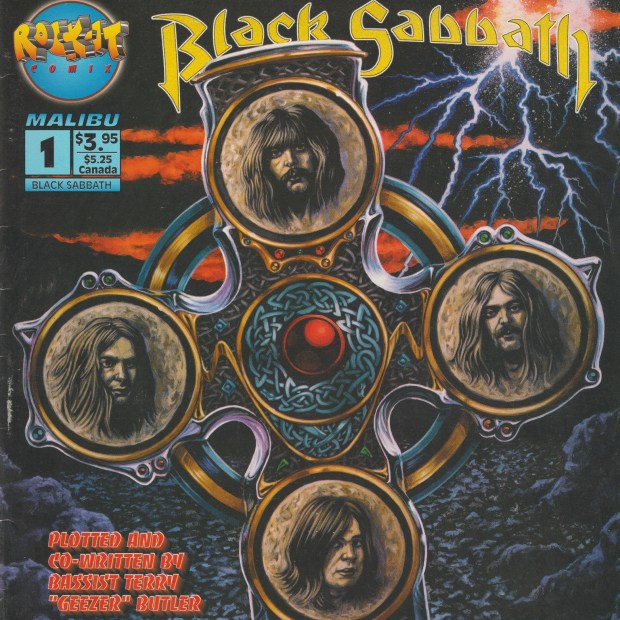
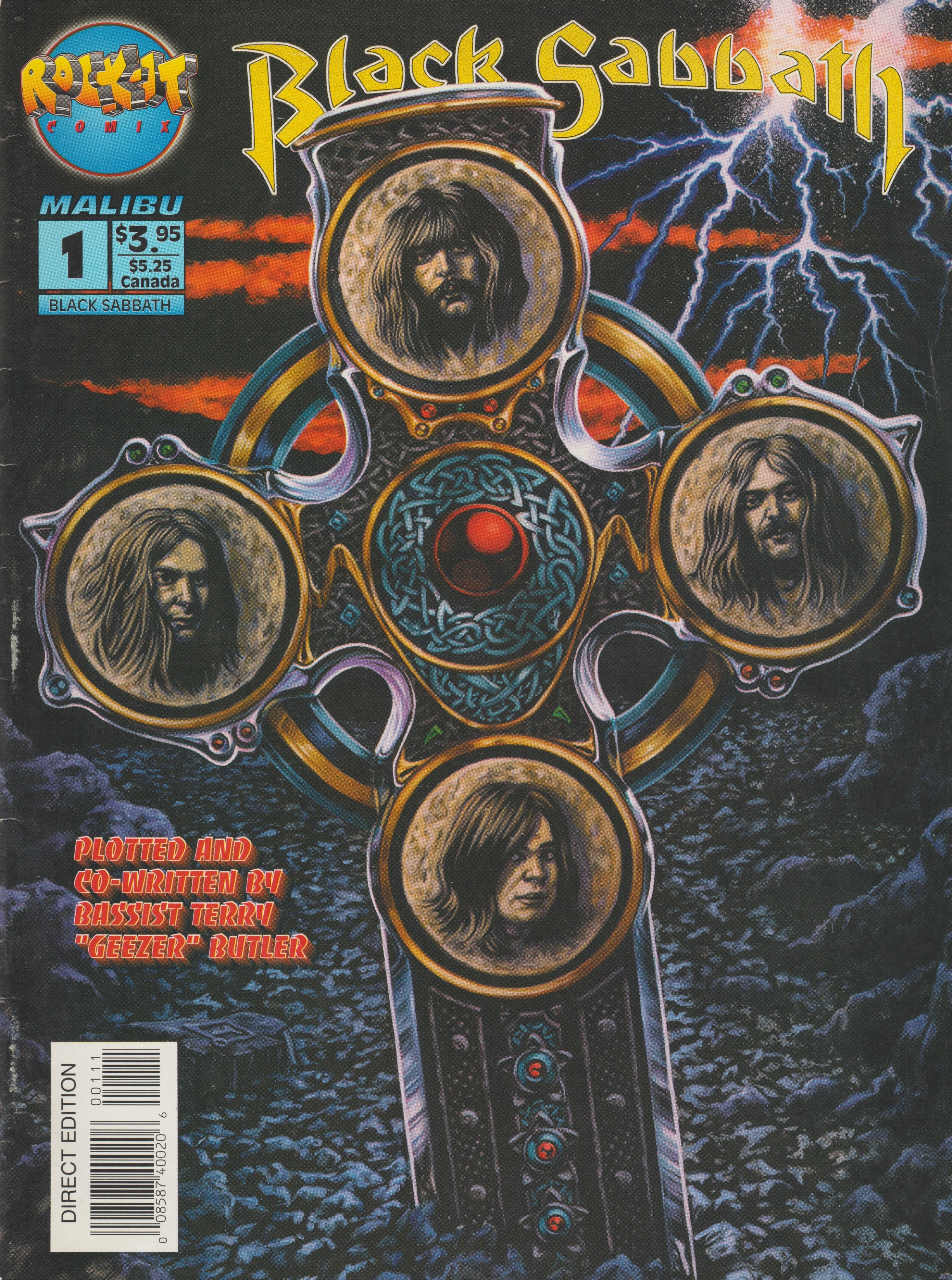
BLACK SABBATH #1 – (1994 Rock-It Comics)

1979:  Ozzy Osbourne walks out on Black Sabbath, the band he has fronted for 10 years.  Things almost get physical, and then Ozzy pledges to rule the world on his own.  Tony Iommi swears to come out on top, with or without him.  Bill Ward looks down, knowing that it is truly time for a change.  Geezer Butler doesn’t want to give it up and recommends they call “that Dio-bloke”.

Malibu comics produced a highly fictionalized version of Black Sabbath’s early history in 1994, with stunningly rich artwork and co-written by one Terence “Geezer” Butler himself.  Understanding that this is a mixture of fantasy and history, “The Power of Black Sabbath” is a hugely entertaining comic.  The basic bones of the Sabbath story are there.  The gradeschool rivalry between Ozzy and Tony was real, but Tony never said “Give it up Osbourne, you sing like a girl!”  And it doesn’t matter because it makes for a good panel.  Meanwhile, a young Terry Butler is visited by a mysterious entity that allows him a brief glimpse at his own future.

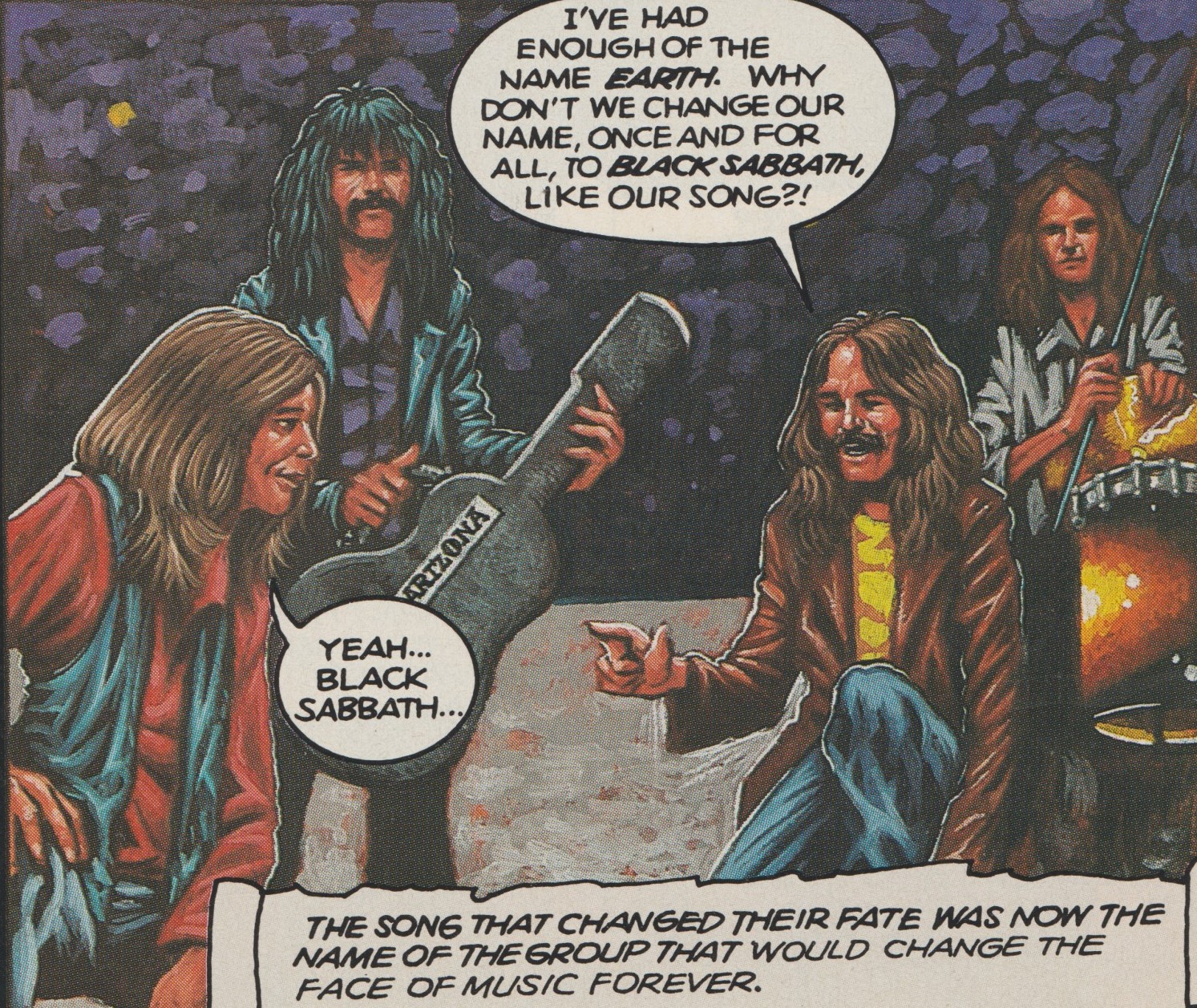
As if like fate, the four members of Black Sabbath eventually merge together.  Their early history as “Earth” precedes the fame.  Dirty managers, “Blue Suede Shows”, and Jethro Tull stories are rolled out panel by panel.  “Why did I ever think about leaving Earth?” muses Tony, as a demanding Ian Anderson commands him to play a solo.  After another supernatural encounter, they finally settle on the name Black Sabbath.

Album by album their success grows, but they cannot shake their continuing and strange encounters with entities not of this world.  By the time of Never Say Die, tensions between Tony and Ozzy result in the temporary hiring of Dave Walker to replace the singer.  Ozzy eventually leaves permanently on his own “Crazy Train”.  Ending the story here, we learn that Geezer Butler has come to peace with the supernatural side of his life.

But that’s only half the book.  There’s still plenty more content of the non-illustrated variety.

An interview with Geezer Butler is about as revealing as ever.  Dig these insightful answers:

Q: Tell us about the new album.

A: It’s called Cross Purposes.  There are ten tracks on it.  We started writing it last February and finished in mid-July.  [He then runs down the band lineup.]

To its credit, Geezer claims that this comic is the most accurate portrayal of Black Sabbath to date, though it does include “poetic license”.

Next is a very cool gallery of photos that you couldn’t easily find anywhere in 1994.  These include full colour pictures of the Glenn Hughes lineup of Black Sabbath, and versions with Dio, Tony Martin, Vinnie Appice, and Bobby Rondinelli.  There are even a couple monochrome photos with Ian Gillan.  At the time these were some of the only pictures I owned of the band in these phases.

The next pages feature a discography, full colour with album art, lineups and tracklistings.  Included here is a warning not to buy Greatest Hits or Live At Last!  “You have an inferior product both in packaging and sound.  You are warned!”  Screw it, I’m buying Live At Last!  The last page is an autobiographical story by editor Robert V. Conte about buying his first Sabbath album Born Again (my favourite).  Within two weeks he had most of their records.

I’ve read a few critiques about this book complaining about the overly fictional portrayal of the band’s history.  I don’t think it particularly matters.  It’s obvious from the supernatural elements that this is not to be taken as gospel (pun intended).  The vibrant ink and colours capture the Black Sabbath members perfectly, and each panel is glorious to look at.  Not to mention it’s an oversized comic so every page has more bang for the buck.  The stylized dialogue keeps the story moving at a good pace, and though the story is but a brief overview, it’s fine for a single issue.

4.5/5 stars

REVIEW: My Wicked Twin – 3 Engines (2020)

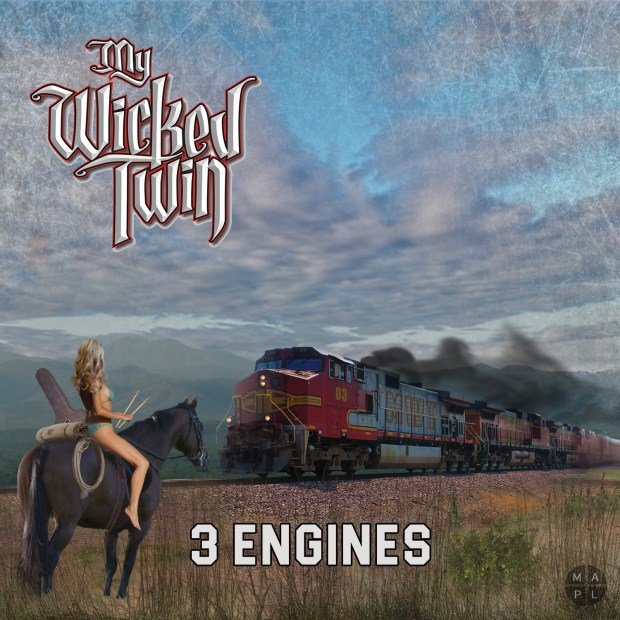
MY WICKED TWIN – 3 Engines (2020)

Like a bolt out of the blue, My Wicked Twin (Brent & Brian Doerner) have a new album out, their fourth, called 3 Engines.  A tight set with 10 songs in the 3-4 minute range, 3 Engines rocks.  Let’s have a listen.

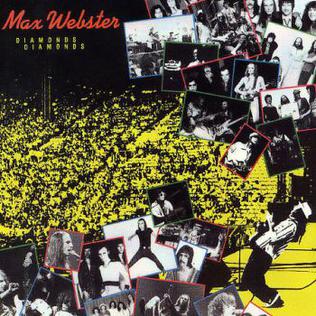
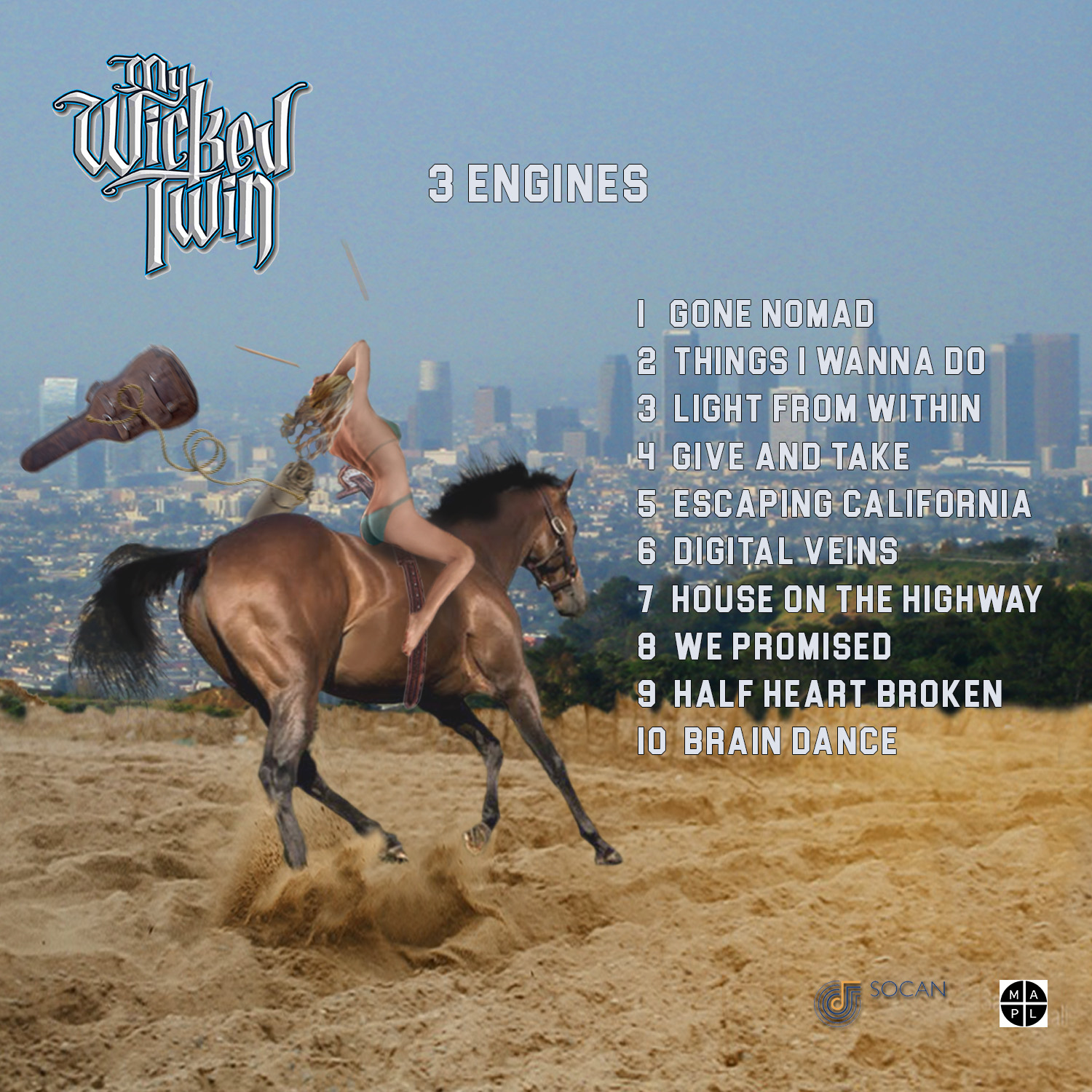
“Gone Nomad”, the heavier than hell opener, is a tricky number that recalls Max Webster, but amped up.  “I’ve got a gun if we disagree,” sings Brent in an electronically treated voice, appropriate to the tune.  By the second track, “Light From Within”, we are in more traditional hard rock territory…until the corner bar piano kicks in!  Clearly nobody was afraid of taking chances.  The dark guitar hook is terrific on this one, as is the melodic bass.  Melody is also the focus of “Things I Wanna Do” a quirky modern sounding track with programmed beats and patches of keyboard.  Dig the engines revving!  “Give and Take” sounds like a natural followup, and it’s interesting to hear so much focus on the vocal melodies this time out.  Clearly a lot of effort went into them.

“Escaping California” has a dreamy quality, with spare use of keyboards that set the scene.  But it’s the following song, “House on the Highway”, that is the most fun.  Who doesn’t love a little banjo?  It adds variety and a little down-home quality and there’s nothing wrong with that.  “House on the Highway” for the win.

For heavy, you want “Digital Veins”.  The guitars and keys complement each other nicely.  “Rock and roll is what I am used to,” sings Brent, but he’s also not afraid to stretch out within those confines.  There’s a cool 80s vibe to “Digital Veins”.  Then “Half Broken” has an interesting rhythm to accompany the cool keys and guitars.  Killer solo here.  “Running Out of Time” has an accelerated pace but also some seriously tasty twang.  The album ends with “Brain Dance”, a cool party tune with a serious thump.  Wicked guitars, with varied tones and licks.

3 Engines is different, and that’s good.  The keyboards add an atmospheric tone, and it’s not dissimilar to old Max Webster.  The electronic treatment on the drums and vocals works, and complement the music.  My Wicked Twin have taken some leaps and bounds on this album, and ended up with some accomplished tunes.  Not for headbangin’.  3 Engines rocks, but it rocks smart.

4/5 stars

Additional musicians:

Paul Chapman – guitar solo on “Running Out of Time”
Jim Mclean – guitar and co-writer on “Light”
Rob Kemp – guitar on “Light”
Graham Smith – bass on “House” and “Light”

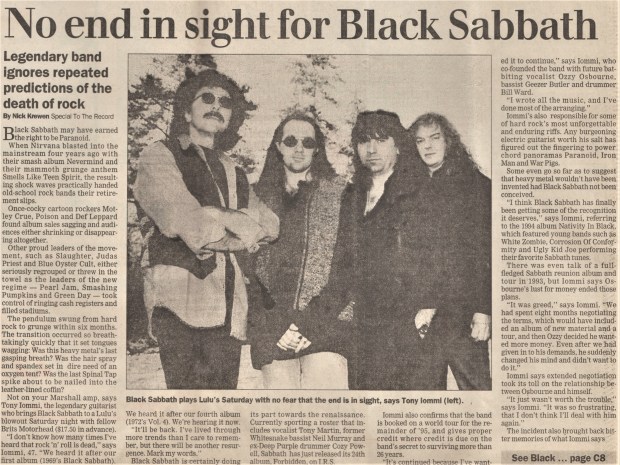
REVIEW: Black Sabbath/Motorhead – 07/22/1995 – Lulu’s Roadhouse, Kitchener Ontario

I thought this review had been lost.  I wrote it in 1995, saved it to floppy disc, later uploaded it to a site called sabbathlive…and when that site disappeared I assumed my review was lost too.  I was wrong!

Guest contributor Holen MaGroin somehow, and with great effort, retrieved the text.  You can compare this with the version I wrote from memory back in 2012.  I’m very grateful to have this back, one of the earliest reviews I ever wrote.  For the record the friends I was with included Iron Tom Sharpe but I can’t remember who else might have gone that night.  It was the night that made me into a Motorhead fan.

This is my first time reading it in decades, so this is almost as new to me as it is to you!  I will leave everything as-is. I can tell that the review is mostly original with a couple sentences added later on when I uploaded it to sabbathlive.  I will put that text in a lighter colour.

The biggest difference between the 1995 review and the rewrite I posted in 2012 seems to be my impression of Tony Martin.  Here I call him “wonderful” and in the version I rewrote from memory, I called him “so-so”.


BLACK SABBATH/MOTORHEAD – 07/22/1995 – Lulu’s Roadhouse, Kitchener Ontario

I arrived at Lulu’s with my friends at 9pm sharp, to find a nicely filled hall. Not too cramped yet at this early hour. Upon our arrival, we were informed that we had missed opening act Tiamat. None of us cared too much. While my friends were there to see Motorhead, I was there to see Black Sabbath.

Motorhead hit the stage on full octane with “Ace Of Spades”. From there on, it was no remorse (pun fully intended). Lemmy looks old, Phil Campbell looks old, but they played like teenagers, and it was refreshing to see. Lem and Phil’s onstage banter was funny as hell, and drummer Mikkey Dee (easily one of the fasted double-bass drummers in the world) was unreal. The highlights of Motorhead’s set were easily “Killed By Death”, “Iron Fist”, “I’m So Bad Baby I Don’t Care”, and the brand new “Sacrifice”. (Lem: “This song is so fucking fast, don’t try to dance
to it or you’ll break both your fucking legs!”) Every single song they played sounded terrific. Exciting riffs, awesome double bass, and cool vocals – if you can call them that. I’m now converted to the gospel of Motorhead: These guys are simply awesome.

The crowd received them very well. I think Lemmy, Phil and Mikkey looked pleased by both the turnout and the response to their set. Lem said he’d come back to play here “any fucking time”, but don’t they all say that?
This time it seemed they meant it. [NOTE: Motorhead did indeed come back to Lulu’s the next year.]

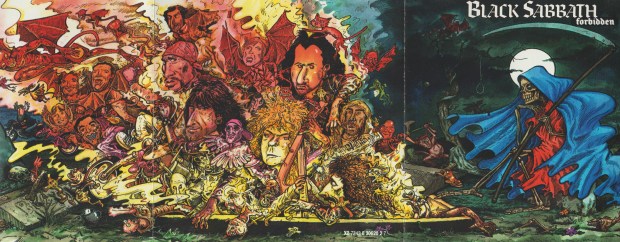
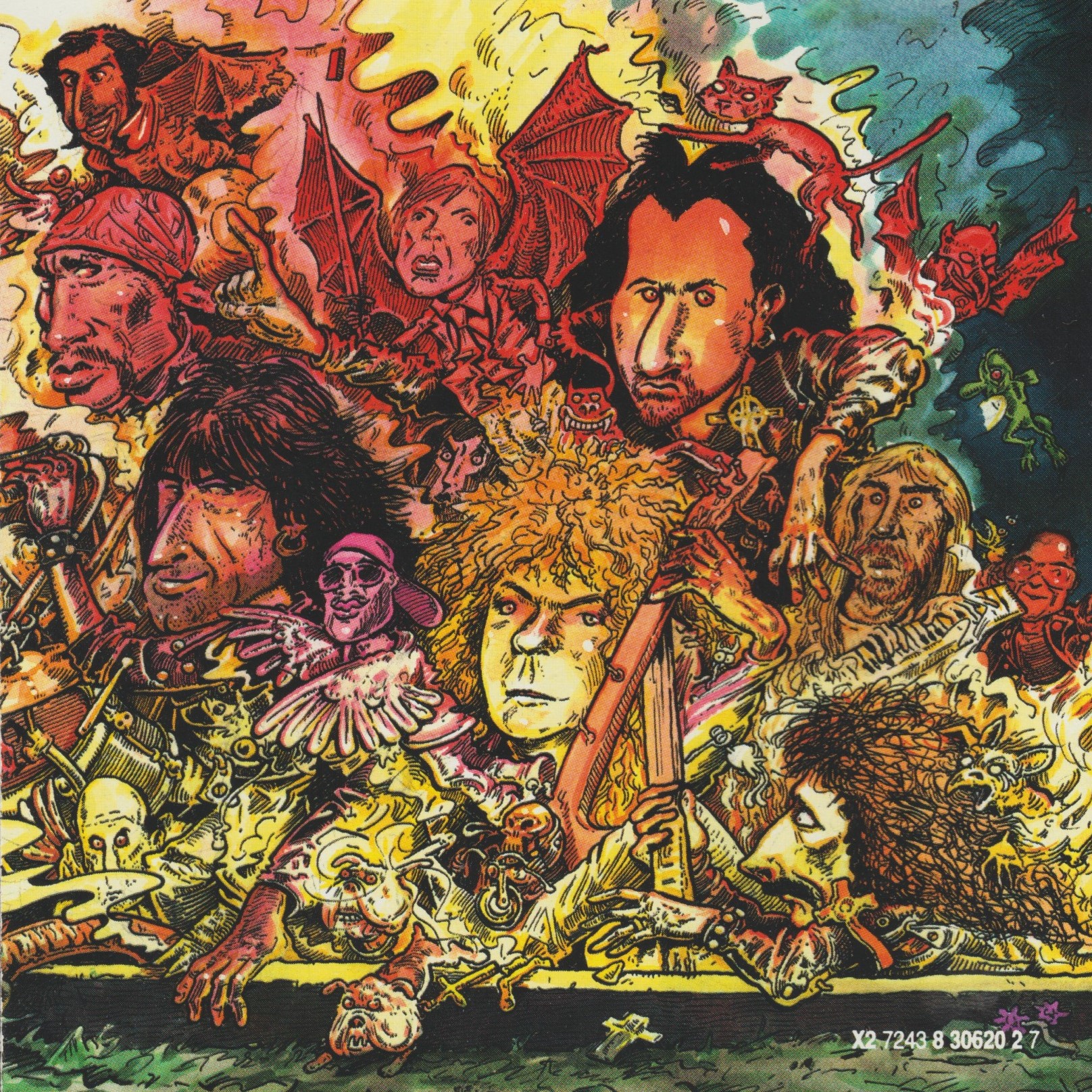
We went back to check out the T-shirts and hats. I really liked the new Black Sabbath FORBIDDEN T-shirts, which had the cartoon cover art. Even a hat would have been nice to own, but I was short on cash. I didn’t even have the $25 to cover a Sabbath hat. D’oh!

We decided at this point to try to stand at the front of the stage for Black Sabbath’s set. We had kind of figured that most people in Kitchener were there to see Motorhead, not Sabbath, and the crowd would thin out a little bit. We were totally wrong. It didn’t take long for the crowd to grow, and thicken in front of the stage.

We grabbed an awesome spot right up front, in between where the two Tony’s – Martin and Iommi – would be. However, this would not be the night to be standing close to Black Sabbath. I’m from small-town Ontario, and rough mosh pits were not what we were used to. During Motorhead’s set the crowd stood there politely, cheered madly after each song, and were generally well behaved, which is the way we liked it. We came to see the band, and hear the music, after all.

The first sign of trouble was when a fight broke out right behind us. A small Cobain-ish kid began pushing around a very large (we’re talking pro-wrestler large) man, who didn’t take it all that well. One headbutt later, the small kid was on the ground bleeding, and the large guy was out the door before security even noticed what had happened. They collected what was left of Cobain.

At 11:30 this was all forgotten. Black Sabbath hit the stage with a powerful version of “Children Of The Grave”. Tony Martin gave the song a fierce energy.

The first thing I noticed was that Tony Martin looked a lot older than I expected. I hadn’t seen any decent pictures of Black Sabbath for a couple years. Martin has small but friendly looking eyes, and receding hair. He sported an evil looking goatee, a long black shirt, black jeans and boots. By contrast, for some reason Tony Iommi looked a lot younger than I expected. He smiled a lot, and even moved around a bit on stage. This is Tony Iommi, the man known for staying riveted in one spot on stage!

Cozy Powell looked the same as he always has, same hair and all, although he did look a little chubbier in the face. Neil Murray looked identical to the way he looked in the “Feels Good To Me” video, five years previous. Keyboardist Geoff Nicholls was partly hidden on side stage. Why Black Sabbath don’t put him up front on the main stage is a mystery to me, he’s been in the band for 15 years now! However, the first thing that hit me about the rarely-seem Nicholls was that he was trying to look hip with his dyed blonde hair.

The set list included all the following songs, although I may have the order somewhat jumbled:

“Children Of The Grave”, “Neon Knights”, “The Shining”, “Get A Grip”, “The Wizard”, “Headless Cross”, “Rusty Angels”, “Can’t Get Close Enough”, “When Death Calls”, War Pigs”, “Sabbath, Bloody Sabbath”, “Black Sabbath”, “Heaven And Hell”, “Mob Rules”.

Encore: “Iron Man”, “Paranoid”, “Heaven And Hell” [reprise]

I felt that Tony Martin was a wonderful frontman. He has his own style. During the instrumental sections of songs, he would back up a few steps, spread his arms like he was awaiting the coming of Christ, and shake his hair about. While singing, he makes eyes contact with you. He smiles a lot. He enjoys what he does. I genuinely felt like the smiles that Iommi and Martin gave off were real, and that’s the real reason that Black Sabbath are still around 25 years later. These guys just love playing music. Cozy Powell and Neil Murray were more reserved, but Iommi and Martin, the core of Sabbath, were happy just being up there.

All the Ozzy-era classics were received with tremendous cheers by the crowd. Tony Martin allowed the crowd to sing most of the lyrics to “War Pigs”. The Dio-era songs were met with equal excitement. Most people in our area on the floor sang along to every word. All the later material was drawn from Tony Martin’s albums, though nothing from the excellent TYR or CROSS PURPOSES, which I found disappointing. However, as Martin said during the set, Black Sabbath have over 200 songs in the catalogue,and you can’t play them all.

They played three of the best songs from the new FORBIDDEN album: “Get A Grip”, “Rusty Angels” and “Can’t Get Close Enough”. They were played well, I felt they sounded better than the album versions. For the “Can’t Get Close Enough” sections of dark fingerpicked guitar, Iommi switched from his Gibson to an unusual make of guitar that I’d never seen before and couldn’t identify.

The highlight of the set for myself was “The Shining”. It had always been my favourite Tony Martin-era song, and I was not disappointed. The surprise was that a lot of people in the audience also seemed to know that song. “Headless Cross” was played equally well, and I was amazed with how rich Tony Iommi’s guitar sounds live. However, this song demonstrated how much vocal range Tony Martin has lost in recent years. He could not hit the high notes. (Play the original and see how high he gets!) Instead, he sang an octave lower. Again, most people seemed to
know this song.

“When Death Calls” came as a surprise, since it was never released as a video like the other Martin-era songs. On the way to the show I said I wanted to hear some obscure 80’s Sabbath, and I got it!

The crowd just ate it up, everything Sabbath served, they ate up and asked for seconds. When the moshing began, I was a bit surprised, and made way further back so as to not avoid injury. A lot of people came out of that show limping, and I didn’t really feel like being one of them.

If I was the only person there surprised by the moshing, it looked like the stage-diving took even the band by surprise! When the first gentleman made his way onto the stage, Tony Martin appeared shocked and backed up a few steps. After this, a security guy parked himself on stage and pushed off every guy who made it up there. It was kind of strange seeing a security guy crouching on stage in front of Martin.

Sabbath ruled. They simply ruled. For sheer intensity they couldn’t match Motorhead, but they held their own. The set list was about as perfect as you could make it, since it’s impossible to squeeze in too many more. After all, the band couldn’t avoid the classics in order to play more material from the 90’s. It was also nice to finally hear Tony Martin’s live renditions of those classics. He really did an excellent job and I hope one day they’ll commit his voice to a live album.*

This was my first time seeing Black Sabbath live. Seeing them so close to home in such a small venue really was an amazing experience. I hope it’s not the last.**


* Cross Purposes Live was released in 1995 in Europe only.

** It was.
 

REVIEW: Loudness – Loudness (1992)

LOUDNESS – Loudness (1992 Warner Music Japan)

It’s safe to say that, while the Mike Vescera era of Loudness has its merits, the band was not the same after Minoru Niihara was let go.  Loudness were not the first Japanese metal band to utilize an American singer in an attempt at greater success.  When that didn’t pan out, Vescera left to join Yngwie Malmsteen.  Unfortunately, this lineup shift happened at the worst possible time in music history:  the 1990s.  The beginning of the grunge movement.

Also gone was bassist Masayoshi Yamashita, leaving only founders Munetaka Higuchi (drums), and Akira Takasaki (guitar).  Returning their focus back to Japan, Loudness sought new members already well known at home.  Taiji Sawada from X (called “X Japan” over here) joined on bass.  In a surprising move, they chose E-Z-O singer Masaki Yamada to front Loudness through the 90s.  Masaki’s style was a vocal shift, drastically different from Niihara and Vescera.  He was also known as a theatrical frontman, using exaggerated makeup and hair.  The name recognition wouldn’t hurt though.  E-Z-O put out two critically acclaimed albums in the US, one of which was produced by Gene Simmons of Kiss.

Having felt pressure to commercialize his music, Takasaki decided to go heavy.  What better way to proclaim that they’ve returned to center than by calling the new album simply Loudness?

“Pray for the Dead” opens with heavy, heavy 90s riffing like a cross between Pantera and Megadeth.  Takasaki was not fooling around.  His trademark divebombs soon give way to a slow grind.  Masaki’s growling presence is swiftly felt.  He might not sound like Minoru but he’s completely right for the new Loudness.  This is not the heavy, technical speed metal of the early albums.  “Pray for the Dead” is the new heavy; slowed down and emphasis on groove.  The difference between Loudness and all the rest of the slow, heavy alternametal bands of the 90s is Akira.  He continued to shred solos that would make most players scratch their heads trying to keep up.

Higuchi pounds his way into “Slaughter House” which wastes no time getting up to speed.  The first fast tempo track of the album gets into thrash territory, leaving Metallica in the dust.  Once again Akira blows minds on the solos, this one going neoclassical before duelling with Taiji on bass.  Not letting up, “Waking the Dead” is a vicious song due to Masaki’s vocal bite.

Loudness is relentless.  The best tune is the groover “Black Widow”, track #4.  It is here that Loudness and Masaki gel most perfectly.  It’s better than a lot of the heavy music coming out of Seattle at the same time.  The production is crisp but weighty.  The performances really jam, even though they’re quite technical.  “Black Widow” is a killer!

A “Kickstart My Heart”-like drum pattern opens a song appropriately called “Racing the Wind”.  This is in the neighborhood of Painkiller-era Judas Priest, but with a bass player who can really shred.  On “Love Kills”, the wah-wah pedal is broken out for some play, but the song otherwise chugs along slowly.  At the time, this was the kind of song that was in the right ballpark to be a hit.  “Hell Bites” then annihilates the senses: a blistering track with incredible musicianship from all around.  There’s that wah-wah again!  It’s the closest thing to an album epic when it goes through different tempos and riffs.  Outstanding track.

An interesting song is “Everyone Lies”, since the music was written by former bassist Yamashita.  At first, it’s not an outstanding track.  After a few listens, the heavy groove becomes unshakeable.  “Everyone Lies” is a serious banger, and it gives Masaki room to really bellow.  “So sick of bullshit, better get wise, everyone lies!”  Masaki was assisted in lyrics by Jody Gray, but this sure does sound like Takasaki’s statement towards old managers and record labels.

There’s a funky groove on “Twisted”, a song that could only have been written in the 90s.  The crazy thing is Taiji’s funk bass skills are phenomenal!  When Takasaki starts Vai-shredding all over it, I forget what band I’m listening to.  Especially when Gray raps.  But that is mercifully brief.  It just goes to show how all-encompassing that altera-rock phase was in the 90s.  It touched virtually every band in some way.  Loudness more than expected.

An absolutely insane thrash metal surgical strike ends the album on “Firestorm”, with lyrics split 50/50 between Japanese and English.  Metal doesn’t come much faster than this.  Hopefully the old fans were shitting themselves in happiness with new music of this velocity.

Although Loudness had returned to their roots in terms of playing fast, heavy music once more, there is no question that they also moved into another direction simultaneously.  Loudness is not The Law of Devil’s Land.  Solos aside, there is nothing as traditionally “metal” as early Loudness.  Masaki isn’t a melodic singer like Minoru.  Instead Masaki goes full blast.  Masaki is an acquired taste with a different style.  You’ll either like it or you won’t.

I like it.

4.5/5 stars


Rest in peace Munetaka Higuchi and Taiji Sawada.


REVIEW: Loudness – Lightning Strikes (1986)

LOUDNESS – Lightning Strikes (1986 Warner – US version)

Eager to repeat the success of 1985’s Thunder in the East, Loudness regrouped with the same production team (Max Norman and Paul Cooper) on the followup Lightning Strikes.  Taking their sound to even wider commercial limits, Loudness wrote a single for the new album, and hoped for American stardom.

When metal bands try their hands at commercial music, the results can be mixed.  Fortunately for Loudness, they had the ability.  Guitarist Akira Takasaki was in a pop rock band called Lazy when he was 17 years old and could write melody.

Lightning Strikes commences with the lead single “Let It Go“, a triumphant upbeat rock song that any band would have loved to write.  The song cannot be praised heavily enough for its sharp catchy riff or singalong melodies.  Singer Minoru Niihara delivers with a knack for a good yell.  Like icing, Takasaki lays down a melodic and technical solo for the sweet tooth.

Seconds up to bat is “Dark Desire”, a terrific track that encourages you to “start a fire with rock”.  This fire goes at a slow burn, but with another notable Takasaki solo as accelerant.  “1000 Eyes” is a bit more metal with its themes of storms and destruction, and screaming chorus to boot.  Check out some bass slaps from Masayoshi Yamashita too.  Then, like a high speed chase, it’s “Face to Face”, pure metal with no commercial considerations whatsoever.  It’s not particularly memorable but the chorus scorches.  The first side concludes with a textbook Takasaki riff on “Who Knows”, a different but decent melodic metal track.  It reminds me of some of the more interesting songs on side B of Iron Maiden’s Piece of Mind, but not as accomplished.

Some tricky stuff via the school of Yngwie Van Lynch is piled onto the front end of “Ashes in the Sky”, a phenomenal power ballad that would have been great on a Dokken album.  (This song was titled “Shadows of War” and served as the opening title track for the slightly different Japanese release.)  “Black Star Oblivion” picks things up with a speed metal track propelled by drummer Munetaka Higuchi.  The jagged chorus makes up for the ordinary verses.  Another memorable riff makes up the structure of “Street Life Dream”, which grinds along at a deliberate pace.  Closing with some dense and blurringly fast riffing, “Complication” sounds like its title.  It’s a bit too busy but certainly ends the album dramatically.

Lightning Strikes is not a bad album.  It has some great tunes, but it has a few that miss the mark.  It houses possibly their greatest song ever, “Let It Go”.  It’s a good album to have, but you just wish it was more consistent.

3/5 stars

REVIEW: Marillion – “Easter” (2020 Version)

MARILLION – “Easter” (2020 video recorded in quarantine)

Count on Marillion to bring the light in the dark.

It has been over 30 years since Steve Hogarth and the Marillios first serenaded us with “Easter”.  As a surprise gift in 2020, they’ve re-recorded the track from isolation.  All five guys with their home setups recorded and filmed their parts for a new video.

“As it’s Easter Weekend, Mark [Kelly] had the cool idea of us virtually-getting-together to record a new version of Easter in our homes. Hopefully it will put a smile on your faces.”

It’s poignant, watching the guys play from their personal spaces, unable to connect in person just like us.  While “Easter” has always contrasted light and shade, this time the contrast is sharper, though that may simply be in the minds of the listeners.

A bare acoustic version with a shortened and re-arranged ending (probably due to necessity), “Easter” soothes.  Even under these circumstances, Marillion pulled together a new recording of an old classic and did it quite well.  (Meanwhile behind closed doors they continue to write for their next studio LP.)  If Marillion can use technology to stay connected and celebrate creativity and ingenuity, then so can we all.

Happy Easter.

5/5 eggs


REVIEW: Thin Lizzy – Still Dangerous (2008 inc. bonus tracks)

THIN LIZZY – Still Dangerous (2008 VH1 classic, iTunes bonus tracks)

Think of this as a companion piece to Live and Dangerous.  Four tracks were previously released on that landmark live album.  Still Dangerous has a bunch more, purportedly recorded in October 1977 in Philly.  10 tracks; 12 if you got it on vinyl with bonus 7″, on iTunes, or in Japan.

Like Live and Dangerous, what you get is live Lizzy at their peak, well recorded, and charismatic as ever.  It’s interesting that they opened with “Soldier of Fortune” since it’s a slower number, though no less powerful than any others.  It merges into “Jailbreak”, leaving the audience no chance to breathe…only to be rocked.  Impressive guitar and drums on this one.

“Cowboy Song” and “Boys are Back in Town” are the same as Live and Dangerous; legendary!  Basically one long ongoing song.  Phil introduces their then-new single “Dancing in the Moonlight” as a song with some sax and sex.  Yet it has a youthful exuberance.  “Now we go steady to the pictures, I always get chocolate stains on my pants.”  You can picture that long, hot summer night.  The next track, the blistering metal of “Massacre” is from Live and Dangerous.  Just listen to Brian Downey on the drums, a prototypical metal machine.  Without “Massacre” there could be no Iron Maiden.

“Opium Trail” doesn’t let up the aural assault.  Brian Downey impresses once again with his creative fills and patterns.  Lizzy moves on to “Don’t Believe a Word”, an older classic but just slightly sluggish.  There are more energized versions out there.  “Baby Drives Me Crazy” is also a bit dull, with one of those long audience singalong sessions.  The standard CD closes with “Me and the Boys”, furiously fast and fun!  It’s a long jammer, but its caffeinated pace really keeps things moving.

The two iTunes bonus tracks (mastered annoyingly louder) are “Bad Reputation” and “Emerald”.  Only Emerald was previously available on Live and Dangerous.  “Bad Reputation” is pure smoke.

Since this album was mixed by Glyn Johns and Live and Dangerous was not, one must assume even the tracks from that album are presented differently here.  If you already know that album front to back, then enjoy the fresh sounds of Still Dangerous instead.

4/5 stars

REVIEW: Black Sabbath – The Best of MusikLaden Live at the Beat Club

BLACK SABBATH – The Best of MusikLaden – Live at the Beat Club (1970 television performance)

When Black Sabbath released their Black Box in 2004 featuring all the original lineup’s studio albums in remastered form, they also included a bonus four-song DVD.  This disc was the oft-released television broadcast of a German show called Beat Club (later MusikLaden).  Sabbath made two appearances in 1970, and the Black Box was the most official release of them.  Before upgrading to the Black Box, I owned an earlier, unofficial DVD release.  I taped that DVD to cassette, and that’s what I’m listening to right now.

“Black Sabbath” is torrential, as intense as the young band was able.  Ozzy sounds as if possessed, truly terrified and warning us that something foreboding and terrible is coming.  “Paranoid” is strangely echoey and distant, but still as incendiary as 1970 Black Sabbath should be.  Interestingly, in this version it really does sound as if Ozzy is singing “end your life” instead of “enjoy life”.  A sparse “Iron Man” announces its arrival with evil Gibson guitar sonic bends.  This version of “Iron Man” is a little stiffer than others, but not for long.  Towards the end, Geezer Butler unleashes the hordes and the song stampedes to a close.

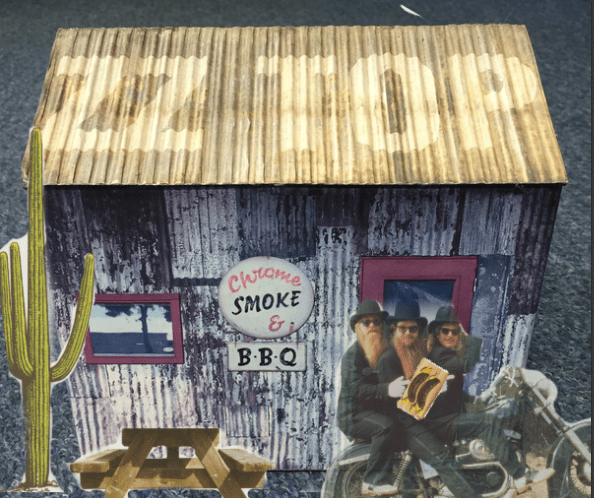
Finally and most notoriously is “Blue Suede Shoes”, a performance pretty much everybody has since disowned.  It’s not terrible, although it’s certainly uncharacteristic.  It’s as if Black Sabbath were suddenly encroaching upon ZZ Top’s territory.  Tony’s speedy solo is interesting if not typical, and the band really stepped it up.  I get why some would mock it; it’s kind of goofy and definitely not as impressive as the Sabbath originals.  But it’s…fun?  Is Sabbath allowed to be…fun?

3.5/5 stars

TV REVIEW: Star Trek – Picard (2020)

“Please, my friends.  Choose to live.”

STAR TREK: Picard Season 1 (CBS All Access 2020)

It truly is a shame that the most Star Trek of all the current Star Treks isn’t Star Trek at all.  It’s a goddamn show by Seth MacFarlane, and it is more true to the spirit of Gene Roddenberry’s vision than any of the three modern Trek incarnations.  If Seth can do it, why can’t CBS?  The newest series (which wrapped up its first season on Thursday March 26) is Star Trek: Picard, based on Jean-Luc of course.  It’s closer to the feel of Trek than Discovery or the Abramsverse, but only by small margins.

Warning:  This review will be light on major spoilers, but there will be spoilers, so proceed only if you don’t mind.

Short Treks:  “Children of Mars”

As set up in the final episode of Short Treks season 2: “Children of Mars”, 14 years ago a devastating attack occurred on Mars.  Mars is close to home, Earth, the seat of the Federation.  The attack, by a new line of androids with a golden skin like Data’s, was devastating.  Jean-Luc Picard was blamed for Starfleet’s inability to respond.  He had taken the fleet to Romulus to save their race from the supernova that would destroy the Romulan homeworld in 2009’s movie, Star Trek. To make matters worse, the Romulans blame Picard for not finishing the job and leaving their people behind when the fleet is urgently recalled to Mars.

Jean-Luc at home at Chateau Picard

In a last-ditch attempt to muster some relief for the Romulan race, Picard offered Starfleet a choice:  help assemble a new rescue fleet or accept his resignation.  They chose not to help.  The broken hero went home to the family vineyard of Chateau Picard while Romulus died and Mars burned.

With all this now in the past, a retired and shunned Picard bears a heavy burden.  Because of the attack on Mars, androids have been banned by the Federation.  The only people that seem to appreciate the former Admiral are his two Romulan housekeepers and bodyguards.  At age 94, Jean-Luc is not as spry as he was when he took command of the USS Enterprise-D decades earlier.  And not all Romulans blame Picard, for some understand that he was powerless when the fleet was sent back to Mars.

Picard’s quiet existence is soon shattered by the appearance of Dahj (Isa Briones), an android who thinks she is human.  Dahj has come to Picard for help.  Someone (Romulans!) tried to kill her in her home, and she somehow knows Picard’s face as one she can trust.  It doesn’t take long for Jean-Luc to recognise Dahj for what she is:  an artificial lifeform, created by unknown means as an offspring of Commander Data.

Dr. Agnes Jurati and Jean-Luc Picard

After a visit with Dr. Agnes Jurarti (Allison Pill) at the Daystrom Institute in Japan, Jean-Luc learns that Bruce Maddox (remember him from “Measure of a Man” in The Next Generation?) was working on a technique called fractal neuronic cloning to create a new kind of android.  Using a single neuron taken from Data’s prototype B-4 (remember him from Nemesis?) Maddox apparently succeeded despite the ban on synthetic life.  Interestingly, fractal neuronic cloning always results in two androids.  Meaning, Data had twin daughters — Dahj has a sister!  Due to her familial relationship with Data, the android that gave his life to save Jean-Luc, he decides he must find and protect the sister.

We have a mission!  To find Dahj’s twin, he needs to locate Bruce Maddox who disappeared when the Federation banned synthetic life 14 years ago.

It takes Picard a few episodes to assemble a crew and get the hell back into space.  Once more, Starfleet refuses to help, and drops the first of many unnecessary F-bombs when asked.  “Just because you can swear, doesn’t mean you should,” says Rob Daniels.

Lieutenant Commander Raffi Musiker

The first three episodes of the show move slowly, as we are spoon-fed dribbles of information about this new Star Trek world.  Jean-Luc had another another first officer after Riker; Raffi Musiker (Michelle Hurd), and guess what?  Preposterously, here’s yet another individual who blames Picard for a whole bunch of things related to the Mars incident.  She’s hooked on booze and smoking “snakeleaf”, but she does have a lovely little motorhome-looking place right near the Vasquez rocks.  Due to the slow moving nature of the writing, it takes a while for Musiker and her motivations to come out.  Apparently she’s a conspiracy theorist, and when Jean-Luc (or “JL” as she calls him) reveals that Romulan agents are running wild on Earth looking for androids, that’s right up her alley.

Raffi is very much correct about her conspiracies, and they go deep.  Dahj’s identical twin sister is named Dr. Soji Asha, and she has been on Romulan radar for some time.  She is blissfully unaware of her own true nature.  Tal Shiar agent siblings Narek and Narissa plan to manipulate her to reveal information they need to wipe out the android homeworld once and for all.  Wait — homeworld!?  That’s right.  Apparently Maddox, on an unknown planet, has been very busy making Data babies.

But why do the Romulans care so damn much about androids?  Things get complicated when you ask that question, and the slow-coming answers never completely satisfy.  It’s all a little too Battlestar Galactica.  “All this has happened and will happen again.”  Cylons uprising against their creators.  Picard digs itself into a pit with this whole storyline, the ancient and previously unmentioned Romulan hatred of artificial life.  A sub-sect of the Romulan Tal Shiar secret police, called the Zhat Vash, is sworn to end all synthetic life — before it ends them, as they have mysteriously foreseen.

Captain Cristóbal Rios

As we slowly piece this information together, Picard also gradually picks up the pieces of the crew in sloth-like fashion.  Next is Captain Cristóbal “Cris” Rios (Santiago Cabrera), yet another former Starfleet officer with a dark, hidden past.  What, are there no happy people left in this world?  What would Gene Roddenberry say about this?  Rios drinks, he smokes cigars — vices that Roddenberry thought most people would recognise as dangerous.  Additionally, Rios has a whole series of holograms of himself, all with different accents and nationalities, to help out around the ship.  Wait…what?  Holograms of himself, with different accents? What the hell is that?  While it’s fun to see Cabrera play five or six “characters” together in a single episode, this makes no sense whatsoever.  Who has that much ego, that they want to be surrounded by holograms of themselves all the time?  With different accents?  Though he’s portrayed as a dark and mysterious captain on an existential journey to heal his broken past, apparently Rios is also a raging narcissist.

OK, are we ready to launch yet?  At the last minute Dr. Jurati from the Daystrom Institute decides to join the crew.  We board Rios’ ship La Sirena and we’re off!

Wait, wait, hold on.  Hit the brakes.  We still have to make a stop.  Once upon a time ago, we learn that the once child-hating Jean-Luc Picard befriended a young Romulan boy named Elnor during the attempted rescue.  Now an adult and fierce warrior raised by an obscure sect, Elnor (Evan Evagora) becomes another of Picard’s new allies.  Needing muscle, we make this one last detour at Vashti to pick up the adult Elnor.  Here we find that…oh, come on — Elnor has a grudge against Picard, too?  It takes one episode (a really good one, admittedly) to introduce Elnor and the Roluman warrior nuns (Qowat Milat) that raised him and taught him those awesome ninja skills.  Only for Elnor to be underused in the instalments that follow.

Elnor

“Please.  Choose to live.”

You will love every time those four words are heard on screen.  You would choose to live too when you see what Elnor can do with a sword.  Those warrior nuns mean business, and they do not like the Tal Shiar one bit.  Elnor practices a lifestyle called the Way of Absolute Candor — total honesty in every word.  This results in some of the lighter, more humourous dialogue in the series.

Picard excels in this first season when going deeper into Romulan culture.  It was never really explored in detail during The Next Generation.  No, instead TNG took it upon itself to define the Klingons.  Deep Space Nine did that with the Ferengi.  And Voyager greatly expanded upon the Borg.  It’s about time the Romulans were fleshed out onscreen, and it’s quite well done.

Because of its setting in time, Picard is also the first exploration of the galaxy post-Romulus.  Its destruction in Star Trek (2009) was established but the repercussions never seen until now.  And guess what — those Romulans have been busy.  They’ve established a colony on a derelict Borg cube, cut off from the collective.  This cube, called the Artefact, and its Borg drone inhabitants are harvested for technology.  And that’s where we find Dr. Soji Asha, assigned to work and study.  Zhat Vash agent Narek (Harry Treadaway) has her wrapped around his fingers.

Seven of Nine

The ties to the Borg story allow us to revisit a couple old friends:  Seven of Nine (Jeri Ryan) and Hugh (Jonathan Del Arco).  These characters are shoehorned into the plot just so that they can be in a new Picard series.  Though once upon a time they were all connected by the Borg collective, Seven’s never met the other two on screen before.  Hugh’s storyline is warm but short.  Seven is…oh man, not again?  A broken soul searching for meaning.  Why can’t any of these damn characters have had a happy life after their series ended?

At least there’s Riker and Troi (Jonathan Frakes and Marina Sirtis).  They seem happy on planet Nepenthe, with their daughter Kestra Riker-Troi.  Riker’s making pizza, and there’s grass and trees and nature and…oh come on!  They have a tragedy too?

Listen, tragedy strikes.  It hits us all.  Lord knows it does.  Star Trek has been building characters on tragedy ever since it killed Sisko’s wife in the DS9 series premier.  It doubled-down when it murdered Kirk’s dad and Spock’s mom in Star Trek (2009).  But why can’t some of our heroes just have life turn out the way they wanted it to?  The way we hoped it would?  Just one character?

Frakes, who directs several episodes of Picard, is still Riker.  The booming voice is augmented by a bigger stature.  Captain Riker has several great moments in this show, in some of the best episodes.

Jean-Luc’s adventures take him from a glitzy Vegas-like planet, to an apprehensive reunion with a Borg cube.  They put our hero in great danger and shine a spotlight on his highest moral standards.  Though the galaxy may have fallen into disarray since we last visited it, Picard himself is just as dedicated to his principles as before.  Perhaps now he is truly able to act according to his moral beliefs, freed of the yoke that was Starfleet command.  Patrick Stewart, as if without pause, has simply become Jean-Luc Picard again.  He still inspires that sense of greatness and meaning that we should all strive for in our lives.  When the adventure concludes, we are reminded that all events set in motion happened because of Picard’s loyalty to his friend.

Commander Data

The lynchpin of the series is Data (Brent Spiner).  Though the beloved android sacrificed himself for Picard in Nemesis (aka Star Trek X, the 10th film), there was always a thread left behind for him to return.  The comic books depicted his return in one way.  Picard takes it in a different direction, one which could either make fans cry or seethe in anger.  Personally speaking I found it to be appropriate and incredibly well performed and directed.  Nemesis was not a great film (perhaps the worst of the original 10) and Data’s farewell was not nearly as impactful as Spock’s was in The Wrath of Khan.  Perhaps this series helps set things right.

We already know a Picard season 2 is in the works, which means we know that the titular character was never in any real danger.  I anticipated one plot twist that happened in episode 10, but a full episode earlier.  It’s a shame they can’t just leave such things unannounced and let the story unfold in surprising ways, not predictable ones.

By season’s end, Picard is a new man again.  With a family-like crew by his side, bonded by life and death and life, the future is promising.  Fans have campaigned for a season featuring Q (John DeLancie) as an antagonist.  This does not seem impossible given that Q’s nemesis, Guinan (Whoopie Goldberg) is confirmed for season 2.  But there are still unresolved threads left hanging in Picard that might be picked up in the second season.  One might even directly tie into Star Trek: Discovery or its spinoff Section 31 starring Michelle Yeoh.

Here’s something else the writers should consider doing next season:  standalone episodes.  We’ve set up Picard’s new ship and crew, as if the season was one 10-hour long pilot episode.  It would be cool to visit strange new worlds every once in a while.  Discover new civilisations.  To boldly go!  To do something more akin to the Seth MacFarlane show, because he’s proven you can do it.  If standalones aren’t likely because overarching seasons are the current fashion, then at least feed us information more quickly and resolve questions sooner.  Picard took forever to get off the ground and moving.  Once that happened…they still spoon-fed the audience in drips.  It doesn’t have to be that way.  To quote Jean-Luc himself, “To say you have no choice is a failure of imagination.”

Soji Asha

Most valuable players:  Patrick Stewart, Jonathan Frakes (as director and actor), Evan Evagora, Jeri Ryan, Jonathan Del Arco, composer Jeff Russo, and newcomer Isa Briones.  In key dual roles as Data’s daughters Dahj and Soji, and even as a singer in the finale, Briones never ceased to impress.  Welcome to Star Trek, Isa.  You’re in it for life now.

Star Trek series typically have rough first seasons.  The Next Generation‘s first season was quite awful.  Deep Space Nine took several years to get moving (literally since it was a space station and they used a new starship to expand horizons).  Discovery underwent a complete re-jigging after its controversial first season.  It would be nice if Star Trek would stop being afraid of its own shadow.  Be what you are, Star Trek.  Don’t try to be Star Wars, or Battlestar Galactica, or anything else that followed in your footsteps.  Writers have always complained that Star Trek is hard to write for, since it has such a long and extensive canon.  Well, Picard is how you avoid those problems — by moving forward into unknown territory, instead of trying to shoehorn your series between others in the timeline.  The future is wide open.  Not only did 2009’s Star Trek create a new playground for the franchise to exist in the cinemas, but it also allowed a “reset” of sorts in the original Picard timeline.  Something bad happened, and the galaxy changed.  This enables freer writing of stories.

It was a good season.  Now run with it, and be intelligently true to Trek at the same time.  It can happen.  To say you have no choice is a failure of imagination!

3.5/5 stars

The next Next Generation.  Engage!

TV REVIEW: The Mandalorian (2019 Disney+)

“Look outside. Is the world more peaceful since the revolution? I see nothing but death and chaos.” — The Client

THE MANDALORIAN (2019 Disney+ series)

2019 might have been the biggest year ever in the history of the Star Wars franchise.  Not only did the original Saga finally come to an end after 42 years of wondering if it would ever happen, but even the very first Star Wars live action TV series came to be.  This comes a full 15 years after its aborted predecessor, Star Wars Underworld was announced.  Headed up by Jon Favreau, The Mandalorian Season One was a commercial and critical success.

But was it as good as its hype?

Pedro Pascal headlines as the mysterious Mandalorian, a bounty hunter trying to make ends meet about five years after the battle of Endor.  The New Republic rules the roost and times are lean, but the Empire is not gone.  Not yet.  The Imperial Client (Werner Herzog) needs a very important asset.  The Client leads a run down, rag-tag Imperial force in hiding on a backwater world.  Via Greef Karga (Carl Weathers), the Client acquires Mando’s services.  Deliver the package alive, but dead will suffice if necessary.  Bounty hunting, after all, is a complicated profession.

Today in 2020, the entire world knows what came as a tremendous surprise back when the pilot episode first aired.  There are no spoilers.  The asset, though claimed to be 50 years old, is just a child.  An alien child with a familiar green hue and large, pointed ears.  The internet quickly dubbed it “Baby Yoda”.

Through the course of eight episodes, we learn that Mandalorians are almost extinct, “purged” by the Empire like the Jedi were.  Those remaining live in secret.  We also discover that the Child the Empire wants so badly can use the Force; powerfully so.  Instinctively with no training.  The implication here is that Yoda’s species are uniquely strong in the Force.  The only other members of the species that we have seen were on the Jedi council.  The Child can do things that only one Jedi in the entire history of the Saga (Rey) has been shown to do.  What isn’t clear is what the Empire wants with the Child.  The Client is just as happy if it ends up dead.  Dr. Pershing, a scientist under his protection with cloning insignia on his uniform, clearly wants it alive.

The Mandalorian is not the average bounty hunter.  Though hard on the outside, he has a soft spot for “foundlings” (orphans), since he was orphaned by a droid army during the Clone Wars.  This also left him with a strong distrust for droids.

Mando’s quest takes him, in his gleaming pre-Empire ship the Razor Crest, all the way to planet Nostalgia in the Fan Service sector.  Every alien species and reference from Saga and spin-off films will await you.  The animated series are likewise plundered for references and threads to pull.  Don’t ask yourself how the scavenging Jawas managed to spread through the galaxy, ask how they brought a sandcrawler with them.  Also ask how the Mandalorian, who lived through both the Clone Wars and the Galactic Civil War, has never heard of anything resembling the Force in his life.  Not impossible, true, not impossible.  But certainly unlikely?

To the show’s strength, Mando surrounds himself with allies including the wise Ugnaught Kuill (Nick Nolte) and the former Rebel shock trooper Cara Dune (Gina Carano).  He even reluctantly forms an alliance with bounty hunter droid IG-11 (Taika Waititi).  Each one of these bring out another aspect of Mando’s disguised personality.

Unfortunately, the show’s weaknesses are apparent by the second episode.  It lacks a consistent tone and even the soundtrack is all over the board.  Mando’s path is too twisted by side missions and quests, like a video game biding its time before you’re back to your main story.  A few episodes play out like actual video games, particularly the sixth. Some such as the fourth suffer from substandard acting and poor direction (which came as a surprise, being directed by Bryce Dallas Howard).  While there is nothing low-budget about the Mandalorian, some of the performances are pretty cut-rate.

The meandering season finally returns to form when Mando and the Child encounter the Imperials once again.  And guess what — they’re not as poorly equipped as we were led to believe.  Giancarlo Esposito, who was unforgettable on Breaking Bad as drug kingpin Gus Fring, menaces our heroes one more time as Moff Gideon.  With a squadron of crack Imperial Death Troopers and a custom TIE Fighter, Moff Gideon is willing to sacrifice his own men to get the Child back.

The show is a hit.  “This is the way” is a phrase that has entered our modern lexicon, along with “I have spoken” and “I can bring you in warm or I can bring you in cold.”  To say that season one was successful is an understatement.  Season two is already locked and loaded, bringing in Rosario Dawson to the fold playing former Jedi Ahsoka Tano.  She will likely be the first protagonist on the show to understand who the Child is and what Moff Gideon wants it for.

Hopefully season two will cut down on the obvious fan service.  (Did Bill Burr really have to do a Gungan impression in episode six?)  With one season down, we look forward to a tighter story with fewer episodes where nothing really happens.  And we certainly anticipate what Pedro Pascal will bring to the role next time.  His performance, limited to voice and body language, was without flaw.  The set must have been electric any time he was together with Werner Herzog.

Episode highlights of the season:  four out of of eight great episodes.

  • 1. “The Mandalorian” directed by Dave Filoni
  • 3. “The Sin” by Deborah Chow
  • 7. “The Reckoning” by Deborah Chow
  • 8. “Redemption” by Taika Waititi

The rest don’t bring much to the story and can be skipped with little lost except most of the fan service.

3/5 stars