Music, movies, and books! I’ve been very occupied these last couple days.
I get the Guiness’ Book of World Records, and the Ripley’s Believe It Or Not books every year. I imagine my surprise when I discovered a friend of ours in both books! Apparently, Sweet Pepper Klopek holds the world record for “Most Baking Sheets Buckled Over the Head for One Minute.” This is a guy who has been on my living room couch! Lemon Kurri says:
“He’s in there a couple times. Most mouse traps sprung on a tongue in 1 min too.”
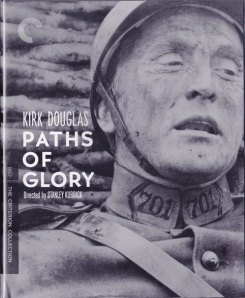
PATHS OF GLORY (2010 Criterion Blu-ray, originally 1957)
Directed by Stanley Kubrick
It is the First World War. The French have dug into trenches, 500 miles long, from the English Channel to the border of Switzerland. As the film’s intro eloquently states, victories are counted in hundreds of yards gained, at the cost of hundreds of thousands of men. This is the setting of Paths of Glory, certainly and easily one of the greatest war movies of all time.
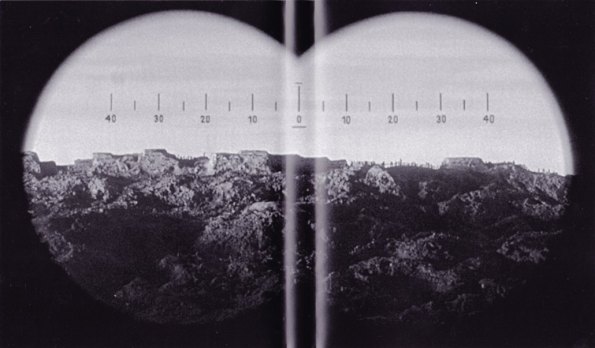
Paths of Glory, one of several Stanley Kubrick masterpieces, contains some of the most realistic First World War battle scenes ever put to film. The landscape is a cratered no-man’s land of mud, wire and bodies. The desperation is captured beautifully. The references to “shell shock” are historically accurate (it was considered to be a mythical condition by the generals of the day).
Kirk Douglas is Col. Dax, once a lawyer in his old life, now ordered to take the “Anthill”. It’s a fortified position that German forces have held for a year. Now the French intend to take it and keep it. All they have to do this with is tired and worn out men. Dax doesn’t think it can be done, but cannot disobey an order. The only alternative for him would have been to be relieved of duty, and Dax won’t abandon his men when they need him.
General Mireaux, his ambition clouding his judgment, set up an impossible undertaking. As is inevitable, the man are slaughtered, not even able to clear their own barbed wire. The few survivors were forced back by more guns and shells. A humiliated and embarrassed General Mireaux then orders his artillery to fire on his own trenches (that should keep them from retreating to them, right?) When that order is refused, he decides to charge them for cowardice in the face of enemy. After all, someone must take the blame for this failure, and why should it be an officer? Col. Dax returns to his role of a lawyer and defends the three token men chosen at random to face the charges of cowardice. Then, the movie morphs into courtroom drama.
Paths of Glory paints a picture of the way it was, based loosely on the practice of executing men for cowardice before they “infect” the rest of the men with it. It’s not a pretty picture. The trenches in the film are perhaps drier than the real trenches but the landscapes look very real indeed. Kubrick’s style here was still that of an observer, which came from his years as a newspaper photographer. He places his lenses where an observer would sit, and you can watch the events unfold like a fly on the wall.
Kirk Douglas is joined by Kubrick regulars Timothy Carey (two Kubrick films to his name), Joe Turkel (three Kubrick films) as well as Adolphe Menjou and a very young Christiane Kubrick.
The story itself is a heart wrenching look at the realities of First World War Europe, and also the human spirit. It attacks our prejudices and practices while reminding us that we are all the same regardless of our station in life. Kubrick seems to have been both fascinated by war while being repulsed by its necessity.
This being such an historically important film, I am glad that it finally received the Criterion treatment. The restoration is very well done compared to the original DVD edition. The audio is in mono just as the original film was. I appreciate that nobody tried to tinker with the audio to make it multi-channel. This is the way Kubrick made it. Supplemental features are here including audio commentary, an essay, and a fun interview with Kirk Douglas from the 1970’s, among numerous others.
This is absolutely necessary for any fans of real war films and Stanley Kubrick. Hopefully this ushers in a set of brand new Kubrick Criterion editions. I bought two copies; the second was for my dad.
5/5 stars
Kirk Douglas … Col. Dax
Ralph Meeker … Cpl. Philippe Paris
Adolphe Menjou … Gen. George Broulard
George Macready … Gen. Paul Mireau
Wayne Morris … Lt. Roget
Richard Anderson … Maj. Saint-Auban
Joe Turkel … Pvt. Pierre Arnaud
Warning: The delightfully titled Hot Tub Time Machine is the same as every other modern comedy. Outrageous situations! Gross-outs! Swearing! Hollow characters!…but I liked it. What can I say, I’m easily amused. I don’t mind this kind of movie, plus it has an 80’s metal slant. The performances by John Cusack and Rob Corddry were good enough to keep me entertained long enough.
Plot in a nutshell: Three dudes plus Cusack’s nephew are going nowhere in life and in their relationships. Trying to dip back into the past, they visit the same ski resort that they went to back in ’86. It’s gone downhill since then, but after a drunken night in the hot tub, they wake up (gasp!) back in 1986, forced to relive one of the most interesting vacations of their lives! Will they do things the same? Will they try to change the future? Can they even get back to the future? What about the nephew? Watch to find out!
Each character has his own trip to relive, Corddry’s being the lynchpin of the whole situation. The plot is pretty simple but the movie is fun. Great music from the 80’s — Poison, Motley Crue, and more — make this a movie for the balding generation. Heck, there’s even a vintage-looking Poison concert complete with some dude that looks exactly like C.C. Deville circa Look What The Cat Dragged In.
To its credit, the ending was a twist I didn’t expect, and I enjoyed the cast including Chevy Chase. It was fun revisiting some aspects of 1986 (even though some tunes, such as “Kickstart My Heart” didn’t come out until ’89).
Blu-ray special features include commentaries, deleted scenes and extended scenes. The best deleted scenes were multiple hilarious takes of Corrdry, who’s comes across as a pretty funny guy. Digital copy is included but don’t ask me about it, because I don’t use them. All I know is that the digital copy is just the “rated” version of the film.
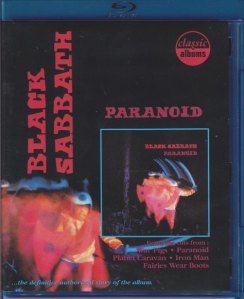
CLASSIC ALBUMS: Paranoid – BLACK SABBATH (2010 Eagle Vision Blu-ray)
Those familiar with Black Sabbath know that Tony and Geezer don’t necessarily make the best interviewees. Their answers are often monotone, bland, and only vaguely remembered. Maybe somebody gave them some coffee before this video. Geezer in particular seems more animated, but they both appear actually alive! Bill Ward is Bill Ward, of course. Ozzy can barely get his voice above a croaking whisper. None of that matters though, because this Blu-ray disc is not about the present, it’s about the distant past, 40+ years distant in fact: the landmark metal album of metal albums, Paranoid.
Everybody reading this knows Paranoid from front to back (I hope so, anyway) and has probably bought it more than once. If you don’t know Paranoid, get the album! Go! Listen to it, come back, and finish reading this review later.
Like all Classic Albums discs, this deconstructs classic tunes to the individual layers. You are invited to hear the basic tracks for songs such as “Iron Man”, “Fairies Wear Boots”, “Planet Caravan”, “Black Sabbath”, and more. Engineer Tom Allom (perhaps best known for his production work with Judas Priest) is your tour guide. Stripped of vocals and guitar, you can hear the rhythm section clearly. Hearing Bill and Geezer playing together without adornment is a revelation. If anyone comes out looking very underrated in the Sabbath saga, it is Bill Ward and Geezer Butler, who are psychically locked-in and loose.
Meanwhile, in new footage from the here and now, Iommi demonstrates some of the most famous riffs and solos in Sabbath history. Meanwhile Ozzy explains how he wrote melodies. This story is unfolded within the context of the late 60’s and early 70’s, and what Sabbath stood for in those tumultuous times.
Bonus features are generous, like all Classic Albums discs. About 45 minutes of additional footage is available, discussing songs and topics that didn’t make the cut of the main Blu-ray feature itself. None of it is filler, all of it is worth watching and probably would have made a completely un-boring extended feature anyway, had it been left in.
My only complaint is the resolution of this disc is only 1080i. Minor complaint at that.
As a companion piece, I highly recommend getting Paranoid in its 3 disc expanded edition. The reason being is, on this Blu-ray you will hear demo versions of songs with alternate lyrics. If you want all of these demos complete and uncut, you have to get the 3 disc version of Paranoid which includes them all (as well as the album’s original Quad mix).
In anticipation the of the soon-to-be-released sequel Machete Kills!
“Machete don’t text.”
MACHETE(2010, 20th Century Fox)
Directed by Robert Rodriguez
I really didn’t know what to expect when I bought Machete, sight unseen. Can you really expand a novelty joke movie trailer into a full length movie? If so, can you have it remain as funny, as action packed, and creative as that 3 minute spot? Robert Rodriguez answers us, “Yes”!
“They just fucked with the wrong Mexican”
Danny Trejo is awesome as our anti-hero and titular character. An unemployed machete-wielding vigilante, he has been offered a considerable sum of money to assassinate a corrupt senator (Robert DeNiro). However, it’s a double cross! The attempted shooting only boosts the senator’s popularity, thus ensuring his election victory, based on anti-immigrant propaganda.
Machete is not alone. His brother the Padre (Cheech Marin) is a gun-totin’ pot-smokin’ priest with a determination to right some wrongs. Blood, gore, people’s intestines being ripped out and used as a rope…this movie has everything you were hoping for and some things you weren’t. Done in the same campy style as Grindhouse, scratchy film and all, if you’re in on the joke you will love Machete. If you don’t get it, hey that’s cool. They’re still making Fast & Furious films.
Jessica Alba, Michelle Rodriguez, Don Johnson, Jeff Fahey, and Steven Segal round out the cast, and they were all clearly having a blast. DeNiro especially seems like he was having a great time camping it up with his cheesiest character yet. And then there’s the most overrated star of all time, Lindsay Lohan. I’m not sure what she’s doing here, except to attract some more viewers who want to see her frolicking around topless.
Blu-ray bonus features are kind of sparse, but there are deleted scenes. There’s also an audience reaction audio track, and I always enjoy those with a film like this. It gives you the feeling of being there in the theater. Still, I was hoping for more bonus features, like another one of Robert’s cooking features. They’re fun. Ahh well.
If you are a fan of this genre, and liked movies such as Grindhouse or Black Dynamite, you will love Machete. If you’re looking for glossy Hollywood action, look elsewhere.
Happy LeBrain Day! It’s my birthday. Sometimes on my birthday, I like to just spend an afternoon watching a favourite movie. This is one.
2001: A Space Odyssey (1968, from the 2011 Stanley Kubrick Visionary Filmmaker Blu Ray Collection, Warner Bros.)
Once upon a time, when the year 2001 seemed aeons away, director Stanley Kubruck (Dr. Strangelove) contacted author Arthur C. Clarke (Childhood’s End) to discuss making “the proverbial good science fiction movie”. Both were sick of films that passed for science fiction, but were actually monster movies set in space, or just replaced science with fantasy.
The result was 2001: A Space Odyssey, the film, and a companion book of the same name which is actually a completely different animal. The film — striking, innovative, visually engrossing, ambiguous, and scientifically solid — is as good today as it was in 1968, even if many of the “predictions” of the film have failed to come to pass.
Separated into four chapters (The Dawn Of Man, TMA-1, & Jupiter and Beyond the Infinite) complete with intermission, 2001 has no dialogue for the first quarter of the film. Beginning with a blank screen (and “Atmospheres”, by Ligeti), this is a film paradoxically anchored by both music and silence. The screen changes to the Earth rising over the moon, and the sun rising over the Earth (an important clue and recurring symbol) accompanied by “Thus Spoke Zarathustra”. We are then introduced to a tribe of pre-human apes (Australopithecus, perhaps), starving and on the verge of extinction. Other tribes are stronger and out-competing them for territory and resources. There is no dialogue, but the barking of the apes, yet that and the scenery speak volumes. Suddenly one morning, the game has changed: a mysterious black monolith has appeared. The apes are drawn to it, and soon find that they are now able to compete with predators thanks to a new discovery: weapons.
The second chapter, TMA-1, begins with what Clarke has called “the longest jump-cut in history”. We see that humanity has evolved into a space-going race. Orbital weapons platforms orbit Earth as a shuttle is making way to an under-construction space station. “The Blue Danube” plays as the spacecraft dance in calculated perfection. Our first main speaking character, Dr. Heywood Floyd, arrives on the station and we are given some tantalizing clues as to why he’s made this trip: Rumours of a plague outbreak on the moon. Yet this is just a cover story. As Floyd makes his way to the moon in another beautifully choreographed sequence, we learn that a magnetic anomoly was discovered in the crater Tycho (named after astronomer Tycho Brahe) — Tycho Magnetic Anomaly 1, or TMA-1. This discovery is potentially so important, that the cover story was created to keep everyone far away from Tycho.
We see that TMA-1 is another black monolith. We see echoes and ripples of past events lead to another jump forward in time. Midway though a mission of discovery to Jupiter, helmed by David Bowman (the perpetually young Keir Dullea) and Frank Poole (Star Trek’s Gary Lockwood). Their ship, the Discovery contains three sleeping astronauts and the most famous computer of all time, H.A.L. 9000. H.A.L. was flawelessly voiced by Stratford Ontario resident Douglas Rain. His eerie voice and Kubrick’s perfect framing shots help create the creepiest computer character ever seen.
The seemingly dull, sleepy daily routine is soon shattered. H.A.L. has detected a flaw in the ship’s main antenna. It will fail, unless one of the astronauts goes outside and repairs it. The antenna is their only link to distant Earth. H.A.L., who controls the life support and every function of Discovery, then begins to show signs of what humans call stress — he makes an error, and acts strangely. Yet no 9000-series computer has ever failed, or found to be in error. The chapter closes with H.A.L. singing the old song, “Daisy Bell (Bicycle Built for Two)”, surely one of the most haunting scenes in cinema.
After an intermission, Discovery finally arrives at Jupiter and its true mission is revealed. This section too has no dialogue, bringing us full circle to the way it began. David Bowman once again must venture outside the ship, and find out how the mysterious discovery on the moon relates to Jupiter. Perhaps even how it related to our millenia-dead ancestors.
What follows is one of the most baffling and strange sequences in movie history, one which will require a few patient viewings to appreciate. The beauty of this final sequence is that there is no right or wrong interpretation. While on the surface it may appear to be a psychedelic kaleidoscope of colour followed by a bizarre dialogue-free encounter with a being that seems to have no bearing on reality, it is Kubrick’s inventive way of showing the audience something that is beyond anyone’s imagination. Like the audience, David Bowman and humanity have come full circle.
Lacking in what modern audiences call “action”, lacking typical space sound effects (there is no sound in space!), lacking dialogue for most of the movie, and lacking any sort of warm human characters (except maybe H.A.L. who is not human), this movie was a challenge to watch in 1968 and is still a challenge today. It is, however, a piece of art that transcends its genre and is a landmark in film making. Kubrick, always a visionary and always breaking through boundaries of what could not be done in film, outdid himself and made a science fiction film that still has not been topped over 40 years later. Nobody has made anything this epic, this beautiful, this deep or this scientifically sound since. The special effects — all practical effects and mostly in-camera, as CG did not yet exist — still stand up today. No movie buff will ever forget the rotating Discovery set that allowed one character to be seated while another seemingly walked on the “ceiling”.
Sure,we don’t have a moon base. We haven’t sent anyone to Jupiter. We do have a space station. We have created computers that can beat the best humans at chess and Jeopardy. This is not that far off. If they had named this film 2031: A Space Odyssey, we might be in the right ballpark. In the end, the year does not matter. You never see modern Earth in the movie anyway.
The blu-ray release is loaded with special features and has a beautiful transfer in 2.20:1, as Kubrick shot it and intended it to be. Both Dullea and Lockwood provide an audio commentary. There are documentaries about Kubrick, about the predictions of the film, and about the effects. The only thing missing is the vintage 1966 Arthur C. Clarke lecture from the first issue of the DVD. I still have that DVD copy because I like that old 1966 footage of Clarke. He’s my favourite author.
2001: A Space Odyssey is, without any doubt or any argument in my mind, the greatest science fiction film of all time. With Kubrick and Clarke now both gone, I doubt we will ever see anything like it again. 5/5 stars is meaningless, since this movie was (for its scale and stature) first, and the best, against everything in its genre.
I’ll rate it 200 billion stars, one for each star in our galaxy.
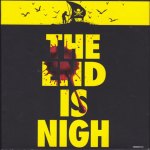
WATCHMEN : The Ultimate Cut – The Complete Story (2009 Warner 4 disc blu-ray set)
Directed by Zack Snyder, 216 minutes
What’s the greatest comic book movie of all time? I’ve seen a lot of them. There’s quite a few I haven’t seen as well, but it’s a great topic for discussion. I always have to put Watchmen on the table when discussing great comic book adaptations.
Watchmen is a complex tale. Its original comic was ambitious, containing page after page of dense backstory information in the form of documents and faux-magazine articles, all very relevant. There’s even a parallel story taking place, a comic within a comic, which directly reflects one (or arguably more) of the characters in the main story. Characters and their psychology are key. In addition, neither the comic nor the movie are linear. The story unfolds within different time periods, flashing back and forth, as we learn more about the characters, their motivations, and the world they inhabit.
It is the world they inhabit that was the hook for me. I’m a sucker for alternate universe stories. Here’s one that sets us on Earth, 1985, but things have unfolded very differently. The influence of various superheroes/vigilantes has caused history to unfold very differently. Specifically, it is the presence of Dr. Manhattan, who puts a swift and decisive end to the Vietnam war, who influences history the most. In this 1985, Richard Nixon is still president, and masked vigilantes are now outlawed.
The Watchmen are a group of such vigilantes, originally known as the Minutemen. Some, such as Dr. Manhattan truly are superhuman. Others, such as Nite Owl and his successor Nite Owl II, are mere mortals with high-tech gadgetry and skill as their allies. All have retired, some in fame and some in anonymity…all but one. Rorschach. He remains active, alone and wanted.
The movie begins as a murder mystery. Someone has managed to identify and kill Edward Blake — The Comedian, once one of the most dangerous heroes alive. To overpower and murder Blake would require an individual of tremendous resources. Who? And are other former vigilantes also at risk? Rorschach seems to be the only one who wants to know.
Being a fan of the graphic novel, I was very happy with the way that Zack Snyder captured Watchmen. It was done with love and care. The things that are discarded, I didn’t miss so much. The things that he changed, I understand why it was done. There’s one layer to the story/mystery that has been discarded, probably to keep this thing under 4 hours! The things that are reverently exactly the same as the comic made my jaw drop in awe. The acting performances are what they are, but I have to give special mention to Jackie Earl Haley as Rorschach.
The soundtrack is one of the best in recent memory. Outside of Wes Anderson, I haven’t loved a soundtrack this much in a long time. It’s awesome from the stunning Bob Dylan classic “The Times They Are A’Changing”, to Nat King Cole, to Simon and Garfunkel, Hendrix and Philip Glass, and probably the weirdest use of Leonard Cohen’s “Hallelujah” in movie history. The soundtrack is where it’s at. The movie even contains a Village People sighting! I’ll skip My Chemical Romance.
This Ultimate Cut weaves the comic-within-a-comic, Tales Of The Black Freighter, previously only available on its own, into the main body of Watchmen. These segments are narrated by Gerard Butler. New live action linking sequences connect the movie to Black Freighter, much like it worked in the graphic novel. People who haven’t read the graphic novel might not understand what “Black Freighter” is doing there, but they should probably start with the less daunting theatrical cut to start with anyway.
The box set includes four discs, beautifully packaged. Hardly a complaint to be registered. The box is heavy and sturdy. Included is Watchmen: The Motion Comic, packed in its own case, 5 hours long on its own. One disc is the expired digital copy of the theatrical cut (whoop de do) and another disc is loaded with special features. Best of these is Under The Hood, which is based on the graphic novel segments covering Holis Mason. Mason, the original Nite Owl I, wrote an autobiography called Under the Hood; this film is a faux-documentary on his story. It is presented as a television program from 1975 re-run in 1985, including commercials and scratchy footage. At 35 minutes, this is an absolute must. Other special features include brand new audio commentaries, for those who dare to keep going deeper. This set is just loaded. Unfortunately I found the sound level inconsistent, I had to turn it up and down frequently.
Having said that, I’m not going to discard my Director’s Cut of Watchmen. Clocking in at almost four hours, watching this version is a commitment. I know that occasionally, I will want to watch the “shorter” version of the film. Since a digital copy of the theatrical (shortest) cut is included here, maybe you won’t feel the need to double-up on Watchmen editions. For an enriched viewing experience, set aside the four hours one afternoon and enjoy.
Some at the record store made fun of me for being such a serious Star Wars fan. I’m not a hard core fanboy; I don’t go to conventions or follow the books and TV shows, but I am pretty dedicated to the films. I booked May 19, 1999 off work well in advance to see The Phantom Menace on opening day.
I’m not going to turn this story into a review for Phantom Menace. That movie’s been reviewed by thousands of people and I’m not interested in contributing to the background noise. The only thing you need to really agree with me on is that there was a tremendous excitement for Phantom Menace back in 1999. I had been dreaming of what might happen before and after the Holy Trilogy since I was 5 years old. My sister was only a baby when the first Star Wars came out, but she did get to see Empire in the theaters. She is a slightly bigger fan than I am, but she doesn’t follow the expanded universe or any of that stuff.
We both booked the day off work and planned to go together. Our strategy was this: Since we knew that the theaters would be absolutely packed for the midnight opening, we picked an out of the way (but still THX) theater that had a noon showing. So, all we had to do was wait an extra 12 hours (at home), and we’d get in no problem!
We showed up at the theater and were, like, seventh in line. No sweat. Soon we had our seats in a sparsely seated theater. Then the trailers (something called Titan AE, which inspired a heckle of “What the hell was that?” from the audience). Then the Fox fanfare, the Lucasfilm logo and finally…”A long time ago, in a galaxy far, far away….”
136 minutes later (we stayed for the credits of course) we were pretty satisfied with the movie. Keep in mind that fast shit had been whizzing in front of our faces for over two hours. There were things that didn’t make sense, there were things we didn’t like much (the kid, Jar Jar) but we kept telling ourselves the same thing.
“Yeah, but it’s the first chapter. The next one will be where it really starts.”
As we were talking about it, I said, “Wanna see it again? It went so fast there was a ton of stuff I’m sure I missed.”
“Sure!” she answered. “Yeah!”
We went back out to the ticket counter. There were a few people in line, but not many. “Two for Star Wars, please,” I said as I approached the counter.
“Didn’t you just come out of Star Wars?” she said with that snooty tone.
“Yep. We liked it,” I answered.
“And you want to see it again?” We did.
We went back in. The second time lacked a bit of the awe. This time, I paid more attention to the details. Questions came to my mind. “If Yoda is the Jedi Master that instructed Obi-Wan, then why is Liam Neeson training him?” Stuff like that.
I still remember that on the way home, we stopped at the HMV store, and I bought Ed Hunter by Iron Maiden. When we got home, we were still excited about the movie, telling Mom and Dad all the details. My dad was skeptical.
“Does it have the emotion of the first one? Does it have the feeling?” he inquired.
“Well…no not exactly,” I rationalized. “This is just the first chapter. The next one will be where it really starts.”
My dad was onto something.
The hilarious Red Letter Media review
I also distinctly remember watching Phantom Menace again with Tom and a franchise owner, on VHS, shortly after it came out.
In 2005 I first met the girl who would later become my wife, but she had never seen Star Wars. I was really excited to be the guy that got to watch Star Wars with her for the first time. For some stupid reason that to this day I will never understand, I decided to start her off with Episode I: The Phantom Menace. Bad idea.
“That stupid fucking dino-guy” is what she named Jar-Jar Binks. She hated it. (She liked Episode III though.) Then, her dad (rest his soul) decided that he wanted to see the Star Wars prequels too. One Saturday night I went over there with my DVD copy of Phanton Menace in hand. And so it was that Jen had to see Phantom Menace not once, but twice.
We’ll be married five years this August, more awesomer than ever, so “that stupid fucking dino-guy” couldn’t have been all that bad, right?
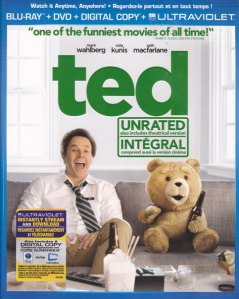
TED (Universal, 2012, directed by Seth MacFarlane)
I don’t often go out to the store to buy a movie on the first day of release anymore, but I did for Ted. I grabbed it at the local Best Buy and immediately popped it in, since I missed its theatrical run. I’m a Seth MacFarlane fan, see? I like Family Guy and recently American Dad too. If you don’t like those shows, chances are, you probably won’t like Ted either. May as well stop reading now.
Still with me? Good. Because this is a fuckin’ funny movie! Once you get past the concept of the walking talking driving tweeting teddy bear who loves coke and prostitutes.
Patrick Stewart narrarates our intro, as we meet John Bennett, a little Star Wars loving boy who gets a teddy bear for Christmas. He doesn’t have many friends, so one night he wishes that Teddy was alive. Connect the dots from here.
Ted becomes a world famous superstar phenomenon (Johnny Carson show and all), only to crash and burn hard by the 1990’s. Now today, he sits on John’s couch drinking beer, smoking pot, watching Flash Gordon; the 1980 bomb that starred Sam J. Jones as the titular Flash. And once again, the lush strains of “Flash”, by Queen, fills the room. This is all fine and dandy until Mila Kunis (insert hot girlfriend way too good for immature boyfriend here) says enough is enough. If Marky Mark and Mila are to stay together, Ted’s gotta move out and get his own place.
Their lives pretty much go down hill from there. Ted gets a job at the local grocer and starts banging a checkout girl on top of the lettuce. But John just can’t separate himself from his best bud, especially when Sam J. Jones himself turns up to party with the boys. Can John achieve the balance between friendship and domestic bliss that eludes him?
Throw in an evil, creepy stalker played perfectly by Giovanni Ribisi, and cameos by Norah Jones and Ted Danson as themselves, and you have a movie.
I’m not going to sit here and lie to you by saying that this is substantially different from any other bro-mances you’ve seen out there. There’s the girl who’s fed up, the jerky male romantic rival, and the two dudes, one of whom wants to get his life together while the other seemingly holds him back. If you’ve watched Paul Rudd, Jason Segel, or Seth Rogen films, you know where I’m going.
What makes Ted so much better than any of those movies (which I already like anyway) is MacFarlane himself. Yes, Ted does sound like Peter Griffin (even acknowledged in the film) but that voice just works for this bear! Ted is easily one of the sickest, yet lovable characters in cinema history. A horny drug using teddy bear has never been depicted on film before, as far as I know. Of course, Ted needs Johnny as much as Johnny needs Ted. They are a movie pair, and they can never be happy apart.
The blu-ray gives you the “unrated” (boobs) and theatrical versions. There’s a DVD, a digital copy, all that extra crap that I never use. Deleted scenes, gag reels, commentary, all that good stuff. Still, there’s no point buying a movie unless you plan on watching it more than once. I’ve watched Ted five times so far, and I still love it.
I guess I have a thing for f-bomb dropping teddy bears that sound like Peter Griffin. What does that make me? Ahh, who cares.
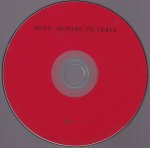
RUSH – Moving Pictures (2011 Anthem remaster with 5.1 blu-ray)
The great musical academic, Tom Morwood, once called Moving Pictures “the greatest album of the 1980’s”. I think he has an arguable position. Besides the obvious “Tom Sawyer”, you get such classics as “Red Barchetta”, “YYZ”, “Limelight”, and of course “Vital Signs”. This is back in the day when 7 or 8 songs made an album, and Moving Pictures’ 7 songs are a hell of a concoction.
Although the Rush catalogue was last remastered back in ’97 (or there ’bouts), this was the first Rush deluxe edition to hit the shelves. Unlike most deluxe editions, this one contains no “bonus tracks” per se, at least none in CD form. Disc one is Moving Pictures, in stereo, and disc two is the entire album in hi-def 5.1, plus three music videos. Disc one has been remastered (yet again!), but don’t fret — unless you’re an audiophile, you don’t need to worry about that. The 1997 CD edition sounded fine, as does this. You’re buying this for the 5.1, and if you can’t play 5.1 just stick with the original CD which sounds pretty much the same to the average Joe Listener. (There’s also a “96k PCM stereo” with “256 times more resolution than a CD” on the blu-ray disc.)
If you don’t own this album yet, then what are you waiting for? You couldn’t find a better CD to start with. Although Geddy had brought the keyboards out, this album still represents the perfect mix of Alex’s guitar and Ged’s keys — not fighting for space in the mix, but sharing it equally and powerfully.
Do I really need to talk about “Tom Sawyer”? It’s Rush’s most recognizable riff. I can think of few other songs where the drum part carries just as many hooks as the other instruments. But that’s Rush, that’s the Professor. That’s part of their genius.
“Red Barchetta” is a futuristic tale. The Motor Law has been passed, banning cars. Romance for the old vehicles still exists in some, who seek the thrills. I always felt the subject matter was similar to the movie The Last Chase, which didn’t come out until the following year. Musically, the song twists and turns like the roads it’s about.
“YYZ” is perhaps Rush’s best known instrumental, a slammin’ piece of polyrhythmic madness. It’s stuff like this that Rush is best known for, and “YYZ” is one of the best examples of it. Alex’s guitar work is nothing short of stunning, meanwhile Geddy’s bass licks are perfect.
Meanwhile, “Limelight” represents the simpler pop side of Rush that the band were interested in exploring at the time. It is still anchored by a solid riff, but with Geddy’s vocal melody enduring. A song like this is an appropriate lead-in to “The Camera Eye”, a more complex piece featuring Geddy’s synth. It’s over 10 minutes long, and perhaps the kind of thing people expect from Rush.
“Witch Hunt” is a shorter one, but ominous and dramatic. Alex’s riff is the main focus, although Neil certainly throws in plenty of interesting accents. The final track, “Vital Signs”, is my favourite. Finding words to describe it is difficult. It’s perfect — an amalgam of incredible playing with interesting influences and complex arrangements. There is a clear reggae vibe, as they had been listening to a lot of The Police. It’s also extremely memorable. Neil’s drum work on this is stunning.
And that’s the album! Seven songs done and dusted.
The 5.1 mix, done by Toronto’s own Richard Chycki (he’s been doing Rush and Triumph remixes for years now) is pretty damn good. It’s different. Listen to “Vital Signs” for example. It’s different, the balance of instruments and vocals. Considering the original stereo mix was perfect, and you can’t fairly compare to perfection, I will just say the mix is different. It’s definitely a great listen on a good system, I liked what Chycki did. Again, listen to “Vital Signs”. What he did there just creates this amazing field of sound. There’s a great separation of instruments. Moving Pictures was a great choice to mix in 5.1, you can really hear the individual playing.
The music videos are old, and don’t look so hot, even on blu. I have always loved watching the “Tom Sawyer” video, Neil bashing his kit in Le Studio with that big glass window behind him in the dead of winter. Geddy with those big glasses. My best friend Peter, he loves Geddy’s glasses! There’s also “Limelight”, which is seen less frequently. The “Vital Signs” video, from the same taping, is previously unreleased.
The liner notes are by David Fricke, and are quite different from the who-played-what-when notes in previous deluxe editions. Fricke’s don’t go into great detail regarding the making of the album nor the 5.1 mix, as previous deluxe editions do. However, it’s David Fricke, and therefore a good read. Enjoy while immersed within this album, in sublime hi-def 5.1.















 mikeladano.com