RECORD STORE TALES #973: “Let’s Get Rocked” – The Wait for Adrenalize
Before the internet, the best way to access your rock news in Canada was to buy magazines and watch the Pepsi Power Hour. We had all the US magazines plus M.E.A.T and some of the best rock coverage with MuchMusic. You’d be negligent in your rock and roll duties if you didn’t buy some magazines.
I remember buying one at the end of the 80s, the turn of the decade. It might have been Metal Edge or something of a lower tier. (You bought what was on the shelf when pickings were slim.) But they had a column by a psychic who was making rock and roll predictions for the coming decade. Stuff like “Will Jon and Richie break up?” What interested me the most was what she predicted for Joe Elliott of Def Leppard. The biggest rock band in the world, she claimed, would get only get bigger. Joe’s next album would outsell Hysteria, and he would get involved with some important causes.
Was she confusing Joe for Bono? Cool if true, but outselling Hysteria? Hard to imagine.
A few things were known about the next album at the start of the new decade. They’d be trying to produce it without “Mutt” Lange for one. “Mutt will be involved,” said Joe, but in a different capacity. The goal was to make a “quick” album — one year instead of several. They had one song earmarked from a B-side called “Tear It Down”. They also had some unfinished ideas left over from Hysteria such as the ballad “Tonight”. As kids, we imagined an album less produced than Hysteria, but hopefully just as good. I had actual dreams of anticipation at night, imagining the new album cover sitting there on the shelves. Continuing with the “-ia” naming convention, the next album was said to be titled Dementia. A title they dropped in favour of something less negative, when once again things went down the toilet.
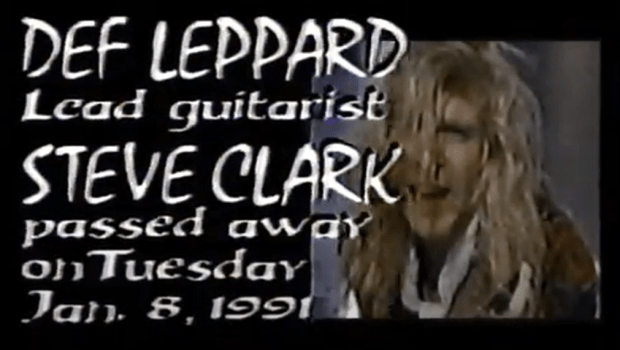
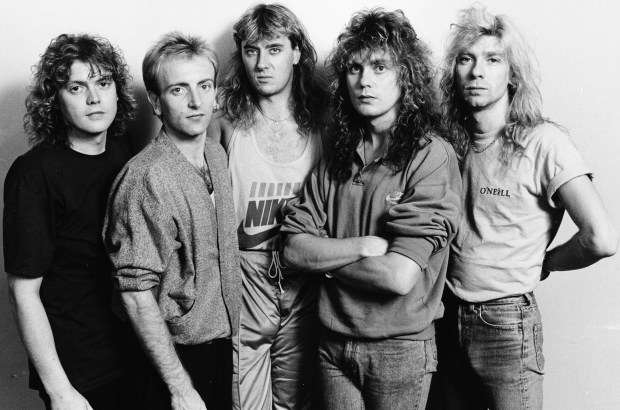
Rick Allen’s car accident was extremely unfortunate, but what happened this time was tragic. Steve Clark, always the band’s riff-master and shape-throwing classic rocker, was gone.
The guitarist had been suffering from his addictions, and this time a deadly mixture of prescription pills and alcohol was enough to end his life. January 8 1991, “Steamin'” Steve Clark was no more.
The band didn’t know what to do but carry on. Record the the album as a four-piece. Dedicate it to Steve. Don’t even think about replacements until it’s necessary.
And so the fans mourned, and waited. As the band toiled away, now producing with Mike Shipley, we anxiously awaited news. Any news. A few song titled leaked out: “Have You Ever Needed Someone So Bad”, “Stand Up”, “Tonight”, “Tear It Down”.
And then, over a year after Clark’s death, listening to the radio one snowy afternoon: Q107 out of Toronto, announced: new Def Leppard. Coming right up.
My sister and I huddled around the radio. We may have popped in a tape to record it; I can’t remember. We didn’t need to since it was about to carpet-bomb the nation with radio and video play. “Let’s Get Rocked” was here!
And it was…
OK.
It was OK. It sounded like Def Leppard. It didn’t push the boundaries in any fashion. It was safe, straightforward, and simple.
“Well, that classical section with the violins was different,” I said trying to see the bright side.
“Yeah, but that was just one short part,” answered my more realistic sister.
Through the years of anticipating a new Def Leppard album, we imagined some growth. Maybe not as drastic a transition as they made from Pyromania to Hysteria, but something at least. The one-time biggest band in the world shouldn’t just spin their tires musically.
“You know what, I’m gonna let it go,” I said. “They’ve had to deal with so much, and when Steve died, they just needed to get an album out. They can grow on the next album.” (And boy did they!)
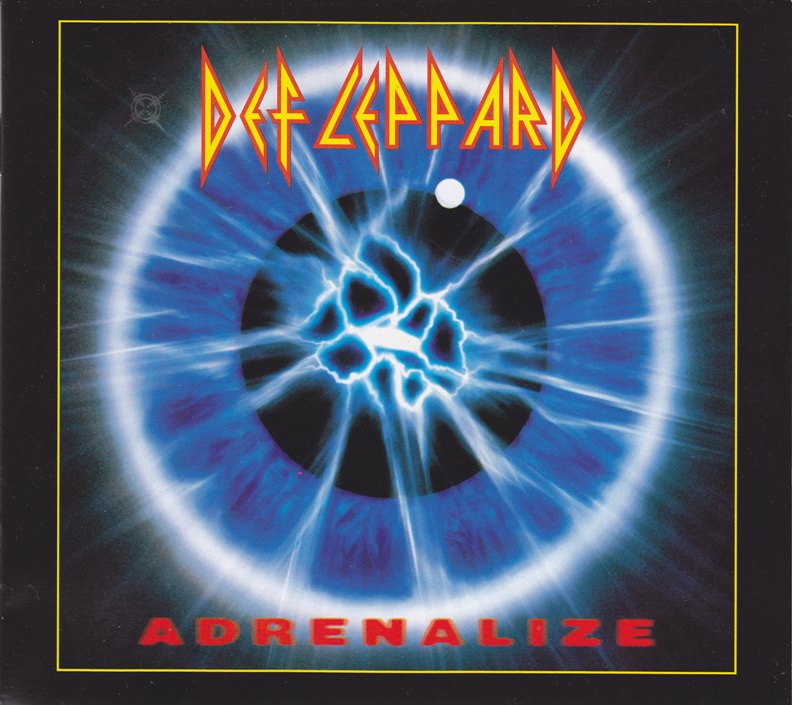
With that attitude, I counted the days until I would trek to the mall and finally get the new Def Leppard in my hands. Now with the title Adrenalize, and with “Let’s Get Rocked” climbing up the charts, it was time for Leppard’s return. A long time coming, if not the way it was planned!
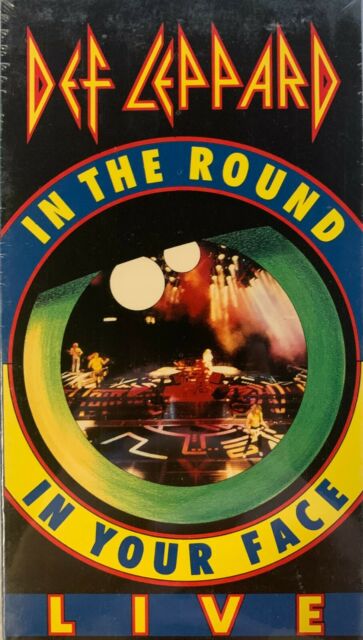
DEF LEPPARD – In the Round In Your Face (1989 VHS, 2001 Universal DVD)
When I was a kid, in love with music and watching every video on television, there was only one concert I wanted to see. Grade 10, going on grade 11, the only show I craved was Def Leppard. Their innovative stage in the round, in the center of the arena, seemed like the ultimate package. But I was just too young and had no one to go with, so I never made it. Fortunately, Def Leppard released a home video to satisfy those of us who could not be there. I rented the tape from Steve’s TV and made a copy. It was the best I could do on my allowance. To make up for it, I bought it three times since on different formats (VHS, DVD, CD).
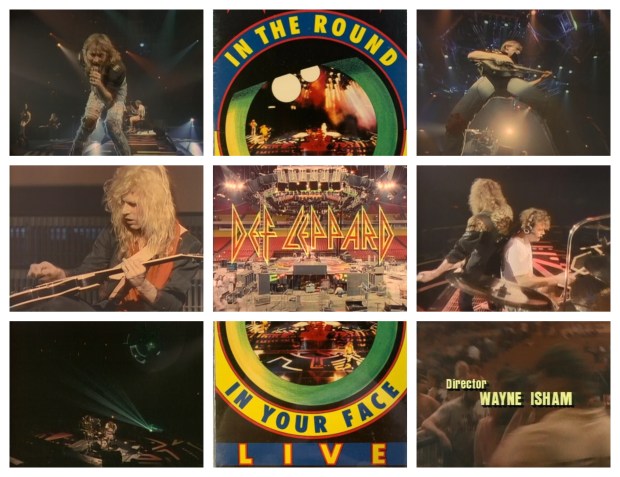
I popped the tape into the VCR with anticipation. A sped-up collage of the stage assembly flashed before my eyes, to the sound of “Rocket”. A massive undertaking, but this was just pre-amble. The show was about to begin!
It was just as I had heard about in the highschool halls. The stage was draped on all four sides by massive Hysteria curtains.
“I know what you’re thinking,” says Clint Eastwood over the sound system. “‘Did he fire six shots, or only five?’ Well to tell you the truth you know in all is excitement, I’ve kinda lost track myself.” A laser show begins dancing on the curtains. “You’ve got to ask yourself one question. ‘Do I feel lucky?’ Well do ya, punk (punk punk punk)?”
Guitars replace the echo of Eastwood’s voice.
“I said welcome to my show!” screams Joe Elliot, teasing us before the curtains finally crash down and “Stagefright” kicks off the proceedings! Even in my armchair, there’s still goosebumps.
Def Leppard rip through “Stagefright”, completely in control, on fire as hot as their early days. Each member throws shapes on stage while Rick Allen keeps the whole thing moving, on drums in the middle. Leppard’s stage is not flat, with catwalks and staircases for the band to run and jump all over, which they do. Overhead cameras capture everything, from every angle. Nobody but Allen is confined to one space, as the band leap from place to place in the name of entertainment.
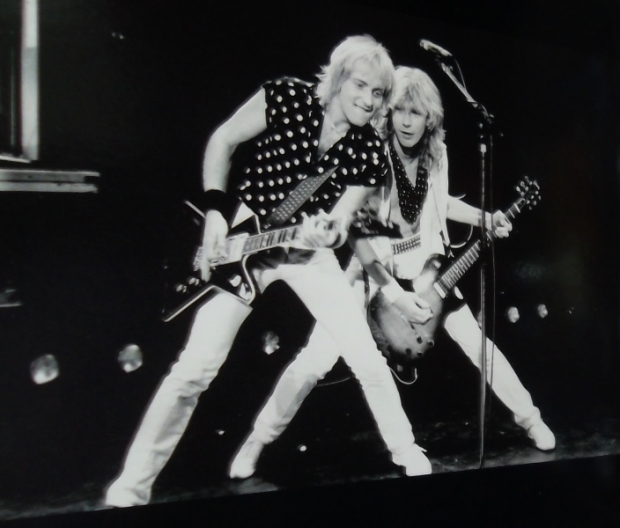
Continuing with the Pyromania, “Rock! Rock!” keeps the pace going at full speed. It brings a tear to the eye, seeing Steve Clark do his trademark whirlwind moves on stage, accented by his red scarf and made only more perfect in the round setting. A reminder that this was it — the last high point of the Clark era. Fortunately captured on camera and tape.
The first new song, and break in tempo, is “Women”. This is the famous version released as a single B-side with the “We got everything we need!” intro. You know it, you love it, it’s legendary: the live version of “Women”. Rick Savage mans the keyboard station for the time being while the lights get dimmer. Lots of echo on this one to duplicate the album ambience. “Too Late For Love” — a damn fine version — brings a ballady vibe, which they then lean into fully on an early appearance of “Hysteria”. The live version of “Hysteria” is lengthier with an extended bass intro. It feels like Def Leppard are a band with four frontmen, with the amount of shape-throwing going on here! And, for a moment, Joe Elliott on rhythm guitar! A funny little 80s axe with no headstock it is, locking down the riff while Steve and Phil embark on a glorious dual-guitar harmony solo.
Steve Clark gets a mini-solo to open “Gods Of War”, a Leppard epic that really shines in the live setting. We always thought it should have been the 8th Hysteria single. Rick Savage on acoustic guitar during the outro. The lights blast at the end, simulation “the bomb” and the band exist the stage as the lights go black. It’s a perfect transition to the gunshot sound effects that open “Die Hard the Hunter”. Lighters up! Off goes Phil’s shirt. This track is a return to the tempo of the opening duo, all three being from Pyromania.
Indeed, it is time to address the setlist. You may have noticed all the tracks are from Pyromania and Hysteria thus far. There is nothing from On Through the Night, and only one from High N’ Dry: “Bringing On the Heartbreak”. “This is one of our earlier songs, that we’re going to play a brand new way for ya,” says Joe. It seems they were trying to focus on the big albums that people had heard on MTV rather than their heavier metallic roots on this tour. Phil Collen gets a nice acoustic intro to show off his skills, along with Steve on doubleneck. This new semi-acoustic version of “Heartbreak” was so the band wouldn’t get sick of the song; it’s interesting anyway.
“Foolin'” ushers in a long stream of big, big hits. Steve’s still rockin’ the doubleneck. Then “Armageddon It” is nice and fresh. Much of this footage will be familiar to fans of the music video. “Animal” is tight, and received with a rapturous applause. Lots of girls in the front row dancing to this one.
There’s a touching moment in the “Pour Some Sugar On Me” intro when Joe says that the return of Rick Allen “the Thundergod” on drums was the biggest “up” that the band ever had. They then make easy work of the hit single. Phil takes a solo rip on the fretboard before “Rock of Ages”, and then of course the obligatory long audience singalong section. (“You can do better than that!”) The encore “Photograph” closes the show, and a great song to do it with. Shirts are no longer required where Joe and Steve are concerned.
This video was expertly directed by Wayne Isham. It is simply one of the best shot and edited live concerts available on DVD. It’s also – sadly – a document of the last stand for this lineup of the band. They had hit the top. Unfortunately you can never stay.
RECORD STORE TALES #970: Soundtrack From the Video Historia
Love is like a bomb (b-bomb b-bomb bomb)…
December 1988: The Zellers flyer.
Zellers was a popular Canadian retailer with a decent music department. They folded several years ago after a slow decline, but once upon a time, they were a central “anything” store for families all over Canada. Anything but groceries anyway; Zehrs had that covered. We’ve talked about Zellers numerous times here, as they were the best store at our local mall. Whether you were buying toys, a new bike, or school supplies, they had kids covered. Meanwhile the adults spent time in housewares, clothing, kitchen goods, and automotive. In the 80s, the era of “Club Z”, Zellers did not suck. They even had a restaurant in the store.
Zellers’ music department sold both albums and equipment in the same area. Needed a head demagnetizer or a record cleaning kit? Batteries, blank tapes, new decks? All there for us kids to gaze at with wishes in our eyes. The selection of cassettes had us constantly flip-flip-flipping. Meanwhile the clerks would be playing music unique to that department, while the rest of the store got Muzak. I first became exposed to the concept of a single B-Side thanks to somebody there spinning “Ride Into the Sun” by Def Leppard. I bought a lot of my Judas Priest and Kiss tapes there. I saw Poison on the shelves at Zellers for the first time. (I thought Rikki was hot before I learned the terrible truth!)
In fact, because of Zellers and that very single (which had “Hysteria” on the A-side), I began frantically collecting everything Def Leppard that I could find. Zellers bears 100% responsibility for this story we are about to unfold.
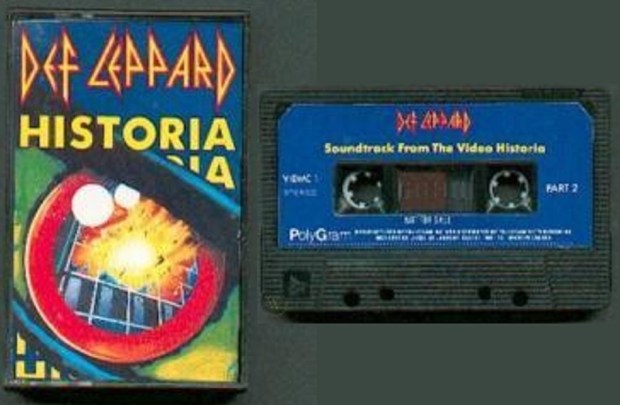
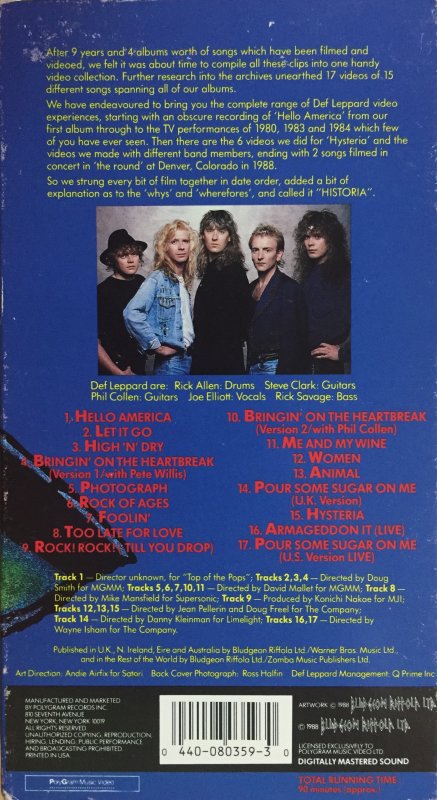
My growing Leppard collection had many gaps, but there was one that I wanted to patch up immediately. It gnawed at me. It was “Pour Some Sugar On Me”, the remix with the extended intro used in the music video. It wasn’t on the album; it wasn’t on the single. It wasn’t available on any known audio formats. Radio stations didn’t play it. The only place you could hear it was on your TV. I kind of preferred that mix, with the long intro. It had more vibe. I remember hanging by the radio hoping to tape it, but was always disappointed when they played the album version. The best copy I had access to was the 1988 Def Leppard home video, Historia. It was a comprehensive home video, and had both mixes of “Sugar”. But I couldn’t make a good taped copy to listen to; all I could do was dub to a cassette in mono.
One day I came home from school, and the Zellers flyer was sitting on the kitchen table. I flipped to the music section, and there it was: Soundtrack From the Video Historia. A brand new Def Leppard release; a “greatest hits” if you will! They had it for sale on cassette. I reasoned that it had to have that remix. If it was the soundtrack to the home video, then it had to have that remix! I would have wanted it anyway, being a “new” Def Leppard release. The possibility of the remix changed it from “want” to “must”.
It was kind of odd that none of the rock magazines mentioned this new release. Nobody talked about it on MuchMusic. That seemed very unusual for a band of Leppard’s stature. They were the biggest rock band in the world in 1988. Why wasn’t this new compilation album mentioned anywhere else? That was worrying, but on the flipside, once I had it, I’d own a Leppard album that none of my friends had.
Later that week, I trekked to Zellers with my best friend Bob. I looked in the Def Leppard section, but they didn’t have the soundtrack there. New releases? Nothing. I went up to the counter, and there it was! Sitting out for store play!
“I’ll take one of those please, Def Leppard Soundtrack From the Video Historia,” I said to the clerk.
“It’s not for sale,” he quashed. He took it off the counter and put it behind him. He wouldn’t even let me look at it.
Not for sale? The hell? It was right there in the flyer, $8.99 or $9.99 was the going rate back then. He refused to sell it to me. It was sitting in front of me under my nose; I could have reached out and grabbed it. Whatever had happened, it managed to get into the Zellers flyer, but it was promotional only — not for sale. It was meant only for them to play in store, but not to sell. I was shit out of luck, and I went home brokenhearted and empty handed.
Now here’s where things get freaky.
That same week, all the way in New Brunswick Canada, Tim Durling (future author of the book Unspooled) saw the same ad in the Zellers flyer. He got just as excited as I did, but there was one catch. Living in rural New Brunswick, his closest Zellers store was an hour away. It was Friday night.
“I pestered my father, ‘we gotta go to Fredericton tonight’,” says Tim.
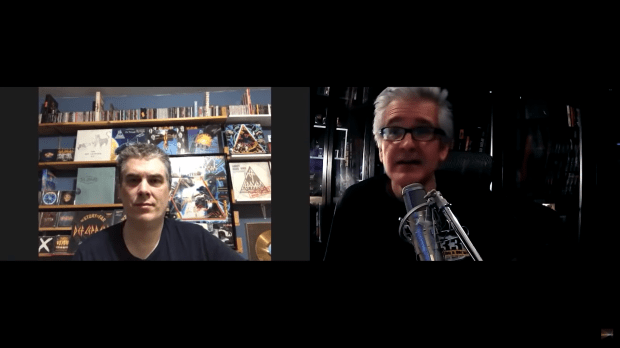
Tim tells the story. This happened live on the LeBrain Train Nov 23, 2021!
His disappointment might even have exceeded mine, as he returned home without his precious treasure.
“The poor girl working behind the counter,” he said. “I was such a little shit. I said ‘I want this tape right here!'”
Isn’t it incredible that two guys who didn’t know each other had the exact same experience at the same time? And that we later put two and two together, and realized we had this bizarre experience in common? It really happened, not a figment of my imagination. The ad was real, and screwed somebody else’s hopes and dreams too! But how did it come to be?
We have two theories. I think it was a simple cock-up, a tape got put in the flyer before they realized it wasn’t for sale. Tim thinks some jerk did it on purpose! We will never know.
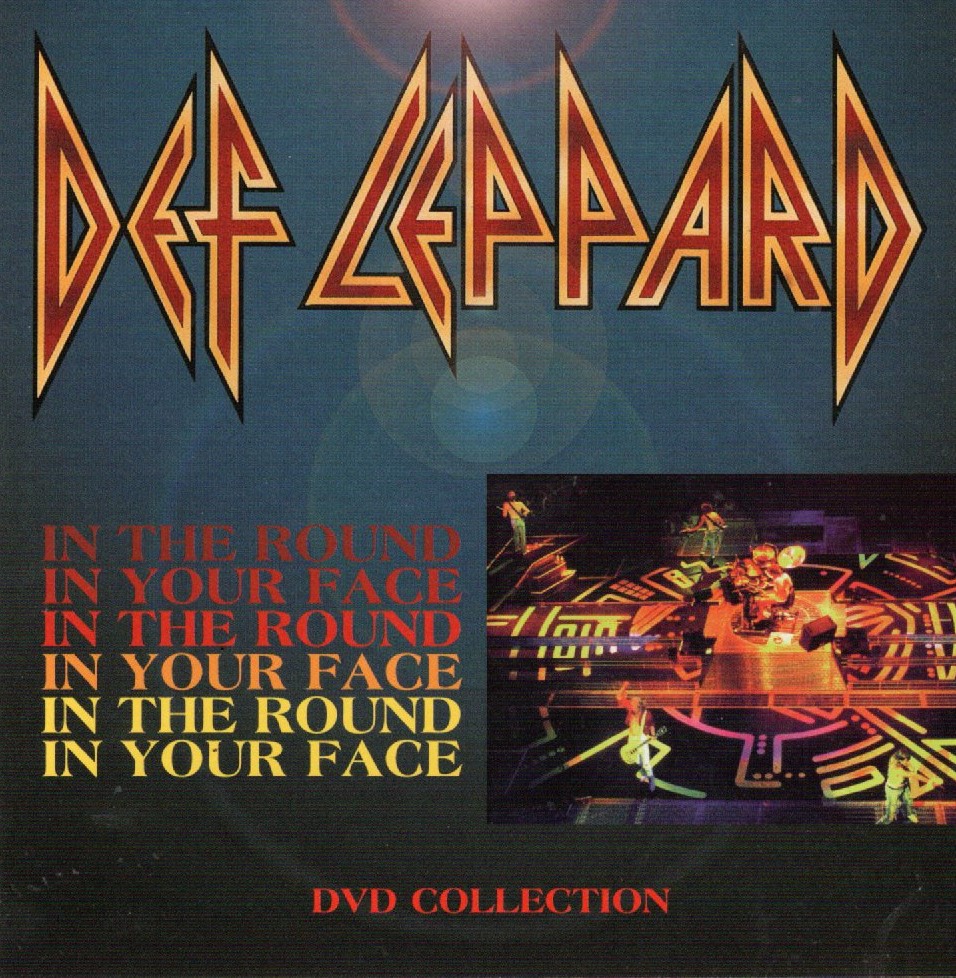
When Historia was reissued and updated on DVD accompanied by In The Round In Your Face on a single disc, it was revised to include three bonus videos from later in the band’s career. We will get to that when we arrive at the Euphoria era.
It’s the episode I’ve been waiting forever for! Tim Durling vs. Martin Popoff on Def Leppard’s legendary Hysteria! I’ve been consistent in my love for this controversial album since its 1987 release. So has Tim! Meanwhile, Martin gave the album a pounding 0/10 score in Riff Kills Man!“Hysteria sucks righteously!”
Let’s see how Tim holds up in this episode, shall we?
Tomorrow in the Def Leppard review series, Tim will be returning to talk about the Soundtrack From the Video Historia. Don’t miss it.
Note: This being the thirdHysteria album review, we will be taking a different approach. The first two reviews were detailed and comprehensive so please check those out for all the nitty gritty. This one will be more nostalgic in nature.
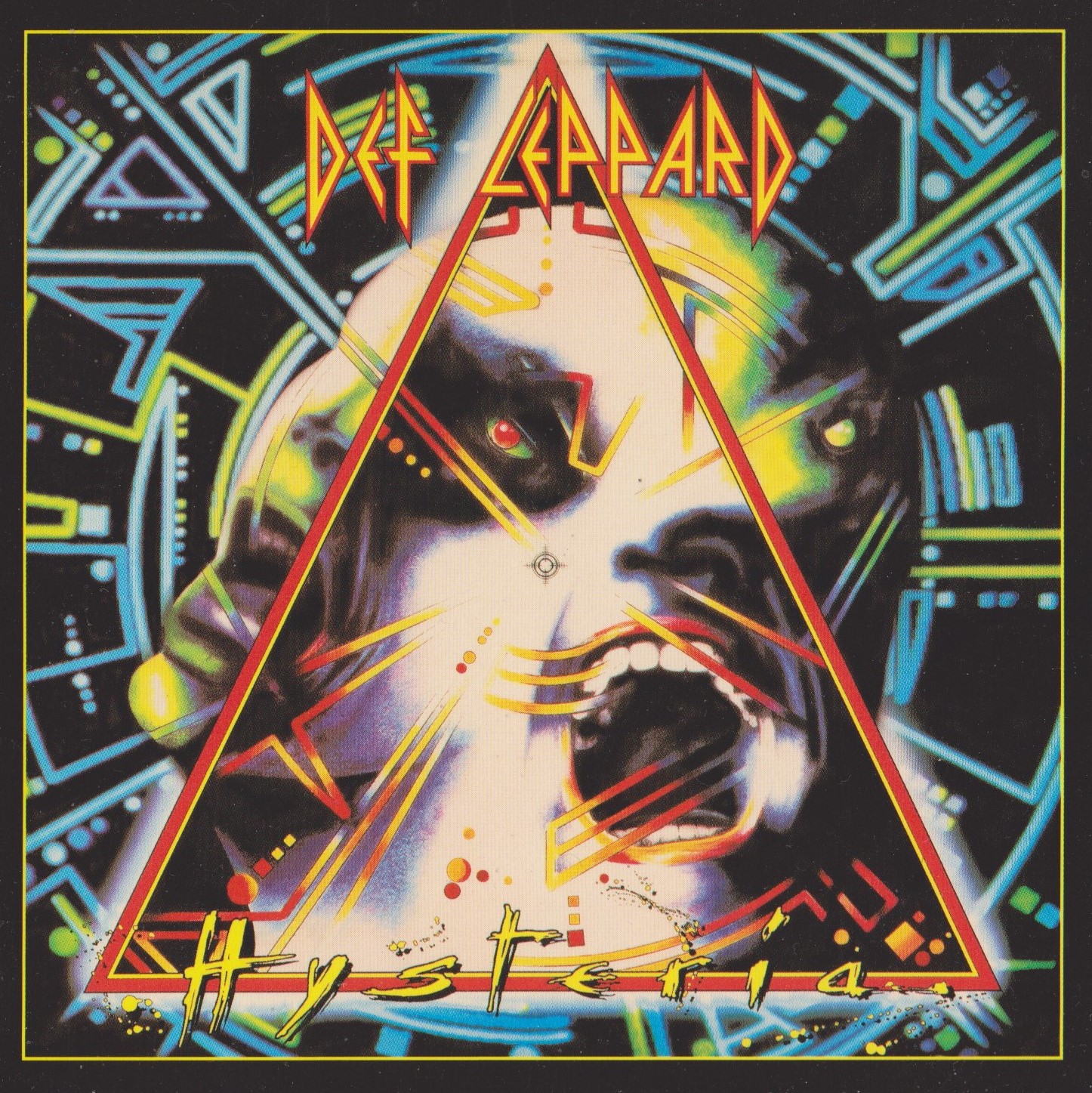
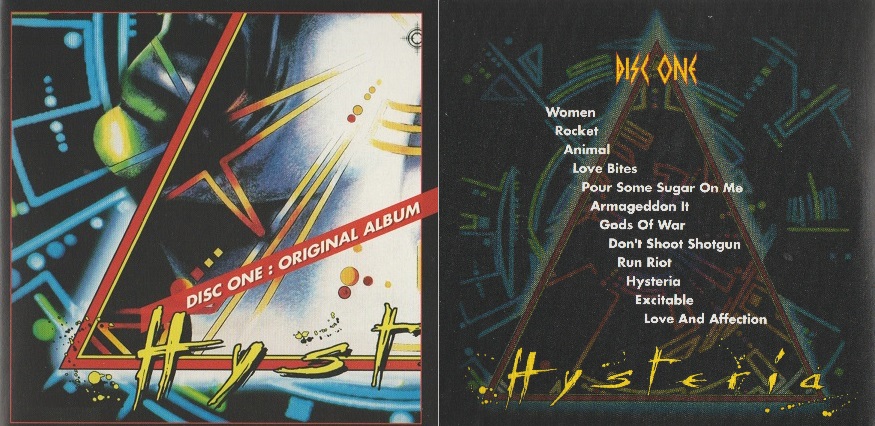
DEF LEPPARD – Hysteria (1987 Vertigo)
Kiss were always my “favourite band”, but the majority of my highschool years from 1987 to 1989 were all about Def Leppard. Although they wanted to be the biggest band in the world with this album, many of us were cheering for them to win. The band had endured years of adversity since the triumph of Pyromania.
Most obviously was Rick Allen’s car accident. It was hard to imagine how the drummer was going to come back from it, losing his left arm and almost his right as well. But he did. He frickin’ did it. Rick Allen, the Thundergod, returned and Joe Elliott said it was biggest “up” the band ever had. How could you not want them to win under those circumstances?
The biggest change on Hysteria (so named to characterise the last four years of their lives) was obviously the drum kit. Rick Allen had a style, employing classic grip and wicked rolls. Now he had a new electronic kit, with samples triggered by foot pedals and an arsenal of modern sounds. Allen adapted with a fresh style, leading the charge with a chugga-chugga and some bam-pow. His new style is one of the defining traits of Hysteria.
The first single here, and first taste of the new Leppard, was “Women”, an unorthodox pick. A slow grind led by a synth-y sounding bassline from Rick Savage, it is neither a ballad nor a scorcher. It’s not immediately catchy either, but it drew us all back in for a second third and fourth lesson until we were hooked. The sound: clean, precise, with layers of vocals and assorted melodic tones. But shit, did the band ever look cool in the video.
Hysteria arrived on my tape deck Christmas of 1987. It quickly monopolized my listening time, though it took a couple spins to “get it”.
“Rocket” threw me for a loop. I considered it filler; too contemporary and not enough rock. Bogged down with samples, backwards vocals and tricks. It sounded like the kind of song that would be impossible to perform live (though they did). Over the years I’ve warmed up to “Rocket”. The tribal beat inspired by Burundi Black makes it quite unique in hard rock, and the lyrics are delightful once you realize that Joe’s just naming all his favourite bands and albums. The meticulously recorded chorus really illustrates the intricate kind of process at hand. Each voice recorded separately and mixed down to the final product. Then there’s the long droning middle section, a unique construction worthy of a detailed listen. “Rocket” was another odd selection for a single, but it was a hit as the seventh and final one almost two years after the album was released.
It was hard to resist “Animal”, even though it was a blatant sonic declaration that Leppard were going for hits. As the second single from the album, it made some impact with its circus-themed music video. Light rock, with a punchy chorus, “Animal” was a well-written track with yet more of those immaculately recorded backing vocals. In the lead singer department, Joe was content to sing more and scream less, a trend that would continue. The fact is, the guy didn’t have to scream, though he’s terribly good at it.
Hysteria has a variety of tracks, but only two are ballads. “Love Bites” was selected as fifth single, and a smash hit it was. I wondered why they used a Judas Priest song title, but the song actually has country origins. Producer “Mutt” Lange brought the bones of it to the band as a twangy country song. The end product is nothing like that, with odd computerized voices and a slow dramatic build. Like every song on the album, the chorus kills. The band (with Lange) had really honed in on writing and recording technically perfect songs. There’s a lot going on in the mix on “Love Bites” but none of it is wasted. Everything’s necessary for the right vibe.
“Step inside, walk this way! It’s you n’ me babe, hey hey!” Shakespeare it ain’t. A hit, it was! “Pour Some Sugar On Me”, the fourth single, was the breakthrough smash that launched this album on the charts for two years. Def Leppard had ripped off a couple classic rock tunes here, but they were selling them to kids who never heard the originals. Mixing rap and rock, Leppard sold a bajillion singles and umptillion albums to kids worldwide. It wasn’t even an obvious hit. The genre-bending song took some getting used to initially.
Closing side one, the sixth single: “Armageddon It”. The stuttering guitar riff made it easy to like, if a bit light. This tune is fun to listen to with headphones on, to help break down all the different tracks of guitar. The cool thing that each guitar part is catchy on its own.
The North American videos for “Sugar” and “Armageddon It” were filmed live, and showed off Leppard’s innovative “in the round” stage. From the TV in the basement, it sure looked like the ultimate concert experience. We’d get a full taste of it on the In the Round: In Your Face home video (1989). Today you can get this concert on both CD and DVD. The CD version is included in the comprehensive Hysteria 30th Anniversary box set.
Opening side two is the track we all thought should have been a single: “Gods of War”, an epic in its own right, from the same lineage as “Overture” from the 1980 debut album. With Ronald Reagan and Margaret Thatcher sampled in the tune, it just sounded cool. Steve Clark’s E-bow opening drone sets the stage for a dramatic tune full of riffs, hooks and guitar action. It’s not political, just anti-war like many Ozzy tunes of the time. Its length probably prohibited it from being a single…but they did edit down “Rocket”.
The first non-single on the album is the hard rocker “Don’t Shoot Shotgun”. Some odd vocal effects keep it from being a standard guitar rocker; almost every song on Hysteria has some strange twist in the mix. Though more laid back in groove, this is the first tune that hearkens back to old Leppard. Slicker, sugar coated and easier to swallow though. It is paired with “Run Riot”, a similar track with a faster tempo. Tasty guitars from Collen and Clarke, chugging drums from the Thundergod. Screamin’ Joe sounding like the Joe from Pyromania, and Savage sounding less synth-y than the other tracks.
The last single on the album was actually the third single released: the brilliant title track “Hysteria”. The diamond-like flawless ballad was laid down literally one note at a time, giving it a precise but delicate nature. It was arguably the most pop Leppard had ever been, and that’s just fine. When you have a song this good, it doesn’t matter what you call it. Best tune on the album? Arguably. The precise picking is delectable and Joe has one of his best vocal performances right here. Unlike other songs on the album, it’s low on sonic gimmicks.
If there was one song to eject from the album, it’s the penultimate track “Excitable”. Back to gimmicks, it relies too much on samples and weird digitally manipulated vocals. It sounds like it was intended to be a crossover hit. It could have been replaced by a superior B-side (which we’ll get to).
The album closer is a majestic mid-tempo not-quite-ballad-thing called “Love and Affection”, possibly the second best tune on the whole album after “Hysteria” itself. It’s all about taste, but this deep cut is one of the strongest. It’s all about the song, no extra trimmings, just melody and arrangement. It easily could have been a single. There’s this one chunky Steve Clark lick that just slays me. Rick Allen’s pound has never been more suited to a track as it slams through the chorus. A really triumphant track that I would have released as ninth single after “Gods of War”!
Although it took a year (until the release of “Sugar”) to recoup its costs, Hysteria was an undisputed win for the band that worked so hard for it. Their loyalty to their drummer was not to lost to fans and media alike, and actually worked in their favour creating a new and exciting 80s rock sound.
But there was more to Hysteria than just the 12 tracks. Remixes and live material aside, there were five notable B-sides. All excellent in their own right.
Backing “Women” was the straight-ahead rocker “Tear It Down”. These B-sides were not produced by Mutt and therefore have a more raw edge, akin to older Leppard. “Tear It Down” rocked relentess, hard but mid-tempo cool. After a one-off live TV performance, the song was earmarked for re-recording on the next album….
On the flipside of “Animal” we find “I Wanna to Be Your Hero”, with a ballady opening and hard rocking middle. How did this song not make the album? Clearly one of the best tunes, it has both a chugging riff and a pop-smart melody.
The heaviest tune backed the softest. “Ride Into the Sun” was the B-side to “Hysteria”, and what a smoker it is. A re-recording of a song from the Def Leppard EP, it is also re-arranged with new lyrics and new chorus. It’s far superior and kicks every ass in the room. The B-side to “Sugar” was “Ring of Fire”, just as heavy as “Ride Into the Sun” but not as immediately catchy.
Finally, the last of the B-sides was a cover. A very confusing cover indeed. “Release Me” featured their roadie Malvin Mortimer doing something that might be considered singing. To add to the mess, the band all switched instruments with Joe on piano, so nobody really knew what they were doing. The band credited the song to “Stumpus Maximus and the Good Ol’ Boys” and in the liner notes, Joe claimed “Rarely in my travels have I come across such a monumental talent as Stumpus Maximus.” Only when Stumpus unfurls his unholy screams at exactly 2:36 did I get the joke.
The Hysteria sessions yielded some unfinished material as well, that Leppard would finally release in the 1990s. One of these tunes, a screaming “She’s Too Tough”, first saw the light of day on Helix’s 1987 album Wild in the Streets, released two months ahead of Hysteria. Brian Vollmer is one of the few singers who can do justice to Joe’s challenging vocal.
Hysteria is available in a comprehensive 5 CD/2 DVD box set with all the B-sides, remixes, and live tracks. It includes the Classic Albums “making of” documentary, all the music videos, and the entire In the Round: In Your Face concert on CD. It is, without a doubt, the best way to own the most important Def Leppard album.
But before you buy, some perspective.
There’s a legendary 0/10 review by Martin Popoff that I’d like to share some quotes from. If I’m over-enthusiastic about Hysteria, then consider this.
“High tech, tasteless, and devoid of life whatsoever.”
“Even Elliott’s vocals, probably the last vestige that hasn’t completely been swallowed by robots, sound like some kind of dry-wheezing mechanical lung wired to the man’s death bed.”
“Hysteria is a major assault to anyone’s intelligence.”
“An offensive kick in the head sent straight from the rock ‘n’ roll bored room.”
DEF LEPPARD – Pyromania Live – L.A. Forum, 11 September 1983 (2009 deluxe edition)
Leppard were riding high when they hit the L.A. Forum in 1983. Pyromania was selling hot enough that every kid in the neighbourhood had heard at least one of its singles on the radio. MTV was factoring in now, and its impact can’t be understated. Leppard had some high budget and good looking videos on offer. Their live show was just as impressive.
Remixed and remastered, the second L.A. show is now easily available on the Pyromania deluxe edition — the first official release of a live album with Steve Clark, although it did not come until 2009.
“Rock! Rock! (Till You Drop)” is a natural opener. Since it already opened Pyromania itself, it was well suited, but its extended (taped) intro made for a dramatic band entrance. Joe’s road-worn scream is employed to great effect. Even so slightly faster than LP, “Rock! Rock! (Till You Drop)” defined the mood. Rock rock till you drop indeed! Keeping with the “Rock” theme, “Rock Brigade” was locked and loaded for the second spot. It sounds fresh with Phil Collen on lead guitar and backing vocals. His solo is balls-out technical, and completely unlike those of Pete Willis.
Joe pauses to say “good evening”, and then it’s straight into “Saturday Night (High ‘N’ Dry)”. This ode to getting wasted from 1981 is not a vast departure from the album version despite Phil amping up the guitar work. Into “Another Hit and Run”, it’s pure adrenaline and foot on the gas pedal. Screaming into the ether, Joe sings of youthful self-destruction. It turns into a jam towards the end, before careening through the finish line.
“Billy’s Got a Gun” is one of those songs that can get a bit rickety live, but this version is solid. The excellent “Mirror Mirror (Look Into My Eyes” follows, and it’s very slightly revised to increase the tension. Some won’t notice the differences. As usual, the chorus kills. It’s been all album cuts thus far, and no hits. But then Joe invites Steve Clark to the spotlight to play an acoustic guitar solo, which becomes “Foolin'”, the first of the three massive hits rolled out in a row. This might be considered the center of the show: “Foolin'”, “Photograph” and (a slightly fast) “Rock of Ages”. Each one a perfect gem, but with the live edge intact. To take it over the top, a ragged “Bringin’ on the Heartbreak”, Leppard’s other recognisable hit, is rolled out immediately after. What do you do for an encore? We’ll get to that.
“Switch 625” follows “Heartbreak” as it should. With the hits behind them, Leppard spend the end of the set rocking really, really heavy. “Switch 625” is already a steamer, but it’s followed by “Let It Go”, “Wasted” and an encore tease, and then “Stagefright”. Clearly, this setlist was designed to rock! “Wasted” in particular stands out from this trio. Phil’s blazing solo technique adds that extra dimension to the song, but it is just as amped up and the best versions from the early years.
But “Stagefright” isn’t the real encore.
“Right, I said we got a surprise for ya. And we have a big one at that. Ladies and gentlemen, will you please welcome all the way from England — Queen’s Brian May!”
Queen were not on tour, but they were in Los Angeles recording their 1984 album The Works. The long friendship between Leppard and Queen began right here. A cover of Creedence Clearwater Revival’s “Travelling Band” is the earliest recording of Joe and May together, but certainly not the last! This is not only a piece of history, but it’s a brilliant track! Joe’s screaming voice is strangely well suited to an overblown CCR cover. But hearing the guitar trio solo together, each with their own style, is the real icing on the cake. May is so creamy!
There are no other live releases from the Pyromania era, and the band’s sound transformed permanently when they next hit the road. This live album is the end of an era, and an excellent good time of it too.
5/5 stars
The Pyromania tour wrapped up 18 December in Dortmund Germany, another two-nighter. Two weeks later, on New Year’s Eve, Rick Allen had the car accident that severed his left arm. In a heartbreaking twist, the arm was reattached, but after an infection set in, had to be removed again. This devastating tragedy united the band. Ambulance-chasers were ready and waiting to take the drum stool away from Rick Allen, but the band refused to see it as the end for the drummer. We all know what happens next. It was total Hysteria!
Disruption! Midway through the recording of Def Leppard’s crucial third album, guitarist Pete Willis was fired. It had been coming for a while. His alleged alcohol consumption was causing problems and the band had their eye on Phil Collen from Girl already. They were lucky to get Phil, as he had already been approached about joining Iron Maiden to replace Dennis Stratton.
This was serious. Once again working with “Mutt” Lange, whose schedule was booked solid, time was money. And music, perhaps unsurprisingly, is a business. The third Def Leppard album was critical. The potential of the band was not underestimated. “Bringin’ On the Heartbreak” made the top 20 in the US and the new album was intended to do better. Lange has a songwriting credit on every song, indicating the level to which he was involved to make the album as perfect as could be. It took 10 months to record, a mind-numbingly long time to the young band. If only they knew….
Pete Willis had writing credits on four songs, including two singles. With rhythm guitars laid down on all tracks by Willis, Collen just needed to whip up a few solos and finish off some bits and pieces. He and Steve Clark made a formidable duo. Collen had a more schooled sound than Willis and the contrast added a new dimension to Leppard’s solos. Meanwhile, the songs were streamlined. Sleaker, more hooks per minute, more direct…more commercial.
Some feel this is where Def Leppard started to go over the cliff. The majority probably see it as Def Leppard becoming the real Def Leppard.
The opening music would have been familiar to anyone who caught Def Leppard live in the early years. “Medicine Man” was an early track with an absolutely killer Clark riff. With Mutt’s help they re-wrote it into the now-esteemed “Rock! Rock! Till You Drop”, but that riff is still the main feature. After the headbanging commences, a screamin’ Joe Elliott lays down one of his most raging lead vocals. Collen’s style is audible from the solo; a fretburner. “Rock! Rock!” isn’t really that far off from High ‘N’ Dry, but you can tell it’s spent more time at the polishing wheel. The production also seems colder and more clinical.
The triumphant “Photograph” really showed where Leppard were going. Sure there’s a riff, but the main features here are the vocal melodies and harmonies. Noticeable keyboard accents de-clawed the Leppard, and the sweetened harmonies have the full-on Mutt Lange treatment that you hear elsewhere with Bryan Adams and Billy Ocean. None of that is necessarily a bad thing, but this is where Def Leppard decidedly left the New Wave of British Heavy Metal behind them. “Photograph” went to #1 in the United States. Mission accomplished.
Track three, “Stagefright” opens with a faux-live intro and a biting riff. Credited to Joe Elliott, Mutt Lange and Rick Savage, it’s surprisingly one of the heaviest songs. Back then Joe’s voice could deliver both menace and melody simultaneously, and he does that here.
While not a deep cut (#9 US), “Too Late For Love” is a lesser-known classic. No music video was made though they did a lip-synched TV appearance that later ended up on their home video Historia. A dark ballad with edge, “Too Late For Love” has cool atmosphere and just the right amount of scream.
“Die Hard the Hunter” opens with synthesised war sound effects and a soft guitar melody that deceives into thinking it’s another ballad; but no. This rocker burns hot, but damn those drums are really sample-y sounding. Rick Allen had a better sound on High ‘N’ Dry, but of course the times were changing. Eliminator by ZZ Top was out the same year.
One of the big singles (#9 US once again) is the undeniable “Foolin'”. Mixing rocker and ballad formulas, it set a template for bands to attempt to copy on their way up the charts. The stuttering chorus is now a Leppard hallmark, and not a second of the song is boring.
You can imagine, spending 10 months in the studio, how monotonous some tasks must be, take after take after take. The simple act of counting in a band — one, two, three, four — must be tedious the hundreth time. Perhaps the next time, to stave off boredom, it’s uno, dos, tres, quatro. Then something else, language by language until finally you end up with “gunter, glieben, glauten, globen”, a nonsense phrase that sounds vaguely Germanic. And suddenly, without knowing it, you’ve created a catchphrase. At least that’s how it happened for Mutt Lange on “Rock of Ages”!
That’s the story of “Rock of Ages” (#1 US), one of Leppard most irresistible hits, and also one indicative of the shift in Leppard’s sound. A very synth-y bassline and tech-y drums stamp out a a robotic 80s groove that was destined for radio and video stardom. The chorus was even more potent. “What do you want?” yells the band in harmony. “I want rock and roll!” you respond, fist in the air. It all seems very contrived, and perhaps it was. Is that so bad? Back then, it really felt like you had to fight for rock and roll. It seemed every church and every politician wanted to neuter rock bands. A good, defiant, radio-ready smash hit like “Rock of Ages” tapped into the 80s.
The killer deep cut here is called “Comin’ Underfire” which, had there been five singles, would have made a fine fifth. Tapping into the angst and tension of earlier tracks like “Lady Strange” and “Mirror, Mirror”, this is nothing but awesome wrapped up in a taut chorus like a bow. Steady, strong, and loaded with hooks. Pete Willis had a hand in writing it, demonstrating the guitarist’s often overlooked value.
Another wicked deep cut is the terrifically fun “Action! Not Words”, which, if there was a sixth single… Anyway, the slippery slide-y riff is reinforced by a simple and effective chorus. Let’s face it, there’s very little fat on Pyromania.
If anything, perhaps it’s the closing track “Billy’s Got a Gun” that might be the the only one that could be argued as filler. Laid back and emoting a dangerous vibe, it’s less exciting than the preceding material. It is, however, the closer, which has to draw the album to a proper close, and end it on the right vibe. “Billy’s Got a Gun” does the job. The album concludes with a song that feels like an ending, especially with that “bang bang” at the end.
A brief record-spinning coda is tacked at the end of the album for those who let it play all the way to the end. It probably fooled a few kids into thinking their turntable was broken, as the record seemingly spins fast and slow, over and over.
There were no B-sides or bonus tracks recorded. No extras, no unreleased songs. Talk about having your eye on the prize!
Pyromania had broad appeal. The numbers showed it. It put Leppard in the big leagues. To date it has sold 10 million copies in the US. It was the end of obscurity. The band toured relentlessly. Though they did not release a live album, the 2009 Pyromania deluxe edition contains one from the L.A. Forum in 1983. We’ll look at that next time.
The fine folks in Def Leppard have been doing an outstanding job of getting their rarities and fan-wishes on the store shelves. We wanted the Def Leppard EP reissued, and they did it. A few times in fact, including a cool 3″ CD included in a recent box set. We wanted all the early B-sides available on CD, and here they are. We begged for decent remastered CD editions of High N’ Dry and On Through the Night, and the band delivered. More than once.
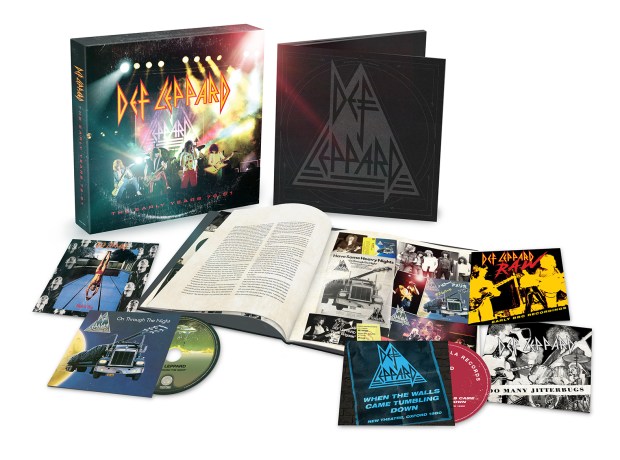
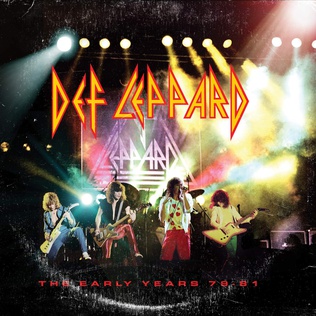
Now there is a wealth of Def Leppard riches out there for you to buy in your format of choice. The Early Years 79-81 is the way to go for a complete set of the music from those years. We’ve gone over it all disc by disc so let’s talk about the box itself.
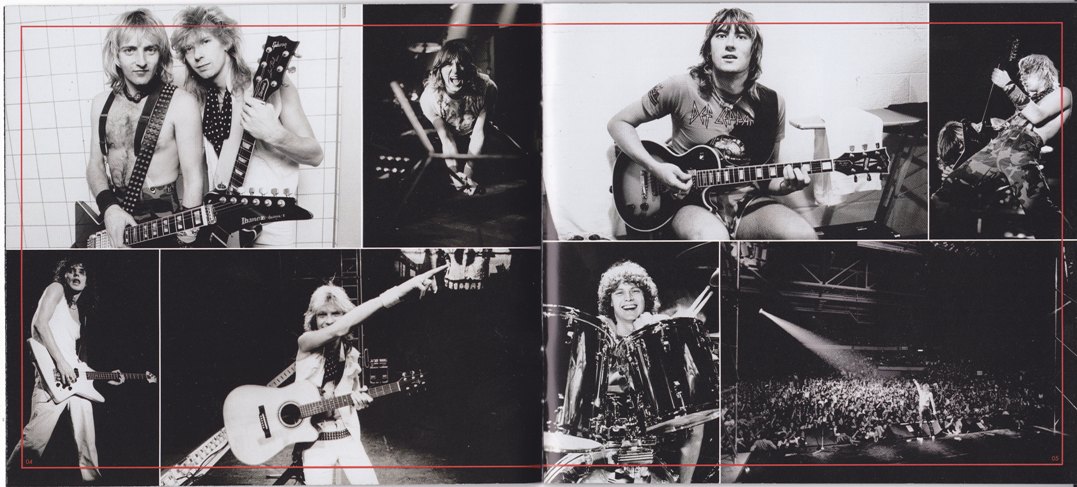
The 10″ x 10″ box format is awkward to store, but Leppard seem committed to the size, with their London to Vegas set having the same dimensions. They’ve at least maximised the space, with a generous hardcover book included inside. This book has the liner notes and essays you expect, broken down disc by disc. A generous set of unreleased photos keep the eyes from being bored while your ears indulge themselves. The CDs are stored separately in a cardboard folder, and they don’t seem to move around in there. Each one has its own cardboard mini-sleeve. The packaging works.
The sequencing is perhaps the only complaint. The set is not a chronological anthology of the early years. In terms of sequencing it’s best looked at as a On Through the Night / High N’ Dry deluxe edition. Two albums, remastered in their original track listing (not the 1984 track listing for High N’ Dry) with a bonus live CD, a bonus disc of B-sides and rarities, and a bonus disc of BBC sessions from the period. Which really doesn’t matter so much, except when trying to review a chronological Def Leppard series and figuring out what order to do it in! The sequencing matters little because the discs are so complete. All those singles, B-sides, edit versions, unreleased versions, and live recordings are what fans have been demanding ever since the idea of “deluxe reissues” were conceived. This is it!
Oh sure, there are a few things left in the vaults. We know of a couple more early tracks called “Heat Street” and “See the Lights”. These are unlikely to ever see official release, but one must leave some scraps for the bootleggers. If the band ever changes their minds, that’ll be cool, but the best stuff is right here.
Consider that these three complaints about The Early Years 79-81 (box dimensions, sequencing, missing bootlegs) are so minor, we can disregard them in our final score. This box accomplished what it set out to do, and when listened to in completion, offers up a real clear picture of the band’s ability and determination. They had a bright future ahead, and a chapter was about to close while a new one opened. With the band scheduled to re-convene with producer Robert John “Mutt” Lange in early 1982, life would never be the same again.
2021: the year of the hamster wheel. It sure felt like we were spinning our tires all year! Sometimes inching a little forward in the mud, only to slide right back. What a year. But we did get some great music out of it.
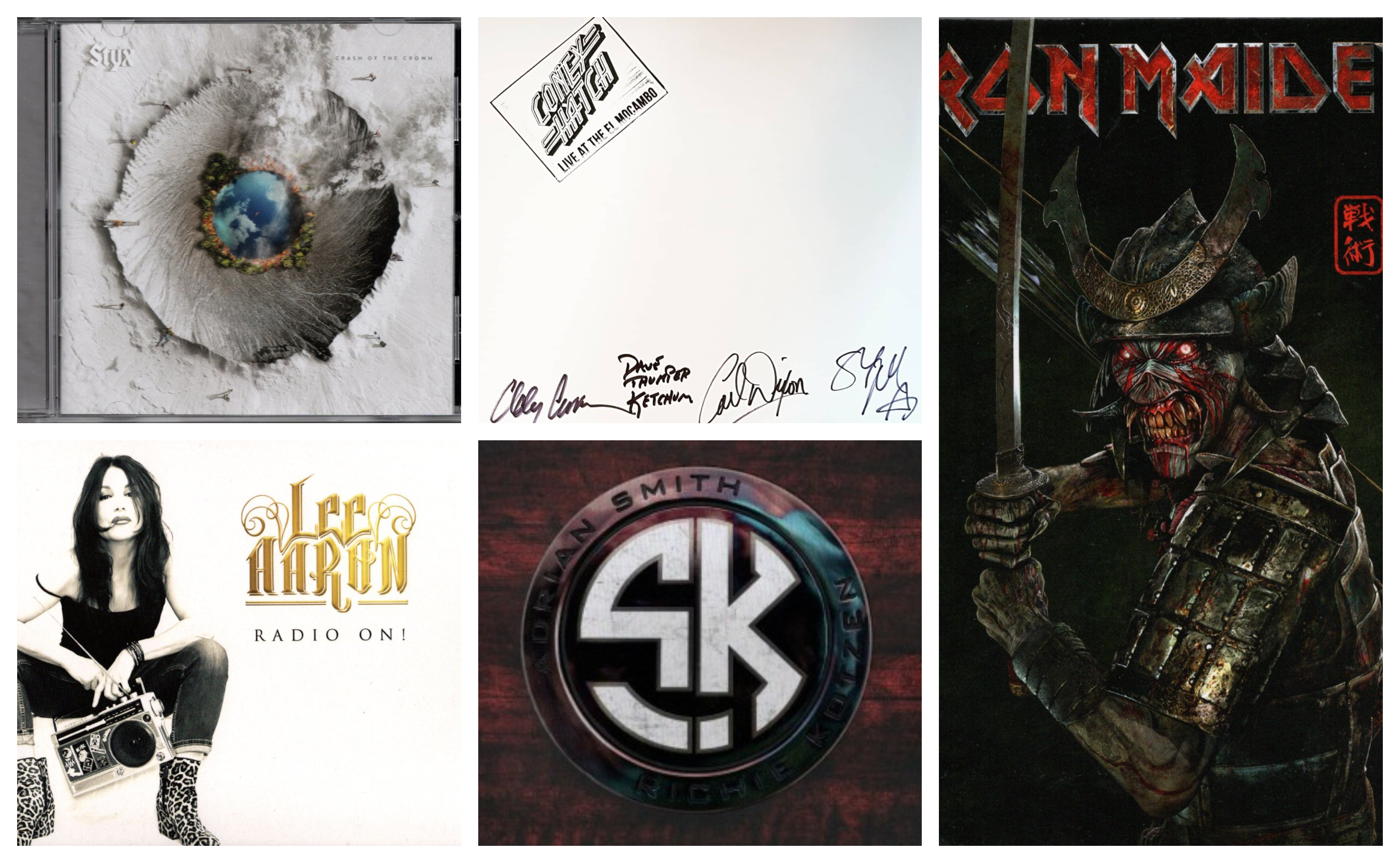
Here at LeBrain HQ, if you go strictly by the numbers, there were two bands that dominated the year, both oldies acts from the 1980s: Coney Hatch and Iron Maiden! They (or members thereof) appear numerous times in the lists you’re about to read. Not so “oldies” after all eh? Five appearances for Iron Maiden, and a whopping seven for Coney and its members!
Even I was surprised by the lists this year! All my favourite things, and the stats of 2021, are curated below.
DEF LEPPARD – Raw – Early BBC Recordings (The Early Years Disc 5) (2019)
This final disc of Def Leppard early tracks consists of two separate BBC sessions: 1979, and a few songs from Reading in 1980. Due to this fact, there is some minimal repeat in the song selections, but you won’t mind getting two versions of “Wasted” instead of just one! This disc offers a variety of early Leppard songs and rarities.
BBC Andy Peebles Session – June 7 1979
The EP was out and Leppard were starting to get radio play. They were invited to the BBC and recorded four songs for broadcast.
Opening with “Glad I’m Alive”, Leppard get one of their most underwhelming non-album tracks out of the way early. It sounds better and heavier than the studio cut on Disc 4 produced by Nick Tauber. Solos and backing harmonies are fire. “Sorrow is a Woman” follows, with a quiet, cool laid-back intro of a different flavour. Things kick in on the chorus of course, but this is not the definitive version of the track. The guitar solo section has a nice shimmer to it. Third up is “Wasted”, which opens with a growl. That guitar is vicious, and Joe just goes for it on the vocals. This recording has bite. The final track, “Answer to the Master” is absolutely fine.
Friday Rock Show Session – October 3 1979
“Satellite” enters with a crash of drums, a little hesitant on the pace. The fun “Rock Brigade” is similar to the early version on Disc 3, but heavier. The second version of “Wasted” sounds heavier than the first — the band was growing. Really this song is a highlight of anything it’s on. This BBC sessions ends with “Good Morning Freedom”, probably the fastest and most pumped-up version we’ve heard yet. This might be the best recording of the track available.
Live at the Reading Festival – August 24 1980
The next time the BBC caught up to Def Leppard, they had an album out. With Ozzy Osbourne, Iron Maiden, Whitesnake and UFO on the same bill, Leppard were anxious. Then Ozzy dropped out, and Leppard had to follow Slade in one of their best festival performances — a daunting task. Fortunately the bandt fought hard and had some killer new material up their sleeves.
Opening with “Satellite” (2nd appearance on this CD) and “When the Walls Came Tumblin’ Down” mashed into a medley, you can hear that the band were fired up. After this workout, it’s the unreleased “Medicine Man” which today we know as “Rock! Rock! (Till You Drop)”. Imagine getting to hear that track back in 1980, and then when it was finally released in ’83 on Pyromania, going “I know that song!” The early “Medicine Man” version is cool because that riff is unstoppable.
The apocalyptic epic “Overture” is right in the middle of the set, but it was already well known due to its inclusion on the original Leppard EP. Joe’s unholy yelp of “Go!” at 1:50 is the moment that the band just tear it loose. Then it’s another new song in “Lady Strange”, absolutely off the hook and hammering with delicious chord after chord, each one more addictive than the last. Finally after some audience participation noise, it’s “Getcha Rocks Off”. The audience goes nuts and Leppard leave triumphant.
This excellent disc collects some seriously well-recorded and preserved archival material. It’s all valuable, showing the growth of the band as they get more comfortable with themselves and performance. They were always great, with a serious knack for riffs, and this disc delivers plenty of them in unreleased format. Untampered, unhampered, and unchained.

















 –
– 




 mikeladano.com