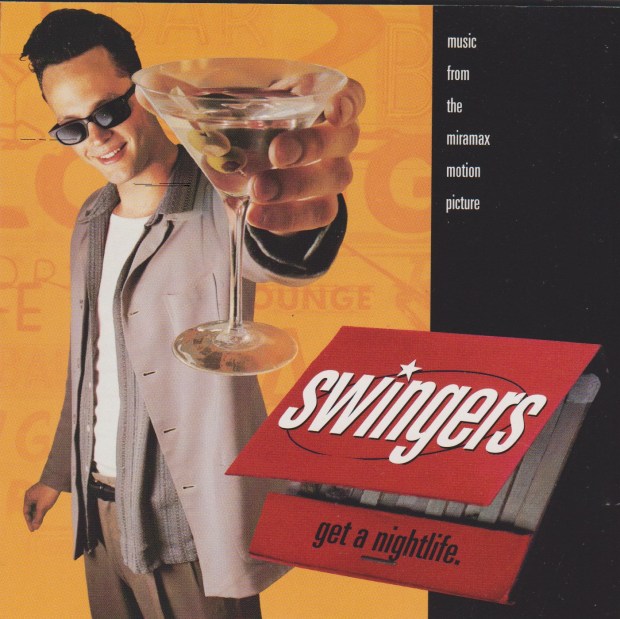
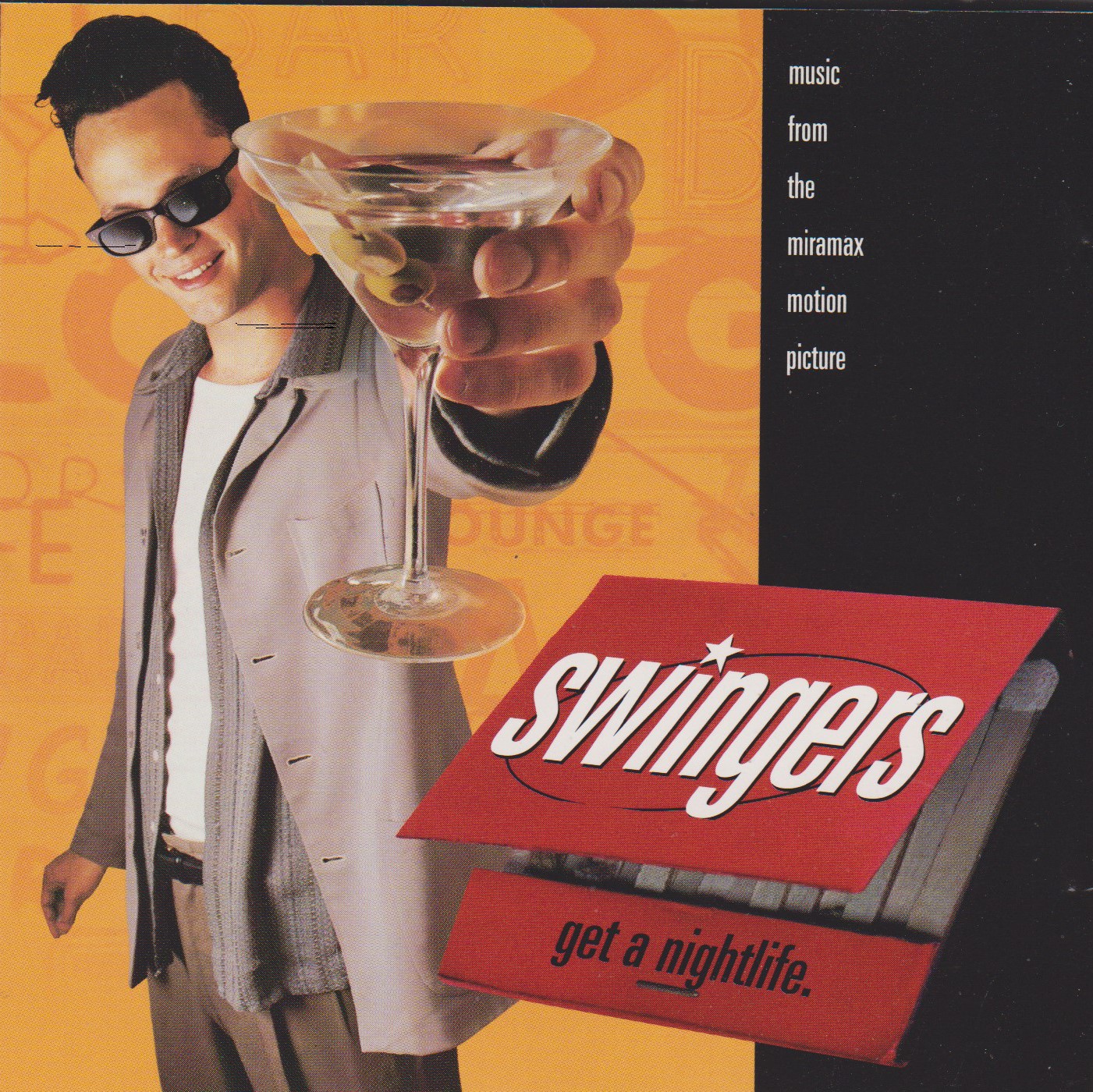
SWINGERS – Music from the Miramax Motion Picture (1996 A&M)
Now here…now here is a soundtrack! Every track is a keeper. With a mixture of oldies and newer songs, Swingers had a peerless balance. If you’re down to swing, dance, or just get dirty, this soundtrack has what you need. Bonus points for the uber-thin and young Vince Vaughn on the front cover too. Jon Favreau executive produced the soundtrack, and it’s clear the guy has good taste in music.
I love it when a soundtrack puts scenes from a movie right in your head. Dean Martin’s “You’re Nobody ‘Til Somebody Loves You” kicks off both the CD and the movie, and all I can think is “Vegas baby, Vegas.” That slow jazz just sets the mood for the adventures ahead. The horns pop! It’s money, baby. Talk about setting the bar high for an opening track; thankfully there’s lots more to come.
“Paid for Loving” by Love Jones brings me right into the film’s setting again, but it’s Tony Bennett’s “With Plenty of Money and You” that has me seeing the bright lights of Vegas before me. Remember Mikey and T rolling up in their suits? You’d feel like a high roller too, with a song like this playing. Tony is followed by Big Bad Voodoo Daddy (who appeared in the film). Now, I do kinda wish it was the live version of “You & Me & the Bottle Makes 3 Tonight (Baby)”. In the film, Big Bad Voodoo Daddy play it live, but this is a studio version. I think including the live version would have been an extra treat for fans, but I’m not complaining. If you don’t find yourself tapping your toes to it, call the coroner, because you may be dead.
Mixing new and old, Scotty and the guys from Big Bad Voodoo Daddy are chased by Louis Jordan, from way way back in 1941. If you love muted trumpet solos, then dig right in. A song you should recognise is the oft-played “Groove Me” by King Floyd (1970). It’s a soul classic that found itself used on TV ads over the years. More jazz (a couple cool instrumentals), and more Big Bad Voodoo Daddy are to be found as the CD progresses. Daddy have three tracks on the CD, all of which were in the movie. “Go Daddy-O” has to be a favourite for sure, but “I Wan’na Be Like You” has a tropical salsa beat.
Roger Miller’s “King of the Road” isn’t jazz and doesn’t swing, but it has the same golden oldie feel. It’s not the only country song: George Jones himself honours the CD with his presence. The melancholy ballad “She Thinks I Still Care” is one of the…saddest, I guess…lyrics I’ve ever heard. It’s a great song from a great scene in the film.
“Pick up the Pieces” by the Average White Band is the kind of song everybody needs. “Need” isn’t too strong a word either. You know the song, you love the song. You have to. It’s required. Finally, “I’m Beginning to See the Light” by Bobby Darin completes the journey, and it’s back to the same kind of sound that Dean Martin started the album with. And what a journey it is! You just…feel BETTER after listening. When I bought this CD, I felt like this line of dialogue directly applied to me:
“You’re a big winner. I’m gonna ask you a simple question and I want you to listen to me: who’s the big winner here tonight at the casino? Huh? Mikey! That’s who! Mikey’s the big winner. Mikey wins.”
“He influenced me as a drummer, but not a person.” – Simon Kirke, Bad Company
BEWARE OF MR. BAKER (2012 SnagFilms)
Directed by Jay Bulger
Cream. Graham Bond. Fela Kuti. Blind Faith. Masters of Reality. The resume is one of the most impressive for any drummer of any genre. It belongs to the one and only Ginger Baker, a phenomenon of a man, a loose cannon, and a rhythmic genius. As you might guess, a documentary based on this wildman prodigy had to be tour de force.
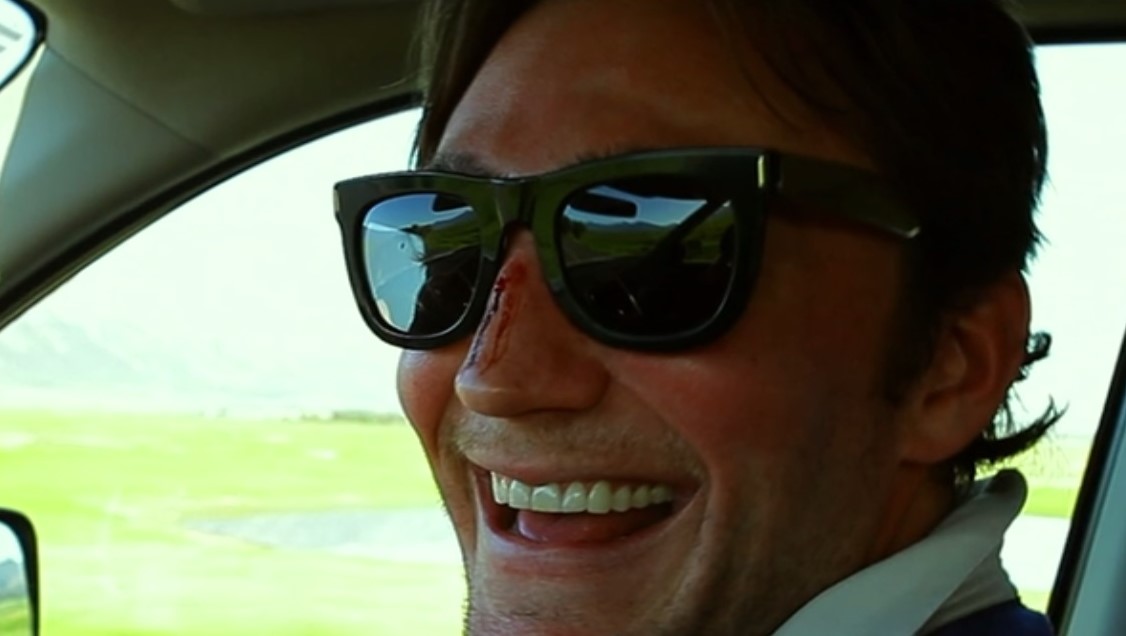
From the start, you know this is not going to be your typical love-fest documentary. It begins at the end, with Ginger Baker assaulting director Jay Bulger with his cane, cracking his nose over the issue of who else might appear in this film. Indeed, Ginger was not happy about some people the director was interviewing, perhaps his ex-wives and arch nemesis but brilliant bandmate Jack Bruce (RIP).
The bloodied director Jay Bulger
Bruce is one of many associates interviewed. Bill Ward, Chad Smith, Neil Peart, Charlie Watts, Eric Clapton, Chris Goss and many more praise the drummer’s abilities. His skill seemed to earn Baker many a free pass over the years, for his quick temper. Poor Eric Clapton thought he was free of the fiery drummer with the end of Cream, but then Ginger joined his new band Blind Faith! In this film, Baker seems like an incredibly difficult individual. He barks at the director many times over questions he doesn’t like. He’s purposely difficult. Living a faraway life on a ranch in South Africa, Ginger Baker had isolated himself from his past. It is a recurring theme in his life. When things got tough, or when he went flat broke, he has always uprooted and gone elsewhere, starting over fresh. Baker never had it easy, losing his dad in World War II when he was only four.
The constant uprooting and starting anew took its toll on Baker and his family. While living in California in the early 90’s with his third wife, he hooked up with Masters of Reality for their landmark second album, Sunrise on the Sufferbus. Though it was a good experience musically, Baker couldn’t hack starting over this time. Opening for Alice in Chains, the drummer was pelted with crap by grunge fans that had no idea who the legend Ginger Baker even was. The union did not last and Baker was off again to start over once more.
Through the mess that was his life, Ginger Baker was always one of the most brilliant drummers on the stage. More a jazz drummer who played heavy, Baker learned to move all four limbs independently which created an illusion of a blur of speed. He wasn’t physically moving as fast as it sounds, but the end result was a unique sound in rock that nobody else copied. Jazz drummer Phil Seaman introduced him to African rhythms which led to a life-long quest. Baker lived in Africa more than once, absorbing the local rhythms and playing with Fela Kuti, learning all he could from the birthplace of the drum.
Johnny Rotten, with whom Baker played in P.I.L., praised the drummer regardless of his personal shortfalls. Whatever his personality might be, it is what was necessary for Baker to perfect his craft, argues Rotten. The ends justify the means. He could not have been Ginger Baker, if he was not Ginger Baker. A very punk-like attitude. Whoever Baker bruised and bloodied, the higher goal of rhythmic transcendence was achieved, and could not have been achieved if he was a different person. That’s the way Johnny Rotten sees it, and since nobody can change the past, that’s a good way of looking at it.
JAYMZ BEE & the ROYAL JELLY ORCHESTRA – ClintEastWoodyAllenAlda(1997 BMG)
Only one of the reasons that Jaymz Bee is totally awesome is that his name isn’t even really James B. He’s actually a James D, from North Bay Ontario, and he is one whacky fellow. A TV music veteran from the Look People (which also spawned Kevin Hearn, future Barenaked Lady) and the Ralph Benmegui show, the man is actually quite a musical genius. After the TV stint, Jaymz teamed up with Jono Grant and immersed himself in lounge music. I have to credit T-Rev for discovering this disc in the late 90’s and turning us onto it. He was all about the lounge music at the time, and Jaymz was catchy and hilarious.
“Man Can Fly” opens the album on a distinctly campy note, but listen to those bass chops and that flute solo! T-Rev, who was always a jazzbo, gave this CD a few fair spins in-store and you can hear why. It’s a great, bright sound that’s perfect for work. “The Man in the Saucy Suit” could work as background music for a Bugs Bunny mapcap adventure, and the lyrics are quite witty.
Our favourite song was usually “You Put the Babe in Baby”, a fast dexterous jazzy tongue twister. Freakin’ incredible, and now I need to pause for a cocktail. Thankfully, the CD jacket has recipes for three suitable drinks: the Berlin Martini, the signature Jaymz Bee Martini, and a Rob Roy!
“Amazon Sugar Pie” is a delightfully jaunty jungle journey with zoot suits and swing. Then on “Tony Bennettless”, Jaymz advises us that no party can swing if it is Tony Bennett-less, and he makes a convincing argument. “Free food and free booze, no it don’t mean a thing,” if a bash is Tony Bennett-less. “A Dog Like You” is another chaotic tongue twister, lyrically hilarious and musically top drawer.
The most surprising track is “A Groovy Movie”, the most straightforward rocking-est of the songs. The humour and swing is intact, but this time you can get down and dance like Austin Powers back in the 60’s again. I think the most interesting song is the slinky, snail-y quiz show sounding title track. It’s fun to try and figure out the compound names before Jaymz gives them away in the words… “BuffySaintMarieAntoinetteFuniCelloBiafra”? “RickJamesDeanMartinShort”?
“Music to Watch Girls By” is yet another fun 60’s swing, and “The Future Keeps Kicking My Ass” is nocturnal and slinky goodness with a Tom Waits vibe…but the closer “Nails” is manic musical insanity. It’s another lyrical masterwork of wit. “Nails! You bang ’em with a hammer! Nails! You cut ’em or you grow ’em…” and you’d be surprised just how many things you can do with nails according to this song, but then we diversify to snails, whales, jails, and finally back again to nails! Best line: “Whales: One swallowed Fred and Barney Rubble!” (You remember that episode, I know ya do.) And stay tuned for the hidden bonus track, in French.
Brilliant with humour like a great Zappa disc. Buy it.
Thanks for joining me this week for Purple Week at mikeladano.com. Today is Part 5 and the last album for now. But don’t worry, I don’t think we’ve seen the last of Deep Purple around these parts…
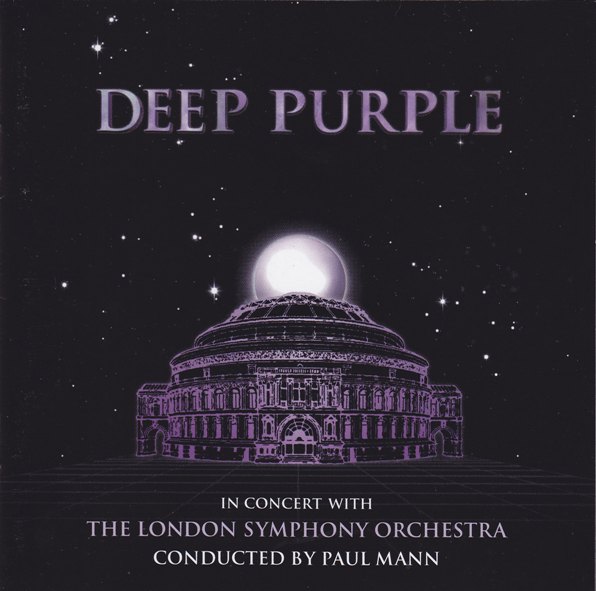
DEEP PURPLE – In Concert with the London Symphony Orchestra conducted by Paul Mann (1999 Eagle Records)
The original Concerto for Group and Orchestra (1969) was Jon Lord’s baby. The rest of the band didn’t care too much for it, and it had only ever been performed twice. The Albert Hall recording became a successful live album, and it was performed once more in Los Angeles. Soon after, the original score was lost, permanently. Even if Deep Purple wanted to (and let’s face it, if Blackmore were in the band he’d probably say no), it could never be performed again without the sheet music.
I’ll let Jon Lord take it from here. From the liner notes to the CD:
“Marco de Goeij, a young Dutch composer…had decided to re-create it by listening to the recording and watching the video. Over and over and over again. A task of mind-bending complexity, dexterity and musicality, which then only left me the far simpler job of filling in what he had been unable to decipher, re-creating what I could remember of my original orchestration, and in part, as those who know the work will hear, re-composing where I felt it needed it.”
Conductor Paul Mann had independently been searching for the original lost manuscript. When Jon informed him of the re-created one, Mann was on board with the London Symphony to do it once more. Deep Purple now had a new guitar player, Steve Morse, who undoubtedly would have to bring his own slant to the guitar solos. For Jon and the fans, it’s the stuff of wishes come true.
Since the Concerto was really Lord’s project, it seems like a fair compromise for each of the members of Deep Purple to also get a moment or two to showcase their solo work. In fact many musicians from those solo works are welcomed to the stage, including the Steve Morse Band, Ronnie James Dio, Mickey Lee Soule (ex-Rainbow and ex-Gillan), Sam Brown, and more. Deep Purple fans are generally open to different styles of music, and this album showcases those styles in a professional, classy format.
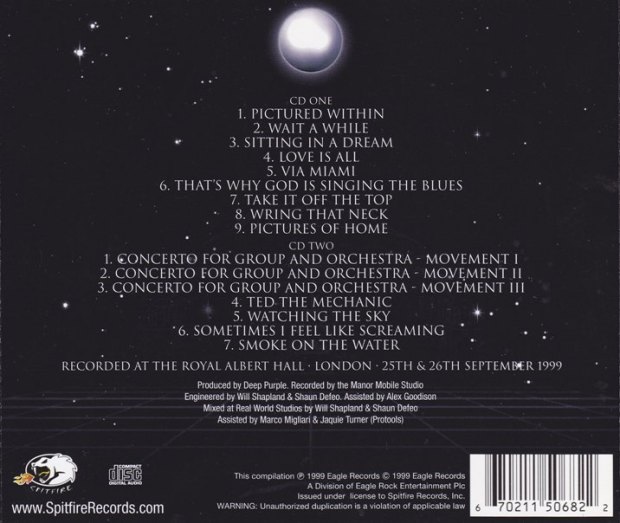
Once again at the Albert Hall, the set commences with a disc highlighting the solo careers. Lord’s “Pictured Within” (with Miller Anderson) and “Wait a While” (with Sam Brown) begin the proceedings with a quiet, powerful pair of songs backed by Jon’s piano and dramatic strings. These versions are, dare-I-say-it, superior to the original studio versions.
From there, Roger Glover’s solo career gets a looksee, with “Sitting in a Dream” and the irresistibly bouncy “Love is All”, my favourite. Ronnie James Dio reprises his vocals from the original Butterfly Ball versions, sounding as great as he did nearly 30 years prior! It really is impossible not to like “Love is All”, which of the two is especially fun.
In 1988, Ian Gillan and Roger Glover did a project together called Accidentally on Purpose, a quirky tropical pop rock album. “Via Miami” is one of the more upbeat tracks from that album. Ian’s “That’s Why God is Singing the Blues” features his solo band’s guitarist Steve Morris (not Morse!) Both it and “Via Miami” spark and roll along joyfully.
Steve Morse (not Morris!) is up next with the Dixie Dregs’ “Take it Off The Top”. It’s the Steve Morse Band and the Kick Horns. It’s always a pleasure to listen to Dave LaRue, Van Romaine, and Steve Morse playing together, but to hear them at the Albert Hall? That’s a venue suitable to the genius they wrench from strings and wood. Graham Preskett joins on violin to dual Morse with string acrobatics.
Ian Paice’s spotlight song is a horn-laden jazz version of Purple’s “Wring That Neck”. This is my kinda jazz, the kind with a rock beat you can swing to! The violin solo lends it a bluegrass feel, too. The first CD ends with a powerfully heavy “Pictures From Home”, originally from the immortal Machine Head record, performed by Deep Purple with the London Symphony. It’s a powerful, dramatic song on which for the full Deep Purple to enter.
Disc two features the entire Concerto from start to finish, all three movements, roughly 50 minutes in length. This truly was Lord’s baby, the piece that kept him up nights in 1968 and 1969 writing little black notes on white paper. It made Deep Purple a unique property when it was released on LP 1969, but had not been heard live in 30 years. Purple fans will be in seventh heaven with this de-extinction. Indeed, Morse’s guitar is different, but he hits the right notes at the right time while still playing within his style. Otherwise, I’ll be damned but I can’t tell the difference.
What can I say of the Concerto itself? I think it’s pretty cool, and I’ve always geeked out to stuff like this. Jon envisioned it as “rock band meets orchestra” — at first they say hello, and play around, then they start shouting at each other, and before long it’s all-out war! Speaking of shouting, my favourite is probably Movement II, which has Gillan’s all-too-brief but oh-so-perfect vocal.
The disc concludes with three more (three Morse?) of recent vintage. “Ted The Mechanic” and “Sometimes I Feel Like Screaming” are two of the best songs from Purpendicular, and “Watching The Sky” is probably the heaviest song from Abandon. I personally feel that all the Abandon material was better live than on album, and “Watching The Sky” maintains that. Unfortunately none of the Abandon songs were really that great.
Of course, “Smoke On The Water” ends the album with guests returning, including Ronnie James Dio who takes a verse. “What do you think Ronnie!” Then the Elf himself is up at the microphone singing “Smoke on the Water” with Blackmore’s old band Deep Purple. I shouldn’t need to tell you that this is one of my all-time favourite live versions of “Smoke”.
This album, which ended up being one of Lord’s last with Purple, was really a special gift to the fans. It is a beautifully crafted live performance containing some of the rarest of the rare gems in the extended Purple canon. An event like this will never happen again. There is a DVD of this show, but beware, it is only about 2/3 of the set. What a disappointment that DVD version was. You want every moment, but you won’t get it.
If you do hunger for more after this, then you can binge on The Soundboard Series 12 CD boxed set. It consists of 6 shows, two of which featured full live performances of the Concerto, with guests such as (yup!) Ronnie James Dio. There is also Live at the Rotterdam Ahoy which lacks the Concerto portion, but makes up for it with a more extensive set of classic rockers, including Dio’s own “Rainbow In The Dark” and “Fever Dreams”!…But that’s another review.
5/5 stars. For the true fan, and anybody who’s not afraid to expand their listening territory.
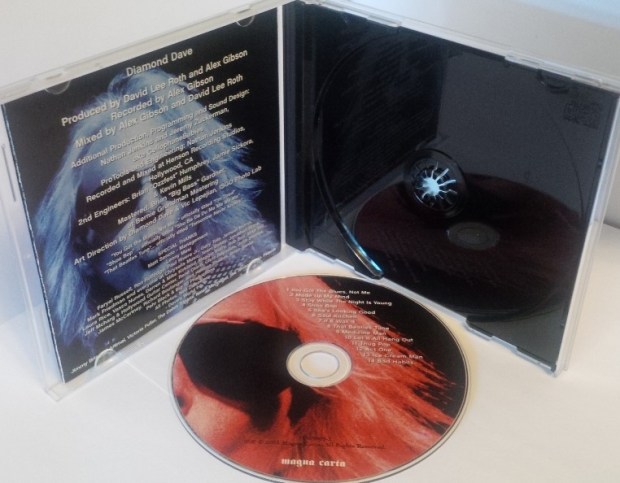
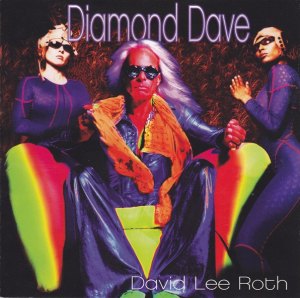
One can indeed judge a book by its cover. David Lee Roth is hands-on with every aspect of his product, be it a photo shoot, a recording session, or an interview. He must have known his Diamond Dave album was crap, so he made a terrible cover to match it. Check out the tan, that wig and them pants! (Also notice: furry walls!)
This album, following up another aborted Van Halen reunion and the surprisingly powerful album DLR Band, switches gears and shows Dave’s “multi-faceted side”. Sure, we all know Dave likes disco, jazz, blues, showtunes, and standards. It’s Dave doing what he did very successfully on Crazy From the Heat, and trying to do so again. To make an album of this stuff would be fine, but Diamond Dave lacks any sort of zap. At all. It’s just one “who cares” cover after another, a couple crappy originals, and a Van Halen tune.
Dave’s voice just doesn’t generate the heat it once did, and all of Diamond Dave suffers for it. The way Van Halen did A Different Kind of Truth used a lot of production on Dave. Here, Roth is a whimper, a wheeze, a breathless gasp at the greatness that once was. To listen to this album in one sitting is an exersize in stamina. I know because I’ve done it.
Positives: Instrumental moments on the Steve Miller cover “Shoo Bop”. The ace rhythm section of LoMenzo and Luzier are complimented by a guitarist named Brian Young who is shit-hot on this. Then Dave goes all dance-y on it…ugh. “She’s Looking Good” is old-school and well done.
The indigestible: The Doors’ “Soul Kitchen”. Nobody needs to cover the Doors; Dave makes them sound like Smash Mouth. Hendrix’ “If 6 Was 9” has too much of Dave’s boring talking voice, but not enough crooning. His cover of the otherwise excellent Beatles number “Tomorrow Never Knows” (which he actually had the audicity to rename “That Beatles Tune”!?) sucks all the life and innovation out of a great song, as he wheezes to the finish line. This is by far the worst song, even though he also covers “Let It All Hang Out”.
There is only one number here worth owning, which is his Las Vegas version of “Ice Cream Man”. He did this shortly after Your Filthy Little Mouth with Edgar Winter, Omar Hakim, Greg Phillinganes, and Nile Rodgers! According to Dave’s autobiography Crazy From the Heat, this was recorded in a live in a video shoot. The video was never released, but the audio finally was. It lives up to the hype if not the wait.
Decide what you are willing to pay for one or two songs, and buy accordingly.
There were some pretty awesome picks this year. I have to give Scottie props for “Coming Home” by Iron Maiden, from the excellent Final Frontier album. I found some things a bit surprising, such as the overplayed-on-radio “Black Betty” by Ram Jam, placing so high.
“Thick As A Brick” was the live version, so just over 10 minutes. Other long bombers included all of “Supper’s Ready” by Genesis, which resulted in a tirade by Phil for just as long, about how much he thinks it sucks! (And he’s an old-school Marillion fan…surprising.) And of course there were several Maiden tunes that clock in well over 5 minutes.
For your edification, here is the official Sausagefest XII Countdown: 75 tracks, plus 35 tributes. One tribute for each person that submitted a list! 110 songs over one weekend! Awesome.
WATCHMEN : The Ultimate Cut – The Complete Story (2009 Warner 4 disc blu-ray set)
Directed by Zack Snyder, 216 minutes
What’s the greatest comic book movie of all time? I’ve seen a lot of them. There’s quite a few I haven’t seen as well, but it’s a great topic for discussion. I always have to put Watchmen on the table when discussing great comic book adaptations.
Watchmen is a complex tale. Its original comic was ambitious, containing page after page of dense backstory information in the form of documents and faux-magazine articles, all very relevant. There’s even a parallel story taking place, a comic within a comic, which directly reflects one (or arguably more) of the characters in the main story. Characters and their psychology are key. In addition, neither the comic nor the movie are linear. The story unfolds within different time periods, flashing back and forth, as we learn more about the characters, their motivations, and the world they inhabit.
It is the world they inhabit that was the hook for me. I’m a sucker for alternate universe stories. Here’s one that sets us on Earth, 1985, but things have unfolded very differently. The influence of various superheroes/vigilantes has caused history to unfold very differently. Specifically, it is the presence of Dr. Manhattan, who puts a swift and decisive end to the Vietnam war, who influences history the most. In this 1985, Richard Nixon is still president, and masked vigilantes are now outlawed.
The Watchmen are a group of such vigilantes, originally known as the Minutemen. Some, such as Dr. Manhattan truly are superhuman. Others, such as Nite Owl and his successor Nite Owl II, are mere mortals with high-tech gadgetry and skill as their allies. All have retired, some in fame and some in anonymity…all but one. Rorschach. He remains active, alone and wanted.
The movie begins as a murder mystery. Someone has managed to identify and kill Edward Blake — The Comedian, once one of the most dangerous heroes alive. To overpower and murder Blake would require an individual of tremendous resources. Who? And are other former vigilantes also at risk? Rorschach seems to be the only one who wants to know.
Being a fan of the graphic novel, I was very happy with the way that Zack Snyder captured Watchmen. It was done with love and care. The things that are discarded, I didn’t miss so much. The things that he changed, I understand why it was done. There’s one layer to the story/mystery that has been discarded, probably to keep this thing under 4 hours! The things that are reverently exactly the same as the comic made my jaw drop in awe. The acting performances are what they are, but I have to give special mention to Jackie Earl Haley as Rorschach.
The soundtrack is one of the best in recent memory. Outside of Wes Anderson, I haven’t loved a soundtrack this much in a long time. It’s awesome from the stunning Bob Dylan classic “The Times They Are A’Changing”, to Nat King Cole, to Simon and Garfunkel, Hendrix and Philip Glass, and probably the weirdest use of Leonard Cohen’s “Hallelujah” in movie history. The soundtrack is where it’s at. The movie even contains a Village People sighting! I’ll skip My Chemical Romance.
This Ultimate Cut weaves the comic-within-a-comic, Tales Of The Black Freighter, previously only available on its own, into the main body of Watchmen. These segments are narrated by Gerard Butler. New live action linking sequences connect the movie to Black Freighter, much like it worked in the graphic novel. People who haven’t read the graphic novel might not understand what “Black Freighter” is doing there, but they should probably start with the less daunting theatrical cut to start with anyway.
The box set includes four discs, beautifully packaged. Hardly a complaint to be registered. The box is heavy and sturdy. Included is Watchmen: The Motion Comic, packed in its own case, 5 hours long on its own. One disc is the expired digital copy of the theatrical cut (whoop de do) and another disc is loaded with special features. Best of these is Under The Hood, which is based on the graphic novel segments covering Holis Mason. Mason, the original Nite Owl I, wrote an autobiography called Under the Hood; this film is a faux-documentary on his story. It is presented as a television program from 1975 re-run in 1985, including commercials and scratchy footage. At 35 minutes, this is an absolute must. Other special features include brand new audio commentaries, for those who dare to keep going deeper. This set is just loaded. Unfortunately I found the sound level inconsistent, I had to turn it up and down frequently.
Having said that, I’m not going to discard my Director’s Cut of Watchmen. Clocking in at almost four hours, watching this version is a commitment. I know that occasionally, I will want to watch the “shorter” version of the film. Since a digital copy of the theatrical (shortest) cut is included here, maybe you won’t feel the need to double-up on Watchmen editions. For an enriched viewing experience, set aside the four hours one afternoon and enjoy.
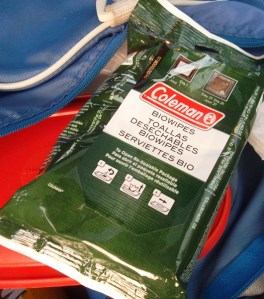
COLEMAN BIOWIPES
$3.99 for resealable package of 30
July 5-6 2013 was the weekend: the annual all-rock, all dude Countdown event known as SAUSAGEFEST. This particular installment being Sausagefest XII. As discussed in Record Store Tales Part 30, and as seen in last year’s video, I suffer from a certain level of anxiety regarding the restroom arrangements. As in, there aren’t any. And I’m not as young as I once was, and the plumbing doesn’t always work as well as it used to when I was in my 20’s.
To the rescue came Biowipes, by Coleman! Not only can you shit with a clean bottom, but also a clean conscience: the Biowipes completely biodegrade in just 21 days. (Less I’m sure if you ate the bacon-wrapped jalapenos that we consumed.)
The Biowipes are large enough (20 x 25 cm) and tough enough to handle whatever you need to do. There are 30 of these moistened towelettes in each package, by my estimation and usage, probably enough to get you through 10 days in the woods.
6/5 stars
Seen below: Some of the many reasons these wipes were necessary!
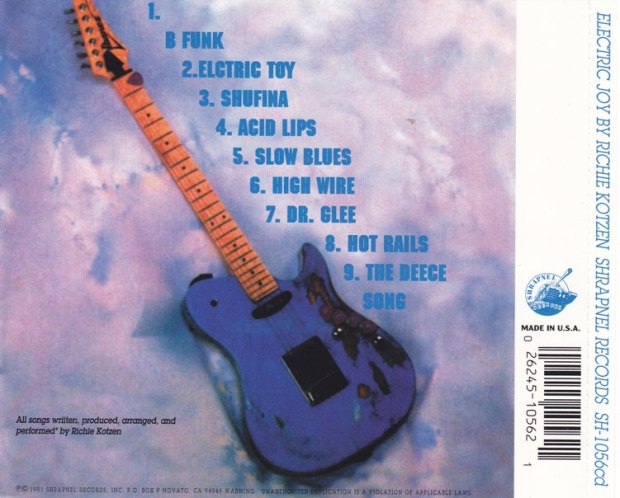
RICHIE KOTZEN – Electric Joy by Richie Kotzen (1991 Shrapnel)
Albums by Richie Kotzen were impossible to find in Canada. My only exposure to his music was “Dream of a New Day”, from his second album Fever Dream. Fever Dream was his first vocal album, but Kotzen returned to instrumentals on his third, Electric Joy. I’d seen his picture in dozens of guitar magazines, but hadn’t heard his tunes until “Dream of a New Day” was included on the Bill & Ted’s Bogus Journey soundtrack.
His debut album was a hit with the shredders, but three albums in, Kotzen had already delivered three completely different pieces of work. Electric Joy has some of the playfulness of the debut, but is mostly a jaw-dropping collection of intricately composed pieces that skirt multiple genres including funk, country, bluegrass, jazz, fusion, and blues. If I had to pick out an influence, I would say that Electric Joy sounds like Richie had been listening to a lot of the “two Steves”: Vai and Morse. His technique is top-notch.
I first got this on a trip to Frankenmuth, Michigan. My parents made a point of going there every spring and I started tagging along, and then later on my friend Peter joined us as well. We’d stay at the Bavarian Inn and on the way back to Ontario, we’d stop at the stores in Port Huron, where I found this as well as old rare Savatage cassettes.
“B Funk” opens the album with some light-speed bluegrass-y licks, but it keeps changing, from a funked up rocker with shredding, to a melodic “chorus” section. Then it’s back to the bluegrass from space.
At this point I’ll point out that Kotzen plays all the instruments except drums, himself. That’s Richie’s standby Atma Anur on drums. What this means is, that incredibly dexterous bassline you’re hearing on “B Funk” is also performed by Kotzen! And it’s almost every bit as stunning as the guitar!
“Electric Toy” begins ballady, with some lyrical Vai-like moments. Of course, Kotzen can’t help but do what he does, so there are different sections, some at lickity-split tempos. This is followed by “Shufina”, which is essentially a blues jam. Kotzen’s deep bends are appropriate, but before too long he’s harmonizing with himself on some unconventional melodies.
A smoking hot riff ignites “Acid Lips”, little lightning licks flicker in and out, but this one has a solid groove. (It can’t be easy grooving with yourself on bass.) “Slow Blues” contains some of Richie’s most lyrical lead work. If you can imagine the lead guitar taking on the role of a singer, then “Slow Blues” is probably the most accessible song on the album.
The next song “High Wire” is uncatagorizable, suffice to say that like all of Electric Joy it combines quirky notes with shreddery, funk and groove. My favourite song is “Dr. Glee”. It sounds like it seems it should – gleeful. I find this pleasant melody to be very summery. Kotzen guitar has so many different sounds and shades, even just within this one song.
“Hot Rails” is another one that sounds like advertized…a train racing down the track. Kotzen’s slide work is anything but simple. This one’s so fast it’s hard to keep track of all the cool different guitar parts. It almost sounds like Kotzen wrote a blues shuffle, and then decided to hit fast forward on his tape deck and learn it at that speed!
Electric Joy closes with “The Deece Song”, which thankfully is mid-tempo allowing us to catch our collective breath. It’s another great performance, similar in style to “Dr. Glee”. It has its sweeping Satriani moments as well.
The production on the album is very dry, which is different from what a lot of the other instrumentalists were doing at the time. While this means it might take some more time to penetrate an album that is loaded to the brim with dense ideas already, it is a worthwhile endevour.
In a bizarre turn of events, Kotzen briefly put his solo career on hold. He received a phone call from Bret Michaels. The Poison frontman was looking for a replacement for the departed CC Deville. The fact that Kotzen was from Pennsylvania, not already in a band, and wrote and sang original material caught Michaels’ eye in a magazine article. Having a shredder, but one with some feel too, might garner Poison some respect in the tough 1990’s.
Kotzen did succeed in co-writing (and in some cases, writing entire songs himself) their most accomplished album, Native Tongue. Of course, it did not sell. The Poison relationship imploded because of another relationship: the one that Kotzen was secretly having with drummer Rikki Rockett’s fiance! Kotzen eventually married her, and he was replaced in Poison by another shredder, Blues Saraceno (who was in the running with Kotzen in the first place).
 SWINGERS – Music from the Miramax Motion Picture (1996 A&M)

















 mikeladano.com