rarities

Part 200: Just Another Annoying Day…

RECORD STORE TALES Part 200: Just Another Annoying Day…

It was a Wednesday in May, 1997.  Early afternoon.  This big, big dude with a shaved head walked into my store.  I greeted him, as I did all customers.  By all appearances he was perfectly normal.

“Hi there,” I said a few moments after he walked in.

“Do you have any Metallica box sets?” he replied, skipping the formalities.

I didn’t need to check inventory to know the answer.  The Metallica box set, Live Shit: Binge & Purge was huge.  It housed three VHS video tapes, 3 CDs in one jumbo “fat” case, a nice booklet, a “backstage pass”, and a stencil.

Legend has it that Peter the Rocker stenciled the “Metallica Guy” on the hood of his car.

There were other things that you might have classified as a Metallica “box set” at the time, but it was 1997 and there weren’t many.  The first Fan Can was out (1996), and there was the vinyl-only The Good, The Bad and The Live: 6½ Anniversary EP Box Set that we wouldn’t have carried (no vinyl in 1997).

“No, I don’t have any.  I know for sure that one of our other stores had one a few days ago.  Want me to check if it’s still there?”

“No.  How much will you pay me for one?” he asked.

“Well, that depends on a lot of things.  It’ll depend on if it’s complete, condition…”

Cutting me off, he abruptly said, “Yeah, yeah…it’s brand new.  It’s my buddy’s.  He has lots of Metallica box sets.  What will you pay me for the rest of them?  He has all of them.”

“All of them?” I queried.  “What do you mean by all of them?  Binge & Purge is the one most people are thinking off.”

“Yeah he has that, and all the others too,” he continued, “all sealed.  Metallica have a lot of box sets.  He has doubles of all of them.”

The dude smelled fishy, and it sounded to me like he was setting up a story in order to possibly go across the street to the mall, steal one or more, and sell them to me.  At this point, my guard was up and I wasn’t interested.  So, as diplomatically as possible, I addressed the big guy.

“Well dude, I can’t make any promises.  I can’t give you any kind of quote or promise without knowing what I’m buying.”

Cutting me off again, he repeated, “They’re all brand new.  Still in plastic.  Yeah, my buddy, he collects them.  But, uhh, he owes me money, and uhh…he said I could sell what I needed to get the money.  Can you give me $400?”

If I was drinking something I probably would spat it up.  “Umm, no man, listen, I really can’t help you out with that right now.”

“Are you hiring?” he replied, changing tack.

I paused, trying to keep up with the guy’s racing thoughts.  Even if I was hiring, there was no way I was telling him that!  I replied in the negative.

“No?  Can you hire me just for this afternoon?  I could lift stuff and help around the store,” he persisted.

“No.  I got it covered.  Thanks, I’m good.”

“I just need enough for the bus.  I have to be in Hamilton on Friday.  I’m going to Hamilton to work, but I don’t have a way of getting there yet.  Can you just, you know, give me some money?” I couldn’t believe I was hearing this.

“Sorry man, I really can’t.  Maybe someone else can help you if you go elsewhere,” I said, politely terminating the conversation.

“OK.  I’m going to go get those Metallica box sets.  My buddy lives really close.  I’ll be back in 20 minutes,” he announced, as he left the store.

I knew a guy at the HMV store at the mall, so I gave him a call.  I asked him to keep an eye on a big bald guy who might be eyeing the Metallica box set a little too closely.  He called the other music stores at the mall and gave them a heads-up as well.

Big guy was never seen nor heard from again!

NEXT TIME ON RECORD STORE TALES…

Warren.  Just Warren.

REVIEW: Fight – War of Words (1993)

Click here to check out the LeBrain Facebook page!

Part 1 of a miniseries on Rob Halford’s solo career!

FIGHT_0002

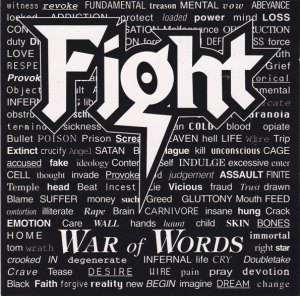
FIGHT – War of Words (1993 Sony)

I was devastated when Rob Halford left Priest.  I was so heavily invested emotionally in the excellent Painkiller album, I couldn’t believe it was over!  Last I had heard, the band were going to be working on two new songs for a greatest hits album (Metal Works) and then Rob would take a break to do a solo album.  Instead, the band split completely!  Halford and drummer extraordinaire Scott Travis formed Fight with guitarists Russ Parish and Brian Tilse, and the bass player from hell, Jay Jay.   (Today, Parish goes by the name “Satchel” when he plays with Steel Panther!)  Regarding Jay Jay, Halford says that he did a number of Rob’s own tattoos.  Rob figured if he could play bass as well he he tattooed, he was in.  Jay Jay also does the grunt-metal backing vocals.

The resulting album, War of Words, is a Pantera-esque thrash-fest, one of the heaviest things Rob had ever done (until Halford’s Crucible album), undeniable brutal, scream-laden, and punishing from start to finish.  Halford had cleverly assembled two shredding guitar players with differing styles too:  Tilse specialized in the noisy speedy solos, while Parrish played the more melodic and traditional speedy solos!  War of Words is solo nirvana for fans of Rob and Priest.  And Rob wrote every single song by himself.

The twin openers, “Into the Pit” and “Nailed to the Gun”, are two of a kind:  they are rip-yer-head-off thrashers with Rob’s patented glass-breaking screams.  The song structures on War of Words are simpler than what we heard with Priest, no doubt since Rob composed the songs by himself.  This simplicity serves to make the album feel even heavier and more relentless.

The lyrics, just as simple and aggressive.  “Into the Pit” doesn’t feature much in the way of poetry:

Conspiring, for sation
Malfeasance, on high
Obstruction, of duty
Disorder, will rise

Rob takes the pace back a bit on the third track, “Life in Black” which I don’t think you can fairly call a ballad, to me it’s more Dio-era Sabbath with a very vintage-Dio sounding solo.  (Rob had just helped out Sabbath live after Dio left, singing lead for two shows while opening for Ozzy Osbourne.)  Meanwhile “Immortal Sin” bears a slow groove with a melodic chorus, downtuned but a bright spot in the proceedings.

The title track opens with the American First Amendment (Rob was living in Phoenix).  It’s another aural assault with Rob keeping his vocals in the upper register.  Travis’ incredible drumming punctuates every venomous word.  Considering that less than three years prior, Rob (with Priest) was in court defending his band during the infamous “suicide trial”, the words are apt.

Dream Deceivers, directed by David Van Taylor, the excellent documentary on the Judas Priest trial

It’s back to dark haunting territory next:  “Laid to Rest” ended the first side of the album.  I find this one to contain one of Rob’s best vocal performances of the album.  It’s reminiscent of “A Touch of Evil” by Priest, but downtuned and slightly exotic.

Side Two’s opener, “For All Eternity” is really the final reprieve.  It is most definitely a power ballad in vintage Priest vibe, but again with the modern downtuned guitars.  A song like this really proved Rob’s songwriting chops.  He’s capable of writing emotive, catchy powerful music completely on his own, and the song is an achievement.  The bridge around 2:25 is just awesomeness, but Tilse’s guitar solo completes the picture.  As if that wasn’t enough, Rob returns to full on scream mode for the end.

“Little Crazy” was a critically acclaimed heavy metal blues, and the second single/video.  I’m struggling to describe it beyond “heavy metal blues”, but this song is definitely a highlight.  Rob puts everything he has into the slinky lead vocal, while band fuse the blues feel with heavy metal’s precision.  I recall reviews of the time saying, “If Rob wanted to drop metal and go full-on blues, he could.”  Now that would be interesting.

The rest of the album is no-holds-barred.  The triple threat of “Contortion”, “Kill It”, and “Vicious” is almost too much.  Each song strips everything down to the basics:  simple riffs, violent words, relentless drums, without much in terms of melody.  This is the most difficult part of the album to penetrate.  In time the three songs grow.  “Contortion” protests what we are doing to the Earth with angry frustration.  “Kill It” is about TV preachers (whom I’m sure had their opinions on Priest during the trial).  “Vicious” was always my favourite of the trio:

You cheating, lying, mother-fucking son of a bitch..

Vicious, vicious,
Fucker, fucker!

I was going through an angry phase at the time!

Rob saved the best track for last.  “Reality: A New Beginning” is a weighty epic, a perfect closer, slightly exotic and successfully combining Fight’s heavy side with Rob’s ability to write great melodies.  This is simply an incredible song, a jewel in Halford’s crown, and a song which definitely deserves another look.  The lyrics seem to be autobiographical:

This time, when I’m leaving,
Who cares where I’ll go?

There was a hidden CD bonus track (not on cassette) after a five minute silence, a jokey song called “Jesus Saves”.  Rob’s voice is electronically manipulated to sound…well, not sure what he’s supposed to sound like.  An angry elf, I guess.

4.75/5 stars

There are some supplementary releases available:

1. This one is on my wishlist, I don’t own a physical copy:  In 1994 Fight released a Christmas CD single called “Christmas Ride” with a message from Rob!  They later reissued this as a free download from Rob’s site, but that is no longer around.

2. The live/remix EP, Mutations (next up in this series of reviews).

3. In 2007, a demo album called K5: The War of Words Demos was released.  This featured demo versions of most of the album, plus five more.  These include four new songs, and “Psycho Suicide” which was later remade for the second Fight album, A Small Deadly Space.   The demos reveal that a much more conventional-sounding metal album was initially planned.  (“The Beast Denies” is a very different version of “Reality: A New Beginning”.)

4. The 2008 Fight box set Into the Pit contains remixed versions of War of Words (again without “Jesus Saves”) and A Small Deadly Space.  But the cool thing it contains is a DVD, Fight Live In Phoenix.  The band rips through the entire album, in sequence (no “Jesus Saves”!) and then Rob’s solo track, “Light Comes Out of Black” (from the Buffy the Vampire Slayer movie soundtrack).

5. Buffy the Vampire Slayer original motion picture soundtrack.  This is the only place you can get the studio version of “Light Comes Out of Black”, featuring his backing band…Pantera.  All of Pantera.

I like “Light Comes Out of Black”, but it’s a lot easier to swallow than Fight is on first listen.  I remember a M.E.A.T Magazine interview with Glenn Tipton and KK Downing, where they trashed it.  “If it were on Painkiller, it would be one of the weaker songs, if not the weakest,” said KK.

KK might have been right about that to a certain extent, but only because Painkiller consists of 10 awesome songs!

REVIEW: Whitesnake – Good to Be Bad (2 CD & Japanese versions)

Here’s my second review from the The Toronto Musical Collectibles Record & CD Sale! It was Japanese import Heaven!

For the last installment of this series, click here.

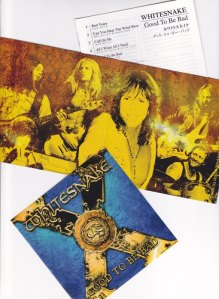
WHITESNAKE  – Good to Be Bad (2008 Warner/SPV)

Whitesnake disbanded in 1990.  Coverdale did his album with Jimmy Page, but that didn’t prove to last either.  Although they’d started writing for a second album, the affair ended and David Coverdale assembled a new Whitesnake for a Greatest Hits tour in 1994.  This reformation eventually led to an album in 1997 called Restless Heart (billed as “David Coverdale and Whitesnake”.  This R&B flavoured album, a personal favourite, did not resonate with some fans of 80’s ‘Snake.

After another hiatus, and a solo album (2000’s Into the Light), David once again formed a new group of ‘Snakes, a mixture of old and new members.  After several years of touring (and lineup changes), the long awaited new Whitesnake album, Good to Be Bad, hit the shelves in 2008.  Former Dio guitarist Doug Aldrich and Winger’s Reb Beach had been a formidable guitar duo since 2002.

GOOD TO BE BAD_0003

Similarly to his partnership with Adrian Vandenberg, David has retained his writing style of co-writing with just one co-writer; in this case, Aldrich. It seems to be evident that the guys have gone for a John Sykes guitar sound and style.  You can certainly hear a lot of trademark sounds and tricks that Sykes used to do, that gave the 1987 album such a cool sound.  This isn’t to say that they don’t play plenty of their own style too, but the retro stuff is frequent.

So similar is the direction of this album to 1987, that you can play “name that tune” with all the new songs:
“Can You Hear The Wind Blow” for example directly references moments on 1987, right down to those flares that Sykes used to do.  “All I Want, All I Need” equals “Is This Love” Part Deux.  Basically, every song on Good To Be Bad is a mash-up of songs from Coverdale Page1987 and Slip Of The Tongue, and you can hear the references quite distinctly. “A Fool in Love” is “Crying in the Rain”.  “Lay Down Your Love” is “Shake My Tree”, without Jimmy Page.  Throw in a little “Kashmir” during “‘Til The End Of Time” (which seems to be based off “Till The Day I Die” from Come An’ Get It) too.

Having said that, despite the lack of originality, Good To Be Bad is still a very enjoyable listen, and a very welcome return. A world without David Coverdale’s voice is like a world without crème brûlée.  That voice is in fine form, perhaps even stronger than it was on 1997’s Restless Heart. The album has a lot more life to it than Restless Heart, although it does lack that album’s subtlety and R&B moments. The band play great, kicking it on every tune, even the ballads. The melodies are strong and memorable.  It’s just…too contrived.

The bonus live disc is the the Canadian special edition is highlights from Live: In The Shadow Of The Blues. No big deal.  It’s nice to hear Whitesnake playing “Burn/Stormbringer” from David’s Deep Purple days, and cool to hear the old 70’s classics.

The real cool version to have is the Japanese release with two bonus tracks.  And a sticker!  Can’t forget the sticker.  The bonus tracks are both remixes (a “Doug solo” version of “All For Love”, and a stripped down version of the lovely “Summer Rain”).  For $20, I wasn’t complaining.

3.5/5 stars

Part 198 / REVIEW: Promos II (King’s X – “Pillow” CD single)

RECORD STORE TALES Part 198:  Promos II

In Part 117, we talked about promo CDs:  How to identify them, what they were, what they’re worth.  A short while ago, Statham and I were having a conversation about promo discs.  The conversation began in regards to one of my treasured rarities, a King’s X promo CD for their 1994 single, “Pillow”, from the Dogman CD.

Even though eBay (supposedly) have strict policies against selling promo discs, I just found one as I was writing this, identical to mine, on sale for $46.99 USD.  It even says “Promo Copy – Not For Sale” in clear writing on the back cover, in the eBay photo!  Somebody at eBay is asleep at the wheel.

I got mine for free, a decade ago!

This one found its way into our warehouse, probably via a liquidation.  The warehouse manager knew we couldn’t sell it, not with that big inscription on the back, so he gave it to me, knowing I was a huge fan.  As I explained to Statham:

LeBrain:  We weren’t legally allowed to sell promos, at least ones that were obviously identifiable as promos, in the store.  We’d been caught once when one hit the shelves .Even if I bought this CD from you for $5, I technically couldn’t sell it in store.  We could have asked $20 for it easily, because of the unreleased tracks.  Those weren’t on anything else.

Statham:  So even on the dark days, the ones you HATED about being there, there were then moments like your getting this CD that made it OK again!

LeBrain:  Yes! Although I had to keep them secret…Our warehouse manager would slide them my way, on the condition that I don’t tell. Don’t know what they would have done with them otherwise, besides throw them out.  That would have been a shame.  [I think the statute of limitations has expired on my promise not to tell!]  We paid money for these promos though, we got nothing for free.  Everything we sold was purchased from somebody else, be it a wholesaler or an individual.

Statham:  Right, but all of that is pre-killed by the writing all over the promos prohibiting their sale. So there never was a [legal] leg to stand on, with those.  But nobody ever reads those warnings anymore. The Interpol warning at the start of a DVD? Just something else to skip. Part of the scenery. Surely we can ignore that, right?

LeBrain:  Yeah exactly.  Every other store in town had promos on their shelves too.  And they weren’t as discerning as we were, they’d sell anything.  [But] you’re right, we didn’t have a leg to stand on.   I guess in the long run it meant that I could get stuff like this for free.

Statham:  Even as recently as last year, I bought a promo single from there [LeBrain’s old workplace]. So apparently things still slip through the cracks!

LeBrain:  I’m sure they do.  After all, it was over 10 years ago that we received a warning about selling promos.  I don’t know who tattled on us, but it always struck me as unfair.  We PAID for those promos.  We got NOTHING for free!  And I would never buy or sell a promo in the store that didn’t have something worthwhile on it, like bonus tracks of some kind.  It had to have some kind of value.

And so it goes.  I have a lot of promo discs from those days, stuff that you technically couldn’t buy in stores, stuff that guys at record shows routinely ask $20 for.  eBay prices?  Double that.  Some of them are worthless, one track promo singles with no cover and no real value.  Others have exclusive live tracks, like this King’s X single we’re about to discuss.

SAM_1940

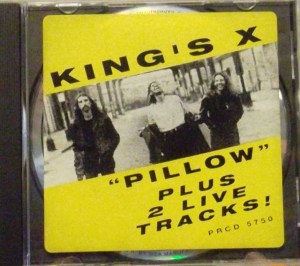
KING’S X  – “Pillow” (promotional CD single, 1994 WEA)

“Pillow” was released as a single in mid-1994, and promptly went nowhere.  That’s too bad, as it’s a great song, heavy and slow, fitting right in with the grunge movement that was still dominating the charts.  King’s X trademark harmony vocals by Ty Tabor can be heard during the chorus, under Doug Pinnick’s soulful lead.  Doug’s 8-string bass chimes while drummer Jerry Gaskill sets the groove.  This track, one of the standouts from the Dogman album, simply crushes.

The two B-sides are live, recorded in Dallas on May 8, 1994.  “Shoes” is another great Dogman track.  What is especially cool is how great King’s X harmonies sound live!  This track proves they have the goods, but the Texas crowd is more than happy to take over the vocal chores.  They clearly knew the new songs backwards and forwards.

The second B-side is the complex “We Were Born To Be Loved” from the landmark Faith Hope Love album.  “I like a crowd that makes a lot of noise,” says Doug, before the band tear into the intricate rhythms and harmonies involved with this rocker.   It’s another Doug lead vocal, with Ty and Jerry on the harmonies.  Knowing how great King’s X are, I’m sure this truly is live — no backing tapes or overdubs.

There’s not much in the way of artwork; just a sticker on the front of the case and a pretty plain white back cover.  Stickers don’t age too well, as the gooey sticky stuff starts to seep through the paper.  Plus if you crack that front cover, you’re screwed.

Since this single was released, both these recordings have seen the light of day on an album, called Live & Live Some More, from 2007.   While that sort of destroys the collector’s value for a single such as this, it doesn’t change the fact that these songs are awesome!

5/5 stars

Next time on Record Store Tales…

Hooray for Stock Transfer Day!

REVIEW: Psycho Circus – Scarred (1993)

This was one of the first, if not the first, discs I bought with my staff discount at the record store!

SCARRED

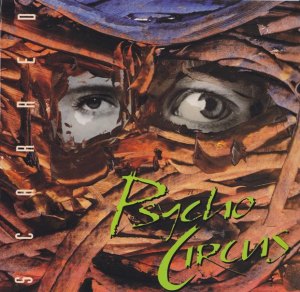
PSYCHO CIRCUS – Scarred (Anthem 1993)

20 years ago, Psycho Circus were one of the bands hyped as the “next big thing” out of Canada. They originated in Mississauga, Ontario, just west of Toronto.  They signed with SRO management (Rush, Van Halen, King’s X, Extreme) and producer Terry Brown (also Rush) and released a trendy but still unique goth-rap-funk-metal album called Scarred.  They also released a music video for the excellent “Pulsate”.

These guys were hanging out with old dudes way before Our Lady Peace.

The problem with Psycho Circus is their split personality.  On one hand (roughly half the album) they inhabit this cool, dark land I call Diet Faith No More.  Singer Vince Franchi has the lungs and range to emulate Patton’s style on The Real Thing.  Their cool use of keyboards also reminds me of that band, but without the dementia.  On the other hand, there’s a goofy rap-funk side, which does not appeal to me in the least.  I think funk metal got stale very quickly, and the juvenile lyrics render the rapping limp.  “Acid Monkey Junk”, a song about the testing of cosmetics on animals, is painful at time.  “Monkeys in the ocean and fishes in the trees?”

A M.E.A.T Magazine interview by Karen Bliss, from 1993, reveals that the band had already dropped even more irritating material from their live set.  They name a discarded song called “Picky Purple People” as being particularly notable for its silliness.  Glad I didn’t have to hear that one.


I prefer the Diet Faith No More side of the band: hard, melodic and dark songs like “Thru the Backbone” (which also features rapping in a non-annoying way).  “Pulsate” is easily the best song on the album, demonstrating Franchi’s impressive vocal range and power.  I’m also fond of the angry “I Know”, the haunting “Leave Me Alone”, and the closer “Goodbye”.  The rest of the album is unfortunately skip-worthy and occasionally irritating to me.

There was also a CD single made for “I Know” featuring an exclusive “Psylicone Mix”.  Although I don’t enjoy the remix as much as the album version, it’s notable for being remixed by Brown and the band, not some outsider.  I happened upon this single within my first year at the record store, and it surely must be one of the rarest discs I have.

For half a good album:

2.5/5 stars

M.E.A.T Magazine

REVIEW: Deep Purple – Collector’s Edition: The Bootleg Series 1984-2000 (12 CD)

fb:  Lebrain
“LIKE” the LeBrain Facebook page for exclusive content.

DEEP PURPLE – Collector’s Edition: The Bootleg Series 1984-2000 (2000 Thames Thompson, Australia only, 12 CD set)

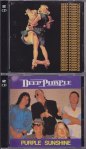
There are two (!) 12 CD Deep Purple bootleg collections; this is the first and best of them.  Although Deep Purple’s career is chock full of live albums chronicling this period, this set does feature many treats that are hard to find or not available on official live albums.  These really are bootlegs; the band decided to release their own versions of pre-existing audience bootleg albums!  All artwork, errors included, are copied from the original bootleg releases.

Before you get too excited I will state right off the bat:  There’s no Deep Purple Mk V or VI.  No Joe Lynn Turner, or Joe Satriani.  There is, however, a show from 1995 with Steve Morse, previewing tracks from the yet-to-be recorded Purpendicular album.  This transitional period is very cool.  You get to hear Morse perform “Anyone’s Daughter”, which was dropped from the set not long after.  Since Morse and Blackmore’s styles are vastly different, it’s a cool take on a track that you don’t hear often as it is.  In addition, you’ll hear Morse reinvent “Woman From Tokyo” on a bootleg from 2000.

BOOTLEGS FRONTThe Bootleg Series also contains my favourite version of “The Battle Rages On” ever released.  1995, Ft. Lauderdale Florida, Ian Gillan tore the roof off with that song.  In my mind I always imagined his screams directed towards Blackmore, even though he was probably furthest from Gillan’s mind.  It’s a magical version, you can hear the electricity and the emotion.  Just awesome.

Also a treat is a revisiting of the old In Rock classic, “Into the Fire” from 2000.  This version crushes!  Unfortunately, a stiff and slow version of “Sometimes I Feel Like Screaming” follows it.  Deep Purple are that kind of band, usually they just kill it.  But their history does contain rare stumbles, and this take of “Sometimes I Feel Like Screaming” is nothing stacked up against other versions available.  On the other hand, Purple just smoke the Abandon track “’69” immediately afterwards!  They extend this concise rocker to include an extended jam with a nod and wink to “Paint It, Black”.

Other highlights:  Blackmore’s solo spot “Difficult to Cure”.  Rarely heard 80’s-era tracks such as “Under the Gun”, “A Gypsy’s Kiss”, “Nobody’s Home”, “The Unwritten Law”, “Bad Attitude”, “Hard Lovin’ Woman”, and “Dead or Alive”.  You can’t buy a live version of “The Unwritten Law” anywhere else.  “Fools”, a rarely played track from Fireball, simply crushes.  Holy Ian Paice, Batman!  Steve puts his own slant on the guitar part in “Fools”, but it is his solo spot on “Cascades” that is truly intoxicating.

These being bootlegs, don’t expect sound quality or packaging or liner notes, unfortunately.  The sound quality does improve as you go from the oldest discs to the most recent.   The oldest shows have a lot of crowd noise, and poor sounding drums.  By the time you get the Japan 2000 show, things sound much better although can still stray towards muddy at times.  Packaging-wise, what you see is what you get:  A box, six jewel cases, front covers and back covers.

This was an Australia-only release.  I have no idea what it’s worth today.  I haven’t seen one in years.

4/5 stars

Bootlegs:

Highway Stars (Adelaide Australia, 11/30/1984)

Third Night (Sweden, 06/16/1985)

Hungary Days (Budapest Hungary, 01/28/1987)

In Your Trousers (Stockholm Sweden, 11/13/1993)

Purple Sunshine (Ft. Lauderdale Florida, 03/04/1995)

Made In Japan 2000 (Osaka Japan 04/01/2000)

I decided that there’s no point rating these bootlegs individually.  For one, it’s a set, and when it came down to splitting hairs, I like them equally.  And that speaks volumes as to the consistency of this band.

REVIEW: Deep Purple – Power House (1977 Japanese import)

PH FRONT CD

DEEP PURPLE – Power House (1977  Warner Bros, Japanese import)

I have always loved listening to the Power House album, featuring the classic Deep Purple Mk II era. After Purple broke up in ’76, the market was inundated with compilations and live albums. This one, and others like Last Concert in Japan, and When We Rock We Rock… were snapped up by fans who wanted more Purple. All of these albums have been rendered redundant by superior, current Deep Purple remasters.  If you’re the kind of fan who collects all of those 70’s posthumous Hendrix albums, then you’ll dig Power House, a brief but enjoyable romp through less familiar Purple. You’ll even get the original liner notes by Simon Robinson.

Power House consisted of 6 then-unreleased tracks. Here’s your complete track list:

1. “Painted Horse”.  This is an outtake from the Who Do We Think We Are sessions in July 1972.  This is the track that Blackmore “didn’t like”.  He hated what Gillan did with the vocal, and demanded it be changed.  Gillan refused, and the result was a great, unique Deep Purple rocker that remained unreleased until after the band was defunct.

2. “Hush”
3. “Wring That Neck”
4. “Child In Time”
From the Concerto for Group and Orchestra program in September 1969.  The original hit LP release of the Concerto had just the three movements of that piece.  Deep Purple played a standard three song set before the Concerto, and here it was released on Power House.  These three versions remain among my favourite performances of these songs.  “Child In Time” had yet to be recorded on album, and Jon Lord’s melodies are experimental and in development.  Very cool.  It’s “Hush” that really smokes, a definitive version of this cover.  Gillan made it his own right there.

Today the Concerto is available remixed on two discs, with the full piece, the Deep Purple set, and the Royal Philharmonic’s rendition of Malcolm Arnold’s “Symphony No. 6”, which was also performed that night.

5. “Black Night”.  Another nearly definitive version in my books!  This is a B-side, recorded at the Made in Japan dates in August 1972.  This is widely available today on various extended versions of the Japan shows, the Singles A’s and B’s, 24 Carat Purple, and many others.

6. “Cry Free”.  Outtake from the Deep Purple In Rock sessions in January 1970.  It is incredible how fertile the band were in the early 1970’s.  As if In Rock wasn’t amazing enough, this kind of song doesn’t even make the album?  Amazing that Deep Purple’s outtakes were so impressive.  That they could throw this away speaks volumes of their confidence at the time.

Regardless of Power House being superseded in recent years by better packages, I still enjoy this album, in this sequence.

4/5 stars

REVIEW: Ozzy Osbourne – “Flying High Again” (2011 Record Store Day exclusive single)

FLYING HIGH AGAIN_0003

OZZY OSBOURNE – “Flying High Again” (2011 Record Store Day exclusive)

Here’s something of an underappreciated item.  Everybody knows that Ozzy and Sharon re-recorded the drums and bass on Blizzard of Ozz and Diary of a Madman back in 2002.  In retrospect this was a shrewd move despite the fan backlash.  In Lucas-esque fashion, it enabled them to restore the original versions for much-hyped reissues in 2011.  To usher in these new/old releases, Record Store Day shoppers were able to buy a replica original “Flying High Again” single.

Both the reissue and the original 1981 single featured the B-side, “I Don’t Know”, recorded live at an unspecified gig.  Like Diary of a Madman itself, this B-side had its bass and drums re-recorded in 2002.  It is difficult to hear the differences, but listen to the bass tracks right around the 2:10 minute mark.  Where Bob Daisley plays lots of interesting harmonics, the re-recorded version has Rob Trujillo hitting the lows.  The bass parts are very different.

DIARY_0001

The credits on the 2002 edition of Diary indicate all tracks, “live” one included, were remixed with new bass and drums.

When Diary was reissued in 2011, it did not include this B-side, but instead an entire (different) concert on a bonus CD. Therefore the original version of the “I Don’t Know” B-side remains a vinyl exclusive.  Cool.  I am not sure why this was not advertised on the single sleeve or in the media.  In fact, I’ve owned this single for two years without putting 2 + 2 together.  The “Flying High Again” vinyl single is the only place you can get the original, untampered “I Don’t Know” live B-side!

For that reason alone:

5/5 stars

But is this worth $12 as per the price tag?  That’s one thing that bugs me about these singles today.  I understand that manufacturing costs have changed and it’s a niche item, but still!  $12 for one song.    One song, because they were going to sell us all “Flying High Again” itself on the Diary reissue, as advertised on the front.

Price: 2/5 stars

REVIEW: Criss – Criss (1993 EP)

“LIKE” the LeBrain Facebook page for exclusive content.

CRISS – Criss Special Limited Edition (1993 EP, TNT Records)

At long last, Peter Criss was releasing new music, for the first time since 1982’s Let Me Rock You, over a decade prior.  Tellingly, it was a mail-order only release, on a small California label called Tony Nicole Tony Records.  It ran me over $40 Canadian (with shipping) to order it.  It was a limited edition, all copies to be numbered and signed by the Cat himself.

An angry letter and six months later, I finally received my Criss EP to find that the hyped signature was just printed on.  Yes, it was numbered (mine is #2408), but for $40…come on.

I overlooked the sad artwork of Peter’s face, half painted in his old cat makeup, and hair bleached blonde.  I cracked the seal, put the disc in and hit play.

I was struck immediately by the poor production.  The drums sound awful.  For a solo EP by a drummer, I was hoping for better sounding drums than this.  Peter’s singing was OK, but the lyrics?  He does this section near the end of the the first song, “The Cat”, that was just…stinky.

Listen to this one now.
Gene and Paul went up the hill to fetch a pail of water,
Gene fell down and broke his crown,
And Paul came tumbling over.

And then his does this weird high pitched shriek that is so embarrassingly terrible, that I couldn’t believe it made it only to the album.  Well, it could only get better from there.

Nope.

The same awful sounding drums, rapping, and another awful lyric:

Planes, trains and limozines,
So what? What does it mean?
We’re burning down like Mercury,
God bless the Killer Queen.

This time the singer isn’t Peter, but a fellow with a mohawk called Mike Stone.  This same Mike Stone would later end up in a band called Queensryche.  And if anything was worse than Peter’s shrieking on track one, it’s Mike Stone’s singing on track two.  And the song sucks, too.

“Good Times”, an electric ballad with a soulful vocal from Peter, is pretty good.  It has the vibe of something that would have fit onto Peter’s 1978 solo album, without the schlock.  OK, one good song.  At least there’s one.

But then Mike Stone rears his ugly mohawk again, on a song called “What You’re Doing”.  No, not the Rush tune.  It’s not a bad song, but Stone’s truly awful singing renders it unlistenable.  Finally, Peter saves this drowning EP with an acoustic remake of “Beth”.  It must be remembered that up to this point, an acoustic version of “Beth” had never been released.  It was presented that way in the Kiss Meets the Phantom of the Park movie, but until this EP, you couldn’t buy it like that.  So this is cool, and slightly different from the version that later ended up on the Cat #1 album.

I have no doubt this is very rare today, and I’ve never seen another copy.  If you can find it, great.  But you may not need to listen to it.

1.5/5 stars

REVIEW: Quiet Riot – Rehab (2006)

Part 2 of my 2-part review of the Quiet Riot Twin Pack set.  Twin Pack bundled the band’s final two releases:  a retro live album, and the final studio album, Rehab.

QUIET RIOT – Rehab (2006 Demolition)

I love Quiet Riot, even more than I have reason to. Metal Health was the first “metal” album I ever bought, on cassette, and I’ve re-bought it three more times since. I just love that album, and I admit it’s probably 60% music and 40% nostalgia. Since it came out, I’ve managed to collect a lot of Quiet Riot.  Prize possessions are my CD copies of Quiet Riot I and II.  This Twin Pack set was important to me because the version of Rehab contained herein has the European bonus track, “Wired To the Moon”.

It turns out, however, that Rehab kinda sucks. It has its supporters who enjoyed the heavier, bluesier sound.  Rehab unfortunately repeats the problem that Quiet Riot have had for many years:  they don’t write very many good songs!  Kevin DuBrow and Frankie Banali were reduced to a duo after the departures of Rudy Sarzo (who went on to Dio and is now in Tateryche) and Carlos Cavazo (now in Ratt).  Rehab had the right ingredients in place, with the awesome Tony Franklin on bass and Glenn Hughes providing backup vocals, but it was not to be. I give them an A for effort, as I am usually in favour of heavying up the sound and adding blues elements.  They get a D for execution.

The concept was to leave behind the glam rock, but the songwriting is so underpar.  Choruses and verses don’t mesh, melodies don’t stick in the head, and riffs don’t hit you where it hurts. The best song, “South of Heaven”, is a really good Zep-ish tune though.  “Strange Ways” features an incredible solo by Neil Citron, like a cross between jazz fusion and Eddie Van Halen.  Jazz Halen?  On the other hand, “Old Habits Die Hard” is one of the more colossal failures.  Aping Joe Cocker’s “With A Little Help From My Friends”, DuBrow sinks this one all by himself with his overwrought lead vocal.

There are some good moments.  Pretty much all the guitar solos and instrumental sections are incredible.  The drums are good.  A song called “Beggars and Thieves” is one of the better songs, because it is anthemic and memorable like old Quiet Riot.  Unfortunately, that cannot be said of most of this material.  Glenn Hughes classes up the place by several notches when he shows up at the end, but this also highlights Kevin DuBrow’s limitations.

I dislike the cover art and packaging.  DuBrow’s wig, oh my God.  Seriously? The old Quiet Riot logo is also gone, and the masked mascot dude is barely visible.  The album was self-produced by Kevin and Frankie, but they really should have spent some money on a producer with a decent set of ears.  These songs would not have passed muster with any serious producer.  The title of Quiet Riot’s final album is now a sad irony, considering DuBrow’s overdose at age 52.

2.5/5 stars

And sadly, almost unbelievably, the band’s legacy has been tarnished even further with Banali’s hack version of the band currently touring without any original members.  And Kevin rolls in his grave.