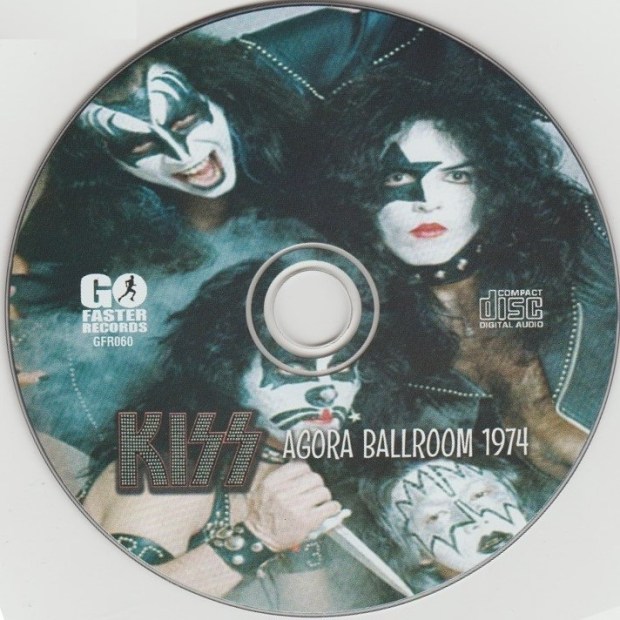
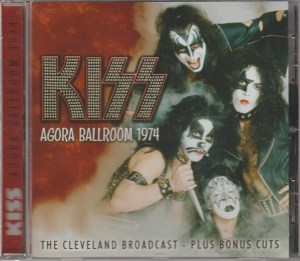
– Agora Ballroom 1974– The Cleveland Broadcast – Plus bonus cuts (2015 Go Faster)
Radio broadcast CDs are common and cheap today. They are a great way to get rare live recordings from bands you love, at a good price, with acceptable sound quality. When this set was recorded at the Agora Ballroom in Cleveland (April 1, 1974) Kiss only had one album out. It’s a rare early glimpse at the band when they were just beginning to stretch their road legs. Already, the performances on this CD were far more fiery than that on their studio albums — and that’s without Gene breathing fire.
The Agora set was a mere eight songs, and a strong representation of Kiss’ best early material. Almost everything is from the first LP; nothing from the second that would be released a mere six months later. The oddity is “She”, an old Wicked Lester holdover that wouldn’t come out as a Kiss song until 1975. Also fascinating is that Gene Simmons even does some talking between songs, and you can see why he lets Paul do all the talking now. “How many are you, a hundred? Are you ready to rock? Rock?” Paul Stanley was clearly better at stage raps, and this CD offers a reason why Gene doesn’t do them anymore.
As with any radio broadcast CD, do not expect flawless audio. This isn’t the greatest recording. There’s hardly any bass. What it is though is a great performance captured at the very beginning. Tracks like “100,000 Years”, “Nothin’ to Lose” and “Cold Gin” have so much reckless energy that they make the originals sound sterile. Kiss were a very active band on stage, and all that jumping around means bad chords, missed notes and vocals that drop in and out as Paul moves to and fro. You wanted authenticity? You got authenticity. The most consistent member is Ace Frehley whose solos were often highlights of any Kiss song.
Best track: “Black Diamond”.
But wait, there’s more! From ABC In Concert (03/29/74) comes additional versions of “Nothin’ to Lose”, “Firehouse” and “Black Diamond”. These are not flawless either, but they have more beef and a lot more bass. The performances are just as ragged. Then from their legendary appearance on the Mike Douglas Show (04/29/74) is the Gene Simmons interview and “Firehouse” once more. “Let me spread my wings”, says an awkward Gene, not quite the character he’d become later, but quite the ham. The audience (and guests) had no idea what to make of him. These are tapes that fans have had and loved for years, but to have them on a commercial CD is pretty cool. Besides, these really are bonus tracks. They’re not on other versions of Agora, such as the 4 CD Radio Waves 1974-1988 which only has the first eight songs.
Any Kiss fan needs the Agora show in some form. This CD may as well be your choice, since it’s affordably priced and has those lovely bonus cuts. Kiss is a band that evolved, year by year, from sheer touring experience. The early performances have a raw un-schooled edge, and that’s what makes them special.
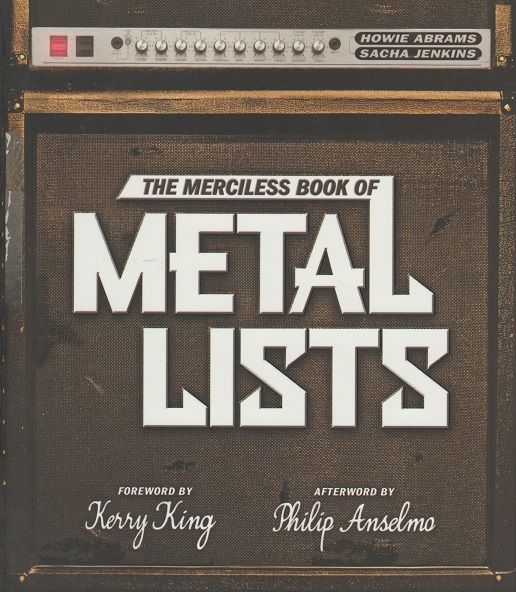
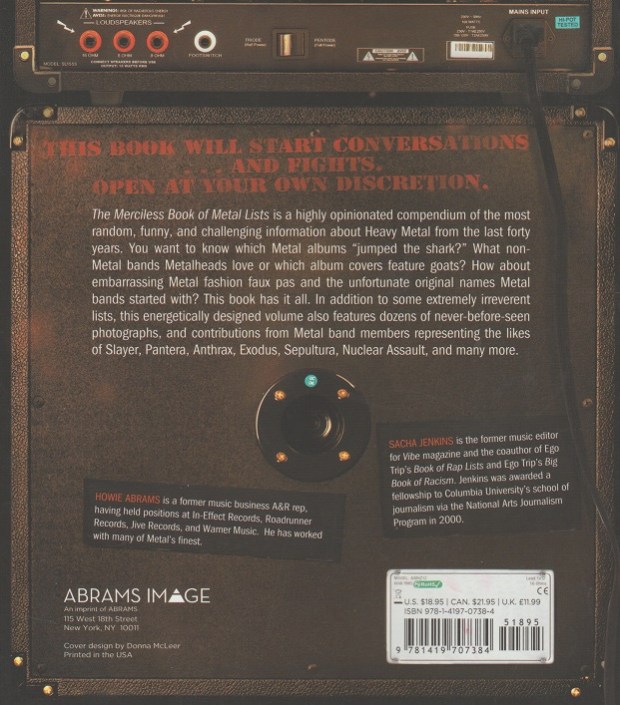
Wanna win a brand-spankin’-new copy of this awesome book? “The Merciless Book of Metal Lists (by Howie Abrams and Sacha Jenkins, retail price $21.95 Canadian) is a highly opinionated compendium of the most random, funny, and challenging information about Heavy Metal from the last forty years.”
Just answer the simple trivia question below. The answer can be found somewhere on mikeladano.com. You just have to find it.
Here are the rules:
Do not leave your answer in the comments. Don’t spoil the contest! Leave your answer by filling out the form below which will be directly emailed to my top-secret address.
You may enter as many times as you like.
But the first right answer and only the first answer gets the prize.
This shouldn’t be too hard, but the contest master might be cajoled into giving out a few clues if this goes sideways and takes forever.
The winner will be required to provide a mailing address for the prize to be sent.
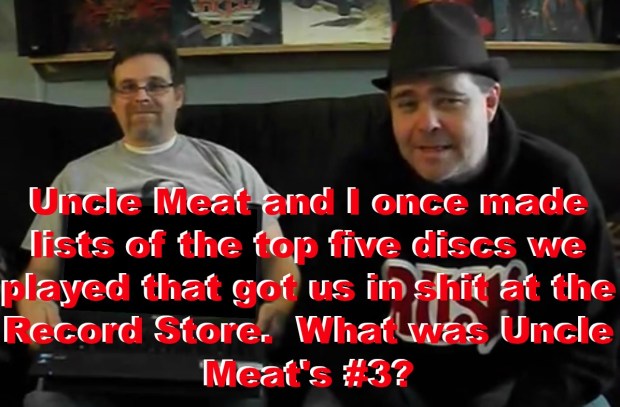
Ready? Here is your question.
The answer, which you can find somewhere on mikeladano.com, may surprise you. Good luck! Let’s see some entries! GO!
– Hotter Than Hell(1974 Casablanca, 1997 Mercury remastered edition)
Sunny California awaited Kiss, and producers Kenny Kerner and Richie Wise. Hotter Than Hell was an apt title for the album they were set to record, but nobody was happy. Maybe it was homesickness, but Hotter Than Hell is sonically perhaps the very worst Kiss album ever released. Brittle, thin and tinny are three appropriate words to describe its sonic flatness. What are supposed to be drums sound more like wooden planks. It sounds less like an human drummer and more like a clanking machine flailing away in a deep cave.
Production issues keep Hotter Than Hell off the tops of many lists, but the songs were all there. It remains a favourite for many, a reminder of times both good and bad, as nostalgia helps wipe clean the lingering audio disappointment. Kiss had little problem coming up with 10 great songs, mere months after their debut album Kiss(also 1974). Gene Simmons and Paul Stanley had the usual goods, and Ace Frehley provided co-writes on three songs. And what songs they were.
The slow riff for “Got to Choose” is a perfect opener, chunky yet melodic. Paul sings lead, Gene harmonizes, and a Kiss classic is born. “Ooh ooh ooh, got to choose who’s your baby!” they sing, and who doesn’t love “ooo ooo ooo’s” in their choruses? They contrast well with the heavy Kiss guitars, much edgier than the jangle of Kiss. Yet that’s nothing compared to the machine gun tactics of “Parasite”, a Frehley signature track as sung by Gene Simmons. When Ace does contribute his own material, it sounds like idiosyncratic Frehley. “Parasite” powers its way through the sonic haze, forcing its way above the sludgy sound. Ace’s solo remains a trademark, a stuttering classic you can hum in your sleep. Guitarists the world over got their start trying to play “Parasite”.
This makes way for the first Kiss “ballad” if you want to call it that: “Goin’ Blind”. It’s really too heavy to be a ballad, but it’s also too slow and mournful to be a rocker. This track goes back years, as Gene wrote it with his Wicked Lester bandmate Stephen Coronel as “Little Lady”. Though the lyrics may not appeal to all (“I’m 93, you’re 16”), “Goin’ Blind” is one of Gene’s finest songs. Ace’s solo just cries (loudly).
Paul Stanley’s title track is a favourite. The groove is what Kiss call their “monster plod”, and you know it when you hear it. It stomps, it rolls, and it takes its time. “Hotter Than Hell” has not one but two amazing riffs, and some of Ace Frehley’s coolest wailing. Frehley’s outro solo is multitracked, surely one of the earliest examples of this in Kiss. Then Frehley burns it all to the ground on “Let Me Go, Rock ‘n’ Roll”. Lightning licks and turbo charged rock n’ roll get the sweat pouring. Anyone who wants to know what the fuss about Kiss is all about just need to play “Let Me Go, Rock ‘n’ Roll”. Get past the sonics and focus on the adrenaline.
Dig that cowbell on “All the Way”, a Simmons rock and roll celebration. Though it wasn’t on Kiss Alive!, and hasn’t become a Kiss mainstay, that is not a reflection on its quality. Hotter Than Hell is often heavy and oppressive. “All the Way” is just fun, blowing off steam, and having a good time. “Watching You”, on the other hand, is one of those heavy Kiss grooves that Gene does so well. Listen to his bass playing, too. Cream were one of his big influences, and though Gene is no Jack Bruce, he composes melodic rolling bass lines. Because of his persona, and because it is more about the act than the musicianship, Gene’s skills on the four string are often overlooked. “Watchin’ You” places them front and center. And just listen to Paul Stanley coming in screamin’ at about 1:35! What a voice. There were no slouches in Kiss. Even hampered by the tinny drum sound, Peter Criss is ferocious, almost tribal. (And with tasteful use of cowbell.)
Paul Stanley has come up with some very cool, simple and classic rock and roll riffs over the years. Tracks like “Mr. Speed”, “C’mon and Love Me”, and more recently “All For the Love of Rock & Roll”. Add “Mainline” to that list of great Paul Stanley guitar parts. This song is given to Peter Criss to apply his rasp to. Compared to the more aggressive material elsewhere, “Mainline” almost slips between the cracks. It has become a favourite in fan circles. So has “Coming Home”, a rare Stanley/Frehley co-write. It is unfortunate that you cannot clearly hear the nuances of the rhythm guitars, because Paul and Ace blend their parts very well. “Coming Home” is so upbeat and energetic that you just keep trying to hear it a little better.
A Sabbathy closer called “Strange Ways” was written by Ace and given to Peter Criss to sing. This is an early example of Frehley’s loyalty to Criss. Ace knew that Peter could use another vocal on the album more than Paul and Gene did. Peter nailed it, and with Gene Simmons joining on the chorus, Kiss just flattened everything. Kiss rarely got as heavy as “Strange Ways”, and “Parasite” too…both Frehley songs.
Hotter Than Hell could easily score a 5/5 stars, but the sonics are impossible to simply ignore. Every time you listen to it, there are things that sound irritating. Instruments that don’t sound like themselves. Notes and beats you struggle to hear. It’s unfortunate that such a potentially lethal album was neutered by the lack of magic in the studio. But it was OK. Casablanca Records weren’t about to give up. A third album would be needed, pronto.
Today’s rating:
4/5 stars
Uncle Meat’s rating:
3 ¾/5 steaks
Meat’s slice: Some of the party/sex/sex/sex etc. songs Kiss filled the first album with were replaced by songs with darker lyrical themes. The sound on this album is, well…shit. This seems fitting considering all the bad experiences the band had while making this record (Ace’s face was mangled in a car accident). There are some great songs here, especially on side one. But side two is murked up a bit with a some clunkers.
Not only the first Kiss album I ever owned, but the very first rock record as well. I think my second record was The Bay City Rollers Greatest Hits.
Favorite Tracks: “Parasite”, “Got to Choose”, “Strange Ways”
– Kiss (1974 Casablanca, 1997 Mercury remastered edition)
The recording contract was signed with Casablanca Records. Management was retained with Bill Aucoin. The live gigs were quickly becoming legendary. All Kiss needed was an album.
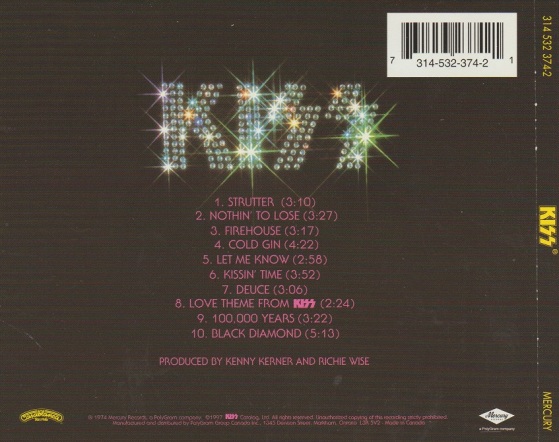
They band convened at Bell Sound studios in New York with Kenny Kerner and Richie Wise (ex-Dust) producing. They selected nine of their best originals and got down to the job of recording. Within a few weeks, they had a fully mixed album in their hands.
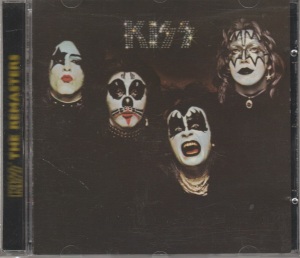
Kiss’ 1974 self-titled debut was simple and to the point. No ballads, no frills, no fluff, very little filler and all rock. It was a lean debut that lacked the thunder of their live performances. Guitar-based, yes, but restrained and underpowered. There was more Keith Richards rock and roll jangle than heavy metal distortion. Yet these songs have formed the backbone of Kiss’ live set for decades.
Peter Criss has the honour of having the first sounds on the first Kiss album – a drum roll to introduce Paul Stanley’s “Strutter”. The jangling Stones-y rhythm guitars of Paul and Ace Frehley are intertwined to create the “Strutter” riff, while Paul sings of a girl that he knows “a thing or two” about. She gets her way just like a child, but there is no bitterness in the song. It’s simply a rock and roll celebration, timeless and perfect as it is. When Ace Frehley arrives with his first guitar solo, it’s clear that he was always a talent to watch. His licks are fluid and precise.
One of Kiss’ biggest musical strengths was the fact that they had three (later on, four) capable lead singers. Gene, Peter and Paul take turns on “Nothin’ to Lose”, a simple rock and roller made perfect by Peter Criss’ raspy scat. The lyrics have nothing to say except that some lucky young lady has nothing to lose. Following this, Paul Stanley calls the “Firehouse”, a live favourite that loses a lot of its bite on album. The fire truck sirens are intact, but the recording is under powered — it needed more crunch and a little caffeine. Much tougher is Frehley’s “Cold Gin”, sung by Gene Simmons. The tempo is a little sluggish but it really came to life in the live arena. This classic was kept in the set long after Ace left the band, proving its mettle. Hard party rock doesn’t get much better than this. “My heater’s broke and I’m so tired, I need some fuel to build the fire.” It’s rare to hear Kiss singing about booze, which usually wasn’t their forte.
“Let Me Know” was one of the first songs Paul Stanley wrote, under the name “Sunday Driver”. It’s right there in the lyrics, “Let me be your Sunday driver, let me be your Monday man…” There are some songs that should get more recognition, and “Let Me Know” is absolutely one of them. Gene and Peter join Peter for an irresistible group effort. It gleefully continues the jangly rock of the first Kiss album, although there is also a heavy closing outro riff. This powerful riff has been recycled live over the years to end other songs. “Let Me Know” closed the first side with this memorable piece of Kiss guitar thunder.
Gene Simmons’ “Deuce” has become one of the most identifiable trademark Kiss songs. “You know your man’s been working hard, he’s worth a deuce.” Gene says the words are meaningless, but lines like “Get up and get your grandma out of here,” had the attitude he wanted. Still one of Kiss’ hardest rockers, and with a riff that kills (ripped off from the Stones, according to Gene), “Deuce” will likely be played live until the end of time itself. You can see Gene up there on stage, tonguing himself for all eternity.
A bit of filler called “Love Theme From Kiss” (formerly: “Acrobat”) is one of their few instrumental tracks. It doesn’t have much meat, and was dropped from the set before too long. Live, “Acrobat” used to feature a fast and heavy part called “You’re Much Too Young” that is far better than “Love Theme From Kiss”. The lollygagging guitars of “Love Theme” just don’t cut it.
“100,000 Years” is driven by a wicked Simmons bass lick, and Paul Stanley’s wailing vocals. Its groove has kept it in the live set on and off for decades, a fan favourite often extended for concerts with a long Paul rap and drum solo. Then finally there is “Black Diamond”, the biggest sounding and most dramatic of these early tracks. It utilizes a sweet Paul Stanley acoustic intro, before it goes full electric and Peter Criss takes the lead vocals. His sandpaper rasp kills it: “Black Diamond” is another Kiss classic that has stood the test of time (and even different singers) over the years. The original album version is hard to beat.
Casablanca weren’t happy with how the album was selling. Label head Neil Bogart rushed Kiss into the studio to record a “hit single”. They decided on covering “Kissin’ Time” and promoting it with a “kissing contest”. Attention achieved, although the single performed only moderately. The track was added to the reissued album, as the first song on side two. The band were never particularly happy with it, and even though it showcases lead vocals from Paul, Gene and Peter, it does not sound much like Kiss. It sounds more like compromise.
Promoting Kiss meant keeping a constant stream of product on the shelves. A few months later, they were off to Los Angeles with Kerner and Wise to record a followup. Kiss would have two studio albums in 1974, mere months apart. Fortunately they had plenty of old Wicked Lester material to dust off. The Kiss debut remains a quaint sounding beginning. While their songwriting was intact and has proven to stand the test of the ages, their knowledge of the recording studio was just beginning. Kiss could have used a heavier edge, but it is what it is: a start.
Today’s rating:
4/5 stars
Uncle Meat’s rating:
4 ¾/5 steaks
Meat’s Slice:One of the best debut albums in rock history; there is not a bad track on the album. You could potentially hear more than half this album at any Kiss concert. Easily a Top 3 Kiss album for Meat. Certainly the production could be better, but the songs are great and even the minimalistic sound makes it feel even more like a great Rock and Roll record. Which is what most of 70s Kiss really is. Classic Rock and Roll. Even “Love Theme From Kiss” has aged well.
Favorite Tracks: “Nothin’ to Lose”, “Black Diamond”, “Cold Gin”
Forgettable Tracks: “Kissin’ Time” (Nitpicking here. Wasn’t even really on the original album in the first place.)
Has any band gone nearly 50 years with such integrity? The only original member left is drummer Ian Paice, but that matters not. Ian Gillan and Roger Glover are original members to laymen. Steve Morse has been in the band for over 20 years, and Don Airey is at about 15. There is no lack of authenticity to Deep Purple, no matter what preconceptions you may have. This most recent lineup with Airey is now on its fourth studio album. The new album Infinite (produced again by Bob Ezrin) will be out April 7.
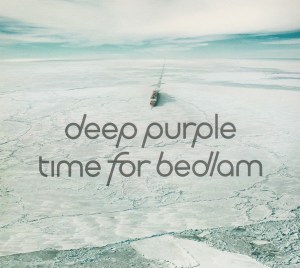
“Time for Bedlam” is a great choice for a single. It rocks a “Pictures of Home” (1972) vibe. Gillan’s lyrics are as biting as ever. “Sucking my milk from the venomous tit of the state…” Meanwhile Deep Purple sound like Deep Purple, but always pushing outwards. There is newness in “Time for Bedlam”. The droning intro is nothing like Deep Purple past, with Ian in a low monotonous voice. But whatever makes Deep Purple sound like Deep Purple, it’s on “Time for Bedlam”. For most people, the organ is the most identifiable ingredient, and Don Airey continues to pay tribute to the original, Jon Lord, in every note. The solo sections from Airey and Morse are jawdropping.
This great CD single has three additional tracks. “Paradise Bar” is a new non-album track, a laid back summer time groove. It has progressive keys and a lazy easy going vibe. It remains to be seen how it ranks among Infinite‘s album tracks. It’s nice to buy a single and get an actual new unreleased track, and “Paradise Bar” isn’t mere filler. Fans will enjoy Steve and Don’s solo trade-offs. An unreleased instrumental version of “Uncommon Man” (from 2013’s Now What?!) will also be of interest to fans of the musicians in Deep Purple. For such a long track (6:59) it’s amazing how well it works as a simple instrumental. You have to hand that to this great band, and producer Bob Ezrin for capturing such great ambience.
The last track “Hip Boots” is an instrumental rehearsal of a track that will be on Infinite. It’s a funky jam, a lot like what Deep Purple have always done. It remains to be seen what the album track is like (will it have vocals, will it be a jam?) but this is an intriguing look at a song in a state that we don’t normally get to hear. It whets the appetite for what could be coming.
Kudos to Deep Purple for still utilizing the singles format (something they also did with Now What?!), and in doing so, giving the fan some added value. They’re creating a buzz for Infinite, so let’s hope that pays off in April!
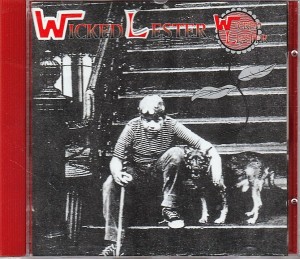
Wicked Lester (1972 unreleased album) & the Eddie Kramer demos (1973) (CD bootleg “promo” with “Epic” logo)
Stanley Eisen and Chaim Witz were two young New York musicians who didn’t particularly care for one another. They met via guitarist Stephen Coronel, a mutual friend and bandmate of Witz. Chaim, who came to the United States from Israel at the age of eight, changed his name to Gene Klein. Stephen Coronel told Gene that young Stanley wrote songs too. Unimpressed, Gene commanded, “Oh yeah? Play one.” Stanley played a prototype called “Sunday Driver”, but the encounter left a foul taste in his mouth.
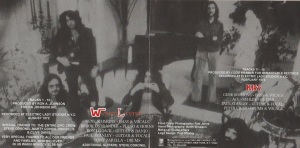
Coronel eventually succeeded in bringing his two friends together, when Stanley Eisen joined their band Rainbow. In was 1971, and Ritchie Blackmore had yet to form the most famous Rainbow of them all, but even so they needed a more unique name. They already knew of one other band using the name Rainbow. Both Paul and Gene had their sights set on bigger things than just New York City. They wanted something original, and settled upon Wicked Lester. They’d also drop their “ethnic sounding” real names in favour of the handles “Paul Stanley” and “Gene Simmons”. They collected together some material they’d written and focused on their originals. The lineup consisted of Stanley and Coronel on guitars, Simmons on bass, Brooke Ostrander (RIP, FYC) on piano and horns, and Tony Zarella on drums.
Wicked Lester performed only two gigs before an opportunity was offered by Ron Johnsen, a resident sound engineer at Electric Lady studios. He saw something in the band, and put up the funds for some demo recordings. Eventually, Epic had their curiosity piqued enough to buy the demos and agree to do make an album. They had only one condition: Get rid of Stephen Coronel. Thus, the man that brought Gene Simmons and Paul Stanley together was fired from the band he shared with them.
Coronel was replaced by a player named Ron Leejack, and recording of the album commenced. The majority of tracks were Simmons/Stanley (and sometimes Coronel) originals, with a handful of covers. To cut a long story short, upon completion, Epic shelved the album and deemed it not good enough to release.
They were right to do so.
Only three tracks have ever been released officially, on the 2001 Kiss Box Set: “Keep Me Waiting”, “She”, and “Love Her All I Can”. The rest are only available on very poor sounding bootleg discs. Even without the full fidelity of a proper release, one can tell from the available bootlegs that the album Wicked Lester was best left in the shadows. When Kiss seemed to emerge fully-formed in 1974, nobody had witnessed their growing pains.
The running order of various bootlegs differ. The red-packaged “Epic promo CD” (surely not) begins with the familiar “Love Her All I Can”, best known as one of Kiss’ early classics from 1975’s Dressed To Kill. The unfocused Wicked Lester original sounds like a hippie commune on speed. Simmons today describes their sound as “like a cross between Three Dog Night and the Doobie Brothers.” Throw in a healthy dose of acid. Who knows where that came from, Simmons being so proudly anti-drug.
An obscure cover “Sweet Ophelia” (Barry Mann/Gerry Goffin) really demonstrates how far out in left field everybody was. It’s mildly disconcerting how well Paul Stanley fits the hippie vibe, far removed from his future Starchild persona. A Stanley original “Keep Me Waiting” bears little resemblance to the style his is known for. Though one could imagine the guitar solo section as part of a Kiss song, “Keep Me Waiting” is a delirious concoction of congas and horns. Simmons’ “Simple Type” is more straightforward. No annoying extra accoutrements. No hooks either, or any balls, but it’s one of the earliest examples of Gene Simmons and Paul Stanley sharing lead vocals on a song. Even at this early stage, it was clear that Paul Stanley possessed a mighty throat.
“Simple Type” merges with the flutes and tambourines of “She”. Flutes and tambourines, on “She”?! Yes, this future Kiss grinder is set to the sultry sounds of more hippie instrumentation, to go with the organ and shakers. As the song fades out, you can just hear the potential it had. This potential is nowhere to be found on “Too Many Mondays” (Barry Mann/Cynthia Weil), light and flaky. “What Happens in the Darkness” (Tamy Lester Smith) is all but indescribable. Deep Purple Mk I gone terribly wrong, but with Paul Stanley leading the choir instead of Rod Evans going it alone. Tougher and better is “When the Bell Rings” (Austin Roberts/Christopher Welch) which again features Paul and Gene singing together. This time, Gene utilizes his early high rasp, also heard on Kiss tracks like “Goin’ Blind” and “Let Me Go, Rock and Roll”. Sounding a bit more like our beloved demon, “When the Bell Rings” is actually listenable. Paul Stanley’s dainty “Molly” brings the flutes back into the picture, and the sooner it’s over the better. A cover of The Hollies’ “(We Want To) Shout it Out Loud” is not bad. And it lent its title to something much better later on.
The “Epic promo” CD has terrible tape bleed-through. It’s clearly a copy of a copy, generations down. The cheap paper cover belies its actual bootleg manufacture. It’s also missing a song called “Long, Long Road”, a soft country track that was recorded but perhaps cut from the intended album. That’s right — soft country.
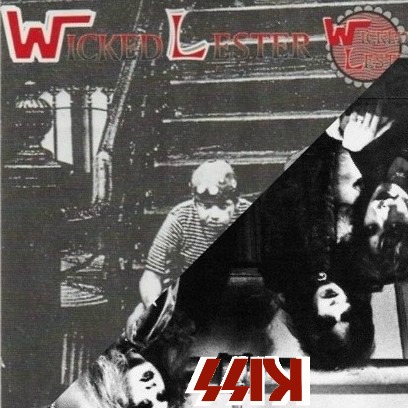
Epic passed on the Wicked Lester album, which was mixed and even had cover art selected. The boy was their mascot, “Wicked Lester”. The cover art was originally intended for another band called Laughing Dogs. Now that the album was shelved (and since Simmons and Stanley were the clear leaders of the group) the fates of the others were pre-determined. Paul and Gene began looking for new members, and experimenting with makeup. They wanted a strong, singular image, not five guys who looked like the line at the local soup kitchen. They also wanted a focused direction, and that was to be hard rock a-la The Who, Cream and Led Zeppelin.
An experienced drummer (his band Lips had an album) named Peter Criscoula was first to heed the call. The new Wicked Lester was a power trio consisting of Peter, Gene and Paul, who rehearsed in a loft located at 10 East 23rd Street in Manhattan. The sound was incomplete: a lead guitarist was needed. Auditions were held at the same loft. Legend has it that Bob Kulick (who features into the story much later) was about to get the gig, when they were rudely interrupted. A spaced out guy with one red and one orange sneaker had plugged in and started wailing away. Paul Frehley snatched the gig at the last minute, and Kiss was born.
The new focus became apparent when the re-named band entered Electric Lady one more time, in March of 1973, with legendary producer Eddie Kramer. The band cut five new originals: “Deuce” (Simmons), “Strutter” (Stanley/Simmons), “Cold Gin” (Frehley), “Watching You” (Simmons), “Black Diamond” (Stanley). Each of these songs later made it onto Kiss albums in 1974. They had the goods.
The Kramer demos sound better on this CD than the Wicked Lester tracks. A different, younger tape generation would be the probable source. Only two of these demos (“Strutter” and “Deuce”) have been released officially, on the Kiss Box Set. These ferocious tracks are almost completely faithful to the final album arrangements. A few extended solos here, and some longer bits there. Tracks such as “Deuce” are faster than they were later recorded, and more akin to what Kiss sounded like live. Playing to their strengths, keeping things simple, and with Eddie goddamn Kramer at the boards, the band laid down one hell of a demo. This is something that bands today would release officially as their first EP, to build buzz for an album. That wasn’t the strategy in 1973, so the band instead stuck to a regular regimen of songwriting, rehearsals and unforgettable club gigs.
Nine months after their debut gig as Kiss at the Coventry, they signed with Neil Bogart’s Casablanca Records. They had built up a repertoire of roughly 18 originals, including some holdovers from the shelved Wicked Lester: “She”, “Simple Type”, “Keep Me Waiting”, and “Love Her All I Can”. These four songs were whittled out again in the process of coming up with the tracks to record for their first LP.
The Eddie Kramer demos and Wicked Lester album alike are important historical documents. They are pieces of the puzzle coming together, and by the time they got with Kramer, the outline was in place. The only way to go was up.
GETTING MORE TALE #551: “You’re Wrong on Unmasked“ (Introduction to the Re-Review series)
When mikeladano.com launched five years ago on March 9 of 2012, one of the earliest projects on hand was posting a complete series of Kiss reviews. This included every compilation I’d ever listened to, every studio album, every official live album, every B-side. As comprehensive as it was intended to be, it was not 100% original. Most of it was recycled from old reviews I wrote long ago and posted elsewhere. Posting the old Kiss reviews was a good way to kick-start the site with loads of content right off the bat.
There was, however, a certain sense of dissatisfaction, as there often is with any old writing that is repurposed for something else.
Several months after the series was completed, I received a text from a girl I knew named Lee. Out of the blue, she sent me this Kiss-related note:
“You’re wrong on Unmasked”.
“Pardon?” I texted back. We’d never talked about Kiss even once. She’d didn’t read my stuff. I didn’t get it.
“You’re wrong on Unmasked.” Then a followup: “Eric told me to text that to you,” she added. “I’m not sure what it means.”
Ah, that made sense. Lee played darts with Uncle “Eric” Meat, legendary Kiss fan and one of the Jedi masters who instructed me in the ways of the Rock. Apparently, Uncle Meat felt I was too harsh on the second of Kiss’ two disco albums. He urged me to one day revisit it. Having moved on to other series since (including Iron Maiden, Van Halen, Aerosmith, and King’s X) I wasn’t too interested at the time of going back and doing any Kiss over again.
Still…I’ve improved as a writer since Kiss. Some of those reviews are over a decade old. Plus, the other series (particularly Van Halen) were so much, much better than Kiss. That text message planted the idea in my head of one day re-doing all of my Kiss reviews fresh, from scratch, the way they should have been done.
So that’s what we’ll be doing: Bigger, better, fresher. The old reviews are fine, but feelings change, even in as short a period as five years. Sometimes you might feel different about an album from day to day, even for an album you’ve owned for 30 years! It will be interesting to compare. The new reviews will be bigger and beefier, with more info and more photos. Plus, Uncle Meat will even be joining me on some albums to add his own ratings and comments! Just as a remastered CD forces you to buy the album again, my “remastered” reviews will hopefully force you to read about Kiss one more time. There will even be a review of a rare officially released Kiss song that I was unaware of when I did the first series! (It was on a tribute album, recently acquired and also featuring other luminaries such as Alice Cooper and Def Leppard.)
For these reasons, and in the effort of creating a truly high-quality series of reviews deserving of the Hottest Band in the Land, we will be taking one last in-depth look at the official Kiss catalogue. One more time! (It won’t be necessary to re-do budget compilations like 20th Century Masters, but everything significant from Wicked Lester to Sonic Boom will be given a second look. Reviews from Monster onwards were fresh from the start, so we won’t need to look at those a second time either. Besides, we have already posted reviews for three separate editions of Monster!) There may even be room for some additional reviews outside the traditional discography.
2017 promises to be the year of at mikeladano.com. Get ready to shout it out loud!
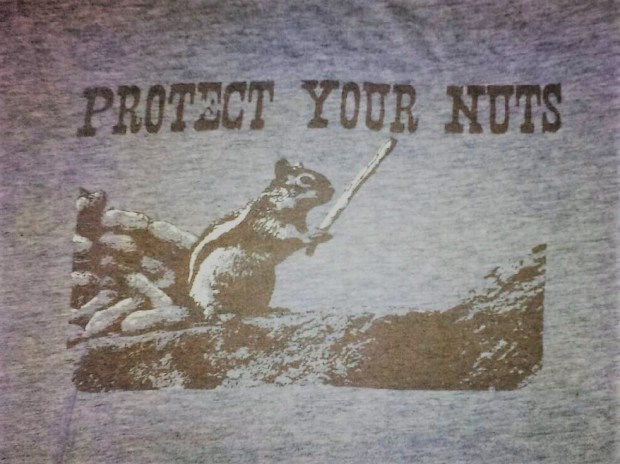
I bought this shirt in Kincardine Ontario, with Jen when we were first going out. The girl at the checkout counter looked at it and muttered, “Protect your nuts?”
I didn’t know how to respond, so I simply said “Yeah…because it’s always good…to protect your nuts…”
 – Agora Ballroom 1974 – The Cleveland Broadcast – Plus bonus cuts (2015 Go Faster)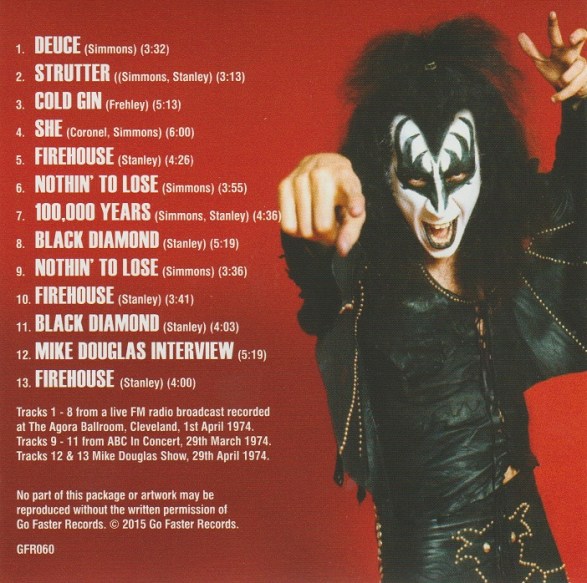























 mikeladano.com