classic rock

Part 199: Hooray! Hooray! It’s Stock Transfer Day!

RECORD STORE TALES Part 199:  Hooray! Hooray! It’s Stock Transfer Day!

A couple weeks ago, I was out driving, rocking to Kiss’ Hotter Than Hell.  Suddenly I realized the car in front of me was being driven by my former boss at the record store.  We happened to be going in the same direction.  I followed him as he pulled into the old record store, where he turned off.  He didn’t see me wave but from the stop lights, I could see him go to the back of the vehicle and pull out a big box of discs for the record store.

This brought back a vivid memory — Stock Transfer Day!  STD!

Twice a week, the local store managers were required to travel to a central location to pick up stock from the other stores.  This stock could include special orders being transferred from store to store.  The majority of the boxes were full of stuff for our shelves, and fresh jewel cases since we went through hundreds a week.  These would fill the trunk, pile up on the back seats, and once in a while the passenger seat too.

The managers decided to do stock transfer on Monday nights, and Thursday afternoons.  I hated Monday nights and Thursday afternoons.  The only good thing about stock transfer was the chance to see some of my store manager friends, such as the eternally interesting Joe.  It was during one of these stock transfers that I witnessed the immortal Open Door Piss.

What bugged me most about the stock transfer arrangements were that the time, gas and mileage on our cars was considered to be “part of our salaries”.  This part of it really sucked, as you could spend a good chunk of your night hanging around doing nothing, waiting for someone.  Sometimes a traffic accident or tie-up on the highway could screw somebody’s route home.  That’s just the way this city was(n’t) planned out.

So while you’re waiting for someone with some orders that you absolutely need, you’re sitting doing nothing, burning your own time.  This happened frequently in winter, but in the summer too.  While this is ensuing,  at home your porch is unoccupied and lacking in beverages.  And that is a shame.

Next time on Record Store Tales…

200th episode!!

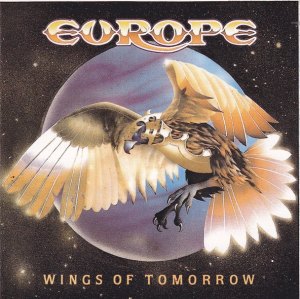
REVIEW: Europe – Wings of Tomorrow (1984)

By request of the Heavy Metal OverloRd.

WOT_0001EUROPE – Wings of Tomorrow (1984 Epic)

In many ways, Wings of Tomorrow is the perfect Europe album.  It combines their early grand metallic leanings with the keyboards and anthemic sheen they would later become known for.   Like the first Europe album, it’s loaded with hard rockers, the odd ballad, and an instrumental guitar workout.  The same lineup from the last album was intact, with the major difference being Joey Tempest adding more keyboards to the mix.

The opener “Stormwind” is a great hard rock/metal tune, with a memorable chorus, riff, plus a tricky sounding solo from virtuoso John Norum.   Second up is the ferocious “Scream of Anger”, featuring Norum playing the heavily distorted riff through a talk box.  This is a solid burner, scorched-Earth policy firmly in place, taking no prisoners.  Tempest wrote this song with Yngwie Malmsteen bassist Marcel Jacob.

The best known song on the album is “Open Your Heart”, which a later lineup of the band re-recorded for the underrated Out of This World record.  I prefer the re-recorded version, because it includes an additional guitar part, really cool and catchy, immediately after the acoustic intro.  The original version is still a great song though, a power ballad, and probably the first great Europe power ballad.

The angry prowler, “Treated Bad Again”, takes us back into metal territory.  This predatory number would have fit in perfectly on something like a mid-period Judas Priest album.  Then, as on the debut album, John Norum ends Side 1 with an instrumental.  This one is called “Aphasia”, which refers to a medical condition that can render sufferers unable to speak.  Get it?

Side 2 opened with an assaulting metal riff, on the album’s title track.  It’s a jagged riff that juxtaposes nicely with Joey’s smooth voice.  “Wasted Time” sounds like the aforementioned Yngwie at first, just because of the riff, but then it begins to gallop into Diamond Head style chorus.  The guitar solo is shredder’s envy.   “Lyin’ Eyes” maintains the momentum.

All this sets the stage for the penultimate song, and possibly the best ballad Europe ever recorded:  “Dreamer”.  It’s a piano power ballad, without the saccharine overload of songs like “Carrie”.  This one’s just a classic ballad, much like you’d find on the first Europe album, but refined a bit.

Wings of Tomorrow closes with the reckless pace of “Dance the Night Away”, which sounds nothing like what its title implies.  It’s a simple metal song, fast burning riff, and plenty of solos.  It’s a shame the guitar wasn’t mixed in heavier.  You get the impression that this album would have sounded so much harder live.

I don’t know if anybody could have predicted the massive success of the next album, The Final Countdown, after labouring in obscurity for two records.  But success did come, and these early albums are a memento of a time before Joey Tempest wrote “hits”.

4.5/5 stars

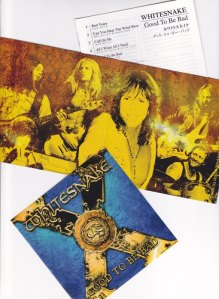
REVIEW: Whitesnake – Good to Be Bad (2 CD & Japanese versions)

Here’s my second review from the The Toronto Musical Collectibles Record & CD Sale! It was Japanese import Heaven!

For the last installment of this series, click here.

WHITESNAKE  – Good to Be Bad (2008 Warner/SPV)

Whitesnake disbanded in 1990.  Coverdale did his album with Jimmy Page, but that didn’t prove to last either.  Although they’d started writing for a second album, the affair ended and David Coverdale assembled a new Whitesnake for a Greatest Hits tour in 1994.  This reformation eventually led to an album in 1997 called Restless Heart (billed as “David Coverdale and Whitesnake”.  This R&B flavoured album, a personal favourite, did not resonate with some fans of 80’s ‘Snake.

After another hiatus, and a solo album (2000’s Into the Light), David once again formed a new group of ‘Snakes, a mixture of old and new members.  After several years of touring (and lineup changes), the long awaited new Whitesnake album, Good to Be Bad, hit the shelves in 2008.  Former Dio guitarist Doug Aldrich and Winger’s Reb Beach had been a formidable guitar duo since 2002.

GOOD TO BE BAD_0003

Similarly to his partnership with Adrian Vandenberg, David has retained his writing style of co-writing with just one co-writer; in this case, Aldrich. It seems to be evident that the guys have gone for a John Sykes guitar sound and style.  You can certainly hear a lot of trademark sounds and tricks that Sykes used to do, that gave the 1987 album such a cool sound.  This isn’t to say that they don’t play plenty of their own style too, but the retro stuff is frequent.

So similar is the direction of this album to 1987, that you can play “name that tune” with all the new songs:
“Can You Hear The Wind Blow” for example directly references moments on 1987, right down to those flares that Sykes used to do.  “All I Want, All I Need” equals “Is This Love” Part Deux.  Basically, every song on Good To Be Bad is a mash-up of songs from Coverdale Page1987 and Slip Of The Tongue, and you can hear the references quite distinctly. “A Fool in Love” is “Crying in the Rain”.  “Lay Down Your Love” is “Shake My Tree”, without Jimmy Page.  Throw in a little “Kashmir” during “‘Til The End Of Time” (which seems to be based off “Till The Day I Die” from Come An’ Get It) too.

Having said that, despite the lack of originality, Good To Be Bad is still a very enjoyable listen, and a very welcome return. A world without David Coverdale’s voice is like a world without crème brûlée.  That voice is in fine form, perhaps even stronger than it was on 1997’s Restless Heart. The album has a lot more life to it than Restless Heart, although it does lack that album’s subtlety and R&B moments. The band play great, kicking it on every tune, even the ballads. The melodies are strong and memorable.  It’s just…too contrived.

The bonus live disc is the the Canadian special edition is highlights from Live: In The Shadow Of The Blues. No big deal.  It’s nice to hear Whitesnake playing “Burn/Stormbringer” from David’s Deep Purple days, and cool to hear the old 70’s classics.

The real cool version to have is the Japanese release with two bonus tracks.  And a sticker!  Can’t forget the sticker.  The bonus tracks are both remixes (a “Doug solo” version of “All For Love”, and a stripped down version of the lovely “Summer Rain”).  For $20, I wasn’t complaining.

3.5/5 stars

Sh*t LeBrain’s Dad Says: Gene Simmons’ Beard

Happy birthday Dad!!

We were in Kincardine, Ontario, on Queen street, or “the main drag” as my dad calls it.  We were in this crappy clothing store called Sandy’s that’s not there anymore.  But this time, they had a Kiss T-shirt for sale!  I never saw any cool band shirts in Kincardine before.  We spent much of each summer there, and when I was younger the place seemed kind of dull.  Finding a Kiss shirt there, well obviously I had to get it.  It was 1992, a Revenge shirt.

My dad asked, “Did you find a shirt, son?”

“Yep,” I answered.  “This one is cool, because it has the new Kiss member on it.”  [Eric Singer]

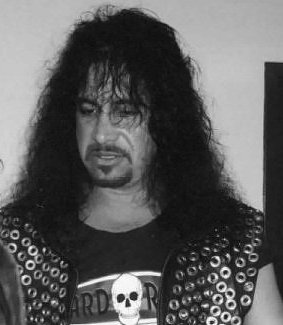
“Yeah,” my dad said with a disapproving smirk.  “I don’t think I’ve ever seen that bearded guy before…”

BEARD

REVIEW: Deep Purple – Collector’s Edition: The Bootleg Series 1984-2000 (12 CD)

fb:  Lebrain
“LIKE” the LeBrain Facebook page for exclusive content.

DEEP PURPLE – Collector’s Edition: The Bootleg Series 1984-2000 (2000 Thames Thompson, Australia only, 12 CD set)

There are two (!) 12 CD Deep Purple bootleg collections; this is the first and best of them.  Although Deep Purple’s career is chock full of live albums chronicling this period, this set does feature many treats that are hard to find or not available on official live albums.  These really are bootlegs; the band decided to release their own versions of pre-existing audience bootleg albums!  All artwork, errors included, are copied from the original bootleg releases.

Before you get too excited I will state right off the bat:  There’s no Deep Purple Mk V or VI.  No Joe Lynn Turner, or Joe Satriani.  There is, however, a show from 1995 with Steve Morse, previewing tracks from the yet-to-be recorded Purpendicular album.  This transitional period is very cool.  You get to hear Morse perform “Anyone’s Daughter”, which was dropped from the set not long after.  Since Morse and Blackmore’s styles are vastly different, it’s a cool take on a track that you don’t hear often as it is.  In addition, you’ll hear Morse reinvent “Woman From Tokyo” on a bootleg from 2000.

BOOTLEGS FRONTThe Bootleg Series also contains my favourite version of “The Battle Rages On” ever released.  1995, Ft. Lauderdale Florida, Ian Gillan tore the roof off with that song.  In my mind I always imagined his screams directed towards Blackmore, even though he was probably furthest from Gillan’s mind.  It’s a magical version, you can hear the electricity and the emotion.  Just awesome.

Also a treat is a revisiting of the old In Rock classic, “Into the Fire” from 2000.  This version crushes!  Unfortunately, a stiff and slow version of “Sometimes I Feel Like Screaming” follows it.  Deep Purple are that kind of band, usually they just kill it.  But their history does contain rare stumbles, and this take of “Sometimes I Feel Like Screaming” is nothing stacked up against other versions available.  On the other hand, Purple just smoke the Abandon track “’69” immediately afterwards!  They extend this concise rocker to include an extended jam with a nod and wink to “Paint It, Black”.

Other highlights:  Blackmore’s solo spot “Difficult to Cure”.  Rarely heard 80’s-era tracks such as “Under the Gun”, “A Gypsy’s Kiss”, “Nobody’s Home”, “The Unwritten Law”, “Bad Attitude”, “Hard Lovin’ Woman”, and “Dead or Alive”.  You can’t buy a live version of “The Unwritten Law” anywhere else.  “Fools”, a rarely played track from Fireball, simply crushes.  Holy Ian Paice, Batman!  Steve puts his own slant on the guitar part in “Fools”, but it is his solo spot on “Cascades” that is truly intoxicating.

These being bootlegs, don’t expect sound quality or packaging or liner notes, unfortunately.  The sound quality does improve as you go from the oldest discs to the most recent.   The oldest shows have a lot of crowd noise, and poor sounding drums.  By the time you get the Japan 2000 show, things sound much better although can still stray towards muddy at times.  Packaging-wise, what you see is what you get:  A box, six jewel cases, front covers and back covers.

This was an Australia-only release.  I have no idea what it’s worth today.  I haven’t seen one in years.

4/5 stars

Bootlegs:

Highway Stars (Adelaide Australia, 11/30/1984)

Third Night (Sweden, 06/16/1985)

Hungary Days (Budapest Hungary, 01/28/1987)

In Your Trousers (Stockholm Sweden, 11/13/1993)

Purple Sunshine (Ft. Lauderdale Florida, 03/04/1995)

Made In Japan 2000 (Osaka Japan 04/01/2000)

I decided that there’s no point rating these bootlegs individually.  For one, it’s a set, and when it came down to splitting hairs, I like them equally.  And that speaks volumes as to the consistency of this band.

REVIEW: Deep Purple – Power House (1977 Japanese import)

PH FRONT CD

DEEP PURPLE – Power House (1977  Warner Bros, Japanese import)

I have always loved listening to the Power House album, featuring the classic Deep Purple Mk II era. After Purple broke up in ’76, the market was inundated with compilations and live albums. This one, and others like Last Concert in Japan, and When We Rock We Rock… were snapped up by fans who wanted more Purple. All of these albums have been rendered redundant by superior, current Deep Purple remasters.  If you’re the kind of fan who collects all of those 70’s posthumous Hendrix albums, then you’ll dig Power House, a brief but enjoyable romp through less familiar Purple. You’ll even get the original liner notes by Simon Robinson.

Power House consisted of 6 then-unreleased tracks. Here’s your complete track list:

1. “Painted Horse”.  This is an outtake from the Who Do We Think We Are sessions in July 1972.  This is the track that Blackmore “didn’t like”.  He hated what Gillan did with the vocal, and demanded it be changed.  Gillan refused, and the result was a great, unique Deep Purple rocker that remained unreleased until after the band was defunct.

2. “Hush”
3. “Wring That Neck”
4. “Child In Time”
From the Concerto for Group and Orchestra program in September 1969.  The original hit LP release of the Concerto had just the three movements of that piece.  Deep Purple played a standard three song set before the Concerto, and here it was released on Power House.  These three versions remain among my favourite performances of these songs.  “Child In Time” had yet to be recorded on album, and Jon Lord’s melodies are experimental and in development.  Very cool.  It’s “Hush” that really smokes, a definitive version of this cover.  Gillan made it his own right there.

Today the Concerto is available remixed on two discs, with the full piece, the Deep Purple set, and the Royal Philharmonic’s rendition of Malcolm Arnold’s “Symphony No. 6”, which was also performed that night.

5. “Black Night”.  Another nearly definitive version in my books!  This is a B-side, recorded at the Made in Japan dates in August 1972.  This is widely available today on various extended versions of the Japan shows, the Singles A’s and B’s, 24 Carat Purple, and many others.

6. “Cry Free”.  Outtake from the Deep Purple In Rock sessions in January 1970.  It is incredible how fertile the band were in the early 1970’s.  As if In Rock wasn’t amazing enough, this kind of song doesn’t even make the album?  Amazing that Deep Purple’s outtakes were so impressive.  That they could throw this away speaks volumes of their confidence at the time.

Regardless of Power House being superseded in recent years by better packages, I still enjoy this album, in this sequence.

4/5 stars

Part 196: Happy Rockin’ Mother’s Day!


RECORD STORE TALES Part 196:  Happy Rockin’ Mother’s Day!

I’m hoping I don’t embarrass my mom too much with this post.  I love my mom.  My friends love my mom.  Everyone loves my mom, they always have.  It used to drive me nuts, actually.  Particularly with my friend Bob, it drove me nuts.  My friends would come over and spend more time talking to my mom than to me!

Joe, who ran one of our stores, was one friend that always enjoyed seeing my mom in his store.  Unfortunately for me, Joe really used to tease me about it, too.  Long time LeBrain readers will remember one story in particular.  Here’s the pertinent text from that tale:

One morning I was opening the store, and my computer beeped the sound that told me, “An order just arrived, please read me!”  So I did.  Only the order looked something like this.

ARTIST:  I’m totally going to

TITLE:  bone your mom.

I was digging through boxes of stuff, as Mrs. LeBrain and I prepare to move to a larger place this year.  In a closet I found a card from the record store.  Joe had signed it.

For my mom…happy Mother’s Day!


Next time on RECORD STORE TALES…

What’s on the menu?

REVIEW: Ozzy Osbourne – “Flying High Again” (2011 Record Store Day exclusive single)

FLYING HIGH AGAIN_0003

OZZY OSBOURNE – “Flying High Again” (2011 Record Store Day exclusive)

Here’s something of an underappreciated item.  Everybody knows that Ozzy and Sharon re-recorded the drums and bass on Blizzard of Ozz and Diary of a Madman back in 2002.  In retrospect this was a shrewd move despite the fan backlash.  In Lucas-esque fashion, it enabled them to restore the original versions for much-hyped reissues in 2011.  To usher in these new/old releases, Record Store Day shoppers were able to buy a replica original “Flying High Again” single.

Both the reissue and the original 1981 single featured the B-side, “I Don’t Know”, recorded live at an unspecified gig.  Like Diary of a Madman itself, this B-side had its bass and drums re-recorded in 2002.  It is difficult to hear the differences, but listen to the bass tracks right around the 2:10 minute mark.  Where Bob Daisley plays lots of interesting harmonics, the re-recorded version has Rob Trujillo hitting the lows.  The bass parts are very different.

DIARY_0001

The credits on the 2002 edition of Diary indicate all tracks, “live” one included, were remixed with new bass and drums.

When Diary was reissued in 2011, it did not include this B-side, but instead an entire (different) concert on a bonus CD. Therefore the original version of the “I Don’t Know” B-side remains a vinyl exclusive.  Cool.  I am not sure why this was not advertised on the single sleeve or in the media.  In fact, I’ve owned this single for two years without putting 2 + 2 together.  The “Flying High Again” vinyl single is the only place you can get the original, untampered “I Don’t Know” live B-side!

For that reason alone:

5/5 stars

But is this worth $12 as per the price tag?  That’s one thing that bugs me about these singles today.  I understand that manufacturing costs have changed and it’s a niche item, but still!  $12 for one song.    One song, because they were going to sell us all “Flying High Again” itself on the Diary reissue, as advertised on the front.

Price: 2/5 stars

REVIEW: Criss – Criss (1993 EP)

“LIKE” the LeBrain Facebook page for exclusive content.

CRISS – Criss Special Limited Edition (1993 EP, TNT Records)

At long last, Peter Criss was releasing new music, for the first time since 1982’s Let Me Rock You, over a decade prior.  Tellingly, it was a mail-order only release, on a small California label called Tony Nicole Tony Records.  It ran me over $40 Canadian (with shipping) to order it.  It was a limited edition, all copies to be numbered and signed by the Cat himself.

An angry letter and six months later, I finally received my Criss EP to find that the hyped signature was just printed on.  Yes, it was numbered (mine is #2408), but for $40…come on.

I overlooked the sad artwork of Peter’s face, half painted in his old cat makeup, and hair bleached blonde.  I cracked the seal, put the disc in and hit play.

I was struck immediately by the poor production.  The drums sound awful.  For a solo EP by a drummer, I was hoping for better sounding drums than this.  Peter’s singing was OK, but the lyrics?  He does this section near the end of the the first song, “The Cat”, that was just…stinky.

Listen to this one now.
Gene and Paul went up the hill to fetch a pail of water,
Gene fell down and broke his crown,
And Paul came tumbling over.

And then his does this weird high pitched shriek that is so embarrassingly terrible, that I couldn’t believe it made it only to the album.  Well, it could only get better from there.

Nope.

The same awful sounding drums, rapping, and another awful lyric:

Planes, trains and limozines,
So what? What does it mean?
We’re burning down like Mercury,
God bless the Killer Queen.

This time the singer isn’t Peter, but a fellow with a mohawk called Mike Stone.  This same Mike Stone would later end up in a band called Queensryche.  And if anything was worse than Peter’s shrieking on track one, it’s Mike Stone’s singing on track two.  And the song sucks, too.

“Good Times”, an electric ballad with a soulful vocal from Peter, is pretty good.  It has the vibe of something that would have fit onto Peter’s 1978 solo album, without the schlock.  OK, one good song.  At least there’s one.

But then Mike Stone rears his ugly mohawk again, on a song called “What You’re Doing”.  No, not the Rush tune.  It’s not a bad song, but Stone’s truly awful singing renders it unlistenable.  Finally, Peter saves this drowning EP with an acoustic remake of “Beth”.  It must be remembered that up to this point, an acoustic version of “Beth” had never been released.  It was presented that way in the Kiss Meets the Phantom of the Park movie, but until this EP, you couldn’t buy it like that.  So this is cool, and slightly different from the version that later ended up on the Cat #1 album.

I have no doubt this is very rare today, and I’ve never seen another copy.  If you can find it, great.  But you may not need to listen to it.

1.5/5 stars

REVIEW: Quiet Riot – Rehab (2006)

Part 2 of my 2-part review of the Quiet Riot Twin Pack set.  Twin Pack bundled the band’s final two releases:  a retro live album, and the final studio album, Rehab.

QUIET RIOT – Rehab (2006 Demolition)

I love Quiet Riot, even more than I have reason to. Metal Health was the first “metal” album I ever bought, on cassette, and I’ve re-bought it three more times since. I just love that album, and I admit it’s probably 60% music and 40% nostalgia. Since it came out, I’ve managed to collect a lot of Quiet Riot.  Prize possessions are my CD copies of Quiet Riot I and II.  This Twin Pack set was important to me because the version of Rehab contained herein has the European bonus track, “Wired To the Moon”.

It turns out, however, that Rehab kinda sucks. It has its supporters who enjoyed the heavier, bluesier sound.  Rehab unfortunately repeats the problem that Quiet Riot have had for many years:  they don’t write very many good songs!  Kevin DuBrow and Frankie Banali were reduced to a duo after the departures of Rudy Sarzo (who went on to Dio and is now in Tateryche) and Carlos Cavazo (now in Ratt).  Rehab had the right ingredients in place, with the awesome Tony Franklin on bass and Glenn Hughes providing backup vocals, but it was not to be. I give them an A for effort, as I am usually in favour of heavying up the sound and adding blues elements.  They get a D for execution.

The concept was to leave behind the glam rock, but the songwriting is so underpar.  Choruses and verses don’t mesh, melodies don’t stick in the head, and riffs don’t hit you where it hurts. The best song, “South of Heaven”, is a really good Zep-ish tune though.  “Strange Ways” features an incredible solo by Neil Citron, like a cross between jazz fusion and Eddie Van Halen.  Jazz Halen?  On the other hand, “Old Habits Die Hard” is one of the more colossal failures.  Aping Joe Cocker’s “With A Little Help From My Friends”, DuBrow sinks this one all by himself with his overwrought lead vocal.

There are some good moments.  Pretty much all the guitar solos and instrumental sections are incredible.  The drums are good.  A song called “Beggars and Thieves” is one of the better songs, because it is anthemic and memorable like old Quiet Riot.  Unfortunately, that cannot be said of most of this material.  Glenn Hughes classes up the place by several notches when he shows up at the end, but this also highlights Kevin DuBrow’s limitations.

I dislike the cover art and packaging.  DuBrow’s wig, oh my God.  Seriously? The old Quiet Riot logo is also gone, and the masked mascot dude is barely visible.  The album was self-produced by Kevin and Frankie, but they really should have spent some money on a producer with a decent set of ears.  These songs would not have passed muster with any serious producer.  The title of Quiet Riot’s final album is now a sad irony, considering DuBrow’s overdose at age 52.

2.5/5 stars

And sadly, almost unbelievably, the band’s legacy has been tarnished even further with Banali’s hack version of the band currently touring without any original members.  And Kevin rolls in his grave.