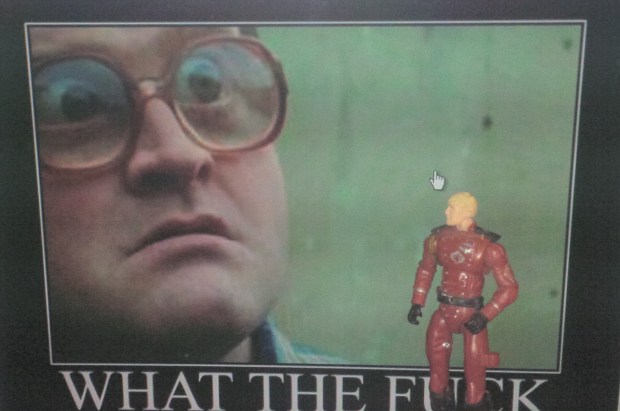
Welcome to a new feature at mikeladano.com! A spin-off from the popular WTF Search Terms, I now present to you WTF Comments. These are real unpublished comments that were left for me, for whatever reasons.
First, we have “Tony Tony” (leaving me to wonder where Toni and Toné were) from Obregon, Mexico. Tony Tony apparently did not like my comments about the 1998 movie turd Godzilla:
tony tony aahh1985@xxxxxxx.com: ad that’s because you all haters are A BUNCH OF FAGS COMPLAINING… HAHAHA what an asshole hehehe… the movie was great… and the soundtrack kicked your asses out…
Thanks Tony. That doesn’t really need any additional commentary from me.
Then we have Max, from Russia. In the past I’ve been clear that I will not share my music. Max asked me to email him a copy of my “Get Your Hands Off My Woman…Again” mp3 single, by The Darkness. As is my general policy, I deleted the comment. A few days later, Max returned with this one:
max fedjudas@xxxx.xx: I got this version, checkmate!
I didn’t realize it was a competition, but good on you.
This comment was sent to me on Facebook. This person posted a comment using a word in a negative connotation that I personally dislike: “retarded”. I replied that it was now 2013 and saying that word in that context is no longer cool. If it ever really was cool. Several people agreed with me, but then I got a private message from this person, Mike F. Private presumably because he didn’t want to be publicly scolded by somebody else for using the word again. This is what he needed to get off his chest:
Mike F*****: Retarded is retarded… Remember the meaning of it? Stupid… Dumb… Ya know… Retarded. 2013 and all its political correctness can kiss my fuckin asshole!
Dear Mike: Welcome to my “block” list! Population: you.
Finally, we have the 164 comments that made up what I called the Neue Regel Saga. I don’t blame you if you do not have the appetite to wade through that nonsense, but here it is, staggering in its absurdity. The first time I had to close comments down!
Thankfully these flavourful comments are few here. If you enjoyed this, and if I receive any more comments that make me “WTF?” then I promise to post them in the future!
FRANK ZAPPA – Shut Up ‘n Play Yer Guitar (1981, 2012 Universal/Zappa remaster)
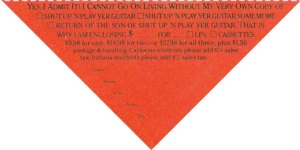
This is the first time I’ve ever seriously tried to write a Frank Zappa review; a daunting task indeed. I rely heavily on the excellent booklet inside the 2012 Universal/Zappa Record reissue of Shut Up ‘n Play Yer Guitar. For example, an advertisement for the album tells me that it was originally issued (in 1981) as three mail order records. You could buy them at once or separately, and they were individually titled Shut Up ‘n Play Yer Guitar, Shut Up ‘n Play Yer Guitar Some More, and Return of The Son of Shut Up ‘n Play Yer Guitar. Then they were later re-released as a 3 LP box set.
I also like how the spines of this series of remasters are all numbered, so you can easily file them in chronological order. That’s how I file my albums (alphabetically by artist, then chronologically by album). These three records were 31, 32, 33. For shits and giggles, I separated the tracks from this 2 CD release into the original 3 LP running order. My logic was, this gave the listener (me) a more “original” listening experience, as I took coffee breaks between “records” to collect my thoughts.
The whole Shut Up ‘n Play Yer Guitar set is a collection of instrumental guitar solos. Many of these are taken from live performances of other songs, but presented on their own, sometimes with humorous dialogue sprinkled in between. All solos are by Frank, although giants such as Steve Vai and Warren Cuccurullo are behind him on rhythm guitar. Frank’s playing is diverse (it better be if your album is an hour and three-quarters long) and interesting at all times. I’m not a guitar head, I can’t sit here and tell you, “Oh right now he’s playing the such-and-such mode in the key of whatever.” I can just tell you when my jaw hits the floor (frequently).
Rhythmically, “five-five-FIVE” (the opener) is one of my favourite tracks. The internets tell me that the time signature is a repeated sequence of 5/8 + 5/8 + 5/4. On top of that are some exotic and mindblowing Zappa tones. I was hooked on the first time. The next one, “Hog Heaven” is slower, a respite. Zappa remains the architect of electric guitar sounds you just don’t get to hear every day. I also love the aptly named “Variations on the Carlos Santana Secret Chord Progression” which does indeed have a vaguely Santana vibe.
Other highlights included “Ship Ahoy” which I’m not even sure how to describe so I won’t. “Pink Napkins” is a jazzy jam session with Eddie Jobson on keyboards that hits just the right notes. The 10 minute closer “Canard Du Jour” is remarkably by being sparse, without wasting precious playing time by being boring. It is aided and abetted by Jean-Luc Ponty on violin, a treat indeed.
I think I’ve said enough. I paid nine freakin’ bucks (Sunrise) for almost two hours of Frank Zappa playing guitar. How is that not one of the smartest decisions I’ve ever made?
Working in a retail environment with the public exposes one to a variety of interesting smells. 90% of customers didn’t have a particular smell to them. They were pretty inoffensive. However, about 10% of customers did have distinct odors. Here are the Top Five things that customers in my store smelled like:
4% – Weed
If I had to break it down, I would say the majority of customers that smelled like marijuana were shopping in the rap section. The red bleary eyes were also a giveaway, but some of these kids just reeked of pot! Didn’t matter if it was 10am and they were selling their CDs to buy another dime bag, or if it was 7pm and they were looking for fast food money. They were omnipresent.
3% – Booze
I’m only hoping that the customers who had booze stench on their breath were not driving. (At the end, I worked on the “wrong side of town,” many of my customers could not drive anyway.) Never mind the fact that some people would be coming in piss drunk at noon on a Wednesday.
1% – B.O.
The dreaded body odor stink afflicted men and women alike. The only thing they had in common: customers with B.O. were always oblivious to it themselves, even though my eyes were watering. Many times these guys were construction workers on break, but not always!
1% – Really strong perfume or cologne
I had a few customers who were used car salesmen. Apart from impeccably trimmed moustaches, they often wore too much Drakkar Noir. There were also plenty of women that smelled so strong you couldn’t breathe.
1% – Bad breath
Halitosis isn’t fun. Some of the people who knocked me out with their breath looked like their teeth weren’t doing so well either, particularly at the stores located on the wrong side of the tracks!
Smash Hits…Unplugged!, the first ever acoustic release by Helix, was certainly a release that deserved more attention. While Helix have continued to make albums (and good ones, too), many of them have been ignored by the media in general. While an album such as The Power of Rock and Roll kicked as much ass as Walkin’ the Razor’s Edge, it went largely unheard. Smash Hits…Uplugged! was a more accessible version of Helix, but it still failed to garner the attention it deserved. I do hear “That Day Is Gonna Come” from this album on the radio from time to time, but this album is too good not to be heard by masses.
This, to me, was the real “classic Helix lineup” reunion album. Unlike Vagabond Bones, you can actually hear Brent and Daryl singing. Daryl Gray in particular contributes a lot to this album, including singing, bass, guitars, and more exotic instruments such as bodhran. All five Helix members participated, including Kaleb Duck with his first Helix album. Old friends such as Sean Kelly and Cheryl Lescom also dropped in.
Every song on this album was a hit somewhere or another, and every song on this album had the potential to be a hit once again. Vollmer sang his butt off as always. Some of these arrangements are startlingly original. Particularly “Gimme Gimme Good Lovin”, which shines with great harmony vocals and mandolin courtesy of former guitar slinger Brent Doerner. This excellent, energetic version is followed by a great single-worthy take of “The Kids Are All Shakin”. The ballads are also well done, in particular the shoulda-woulda-coulda-been hit “That Day Is Gonna Come” and their cover of “Dream On”.
It is a new cover version that really blew me away. Vollmer sings his very best on “Touch of Magic” originally by the late great James Leroy. This long forgotten song is a wonderful tribute to Leroy, an under-appreciated Canadian singer and songwriter from the 1970’s. His original version of “Touch of Magic” was a #6 charting single. While I can’t say that Helix have topped or equaled him, it is a nice tribute and let’s leave it at that.
Really in total honesty, every version here is great — I can’t say much more than that. I found some arrangements, such as “Rock You”, to be pretty standard, while others to be more adventurous especially in instrumentation. A sprinkle of fiddle here, some 12-string there, and you get a rich unplugged album much more interesting than most major bands’.
Pick up Smash Hits…Unplugged! by Helix. Not only do you know all these songs already, but you’re supporting a band that really deserves it.
This album is significant to me for one reason only: It was the first CD bought for me by my lovely wife, Mrs. LeBrain. She knew I liked Kiss and she knew I didn’t have this album. It was a total surprise! It was also a total disappointment.
Paul’s 1978 solo album is a milestone for me, it’s one of those albums I can put on any time, any where, anyhow, and I always love it. When Paul wrote (quoted in the “Kiss: Behind The Mask” book) “Let’s just say it needs a sequel right about now,” I was so excited. Yet I forgot, the word “sequel” has many different connotations.
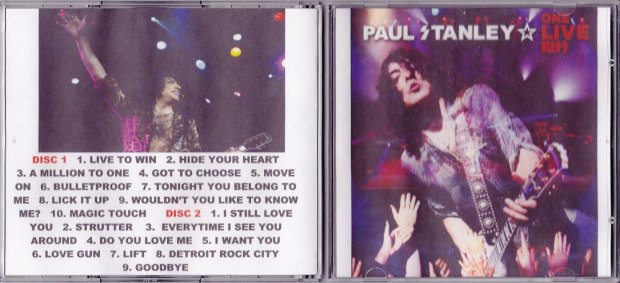
Unfortunately, Live To Win is a sequel in the sense that it’s inferior to the original in every way. The production is plastic, modern synthetic, and boring. The songwriting is good in parts, but there are three ballads here. Paul’s first solo album had nine songs and one ballad. Here, there are ten songs and three ballads. You can work out the math on your own. The playing is bland and generic. John5 plays guitar a bit, and he’s always great, and Bruce Kulick plays bass (why bass?) on a few songs. Everybody else is just a studio cat, guys who are paid big bucks to make people like Avril sound good. Good players, but there’s no personality on this album. Not like when Bob Kulick ripped Paul’s first solo album to shreds.
There are two good songs. They are “Wake Up Screaming” and “Where Angels Dare”. “Wake Up Screaming” starts off with some terrible drum machines. (Yes, not a misprint. There is far too much ProTools and programming on Live To Win.) It’s generic sounding, until Paul’s melody and vocal elevates the song to a whole different level. Still, it’s not aggressive enough for a song called “Wake Up Screaming”. Raw production would have turned this into a classic. The other good song is “Where Angels Dare”. It’s another great song with Paul’s riff, vocal, and melody taking it where it should be. A highlight.
“Live To Win” is also decent, it has a good chorus, but the riff and verses are boring. “Bulletproof” sounds like a Hot in the Shade outtake. “Lift” should have been on Carnival Of Souls, it has that grungy sound. The rest of the album is just plain boring, especially the ballads. Among the ballads there’s nothing here that can hold a candle to the dynamics of “Hold Me, Touch Me” even though they are every bit as schlocky.
Paul, I’m disappointed. For a guy who had the idea to go back to basics and record the Kiss album Sonic Boom on analog tape, this just doesn’t even sound like it came from the same person. Maybe if your first solo album wasn’t so good, so classic, then I wouldn’t have expected so much. Yet, Paul, you are a rock god. There’s no denying it even to non-fans. You are an icon, and you are responsible for a dozen or more of the best songs in rock history. There’s no denying it! For you to put this out, I can only conclude you were out of touch with your fans and rock in general. Or, worse, you were trying desperately for a hit.
Following the demise of Whitesnake and the failure of Zeppelin to mount a 1991 tour in support of their first box set, it was almost inevitable what happened next. It was something that many Zeppelin fans feared. Lead Snake David Coverdale, who was once derided as “David Coverversion” by Robert Plant, joined Plant’s erstwhile bandmate Jimmy Page in a new supergroup. Geffen’s John Kalodner (John Kalodner) helped facilitate this move which should have generated sales over 10 million units. Unfortunately another thing also happened in 1991: grunge.
The shame of it is that Coverdale-Page is a stunning rock album. For years it haunted my bargain bins, simply because of the hard rock stigma that permeated the 1990’s. Many fans refused to listen to it, others simply chose to mock superficial elements of it, such as Coverdale’s man-shrieks. The fact that Page was looking and sounding great should be enough to warrant multiple listens by any serious rock fan. He hadn’t released any new material since 1988’s Outrider. As for Coverdale, it was a chance to get back to his bluesy rock roots, something he expressed a desire to do shortly after Whitesnake’s dissolution.
The studio band weren’t hacks either. Ricky Phillips had played bass with Neal Schon and Jonathan Cain in Bad English, and he’s been in Styx for ages now. Drummer Denny Carmassi was in Montrose (that’s him on the cover of the classic 1973 self-titled record) among many stellar bands, and he later did a stint in Whitesnake itself. Coverdale and Page co-produced the album with veteran Mike Fraser.
Finally, the most important elements were also in place: the songs. 11 songs, most in the 5-6 minute range, make up Coverdale-Page. Those expecting or even hoping for a Zeppelin album were bound to be disappointed. Despite the “Coverversion” nickname, Cov the Gov is his own person and persona. Singing over Pagey’s classic Zeppish riffs does not a Zeppelin make. Rather, Page and Coverdale comingle over their common ground, and naturally there are elements that have a Whitesnake aura. To expect otherwise would be folly.
“Shake My Tree” was the perfect opener. Pagey’s tricky little licks have that familiar sound, immediately. Then the great lothario Cov the Gov starts howlin’…the stage was set within the first minute of the album. The closest comparison I can think of would be “Slow An’ Easy” in terms of overall vibe. Just replace Moody’ slide guitar with Jimmy’s intricate chicken pickin’. David’s lyrics were as naughty as ever. It must have burned Robert Plant’s ass to have to sing it when he reunited with Jimmy later on himself. He seemed to be freestyling it quite a bit with David’s lyrics, barely sticking to the words at all!
“Waiting On You” would have been a radio-ready single. It has that kind of smoking hard rock riff, a killer of a chorus, and great vocals. Coverdale’s no poet, but I dig his words. “Ever since I started drinkin’, my ship’s been slowly sinkin’, so tell me what a man’s supposed to do.” Well, let me tell you David. 1) Drinking and boating is against the law, just like drinking and driving. 2) Put on your goddamn life vest!
I hesitate to call “Take Me A Little While” a ballad. I mean, it is a ballad, but it’s also a pretty good bluesy workout for David. It’s a little classier than the average “power ballad”, because hey…it’s Jimmy Page. It doesn’t sound like other ballads by other bands, because not too many bands have Jimmy Page. His playing and writing are unlike anyone else’s, he is one of the most recognizable musicians in rock and roll.
“Pride And Joy” was the first single, and what a single it was. It starts off swampy and acoustic, before Jimmy’s big Les Paul announces its presence with some big chords. Then David’s back in lothario-land, seducing “daddy’s little princess, Momma’s pride and joy.” Despite the lyrics, the song’s still a stunner. “Over Now” is also cool; a thinly veiled attack on Tawny Kitaen.
You told me of your innocence, An’ I believed it all, But your best friend is your vanity, And the mirror on the wall.
It doesn’t get any nicer from there, but musically this is one of the most Zeppelin-ish songs. While you can’t compare it to any specific song in the Zeppelin oeuvre, but it’s there in that slow relentless drum beat, the orchestration, and Pagey’s unorthodox guitar.
The closest thing to filler on Coverdale-Page is “Feeling Hot”. It’s not outstanding, but it does show off the faster side of Jimmy’s playing. It’s akin to “Wearing and Tearing” but with naughtier lyrics. Once again it is Jimmy’s playing that I’m tuned in to. That continues with “Easy Does It” which begins acoustically. Like most acoustic moments on the album (and like Zeppelin), Jimmy’s guitar is recorded in layers, giving it real heft. This all changes halfway through the song, when Jimmy’s Les Paul once again takes center stage. Then it transforms into a bluesy prowl.
Possibly the most commercial song is “Take A Look At Yourself”. Not a bad song, but definitely the most “pop rock”. It’s probably closest to a Whitesnake song such as “The Deeper The Love”. Had the year been 1990 or even 1991, “Take A Look At Yourself” would have been a top charting single everywhere. David seems to have cheered up with new found love here. However the heartbreak is not over. “Don’t Leave Me This Way” is about as earnest as it gets. At 8 minutes, it’s also the most ambitious song. It’s the centerpiece of the album. It sounds at once like it’s the most sincere song, showcasing some of Jimmy Page’s best post-Zeppelin guitar work. As for David, he’s never sung better.
“Absolution Blues” begins similarly to “In The Evening”. Fading in are layers of atmospheric guitars as only Jimmy plays them. These give way to the fastest, heaviest song on the album. It’s also one of my favourites. You you can hear the elements of Jimmy and David separately, but working together. The song goes through numerous changes before returning to that riff. If you thought Jimmy Page had already written every great riff in Led Zeppelin, think again. It’s “Black Dog” sped up to ludicrous speed.
Album closer “Whisper A Prayer For the Dying” is as cheerful and uplifting as the title alludes. It’s has an epic quality and length like “Don’t Leave Me This Way”, but this time the lyrics are less personal and more topical. David laments the innocent casualties of modern warfare, and refers to politicians as “bodyguards of lies”. While certainly not profound, it’s refreshing to hear Coverdale change the bloody subject away from the female of the species every now and again. Profound or not, I’m certain that it was heartfelt, and musically it kicks ass. It’s also a perfect album closer for a dark and brooding record like this. So there.
Hugh Syme (Rush) did the artwork. Say what you will about the bland cover itself, but I like the way he used the “merge” sign much like the “object” was in the artwork for Presence. And like many Zeppelin albums, there are no pictures of the artists anywhere.
The year 1993 was not a kind one to singers of Coverdale’s ilk. Most of his competition had been replaced by Chris Cornell, Eddie Vedder, and Kurt Cobain. One way or the other, the Coverdale-Page tour was not doing enough business and the plug was pulled. David has since mentioned that he and Page had more songs, enough to get started on a second album. He’s also expressed a desire to release those songs on some kind of deluxe edition reissue. I hope that happens. I’d buy Coverdale-Page again. It would only be the third time.
RECORD STORE TALES Part 251: Punched In the Teeth By Love
Back in December of 1991, an old M.E.A.T Magazine article on Motley Crue revealed a cool little nugget of an exclusive. Motley were promoting their first “greatest hits” CD, Decade of Decadence. Like any good official compilation album should, it contained three brand new songs. They were heavier, alluding to an evolution in direction for Motley Crue. However there was a fourth new song that didn’t make the cut:
It always disappointed me that since Vince Neil left the Crue in early ’92, that song title never appeared on their next album. Too bad, I thought. Something about the title jumped out at me; I was looking forward to hearing the song, but it never came out. Bummer. Especially since I did indeed get “punched in the teeth by love” (figuratively) and been knocked out a couple times. But you could never keep me down for the count, I always bounced back.
Any time I broke up with some girl back then, I’d always tell the guys at the record store the same thing. “Man, I need to write a song called ‘Punch In the Teeth By Love’!” I figured, since Motley Crue hadn’t used it, the title was up for grabs! I threw some words and a rudimentary riff/melody together as a joke but it never went beyond that. It always generated a few laughs though, and laughing at work is healthy, especially when you’ve been punched in the teeth by love.
Of course later on (1997) Vince Neil did rejoin Motley Crue. Later still, after Tommy Lee quit the group acrimoniously, they released possibly their worst ever album New Tattoo (2000). Interestingly, that album’s track #7 was called “Punched In the Teeth By Love”!
I don’t presume this to be the exact song that would have come out in 1991, since Randy Castillo (Tommy Lee’s replacement) is credited as a writer. Maybe the lyrics are recycled, maybe just the title, whatever: it doesn’t matter. Finally “Punched In the Teeth By Love” surfaced and as hoped it was one of the heaviest songs. The riff was pretty generic, but Mick Mars’ guitar work is impressive. I’ve always felt Mick has grown as a guitar player tremendously, especially since Dr. Feelgood. It’s certainly not the greatest song, but it rocks hard enough and has a cool gang vocal chorus, so I’ll give it a B or a B+.
It was considered to be worthy of the concert setlist in 2000 (Samantha Maloney on drums now, filling in for the terminally ill Randy Castillo). It was played only on that tour though, and it was not included on any Crue compilation since then, including the double Red, White & Crue. So I’d like to bring your attention back to this track, a pretty good if not great dirty little Motley Crue song: “Punched In the Teeth By Love”!
After Aldo’s career had been declared clinically dead and Aldo himself a “one hit wonder” (“Fantasy”), it took the mighty Jon Bon Jovi to resurrect him. JBJ, who co-produces and co-writes pretty much every song here, has a heavy stamp on this album. Considering that Aldo played on several Jon Bon Jovi releases, this album will appeal mostly to fans of the Well-Coifed One.
The problem with Blood On The Bricks is not lack of decent material, or lack of chops. Indeed, Aldo proves on several tracks that he is a burnin’ axeman, and he even takes a brief keyboard solo on “Bright Lights”. The problem here is that this album is choked to death in overproduction, and I have to blame JBJ for that. Every song collapses under its own weight of gang “whoa whoa” backing vocals, shrill instruments, and thudding shapeless drums with all the characteristic telltale signs of samples.
A song like “Medicine Man”, for example, is a decent if generic song on its own. However it stumbles under the weight of layers of backing vocals and overdubs. The production has spoiled this batch of pleasant if ordinary rock toons. This type of production value was way too common in 1991. Play Prisoners in Paradise by Europe, or Hey Stoopid by Alice Cooper for an idea of this sonic quality. Aldo’s album is recorded and mixed even worse than the afforementioned. And the lyrics are pretty juvenile. “His boom-box blastin’ some Metallica track”? Did Aldo really sing that?
Song highlights for me incluced the burning title track, “Bright Lights”, and nostalgic moments like “Touch Of Madness”, “Young Love” or “Medicine Man”. However aside from the guitar playing everything here is terribly generic; there’s nothing here that you haven’t heard before. For example, “Veronica’s Song” boils down to a rewrite of Bon Jovi’s “Silent Night”, and that makes me sad.
Two more Bon Jovi connections to mention: the great Kenny Aranoff, whom Jon likes to use on his solo projects such as Blaze of Glory, plays drums. Phil X is pictured in the CD booklet as he was in Aldo’s touring band, but he does not play on Blood on the Bricks. Phil X, known to his friends as Phil Xenedis, is currently on the road with Bon Jovi, filling in for Richie Sambora.
I do like the original cover, it was cool if a bit bland. This edition has an annoying “FEATURING JON BON JOVI” scrawled all over it, as large as the album title. That also makes me sad.
ALCATRAZZ – Disturbing the Peace (1985 EMI, 2001 Light Without Heat)
Released as part of Steve Vai’s The Secret Jewel Box
This is the only Alcatrazz album I own. The reason I own it is Steve Vai. I’m a Steve Vai fan before I’m a Graham Bonnet or Yngwie Malmsteen fan. Plus, this album was reissued exclusively in Steve’s stunning looking Secret Jewel Box (2001) as CD 2. The collector in me wanted that box set and I was glad Steve was so thorough as to include collaborative efforts like this one in his box set. According to Steve’s 2001 liner notes, Alcatrazz was one of his favourite band experiences and I think you can hear that.
Disturbing the Peace, Alaztrazz’s second LP, is very idea-heavy. It’s dense musically and conceptually while still being straight-ahead rock music. It’s the same trick Steve pulled on David Lee Roth’s universally acclaimed Eat ‘Em and Smile record. Vai is credited as a co-writer on every track, except the instrumental “Lighter Shade of Green” on which he has sole credit. Clearly, his input on the album is tremendous as it is literally covered with his fingerprints. His style is all but fully formed (he had already recorded and released his experimental first solo album, Flex-able). His guitar sound was certainly well on its way, and the way it shimmers with multiple layers is omnipresent on Disturbing the Peace. Hell, Vai even recycles melodies from Flex-able, which he would recycle yet again on Passion & Warfare!
(Note: I’m referring to the melody from Steve’s “Answers” from Passion and Warfare, which is also in “Wire and Wood” on Disturbing the Peace and “Little Green Men” on Flex-able. While this is strictly conjecture, I assume this melody to be among the many that Steve “heard” in his lucid dreams that inspired the Passion and Warfare album. Another such melody is “Liberty”, which was based on recollections of a lucid dream.)
There are some really great songs on Disturbing the Peace. “God Blessed Video” (which had its own great video that featured Steve extensively) is a great example of the kind of powerful, melodic hard rock Graham Bonnet can produce. It superficially resembles Rainbow’s “Death Valley Driver” (surely a coincidence) and has the same relentless drum stomp and chugging riff. This is all left in the dust by Steve who anticipates his role as the “Devil’s Guitarist” from the movie Crossroads by stewing up an unconventionally wicked guitar solo.
The more straightforward metal of “Mercy” is credited to the whole band, also including Gary Shea (bass), Jan Uvena (drums) and Jimmy Waldo (keyboards). That’s probably why it’s much more standard in construction. Bonnet’s pipes get quite a workout, and Steve’s solo is jaw dropping. The solo section here absolutely sounds like a prototype for Passion and Warfare. “Will You Be Home Tonight” is steamy, a bit more laid back and heavy with atmosphere. None of this prevents Bonnet from wailing, nor Vai for throwing down some space-age bluesy licks. This kind of thing would come in handy for Whitesnake, later on.
The aforementioned “Wire and Wood” is actually the most Rainbow-like of the songs. At times it almost sounds like a leftover from Down to Earth, but then Vai reminds us that this it was now 1985 and there’s a new kid on the block. Side one closed with “Desert Diamond”, Steve Vai on Choral sitar this time. This time I’m reminded of a similar gimmick on “My Little Man”, which Steve co-wrote for Ozzy’s Ozzmosis album.
“Stripper” is pretty far from lyrically sophisticated. While “A dark and crowded room / Warm beer that’s stale” does set the scene, it’s not really a story that needed telling, I suppose. Similarly, “Painted Lover” could not misconstrued as poetry. “She just wants that hard stash, hot from your pocket.” I’m sure, Graham.
It’s kind of weird hearing trashy lyrics like this sung over Steve’s schooled and intricate melodies and tricks. It’s like the smartest kid in class helping out a less talented classmate or something. Nothing against Graham of course, he’s had more hits than I have, so what do I know?
“Skyfire”
Steve’s “Lighter Shade of Green” solo is a brief intro to “Sons and Lovers”, one of the most accessible hard rock songs. It has a grand chorus, courtesy of Graham, the kind of thing he’s very good at. “Skyfire” (surely named after the 1985 Transformers character, right?) is a very 1980’s sounding groove. I like the fast chuggy parts, the strong melodies, and Steve’s guitar bits. I also like that I’m going to start a rumor that it’s named after the Transformers character. (It’s actually about a UFO that Graham sighted.)
The only song I kinda don’t like is the last one, “Breaking the Heart of the City”. It’s here that I feel the Vai/Bonnet experiment fails somewhat. It sounds like it wants to be dark, heavy, and ominous, but Steve is whimsical at times, space-y and too smart. Meanwhile I’m feeling that the song needs something gritty, some more chug, a little bit of grind, you know?
After revisiting Disturbing the Peace, I now feel an urge to get No Parole From Rock ‘n’ Roll and compare. Steve Vai and Yngwie Malmsteen are polar opposites stylistically and it’ll be interesting to hear Yngwie’s version of Alcatrazz.
4/5 stars
Interestingly, Disturbing the Peace was produced by Eddie Kramer!
It was with great excitement and anticipation that I hit ‘play’ on my brand new mp3 copy of “The Horn”, a new single from The Darkness. Like much of the preceding album Hot Cakes, this is a dirty little number about (surprise) sex!
I would like to take this opportunity, to mention the fact that while some of the acts that I may have described in this song appear to be degrading, they were in fact consensual. — Justin Hawkins
I won’t share the details, except to say that the words “my pale buttocks” are uttered.
Musically, “The Horn” is heavy as…well, not quite as heavy as lead. Platinum perhaps? It has a merciless guitar riff, bloodthirsty drums, and a hefty groove. Sonically speaking, “The Horn” strikes me as one of the heaviest Darkness songs. The guitars have some chunkiness to them, and the direction seems simple enough: let’s rock out! With Justin’s particular brand of lead vocal, there’s no mistaking this band for anyone else.
I would like to take this opportunity to mention that fact that Justin is still singing as great as ever. He has a knack for some utterly odd vocals, but at the same time, he makes them awesome. Acrobatic, never too serious, but always fascinating to listen to. By the end of this song, I’m picturing a coop full of chickens singing in harmony.
This bodes well for a new Darkness album. Not only are they quickly out of the gates with new material, but it’s really good material. Without a doubt, I like “The Horn” better than many of the songs on Hot Cakes. And I liked Hot Cakes a lot.
5/5 stars
There was a vinyl 7″ single, but only 500 copies. There’s also a new Darkness demo out there, a ballad called “Second Fiddle” . This song boasts multiple vocalists and an uber-catchy chorus: “We are the Hawkins Brothers / And I am Frankie Poullaine / We are the Hawkins Brothers / And this is Eddie Graham.” Solid!








 mikeladano.com