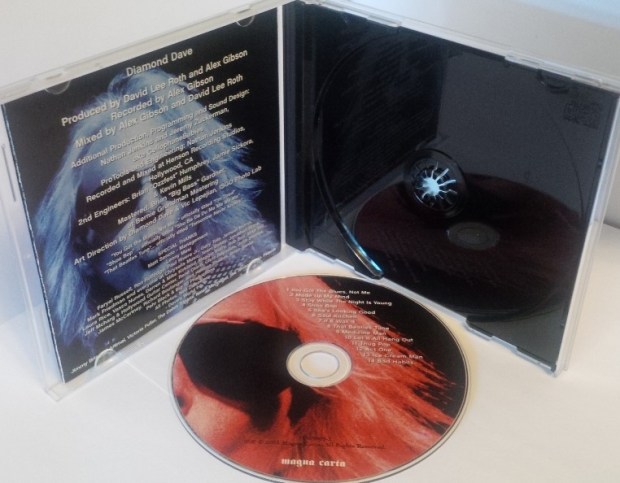
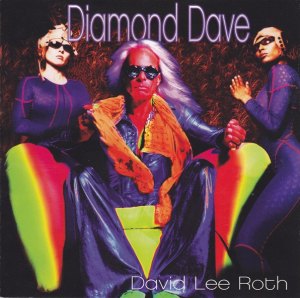
One can indeed judge a book by its cover. David Lee Roth is hands-on with every aspect of his product, be it a photo shoot, a recording session, or an interview. He must have known his Diamond Dave album was crap, so he made a terrible cover to match it. Check out the tan, that wig and them pants! (Also notice: furry walls!)
This album, following up another aborted Van Halen reunion and the surprisingly powerful album DLR Band, switches gears and shows Dave’s “multi-faceted side”. Sure, we all know Dave likes disco, jazz, blues, showtunes, and standards. It’s Dave doing what he did very successfully on Crazy From the Heat, and trying to do so again. To make an album of this stuff would be fine, but Diamond Dave lacks any sort of zap. At all. It’s just one “who cares” cover after another, a couple crappy originals, and a Van Halen tune.
Dave’s voice just doesn’t generate the heat it once did, and all of Diamond Dave suffers for it. The way Van Halen did A Different Kind of Truth used a lot of production on Dave. Here, Roth is a whimper, a wheeze, a breathless gasp at the greatness that once was. To listen to this album in one sitting is an exersize in stamina. I know because I’ve done it.
Positives: Instrumental moments on the Steve Miller cover “Shoo Bop”. The ace rhythm section of LoMenzo and Luzier are complimented by a guitarist named Brian Young who is shit-hot on this. Then Dave goes all dance-y on it…ugh. “She’s Looking Good” is old-school and well done.
The indigestible: The Doors’ “Soul Kitchen”. Nobody needs to cover the Doors; Dave makes them sound like Smash Mouth. Hendrix’ “If 6 Was 9” has too much of Dave’s boring talking voice, but not enough crooning. His cover of the otherwise excellent Beatles number “Tomorrow Never Knows” (which he actually had the audicity to rename “That Beatles Tune”!?) sucks all the life and innovation out of a great song, as he wheezes to the finish line. This is by far the worst song, even though he also covers “Let It All Hang Out”.
There is only one number here worth owning, which is his Las Vegas version of “Ice Cream Man”. He did this shortly after Your Filthy Little Mouth with Edgar Winter, Omar Hakim, Greg Phillinganes, and Nile Rodgers! According to Dave’s autobiography Crazy From the Heat, this was recorded in a live in a video shoot. The video was never released, but the audio finally was. It lives up to the hype if not the wait.
Decide what you are willing to pay for one or two songs, and buy accordingly.
How many bands is Mike Portnoy in anyway? I have no idea, but I’ve bought many of them over the years. Flying Colors is another, a supergroup featuring Steve Morse, the unrelated Neal Morse of Spock’s Beard, Dave LaRue from Steve Morse Band, and Casey McPherson of Alpha Rev. McPherson is the only one I’m not familiar with from elsewhere, and he handles lead vocals as well as keyboards and guitar. Peter Collins (Rush) produces, a man who knows plenty about progressive rock that gets played on the radio.
Together they created an accessible album of jaw-dropping chops but also something melodically engrossing. While these guys are all primarily renowned as musician’s musicians, together it seems they know how to write a song or two. The 7-minute opener “Blue Ocean” is a great example. It’s very hard to describe because it’s not any one thing. It has a hypnotically cool lead vocal, but backed by a neat shuffle and Morse’s trademark hybrid style.
“Shoulda Coulda Woulda” is a heavy one, again with a hypnotic vocal. It’s unforgettable and one of the most powerful tunes. Steve Morse lays yet another awesome guitar solo on top of it. It’s not how many notes he plays or how fast he plays them. It’s what he wrenches out of them. Then like a 180, “Kayla” opens with some gorgeous classical guitar, as if we switched to a Blackmore’s Night album! But this is temporary; “Kayla” is a sparse mid-tempo rock song, with an anthemic chorus. “Kayla” is one of the most instantly catchy moments on Flying Colors. The vocal harmonies in the middle section are killer.
This is followed by my favourite tune, the radio-ready “The Storm”. The chorus here is the best one on the album, powerful and layered. The verses are soft and melodic; commercial rock goodness. Portnoy perfectly compliments the song without overplaying. Only a classic Steve Morse solo could further elevate “The Storm” to the heavens, and that’s exactly what happens.
LaRue funks it up a bit on “Forever in a Daze” which thumps along nicely. “Love is What I’m Waiting For” has a Beatles vibe, which is interesting enough. It’s probably worthy of radio play in a perfect world. “Everything Changes” is another 7 minute long-bomber, and I don’t want to call it a ballad, so I’ll call it “quiet”. It’s an epic. It has acoustic guitars and strings and all kinds of cool stuff, including plenty of electric Morse. Once again, I hear Beatles.
The introspective “Better Than Walking Away” is another really good song, soft and pretty but lyrically intense. Then like a cold slap in the face comes “All Falls Down”. This the most “metal” moment on the album, a blazing blitzkrieg of guitars and drums. It’s over in 3 minutes and 20 seconds, but it’ll leave you knocked out. I really love the vocals on this song too.
Approaching the end, “Fool in My Heart” is a slow dance. Its melodies are warm and classic sounding. This serves to cleanse the palette before the final 12 minute feast of “Infinite Fire”. It’s one of my favourites, and it’s over more quickly than it seems it should be. It doesn’t wear out its welcome; it has a bit of everything in it including melody and spellbinding playing.
How the hell have Portnoy and Morse managed to put out multiple great albums in 2013 is beyond me. Why are guys like these not the biggest rock stars on the planet? Thankfully, a live album and second studio record are on their way.
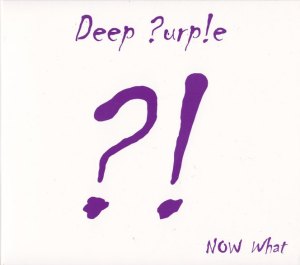
Disclaimer: I am so happy with this album, Deep Purple’s latest, that I put off and put off writing a review for it. As a fan of both Deep Purple Mk VIII and Bob Ezrin, this album would either colossally astound or disappoint me. I’m happy to say that NOW What?! is my favourite album since Purpendicular back in ’96.
At first I thought NOW What?! was going to be an uncomfortably mellow album. How wrong I was. Sure, “A Simple Song” starts powerfully soft (think Purpendicular‘s “Loosen My Strings”). It then takes off into a modern Purple tangent, with groove, a chorus that kills and absolutely outstanding organ work by Don Airey. If there was ever a man to pay tribute to the legacy of Jon Lord, it is Don Airey. He does so with class, homage, and love.
I love “Weirdistan” both for the title and the song itself. It is however “Out of Hand” that is the first mind-blower for me. The strings and arrangements of Ezrin are on this song like a stamp, yet it is also blatantly no other band than Deep Purple. Even though Purple have been backed by strings many times before, Ezrin’s approach sounds like classic Ezrin. It’s hard to verbalize, but Ezrin uses the strings in a support role, yet often up front and in your face.
If none of the previous songs sounded enough like old Deep Purple to you, “Hell to Pay” is sure to satisfy. The edited version from the CD single has nothing on this. The soloing is better than the song, quite frankly, and too much of it was edited out of the single version. Musically “Hell to Pay” has that hard, slightly funky vibe that a lot of later Deep Purple possesses. As far as the solo sections, you’re hearing things that go all the way back to 1968 and “Mandrake Root”. It’s trippy. The spirit of Jon lives on.
“Body Line” is pretty good, again it’s kind of funky in that Purple-y way. Ian Paice, the only remaining member from the original 1968 Mk I version, is responsible for many of the funk vibes, aided and abetted by Morse and Airey. Actually, it’s really hard to single out any one member as MVP on most of these songs. Deep Purple Mk VIII have gelled so well as a band over the last decade, that everything is in sync. Everybody bounces off the other players in a way that is reminiscent of the classic Deep Purple years.
“Above and Beyond” (to be released as a 7″ and CD single October 25) is one of two songs dedicated to Jon Lord. This is probably the most progressive sounding of the new songs. It’s certainly one of the most epic. I think Jon would have loved it. It’s worth noting at this point that Bob Ezrin, as per his modus operandi, has a writing credit on every song. In the same way you can hear him tightening up the songwriting of artists like Kiss and Alice Cooper, you can hear his shine on “Above and Beyond”.
I’m sure it’s a coincidence since almost all the members are different, but “Blood From A Stone” begins similarly to “You Keep On Moving” from Come Taste the Band. Then it gets slinky, before Morse rips some heavy riffs on the chorus. Don Airey shines as well, classing up the place several notches more. This transitions seamlessly into the second Lord tribute, the beautiful “Uncommon Man”. Morse’s guitars are uplifting and unmistakable. I just love listening to him play because there is truly nobody else in the world who sounds like Steve Morse. (Just as there is nobody, Yngwie included, who sounds like Richie Blackmore.) Back to “Uncommon Man”, it features a similar fanfare to “Above and Beyond”, linking them thematically. It also has my favourite keyboard solo on the whole album.
“Après Vous” sounds like a Rapture of the Deep outtake, but a good outtake. Glover has a great groove going on, and there is once again a long instrumental section. When it’s a band like Deep Purple, these aren’t the sections you want to skip through. These are the highlights of a song!
I reviewed “All the Time in the World” when the single was released. Quoting myself, “I’m really fond of “All the Time in the World”. It reminds me of the laid back Purple from Bananas. The classy keys from Don Airey seal the deal for me, but how about that Steve Morse solo? Fantastic!…It might not sound like the Deep Purple of 1970, but that was a long time ago now. It does sound like a rock band staying classy well into their silver years. I don’t hear any compromise nor contrivances here.”
Uncle Meat’s favourite song on the album was “Vincent Price”, and while the whole album is excellent, “Vincent Price” is also instant. It’s really fun, and Ezrin brings his trademark sound effects back to the table. Morse’s spooky guitar line seals the deal. Gillan’s lyrics about vampires and zombies are amusing enough. (This is the kind of lyric that never would have made it past the tyrannical Blackmore.)
There are a couple bonus tracks to be had. “It’ll Be Me” is an unlikely cover, by country singer Jack Clement. Deep Purple pull it off, thanks to Gillan’s lively vocal. “First Sign of Madness” was a free download track, also later released on the “Vincent Price” CD single. It’s a lively song, but different from the album tracks. It reminds me of “Via Miama” from the Gillan/Glover album Accidentally on Purpose. It took a while to grow on me, but I quite like it now just because it doesn’t sound too much like the rest of the album. But these songs will all be on the forthcoming “tour edition”.
Deep Purple pulled off the damn near impossible and put out one of their best albums 45 years after initially forming. Most bands would dream of being able to do this. Hell, most bands don’t put out albums as good as NOW What?! during their primes. If this is a career capper (and I pray Purple have another album in them) then I couldn’t imagine a better album to finish on. The same goes for Ezrin, the guy who produced such classics as The Wall, Destroyer, and Billion Dollar Babies. If Bob retired tomorrow, he could do so having done a freaking great Deep Purple record.
I got this Japanese import CD from one of our franchisees. Even though we technically were not “allowed” to buy CDs from one of our franchises, we all did it, even the head office people who enforced the rules. In this case the franchisee himself was glad to have a guaranteed sale, rather than sit on an expensive Dokken flop for several months in inventory. It even came with the original obi strip, stickers, and everything else was mint. The scarcity of the complete package was reason alone to buy it.
The infamous Shadowlife will probably go down in history as the worst Dokken album. It’s certainly the most dysfunctional (even though that was the title of the previous, much better album). The dysfunction largely came down guitarist George Lynch, who according to sources at the time, purposely sabotaged the album. He did this to put an end to Dokken, go the claims. Don himself was very unhappy with it, as quotes from the era will reveal (look them up). He also referred to a lead vocal shot (“Here I Stand”) by bassist Jeff Pilson as too “bar band-y”, meaning the lead singer of a pro band is the lead singer, and the bassist is the bassist. Clearly, ego was an issue as well.
Kelly Gray
Not to escape without blame is producer Kelly Gray, who had just ruined the career of Sven Gali a couple years prior. Gray produces, engineers, mixes, and even co-wrote a couple tracks. According to Don, Mr. Gray would not let the band sing their trademark harmonies, opting for grittier more modern sounds. Gray’s trademark distortion on the lead vocals is omnipresent.
There are very few standout tracks here, although many have good parts and interesting bits. It is difficult to remember any songs distinctly even after a few listens. The grungy “Puppet On A String” is OK, due to a blazing George Lynch guitar solo (although buried in the mix). It has a heavy groove, but the distorted lead vocal wrecks it for me. “Cracks in the Ground” is better, containing a shadow of the Dokken harmonies, but mired in boring melodies and production. “I Feel” sounds like Dokken, at least. Not really great Dokken, but Dokken nevertheless.
The Japanese, always so lucky, got two bonus tracks: “How Many Lives” and “Deep Waters”. Neither stand out any more than the album tracks. Not really a bonus this time, sorry Japan. If anything, these songs detract from the album, by making it a longer, more agonizing experience.
In general the album is too slow, too tunelessly dull, too dreary. It’s disjointed and it’s uninspired. Too rainy, like a dark Seattle mist. Mick Brown does rock, at least. There are a few heavy songs, such as “Hello”, but I think my favourite song would be the moody acoustic ballad “Convenience Store Messiah”. It’s the only song that sounds like a fully composed, complete arrangement.
Avoid.
1/5 stars
Afterword:I played around the idea of just writing a two word review a-la Spinal Tap (“Shit Sandwich”). I was going to call it “Shadow Turd”. In the end, my OCD level attention to detail refused to allow it, and the wordy essay on the art of turd-making you just read was posted instead. I’m sorry. (Blame Kelly Gray for that, too.)
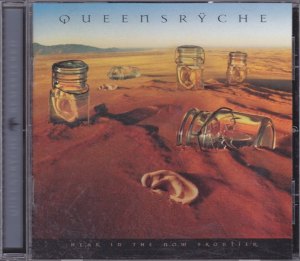
QUEENSRYCHE – Hear in the Now Frontier (1997, 2003 EMI remaster)
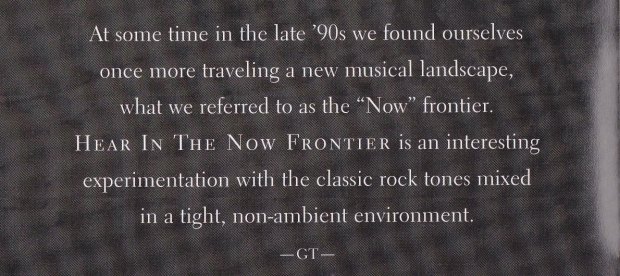
I remember when this album came out in the spring of ’97. There was anticipation and a certain amount of fear: How could Queensryche possibly top Promised Land? The band, as always chose to do something different. In this case they dropped the production, sound effects, and themes, and created a stripped down album of individual unrelated songs. That’s the nice way of putting it. Critics of the album say “Queensryche went grunge,” or “Queensryche went alternative.”
Whatever you call it, this is not a great album. There are some truly great songs, but they are in the minority, swimming through a sea of padding. Guitarist Chris DeGarmo wrote the music for almost every song here, and about half of the lyrics. He even got his first lead vocal (“All I Want”). Even though Hear in the Now Frontier (God I hate that title) isn’t a great album, Queensryche has missed DeGarmo’s presence. This was his last album with the band.
As I said, there are some great songs. They include:
“Get A Life” – Not very Ryche, but it’s a heavy rocker based on the riff and Geoff Tate’s shredding vocal melody.
“All I Want” – A piano-based ballad with a nice rhythm, very different from anything Queensryche have done before or since.
“Hit The Black” – Grungy, distorted lead vocals drive this heavy riff-oriented groove rocker. I like it.
“Anytime/Anywhere” – Another heavy rocker that would have fit right in on the Q2k album.
“sp00l” – The only song that I might describe as progressive, and the one that sounds the most like Queensryche. Powerful vocal and melody. Sonically interesting, and centered on the bass guitar much like “Della Brown” or “Promised Land”.
But that’s pretty much it for me. The other 9 tracks I would describe as dry, flat, not memorable, melodically poor and homogenous. It is clear that the vision for this record was to make something that sounded stripped down, and even with odd flourishes such as violin and piano, it’s just too boring. Even the cover art (by Hugh Syme again) stinks.
There are four bonus tracks, all of which are decent. Three songs come from the “Sign Of The Times” CD single; “Chasing Blue Skies” is a studio track, and had it been on the album, it would have been one of the best songs. Why it was left for a B-side, I don’t know. Maybe because they didn’t want another ballad on the record, which was already bogged down by slow numbers? Anyway it’s great, and sounds like something from Promised Land. Then there are three MTV Unplugged tracks, all fantastic. “Silent Lucidity” and “The Killing Words” were released as B-sides, but “I Will Remember” was completely unreleased in audio format until now. These songs are all considered rarities, as the singles have been out of print for over a decade. They are at least worth having, even if you don’t like the album.
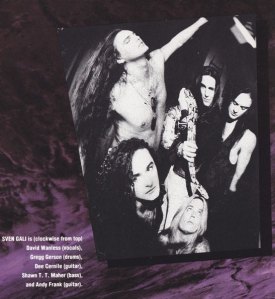
Sven Gali were a good band. To put this into context, in the early 90’s Canada was home to a growing hard rock scene that combined traditional metal with the harder alternative sounds that were coming out of Seattle. I Mother Earth was probably the first band to combine these sounds into one unique whole. Sven Gali were more on the rock side, but they did combine the groove and heaviness that was coming out of Seattle with hard rock. The first single “Under The Influence”, which was a hit on Much, is a great example of this.
Comparisons with forebears Skid Row were added to album cover stickers, and the talented drummer Gregg Gerson was poached from Billy Idol’s band. (Prior to this, Steve Macgregor and Rob MacEachern occupied the drum stool. MacEachern would later go on to play with Helix.) While nobody in the band were slouches, singer David Wanless boasted a tough, powerful voice able to handle the heavy material, similar to someone like Johnny Solinger of Skid Row. (I have heard that Mr. Wanless worked at Home Depot in St. Catharines after Sven Gali.) Also notable was the late guitarist Dee Cernille, who recently lost his long battle with cancer.
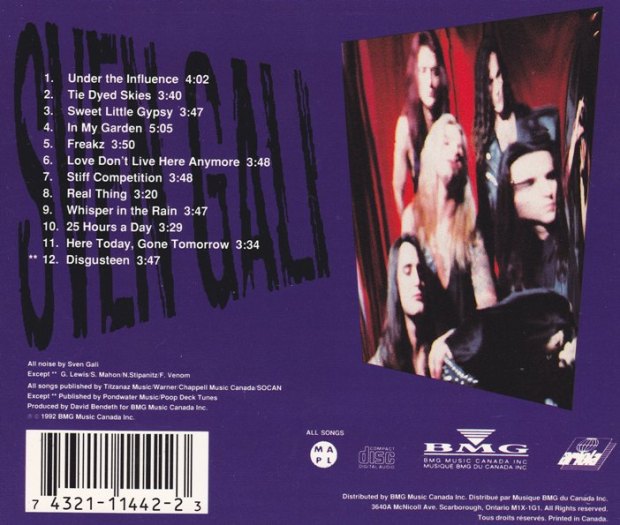
Sven Gali is stacked top-heavy with standouts. This means it tends to have a stronger side one vs. side two. The first two songs were singles (the video hit “Under the Influence”, the helicopter whop-whop of “Tie Dyed Skies”). Both these songs walk a fine line of heavy but singalong choruses, while maintaining its gritty 90’s-ness.
The generically titled “Sweet Little Gypsy” is a strong, Crue-like album track, but it is followed by another single, “In My Garden”. This is a dark ballad, demonstrating the 90’s side of the band. It too was a video hit. “Freaks” is a hard rocker that could have been a single in my books. I had this one early on a Sven Gali sampler cassette mailed out by M.E.A.T Magazine. I’d be happy to show that cassette if it wasn’t packed up in a box. Side two was finished with the excellent ballad “Love Don’t Live Here Anymore”. It’s obvious that Sven Gali were going for the Extreme/Mr. Big template with this one. There are no drums, the lyrics are sentimental, and it was designed for the female side of the hard rock fan spectrum. But it’s still a good song, and performance. I’d rate this one as a solid-also ran behind “More Than Words” and “To Be With You”.
Side two commenced with the furiously heavy “Stiff Competition”, once again firmly planted in Van Skid Crue territory. Far from the best song on the album, it’s certainly the heaviest, gratuitous “F-bomb” included. “Real Thing” is pretty poor. It’s an annoying and grating throwaway. “Whisper in the Rain” is another ballad, this one is a little more generic than the preceding two. And didn’t you just know it was going to be a ballad by the title? It has a moment or two, but in general I’ve heard this kind of song done better before by Skid Row…Killer Dwarfs…Motley Crue…Guns N’ Roses…etc.
“25 Hours A Day” is back to rock. It’s not a stinker, but aside from a good chorus, the song doesn’t stand out. “Here Today, Gone Tomorrow” is back to the speedy rock sounds of “Stiff Competition” with which we began this side of the album. If anything these two songs show off Gerson’s incredible drum chops. Shame he left the band after this album…
Sven Gali closes with the Teenage Head cover “Disgusteen”, saving the best for last. Frankie Venom himself (R.I.P., cancer again) performs the exorcism scene. Awesome!
Sven Gali earned the band two 1993 Juno Awards nominations: Most Promising Group, and Hard Rock Album Of The Year. They won neither, but good on them. Aaron would be pleased to remember that Skydiggers won Most Promising Group that year. Hard Rock was won by rival band Slik Toxik.
Unfortunately, all would not go well for our friends in Sven Gali. Seattle came a-knockin’, and they answered. Or was it the other way around? It doesn’t matter; it ends the same way. Find out tomorrow when we finish the tale.
DAVID LEE ROTH / DLR BAND: DLR Band (1998 wawazat!!)
In 1998, David Lee Roth was angry. He’d been conned by Van Halen into appearing on the MTV awards with them to promote their new greatest hits, and implying that Dave was back. Dave was not back. Van Halen released the derided Van Halen III with Gary Cherone earlier in ’98, while Dave sat back waiting to unleash the DLR Band.
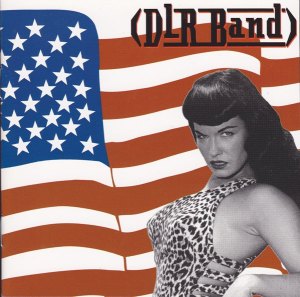
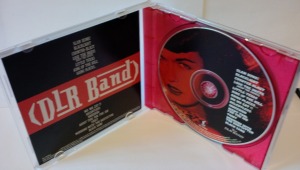
The DLR Band consisted of Dave himself on vocals, John 5 (yes, the John 5) and Terry Kilgore on guitar, and Ray Luzier on drums. Of course, today John 5 is well known for his work with Marilyn Manson and Rob Zombie, and Ray Luzier is in Korn. Terry Kilgore had been working with Dave since 1994’s Your Filthy Little Mouth. Cover art was simple, a picture of Bettie Page over an American flag and no real indication that this was David Lee Roth. A lot of stores didn’t know either, and filed it under “DLR Band” instead of Roth, guaranteeing lack of sales.
So this was one smokin’ band, and with John 5 on board, a hot guitarist to rival the flaming fingers of St. Eddie. John 5 sounds to me like a cross between Van Halen, Steve Stevens and Tom Morello. For the bluesier sounds on the album, Terry Kilgore’s strat aptly filled the gaps. And that basically sums up the album. It goes from bluesier grooves such as “Lose The Dress (Keep The Shoes)” to space-age fast-paced VH shuffles like “Slam Dunk!” Additional guitar and writing is supplied by Mike Hartman.
Dave’s not as poetic on the lyrics this time, with “Counter-Blast” being particularly bad. I can’t think of one good song about the internet, and this is no exception. “I’m gonna fax you into the atom age”? “Your page or mine”? Sorry Dave. Stick with what you know. Hot cars, girls, a drink and some philosophy of life.
Highlights for me are many. On the faster, space-age side are “Slam Dunk!”, “Relentless”, and the aforementioned “Counter-Blast” which is great musically. On the groovier, sleezier side are “Wa Wa Zat!!”, “Weekend With The Babysitter”, and “Lose The Dress (Keep The Shoes)”. The album ends with “Black Sand”, an atmospheric sunset-stained journey. But really, there are no lowlights on this album of strong rock songs. No ballads.
The sound of the album is crisp and tight, recorded in just 10 days like the Van Halen albums of old. No gloss, no flourishes, no flashy production except in John 5’s guitars. Where this album differs most from Van Halen classics is Dave’s voice. On the old albums, Dave could hide his voice’s weaknesses behind Mike and Ed’s backing vocals. Here, Dave’s voice is naked, sometimes flat, sometimes sharp, sometimes wheezing.
Having said that, I still recommend DLR band to fans of Roth who love that attitude and hot guitar. However, if you’re expecting the man to sing like he’s 25 again, best to stick to the old albums.
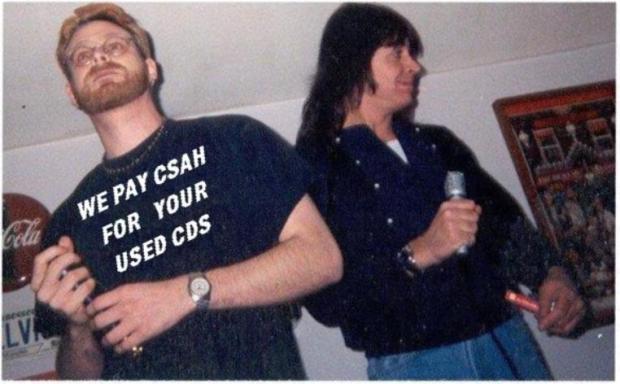
One Saturday in 2002 after a long (8 hour +) shift at the record store, I went over to my friend Shannon’s house. Her next door neighbors were having a karaoke party that night and we were invited. I like karaoke, although Shannon warned me in advance that her friends didn’t have many songs I’d like. If any.
She was right. Among the Shania Twain, Meat Loaf and Grease songs were a few rockers, but her neighbors didn’t like rock. So I sat quietly and listened to some of the worst singing I’ve heard this side of Britney Spears. A little bit later on, another rocker guy showed up. For the life of me I cannot remember his name. (George? Gord? Gomer?) It doesn’t matter, because from that day forward he was known to us as Steve. Steve Perry.*
As soon as he walked in, long hair and pack of cigs in hand, I whispered to Shannon, “Does that guy not look like Steve Perry from Journey?”
Shannon turned and looked. Turned back. “Oh my God. He kind of does!”
Once Steve Perry showed up, we managed to get a little rock into the night. I dueted with him on “Jump” by Van Halen, but I was most excited to share the microphone with Steve on “Don’t Stop Believin'”. A picture was taken of this life changing moment. Incidentally, singing Journey songs in general is really, really hard! I don’t recommend it to the weak willed.
Microphone in one hand, pack of cigs in the other.
I sent the picture to My Favourite Aunt. “Doesn’t this guy look like Steve Perry?” I asked in the email.
She responded, “No. Steve Perry from Aerosmith is sexy. That guy doesn’t look anything like Steve Perry.”
I was a little ashamed that I had to explain the difference between Joe Perry and Steve Perry to my Aunt. She told me she didn’t know who Steve Perry was so she couldn’t offer her opinion on his doppelganger. However I remain convinced that my co-lead vocalist that night bore a passing resemblance to the rock great. Visually, not vocally. Vocally, “Steve” would have given Rebecca Black a run for her money.
Note: Shannon tells me that for some reason, she still remembers Steve Perry’s real name: Ed!
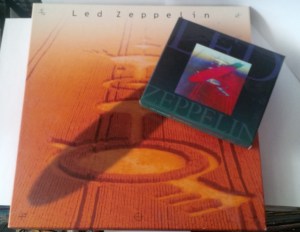
Take a trip back to September, 1993. Led Zeppelin had no greatest hits albums available and just three years previous, the monstrous Led Zeppelin box set was a smash hit. I believe it was the most successful box set ever at the time!
It was, however, just a sampling of Zeppelin’s catalogue. A generous sampling, but a sampling nevertheless. 31 album tracks were missing, as it was just a four disc set. The missing tracks are not throwaways though. How could you say that about “Good Times, Bad Times”, “Living Loving Maid”, “Out On The Tiles”, “The Rover”?
So, predictably, three years later came Box Set 2 with all those tracks plus the recently discovered “Baby Come On Home”. The result is a complementary set; you really can’t have one without the other. Having both sets is how I originally heard the Zeppelin catalogue, and I do have a certain nostalgia for these sets.
Much like the first box, this set was lovingly sequenced and remastered by Jimmy Page himself. As such, the track order takes you on a journey of sorts. Unfortunately it’s just not as epic a journey as the first box. How can there be? With no “Kashmir” or “Stairway” available, it could never be as monumental. Still, it’s a pretty cool trip. Starting you off on disc one with “Good Times, Bad Times” and closing disc 2 with the melancholy “Tea For One”, this tracklist does what it was meant to do. Sandwiched between there are some of the best Zeppelin album cuts of all time.
I don’t think I need to go over highlights. I do? Alright. “Down By the Seaside” is simply gorgeous, one of my personal favourite Zeppelin songs. It’s in my top five for sure. Although it’s a bit silly, I dig the country hoe-down of “Hot Dog”. It’s certainly the heaviest country music I ever heard. With John Bonham on drums, how could it not be? “That’s the Way” is another beauty, acoustic and pretty. It’s “Carouselambra” that throws me the most, a complex swirl of synthesizers and howling Plant vocals.
The sound quality was great for its time, but technology, tastes and standards change. The songs have been remastered since, and will be again. Personally I have no qualms with the sound and I still enjoy this box to this day, even though I own the massive 10-disc Complete Studio Recordings as well. Really, my only issue was the inclusion of just one previously unreleased song. “Baby Come On Home” is a wonderful slice of soul, a young Plant belting about a cheating woman while Pagey plays some elegant notes behind him. Yet, as we saw later with the release of the BBC Sessions, there was more in the vaults. Why couldn’t “The Girl I Love She Got Long Black Wavy Hair” or “Something Else” be included here much like “Traveling Riverside Blues” was included on the first box set? We know Jimmy has dug up more rarities since.
It is what it is. Maybe it was a bit shameful to bait die-hard fans with one new song, but the remastering of the set was also considered a major selling feature. The set, being only a 2 disc set, is physically much smaller than the original, and contains one new essay, by David Fricke. The packaging is quite beautiful, and everything from the cover art to the layout echoes the first box. Clearly, you are meant to have both.
QUEENS OF THE STONE AGE – “First It Giveth” (2002 single)
I’m on record for being a huge fan of Songs For the Deaf. Uncle Meat and I disagree on this issue, as he considers Songs For the Deaf as being the beginning of a downturn. I see it as some kind of peak, on an equal plane with Rated R. “First It Giveth” is undoubtedly one of the highlights from Songs. It has a brutally heavy groove on the choruses, coupled with haunted, frantic verses. Dave Grohl’s best work is to be found on Songs For the Deaf. That is my belief. I consider “First It Giveth” to be among the evidence to this.
Track 2 is the groovy spy drama rock of “The Most Exalted Potentate of Love”. This is apparently a Cramps cover. Wikipedia says The Cramps are “psychobilly”. Having heard this song, sure, I’ll go with that. It’s pretty cool, that’s for sure.
I’ve never hidden my dislike for remixes. 9 times out of 10, the album versions are superior. I do think a remix has some merit when it completely transforms a song into something new. This remix of “Song For the Deaf” does that. Unfortunately I don’t think it’s an improvement in any way. The original song is a relentless beast. Waves of guitar wash over Grohl’s stumbling drum rolls, while Josh Homme sings hypnotically. This remix strips away most (if not all?) of the original instrumentation, isolating Homme’s vocal tracks. Then it adds electronic beats, piano, guitar squeals and effects. It’s…interesting? I’m at a loss for words. I don’t like remixes OK?
I have said in the past that I think remixers should come up with better, more original titles for their remixes. At least whoever mixed this (the credits don’t say) came up with an original title: “The Blind Can Goes Get Fucked Remix” [sic].
Although the technology is kinda dated, there’s also a music video for your computer. This is for the main track, “First It Giveth”. This is a cool performance video made up of tour and backstage footage.
Two out of three good tracks? Pretty easy to rate this one.
 DAVID LEE ROTH – Diamond Dave (2003 Magna Carta)














 mikeladano.com